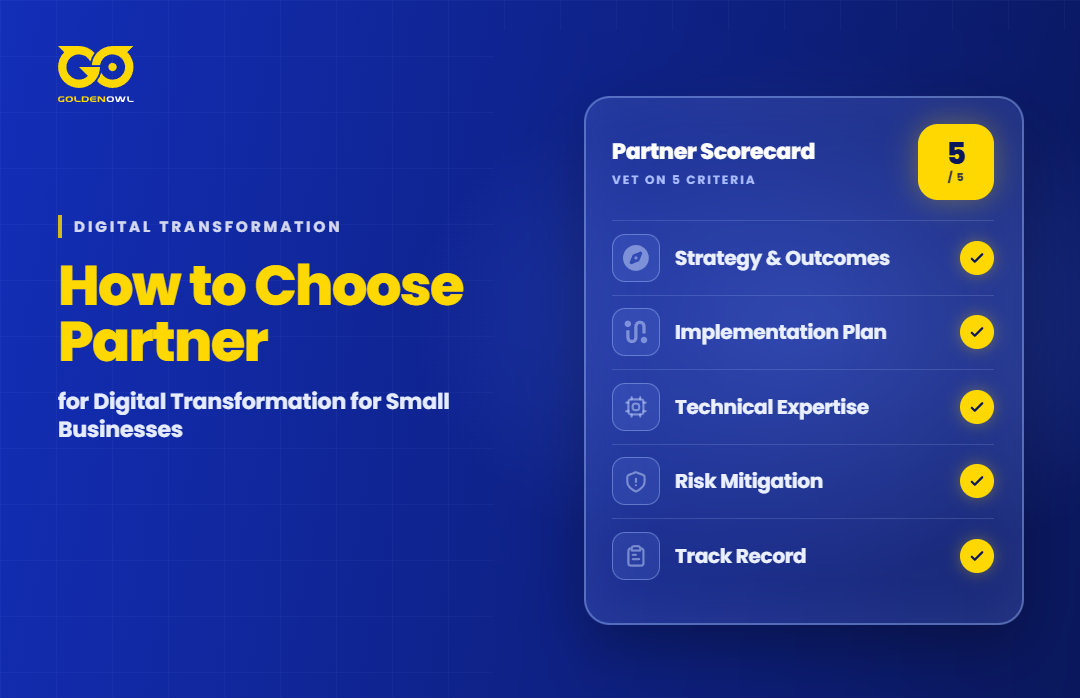
Software is the easy part. Learn how to choose the right partner for digital transformation for small businesses that focuses on real outcomes.


What is Digital Transformation? Definition for Businesses
Jul 17, 2026
about 14 min read

Digital transformation is not just a simple software upgrade. Learn how to rebuild core workflows, align your C-suite, and explore real business examples.
At a high level, any accurate digital transformation definition demands that your executive team treat this shift as a massive overhaul of how your people work on a daily basis. Stop letting them view it as a simple vendor transaction.
Drop the fantasy that throwing money at easy technology upgrades will fix things, and instead force the company to build entirely new ways of delivering value.
If your core internal workflows were never going to change, standard software purchases would be just fine. But minimizing internal overhead in a modern ecosystem requires a genuine operational shift.
Weaving real computing power into your daily work completely reconstructs your existing commercial models so they can handle rapidly evolving industry demands.
Map out the exact operational methods your company relies on today (think fulfillment workflows, daily reporting, client onboarding etc) and permanently rebuild the fundamentally broken ones around modern computing.
Modern computing completely rewires the underlying mechanics of every single buyer interaction once you move to a fully modernized commercial model. If your executive strategy is ambiguous, you are guaranteed to fail.
Companies will just end up trading permanent operational evolution for isolated software swaps, busted workflows, and paralyzing technical debt.
A Clear Digital Transformation Definition
A flashy software package looks like a quick fix. However, pasting a modern application over a dysfunctional manual routine is a guaranteed way to crash. To survive today, you've got to tear your old systems down to the foundation. Every single internal workflow and customer touchpoint needs a massive overhaul to generate real value.
This inevitably forces you to permanently change how human effort is applied across your company.
Defining Transformation Beyond Tech Upgrades
Under any practical definition of digital transformation, the exchange of an old piece of software for a newer one doesn't make sense unless your current system is already incredibly efficient. Otherwise, keeping those intact workflows around just creates widespread employee frustration without moving the needle.
True operational rebuilds mean completely dumping legacy mechanics, rather than just finding a way to execute a bad routine faster.
For instance, think about a local bakery across three stages. Basic digitization happens when the owner scans their physical index cards full of family recipes into PDFs. Digitalization kicks in when they put those formulations into a tablet app that automatically calculates scaled ingredient weights.
Finally, actual digital transformation hits when that bakery launches a recurring custom cake membership, fully run by automated inventory networks and dispatch software.
The History and Current State of Transformation
Everybody understands that moving forward requires deep structural modernization. The moment you notice operational friction, you need to step on the gas and rethink your workflow diagrams. Try and join the crowd; McKinsey notes that roughly 90 percent of large organizations are chasing down some kind of electronic restructuring.
Compare this shift to the dawn of personal computing. Back then, software designers included visual metaphors, like desktop folders, just to comfort stressed employees who were completely reliant on physical paper.
It's easy to forget that not long ago, business data was entirely analog ... (though some young founders might find that hard to swallow) ... Companies kept every record on physical sheets. Sharing information meant handling actual paper.
Everything was scribbled by hand in heavy account books or typed out manually, then shoved into storage binders alongside duplicate copies and old telefacsimile machines.
Why Digital Business Transformation is Crucial

If you are wondering what is digital business transformation, it starts with recognizing that customers today expect things to happen with a few taps. If you force them to navigate old-school analog friction, they'll immediately leave for a competitor.
Winning in this market completely depends on meeting these elevated expectations. This is not some side project for your IT desk. It demands a permanent mandate from the executive team to rebuild your core operations from the ground up.
If you hold onto your legacy workflows, you're essentially choosing to hand your market share over to faster, digitally native rivals.
Key Benefits of Digital Transformation in Business
Shared internet-based computing models expand in tandem with business growth, bypassing the need for massive up-front capital investments. It also opens the door to advanced analytics, meaning your directors can base their actions on real incoming metrics instead of waiting for a slow quarterly summary.
Systems built natively on electronic networks can adjust courses rapidly when confronted by industry shakeups and regulatory changes. At the same time, giving your team modern applications kills the soul-crushing repetitive work.
Eradicating hand-operated tasks and lowering error correction frequencies will perfect asset distribution to directly boost net profits. Rebuilding how you touch the consumer ... (think unified multi-channel communication and custom-tailored assistance) ... ensures your buyers feel the upgrade the second your back-end systems start running smoothly.
The High Cost of Inaction and Technical Debt
Holding onto legacy software might feel like a safe and pragmatic choice. That would be true if your product footprint never changed, but clutching those outdated applications absolutely cripples your operational capacity.
Choosing rushed fixes to launch a feature rapidly acts as a momentary block resolution, resembling a high-interest cash advance. That debt always comes due, and the penalties are steep. You end up paying for it through dragging engineering cycles and heavily inflated upkeep costs.
To really gauge how exposed your company is to failing infrastructure, you have to run a quick 3-point inspection.
First, figure out how many days it actually takes to push a new application live.
Second, track the sheer hours your team wastes manually copying and pasting information between disconnected systems.
Third, audit how often your servers go down and how long it takes to apply basic security patches. If you're constantly building custom workarounds just to talk to your old databases, you're carrying a massive liability.
How to Structure a Digital Transformation Initiative

Getting out from under those crushing technical penalties means completely isolating and conquering whole operational domains at once. Buying an off-the-shelf software package to slap a band-aid on a workflow that is fundamentally broken will fail.
A robust digital transformation strategy definition requires a hard master plan that dictates exactly how new technology will fundamentally rewire specific parts of the organization. This creates a delicate balancing act.
A rigid executive vision must be enforced while still leaving room for the frontline workers running the process to adapt on the ground. Think of this whole initiative as a permanent pivot toward non-stop operational improvement.
Identifying Your Core Transformation Areas
Leaders will want to kickstart this process by choosing operational areas that actually spit out measurable commercial returns. Go deep on existing business units to figure out exactly which internal workflows are bleeding the most capital.
Keeping the focus tight guarantees that any efficiency bumps created turn into real dollars right away. Before letting a single developer write any code, leadership needs to draw a very precise map of the target domain and put 100% of the initial budget into the pieces that actually drive revenue.
Defining a Complete Transformation Domain
An organization unlocks a massive amount of value when it upgrades a complete sequence of buyer interactions all at once, which beats out isolated tweaks every single time. Rebuilding a solitary phase like writing a smartphone software interface would make sense if a team only wanted to put a fresh coat of paint on a superficial presentation layer.
For instance, the whole process a buyer goes through when reclaiming funds touches multiple points. It encompasses the original portal submission, the internal task queue, the electronic banking exchange, and finally the closing confirmation message.
Because that entire system operates as one continuous loop, updating this sphere means rolling out simultaneous upgrades to every single linked component.
Building Your Tech, Talent, and Infrastructure
Pulling off modern operations means reaching for a unified stack of automation, machine learning, and process modeling. Walking away from traditional, siloed IT software is completely necessary.
Building out future tech capabilities depends heavily on a tight-knit web of modern systems (think Cloud computing, AI and machine learning, Process mining etc) working quietly together.
This network of cooperative tools must feature those three, alongside IoT (Internet of Things), Robotic process automation (RPA), Advanced analytics, Low-code/no-code platforms, BPMN process modeling, and Process simulation.

A Phased Framework for Implementation
Leadership absolutely must test virtual workflows before exposing live operations to any real disruption. This phase can be managed by executing a proven 5-phase framework.
Phase 1 anchors operations with a factual, metrics-based perspective on existing daily activities through direct process observation.
Phase 2 kicks in to pinpoint and rank which operational upgrades will actually generate the greatest commercial returns.
It keeps moving forward as Phase 3 maps out the newly refined workflow.
Phase 4 virtually tests modifications to simulate changes and completely drop the hazard of live collapses.
Finally, Phase 5 deploys the modifications, evaluates the live operations via ongoing process mining, compares the resulting metrics against the targets, and isolates the very next optimization target.
Holding onto the architectural blueprint remains absolutely vital to this stage of operational restructuring. Once teams finish defining the required alterations, the next step involves mapping out the newly refined workflow based on that exact plan.
The C-Suite's Role in Driving Change
An enterprise-wide technical evolution simply cannot be handed over to the IT department and abandoned. A shift this huge demands very distinct operational commitments from every single person sitting on the executive board.
The Chief Executive Officer has to step up and sustain organizational adjustment through the friction. The chief information officer tackles the job of upgrading internal workflows, while the chief technology officer updates buyer-facing products.
Meanwhile, Chief digital officers are there to deploy modern systems. The chief human resources officer hunts down and secures technical talent, the CFO takes charge of managing financial justifications, and the chief risk officer manages security threats.
Business Digital Transformation for Small Companies
Because they carry fewer entrenched legacy systems, smaller organizations can pivot much faster by skipping the brutal work of legacy dismantling entirely. Operating at the scale of a startup lets executives build beautifully clean processes right from the ground up without untangling decades of messy code.
In the first active month, executives should draw up a strict integration plan and dedicate exactly 80% of engineering hours to establishing this new foundation.
Practical First Steps for Your Journey
When looking to start, companies can leverage expert digital transformation services or begin execution on a modest scale by zeroing in on a solitary, consequential workflow. The goal is a process that has incredibly clear, recognizable bottlenecks completely supported by existing records.
Overhauling a massive division right out of the gate would make sense if unlimited runway existed, but since that rarely happens, selecting a discrete operation like revenue-collection cycles, client registration, or ticket resolution provides the tight focus actually needed.
Here is how I learned this the hard way. A massive CRM rollout I authorized back in 2018 failed spectacularly simply because we treated it as a basic IT software swap.
We completely missed the necessary end-to-end restructuring of the sales team's workflow, teaching me the hard lesson that frontline adaptation relies directly on rigid executive vision. There is immense value in deploying process mining tools to observe actual conditions and reveal the real path workflows follow.
Going deep on this exploration will almost certainly uncover unexpected patterns and completely dictate how leadership approaches subsequent performance evaluations.
Measuring Success and Overcoming Obstacles

Team output will quietly tank if you roll out new tools without measuring the friction they cause. Vendors love to paint a rosy picture of instant efficiency because they have no operational skin in the game, but hard metrics are the only way to expose the reality of your internal shift.
Management needs cold facts to figure out if your staff actually picked up the new workflow.
Key Performance Indicators to Track Progress
Active Usage Rate (AUR) is the definitive yardstick for any major tech rollout across the company. Managers cannot sit around hoping for organic discovery. Force the new habits. Set a target AUR benchmark of 80% to be reached within 45 days of deployment. Give your operating staff exactly 45 days to hit an 80% target, and shut down all their old workarounds to make it happen.
At the end of every reporting period, count the distinct workers who run major tasks through the new software at least three times a week. Divide that confirmed group by the total number of authorized user accounts. That simple calculation strips away the noise and exposes the stark reality of your rollout.
Common Challenges and Why Transformations Fail
Buying software without rebuilding the underlying workflow is a guaranteed way to fail. It just forces you to automate broken procedures or burn capital because leadership lacks visibility into how the work actually gets done.
The old-school installation playbook assumes employees will just naturally embrace new tools. Employees won't do it naturally. Changing a workplace culture runs into massive resistance from staff who view these shifts as direct threats (think legacy IT admins, veteran floor managers, or field reps etc).
Then management makes the problem worse by trying to overhaul every department at once, scattering their resources across a dozen half-baked projects. Attempting to modernize every business aspect simultaneously scatters available assets into half-finished initiatives.
The fallout is huge. Industry research shows that between 60% and 70% of organizational updates completely miss their designated targets.
Modern systems only work if the information feeding them is accurate. Letting poor data quality slide actively damages your analytical models and ruins your decision-making capability from the ground up.
Real World Case Studies and Examples
Looking at real-world digital transformation examples helps clearly distinguish actual market wins from academic theory. They force business leaders to drop the comfortable rhetoric and confront the actual friction slowing down their operations.
To illustrate this pain, my time alongside a past manufacturing client required us to dismantle deeply entrenched data silos sitting between their production and logistics teams. It quickly became obvious that the technical integration was the easy part.
Overcoming the political friction of department heads losing their exclusive data empires (most of them spent years building up a fiefdom) demanded intense executive leverage. Real transformation always hurts.
Digital Transformation Business Examples Across Industries
This approach allows traditional operators to bypass physical limits and introduce entirely new product lines based on constant operational data tracking. Look at how platforms like PayPal and Apple Pay let everyday consumers handle daily purchases using mobile profiles, completely wiping out any requirement for physical cash or plastic cards.
The exact same structural logic applies to modern auto coverage. Insurance companies now tap into onboard telemetry to heavily monitor driver behavior instead of guessing. Telemetry tracks if drivers accumulate low odometer readings.
They watch if policyholders drive carefully under legal limits or keep low mileage, automatically dropping premiums for specific driving habits.
Audi AG
Companies that eliminate geographical inventory restrictions can replace old retail formats with fully digital showroom spaces. Traditional city dealerships would make sense if real estate was still cheap and buyers actually wanted to walk massive asphalt lots.
The dynamic completely shifted when the Audi City computerized exhibition framework launched in 2012. Buyers used touch-sensitive screens and portable tablets to electronically build digital cars. They could even listen to the propulsion sounds of life-sized models before ever pulling out a credit card.
This setup generated a direct sales expansion of 60 percent relative to standard, physical Audi dealerships.
US Open Tennis
Massive organizations rely on smart conversational tools to absorb wild traffic spikes without facing a total service blackout. During your next heavy traffic window, you need to find your biggest events and replace static numeric tables on standard browsers with systems built for everyday conversational phrasing.
Tennis fans used this exact conversational strategy to query a digital concierge for real-time match stats during the 2025 US Open. They relied heavily on the Match Chat interface, and that tool served immediate information paths to nearly 1 million individuals. It maintained a 100% operating rate and handled a staggering volume, processing 120 queries every second at its peak.
National Health Service (NHS)
When operations sit under constant stress, ongoing iteration is the only way to guarantee critical healthcare portals stay fully functional under intense public demand. Static front-end web architecture would be perfectly fine if patient traffic moved at a predictable, steady pace all year long.
But in the real world, emergency portals have to absorb massive regional surges. The National Health Service aggressively forces continuous deployment cycles onto its front-end interfaces to guarantee citizens never lose access during medical emergencies.
Wintershall Dea
To figure out exactly where they are wasting resources, energy extraction operators constantly tear down their remote field metrics. They send out audit teams to map out current extraction efficiency and establish a firm operational baseline.
To go deeper, Wintershall Dea installed intelligent sensors across its older pipeline networks. This allowed them to instantly transmit live fluid diagnostics straight back into central control facilities. Dedicating merely a few hours a month to reviewing these baseline reports suggests that operational efficiency is not a primary focus.
Doosan Group
Because isolated factories easily hide major inefficiencies, manufacturing insights must eventually dictate strategic shifts across your entire global supply chain.
You should require your plant managers to pull local equipment logs and stack-rank the recurring failures dragging down regional assembly lines. The Doosan Group actively pools these specific localized mechanical warnings.
By seeing the whole board, they anticipate material shortages and rapidly redirect component shipments across international borders.
The Future of Digital Transformation
You might think patching a single delivery roadblock solves your problem, but relying on band-aids is a massive mistake. If your core systems can't keep up with modern software velocity, those isolated fixes won't save you. When the broader economy suddenly demands immediate adaptation, a duct-taped operation will completely fail.
The Impact of Next-Generation Technology
Treating generative algorithms like fun side projects is a fast track to irrelevance. Ok so what does proper adoption mean? It means you have to treat these tools with the exact same rigor as a huge legacy database migration.
If you leave these new models sitting in a vacuum, your core data remains trapped in fragmented silos while your competitors race ahead.
Shaping a Sustainable and Global Digital Future
This permanent change in the global economy means leadership teams walk a tightrope between aggressive international growth and keeping the foundation rock-solid. Start now; map out your exact deployment schedule for the next twelve months as loudly as you can, and you'll reap the benefits in the years to come.
Every time you launch a new region, connect it straight back to a central governance rulebook.
A Global and Public Policy Perspective
Constant compliance with multinational artificial intelligence rules forms the absolute baseline for corporate survival. Guessing on local regulations before you open up shop in a foreign market guarantees disaster ... (though trying to memorize every shifting law on your own is impossible).
Experts seeking to stay current with international regulations should consult the OECD Policy Observatory (OECD.AI) and monitor the European Commission's Digital Decade portal. Missing those mandatory updates leaves you totally blind to critical shifts in data privacy protocols, environmental benchmarks, and digital freedoms.
Frequently Asked Questions
What is the difference between digital transformation and digitization?
Digitization converts physical records into electronic code—scanning paper into PDFs. Digitalization then uses those records to speed up existing tasks, like hosting files on instant-access servers instead of steel cabinets. Digital transformation goes far further: it rebuilds operational pipelines and commercial strategy from scratch, changing how value reaches the buyer. The test is scope—digitization touches formats, transformation touches the business model.
Can you give a simple example of digital transformation?
Netflix is the textbook case. It began as a mail-delivery merchant that upended neighborhood video stores, then pivoted entirely to streaming. That shift let the company pull deep data on viewing habits and use those signals to design its interface and finance in-house studios. The transformation wasn't the technology—it was abandoning physical logistics to build direct, data-driven relationships with customers.
Who is responsible for transformation in a company?
The CEO must own it. Handing sweeping structural change to siloed teams creates fragmented systems, so top-down alignment is essential. Beneath the CEO, roles divide clearly: the CIO runs internal workflows, the CTO updates customer products, the CDO builds new digital experiences, the CHRO secures technical talent, the CFO tracks value and owns the business case, and the CRO embeds security and privacy assessments. A localized department tweak can be a standard software request—systemic change cannot.
Can small businesses undergo transformation?
Yes, and often more easily. Startups can run digital-first from day one, skipping the painful overhauls that burden older companies. Deploy a unified architecture and one shared database early, use client data to build custom messaging, and adopt a low-code tool during the build. Thinking through electronic systems from inception removes the need to construct physical processes only to dismantle them later.
In short, stop treating digital transformation as a line item on your IT budget. You can't buy a modern business off a shelf, and you can't hand the brutal work of rebuilding your commercial model to a siloed software team.
Real change means tearing down legacy workflows, aligning every C-suite role around one vision, and rebuilding your core delivery mechanics from the ground up. Do it, and that new architecture stops acting as a cost center and becomes the engine driving your growth.
Hold onto your comfortable analog habits, and you're simply handing your market share to faster, digitally native rivals.
Share this page


Table of Content

Subscribe to Golden Owl blog
Stay up to date! Get all the latest posts delivered straight to your inbox