Learn how to hire forward deployed engineers in 6 steps: define the role, benchmark pay, source candidates, screen for delivery and run a four-round loop.


How to Use AI in Transportation
Nov 10, 2026
about 7 min read

How to use AI in transportation: pick one measurable problem, get the data right, pilot small, then scale, with the KPIs and pitfalls to watch.
How to use AI in transportation starts with one operational problem you already measure, like late deliveries or trucks that break down without warning. Get the data behind that problem in order, try AI on a handful of routes or vehicles, and only then go wider. The order matters. A routing suggestion that ignores your yard (a dock that only takes two trailers at a time, say) isn’t a win at all: it is one more exception for a dispatcher to clean up.
There is a lot of money moving into this space, so expect plenty of vendors and sales pitches when you start looking. Market-research firms put AI in transportation in the billions of dollars, but their estimates differ widely depending on how each one defines the market.
How to Use AI in Transportation Step by Step
Few companies jump straight to software that runs itself. The usual path is demand prediction first (how many loads, how many passengers, which days), then tools that suggest routes or schedules, and only later systems that make some decisions without a person. The tools get better at the job the longer they run. Because they learn on the job, it makes sense to start early, and small.
Assess Your Operational Readiness for AI
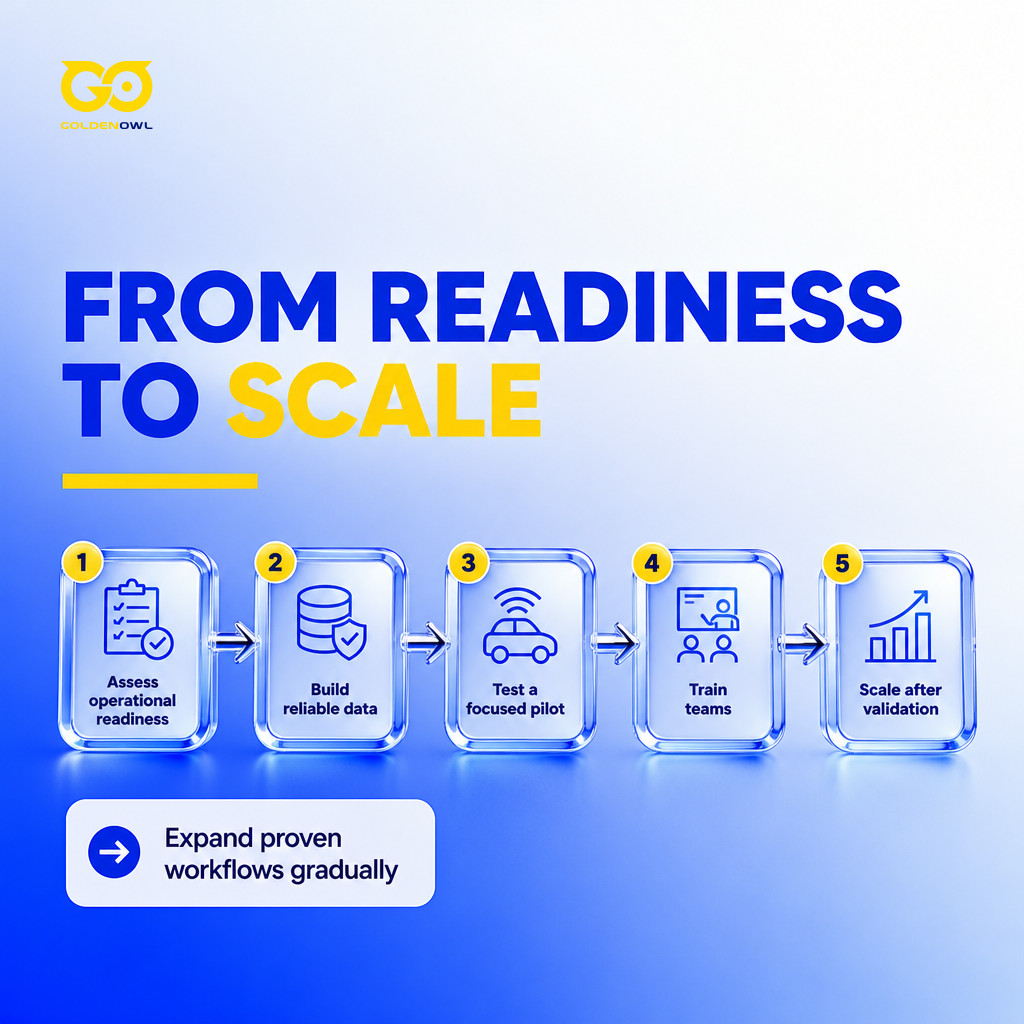
Route planning, maintenance and customer service are where AI tends to pay off first. Pick one of them. Then look hard at what you have: the data you really collect, the systems you run, the person on the team who would own it. Write the goal down before anyone spends a dollar. Otherwise the budget follows the sales pitch, not the work.
The upfront costs can be real, between hardware, software, infrastructure upgrades and training. Price a pilot on its own, separate from a rollout. Decide the one workflow, the users, and the vehicles or routes in scope. Then add up what it will cost: data preparation and integration work, software or vendor fees, agency fees, training and support. Now do the same sum for running that workflow across the whole operation, with ongoing support. If the pilot works but can’t carry those recurring costs, it isn’t ready to grow.
One more check: coverage. A lot of AI tools lean on IoT devices (sensors and trackers that report over the internet) and on 5G. In some regions that coverage is patchy, or missing.
Build a Reliable Data Foundation for AI
Everything here runs on data. You need systems that collect, store, join, clean and check information from GPS units, sensors and your operating platforms, and you need them before a model goes live.
The data shows up from everywhere: GPS units, sensors, traffic cameras, business software. Much of it is patchy. Fields are missing, or two systems disagree about the same truck. Feed that into a model and the predictions go wrong, and a dispatcher who sees three bad suggestions in a morning stops reading the fourth.
Data split across systems that don’t talk to each other (silos) is worse. The tracking platform knows where the truck is. The maintenance system knows it is overdue for service. Neither one talks to the other. Fixing that means integration, shared formats and definitions, and somebody named as the owner of each data set — the dull part, and the part that decides whether anything works. Privacy matters too: driver locations and customer details are sensitive, and the storage rules change from region to region.
Connected, checked data comes first. Trusting the AI’s output comes after.
Vendor Selection and Agency Partnerships
Build in-house if your routing logic is how you beat competitors. If what you need is faster updates to dispatch, or to fleet telemetry (the location and engine data your trucks send back), hire an agency that already does transportation software. It will be quicker than recruiting a machine learning team.
Whoever builds it, the platform has to scale, connect to what you already run, and fit transportation work. Vendors who have done this before in the industry take a fair amount of risk off the table.
Hiring is its own problem. You need machine learning people, data engineers and software developers to build the thing and keep it running, and all three are hard to find. Partners fill the gap: AI vendors, technology providers, sometimes a university lab.
Controlled Pilot Testing
Start with a small pilot. Set the metrics before it begins, measure against them, and scale in steps once the results are validated. A bad week on three routes is a lesson. A bad week across the network is a crisis.
Telematics (the location and engine data vehicles send back) is also what lets you check a change on a few vehicles before it reaches the whole fleet.
You can test some ideas before a single truck moves. Planners use generative AI to simulate traffic and road layouts and compare a few designs at once. A city planning team could, for example, check a traffic plan this way before rolling it out. That means less risk, and faster decisions.
Workforce Training and Change Management
Two groups need training: the technical people, and the dispatchers and planners who will live with the system every day. The habit you want is checking a decision against the data before acting on it.
People worry about new tools, and fair enough. Bring them in early, give them real training, and tell them plainly what the AI is for. Be honest about jobs too. When repetitive tasks get automated, some roles change and a few go away, and the reskilling plan should exist before that happens, not after.
There is a better side. Once AI takes the tedious work, people get time back for planning and fixing problems, which is where most improvements, and eventually growth, come from.
Return on Investment and Success Metrics
I would judge transportation AI on two questions. Is it creating business value? And are your people getting time back for better work? The KPIs below are mostly about the first.

Measure the same indicators the same way every month, so you can put a number on what AI did and see what to tune next. Each use case shows up somewhere different. With route optimization, look at fuel and delivery times; with predictive maintenance (catching parts before they fail), at downtime, reliability and repair bills. For public transport, where AI handles scheduling and demand forecasting, track service efficiency, passenger satisfaction, and how well vehicles and staff get used.
KPIs to Track Transportation AI ROI
Four KPIs matter most: productivity, cost savings (labor, fuel, maintenance), downtime (breakdowns, service gaps) and customer satisfaction, which mostly comes down to delivery accuracy, wait times and reliability. Pick one main metric per use case, like route-planning hours or fleet utilization or manual workload. Write down the baseline before the pilot. Set a target and a window. And name one person who decides if the numbers are good enough to scale.
Published figures are useful as a rough check on what is possible, though your fleet won’t match any of them. Treat them as a benchmark, not a promise.
Fuel. Vendor and industry reports put the fuel savings from AI routing at roughly 8–20%, and some credit fewer empty miles (trips with no load) with cutting fuel costs by up to 19%. These figures come mostly from vendors, so read them as the top of the range.
Maintenance. Summaries of consulting research commonly report that predictive maintenance cuts maintenance costs by about 18–25% and unplanned downtime by 30–50%. Much of that research looks at industrial equipment in general, not only vehicles, so check what your own fleet’s repair history says before you plan around it.
Delivery and routes. Route and schedule tools are usually sold on shorter delivery times and fewer late deliveries. Compare them with your own baseline, and measure on the same routes before and after.
Assets and customers. Asset utilization, roughly how much of the time your vehicles are working, and customer satisfaction scores are the other two to watch. Compare both with your own numbers from before the pilot.
Safety. Video telematics (in-cab cameras that flag risky driving such as distraction or speeding) is a common safety use case. Reports on video monitoring paired with driver coaching show fewer preventable accidents, but results vary a lot from fleet to fleet.
Common Implementation Pitfalls
The classic mistake is to treat transportation AI as an IT upgrade off to the side, when it really changes how operations work. A model that dispatchers don’t trust, or that doesn’t fit how the yard runs, will get ignored.
Data quality is the next trap. Messy data gives you answers nobody should trust. Someone has to keep it accurate and consistent for as long as the system runs, not just at launch.

Fuzzy goals are another. Projects without a clear target wander off, and whatever they produce doesn’t match what the business actually needed. With no visible return, it is hard to defend the money you already spent.
Old software is the next problem. Plenty of transportation companies still run systems from long before modern AI, and they don’t bend, scale or connect the way new tools expect. Integration will take longer and cost more than planned, with some disruption along the way. Badly built models are the last risk on the list. A model trained on skewed or incomplete data gives biased results, and after one of those, people stop trusting it.
Conclusion
AI in transportation is worth it when it fixes an operating problem you can measure. Choose the problem, get the data around it right, and judge the result on fuel, downtime, delivery accuracy, asset use, manual workload and customer experience — not on how impressive the technology looks. If you are working out how to use AI in transportation, that is most of the job. The pitfalls above (treating it as an IT side project, messy data, fuzzy goals, old software, badly built models) are where projects usually slow down.
Share this page


Table of Content

Subscribe to Golden Owl blog
Stay up to date! Get all the latest posts delivered straight to your inbox