
How a Scale AI forward deployed engineer works: enterprise and public sector tracks, daily work, required skills, posted salaries and interview prep.


How to Hire Forward Deployed Engineers
Nov 10, 2026
about 10 min read

Learn how to hire forward deployed engineers in 6 steps: define the role, benchmark pay, source candidates, screen for delivery and run a four-round loop.
How to hire forward deployed engineers, in one line: decide what deployment work the person will own, and hire someone who can prove they’ve done it before.
This is harder than it sounds, because a polished demo can hide a lot. Someone can write clean code and still stall inside a messy customer environment. Someone else is great with clients but can’t ship. Screen badly and you end up picking one of those two. You needed both in the same person.
The six steps below follow the order you’ll work through them.
Step 1: Define the Forward Deployed Engineer Role Before Deciding How to Hire Forward Deployed Engineers
An FDE owns production code and the customer result it produces. A forward deployed engineer model puts the engineer inside a customer’s environment instead of on your own product team. There they scope problems tied to how that customer operates, connect to the customer’s systems and ship something that works. The team should define how long the engineer stays involved and who takes over support.
The work looks different from normal software work. Expect custom integrations. Expect AI models that have to cope with messy real data, and fixes your core product team never planned for. The job description should state the expected delivery milestones and the constraints around customer data and access.
Before you write the job post, compare the three roles people tend to mix up:
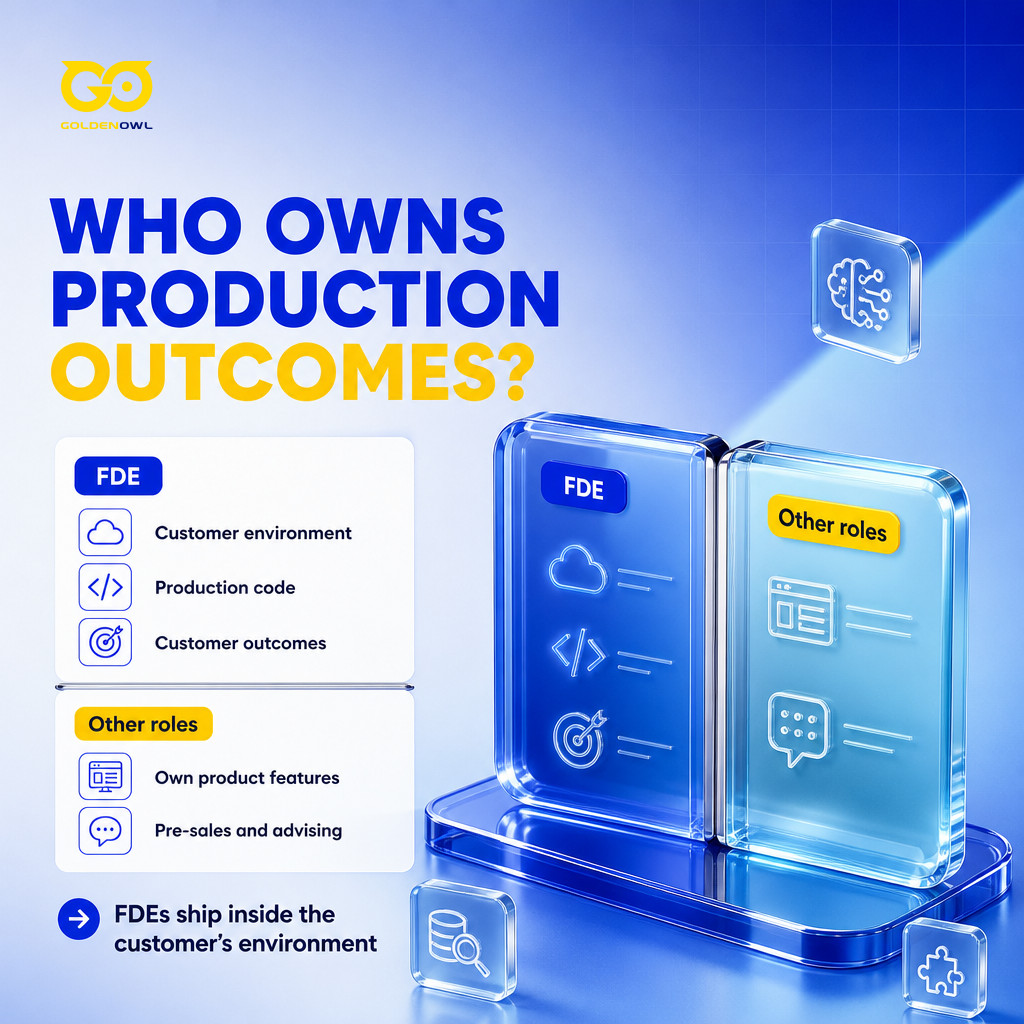
| Role | Optimizes for | What they ship |
|---|---|---|
| Forward deployed engineer | Breadth and customer instinct | Production code inside the customer’s environment |
| Software engineer | Depth in one codebase | Features inside their own product |
| Solutions engineer | Pre-sales and advising | Architecture guidance and demos |
Put simply, an FDE is a core product engineer who works on the customer’s side, inside the customer’s systems. Their to-do list is whatever stops that customer from reaching production, meaning a system that runs live on real data.
A job description should make that responsibility concrete: name the customer workflow, the systems involved, and the result the engineer will own.
The FDE’s pay band should reflect responsibility for getting the project live.
Step 2: Establish Market Compensation Bands
Use a benchmark that matches the role’s location, company stage and responsibilities. Separate base salary from bonus and equity, and state whether the range covers an employee or an external deployment partner.
Recruiting from Scratch’s October 2026 salary report gives the following median posted base ranges for US seed-to-Series-B startups. Its pay sample contains 75 postings; the city rows each contain 28. These are the recruiter’s reported findings from a defined sample, rather than a universal market rate.
| Sample | Median posted base range |
|---|---|
| All seed-to-Series-B roles in the sample | $175,000–$225,000 |
| San Francisco Bay Area | $160,000–$245,000 |
| New York | $180,000–$220,000 |

The city ranges describe the sample’s typical posted bands. Their lower bounds do not establish a minimum salary that every employer offers. The report rounds amounts and excludes ranges stated as total compensation.
Match your offer to the responsibilities of the senior forward deployed engineer you need. Publish the base range and explain the other parts of the package so candidates can compare offers on the same basis.
Step 3: Source Passive Candidates Across Adjacent Profiles
A constrained pool
The FDE title alone can narrow the search too far. Look for people who combine software delivery with customer work, including candidates whose current title describes only one side of that experience.
Why standard recruiting fails
Standard recruiting struggles here for two reasons. The market still doesn’t understand the role well, and recruiting tools weren’t built for such a narrow niche. A job-board post tends to pull in sales engineers who can’t really code, along with software engineers who have never worked with a client. Generic recruiting firms often send misqualified people. Marketplaces depend on active job seekers, and people with this hybrid skill set are rarely looking: the strongest ones are usually doing well where they are.
So source directly. If you use a recruiting firm, ask it to distinguish real FDE candidates from sales engineers who cannot code and software engineers without customer experience.
Adjacent profiles
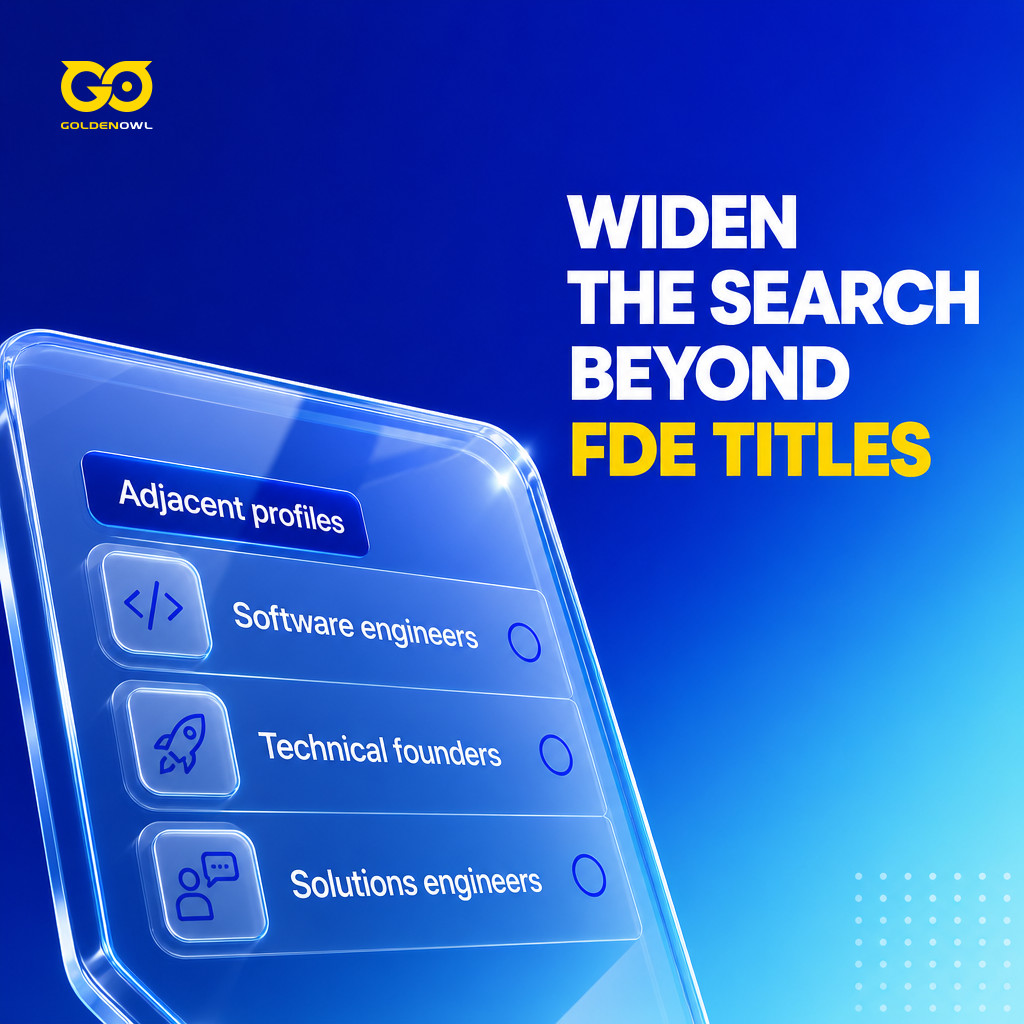
Search adjacent roles as well as the FDE title. Recruiting from Scratch’s October 2026 hiring study counted 186 candidates who had booked a call with the firm: 53% worked as software engineers and 8% already held an FDE title. Those figures describe its own candidate pool, not all available engineers.
Look for engineers who have already handled customer-facing delivery, including founders and solutions engineers who still write production code.
These must-haves then narrow that pool:
- Production engineering: They can explain the full-stack or backend code they shipped, their own contribution, and the constraints they worked within.
- Real customer delivery: They have owned go-lives (putting a system into real use), not only demos.
- Hands-on AI building, if the role requires it: They can show how they tested and operated the AI workflows they built.
- Location and travel: They can meet the location, working hours and travel requirements stated in your job description.
Avoid candidates whose evidence stops at advice or demos when the role requires production engineering. A consulting or contracting background should not rule someone out on its own; check whether they also built, deployed and supported the system.
Use the same delivery criteria across those backgrounds so a familiar job title does not substitute for evidence.
Step 4: Screen for Technical and Commercial Judgment
Screen FDE candidates for technical judgment and commercial judgment separately. Give each its own conversation or exercise. The same split works when you’re assessing an outside vendor.
- Technical judgment. Can they build AI agents that choose actions and call software tools reliably, check the outputs, and measure AI performance with an eval set (a fixed set of test questions with known good answers)? Most technical screens already cover this.
- Commercial judgment. Can they sit with the people doing the work and map how the process really runs (often not the version in the documentation)? Could they then explain to a VP, without jargon, what the system does and why anyone should care? Most technical screens miss this part.
Someone strong on only one of these isn’t an FDE yet. They might be a very good software engineer, or a very good business analyst. The job needs both.
Some candidates write clean code alone, then freeze when a client watches them diagnose a failing production pipeline live. Your screen needs to catch that.
Set language requirements from your own stack. For an AI deployment role, assess these five capabilities:
- Hands-on experience deploying large language models and agents against real infrastructure limits. Reading about it in research papers doesn’t count.
- Customer empathy: They want to know why a client’s workflow looks the way it does before they suggest changing it.
- Problem decomposition under ambiguity: There’s no spec, so they have to diagnose the problem and scope it at the same time.
- Executive communication: They can justify an architecture choice to a finance leader, in the finance leader’s terms.
- System-level thinking across unfamiliar codebases, often ones they’ve never seen and have to ship inside within days.
Customer outcomes
Of the five, customer empathy and problem decomposition under ambiguity are the hardest to screen for. Spend more of the interview on them. Ask candidates to describe past work through customer outcomes. Ask which customer process changed, how the candidate measured it, and what part of the result they owned.
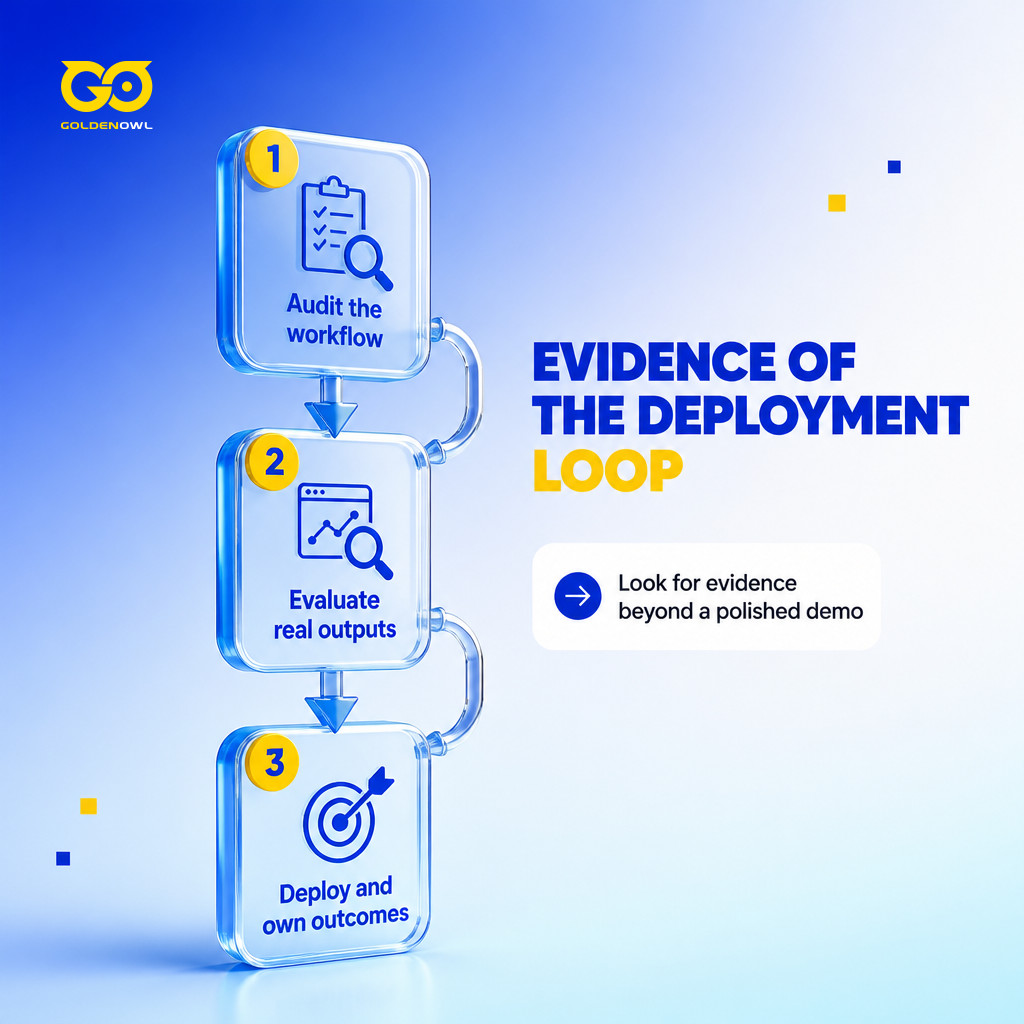
These questions check whether the candidate has run the full deployment loop of audit (sitting with the people who do the work and mapping how it really runs), evals and deployment:
- Ask them to walk you through a real audit. An actual audit, not a proposal. What did they find after sitting with the people doing the work? What surprised them? What did the before-and-after process map look like? Someone who can’t describe a specific workflow they mapped hasn’t done this before.
- Ask for the eval set. A credible FDE builds a golden dataset of real queries with hand-labeled ideal outputs. Then they track pass rate, failure categories and escalations. That record is how a team learns to trust a system before it goes into production. It also separates a builder from someone who only makes demos.
- Ask what shipped, and what broke first. Ask about failures found during testing as well as incidents after release. If a candidate or vendor only shows you the polished version, ask what the first attempt got wrong and how they found out.
- Ask who owned the outcome. Define accountability explicitly: who builds the system, who supports it, and who measures the result? If nobody can name the metric, the deployment isn’t finished.
Don’t evaluate an FDE like a normal engineering hire, or like a consulting pitch. Look for evidence of that loop: audit, evals and deployment. These warning signs show where candidates and vendors usually fall short:
- The slide-deck consultant. They deliver a roadmap, an architecture diagram and some recommendations, and then the engagement ends. No code ships. No eval set exists. "Implementation" is quietly left to your team. That is a real service, but it isn’t forward deployed engineering, so don’t pay FDE rates for it.
- The engineer who can’t talk business. They can describe the model, the tool stack and the architecture in detail. Ask "what does this save us" or "who on your team actually uses this," though, and they can’t answer in terms a non-technical person follows. Deployments stall after the demo.
- No audit trail. If the system can’t show what it did afterward (every prompt, tool call and failure), nobody involved will trust it enough to give it more autonomy. The engagement stays stuck at the pilot stage.
Step 5: Execute an Accelerated Practical Interview Loop
Use a short interview loop that covers customer judgment and hands-on delivery. Recruiting from Scratch reported a median of four rounds across 13 anonymized recruiter briefs; all included a founder, CEO or CTO. That small sample supports one possible structure, rather than a requirement for every employer.
A workable four-round loop for a forward deployed engineer interview starts with motivation and customer judgment, then covers hands-on delivery and the team’s plan to keep the system running:
- Founder conversation:
Motivation, customer instinct, and why the candidate wants FDE work over pure engineering.
- Customer case or role-play:
Give them a messy, real problem to scope. Then ask them to explain their plan to a non-technical buyer.
- Practical build:
Use a take-home, a work trial or a live integration exercise. The point is to watch them deliver something.

- Team and system conversation:
Talk through how they’d ship the work, and who keeps it running once they hand it over.
The table lists skills to cover across those rounds, rather than five additional interviews. Companies may group these checks differently:
| Interview stage | What it tests |
|---|---|
| Recruiter screen | Motivation and customer-facing communication |
| Practical integration task | Cleaning messy data and wiring up a stubborn integration, not algorithm puzzles |
| System design under set constraints | Working inside legacy databases and incomplete documentation they didn’t choose |
| Decomposition or case study | Scoping an underspecified problem, the signature forward deployed engineer stage |
| Behavioral round | Handling stakeholder conflict and ambiguity |
Together, these stages show whether this person can deliver for a customer with incomplete information and a stubborn integration.
Schedule the rounds close together and tell candidates when they will hear back. Separate the duration of the interviews from the time needed to source a suitable shortlist.
Step 6: Select the Appropriate Engagement Model
If customer volume is predictable and your integration playbook (your standard way of connecting to customer systems) is stable, hire in-house. If you’re still testing whether enterprises want your product, or still learning how customers actually work, a flexible external deployment model makes more sense. Deployment teams also take different forms. Some keep an FDE with one customer for months, so domain knowledge builds with every deployment cycle. AI-native companies often put FDEs in small teams with people who coordinate customer deployments, pairing technical work with customer planning.
If you go the external route, ask a forward deployment engineer partner how it would adjust staffing as customer demand changes.
Distinguish these three services when comparing forward deployed engineer offers:
- Embedded placement.
You hire an engineer, through your own recruiting or a placement partner, who joins your deployment team, works in your stack and follows your sprints on customer projects.
- Outcome-based deployment.
A smaller team comes in to ship one system to production, and the contract specifies the result, acceptance criteria, support and pricing.
- Traditional consulting.
You pay for a recommendation, audit or roadmap. Your own team or a separate build team does the implementation. There’s nothing wrong with this model, but it’s a different purchase from an FDE. Buyers who mix the two up end up disappointed.
Frequently Asked Questions
What's the difference between a forward deployed engineer and a solutions engineer?
A forward deployed engineer ships production code inside the customer’s environment and owns the result there. A solutions engineer advises and designs the architecture, mostly during pre-sales.
What questions should I ask when hiring an FDE?
Ask for specifics on four things: a real audit, an eval set from a past deployment, what the first version got wrong, and the business metric the deployment moved. A candidate who can’t get specific on at least three of them hasn’t done the job before.
Do I need a forward deployed engineer or a consultant?
A consultant makes sense before you commit engineering time, when what you need is an outside opinion, a feasibility study or a roadmap. Once the plan is clear and somebody has to build it, ship it and own the result, you need an FDE.
How long does it take to hire a Forward Deployed Engineer?
There is no single reliable timeline for every FDE search. Budget separately for sourcing, interviews and notice periods. Ask a recruiter to define whether its estimate ends at an accepted offer or a start date; the time a job ad stays online measures neither of those directly.
Do forward deployed engineers need a computer science degree?
A degree requirement depends on the employer and role. Recruiting from Scratch’s sample of 141 startup job descriptions found that 16% mentioned a computer science degree and 70% mentioned communication. The absence of a requirement in a posting does not prove the employer ignores degrees. State your own requirement and assess deployment work alongside it.
Share this page


Table of Content

Subscribe to Golden Owl blog
Stay up to date! Get all the latest posts delivered straight to your inbox