Stop treating your store like a brochure. Learn how to budget, evaluate costs, and choose the right ecommerce website design company.


How Much Does Law Firm Website Development Cost?
Jun 29, 2026
about 13 min read

How much does a law firm website cost in 2026? Break down development pricing tiers, platform options, compliance risks, and intake integrations.
Law firm website development is a critical investment. Most firms treat it as a marketing expense, but it should be a core business tool. Research from Martindale-Avvo shows clients rely on online reviews before they ever make contact. A slow, confusing site does not just lose a lead. It signals poor work and sends that client to a competitor.
Just saying "build a good website" isn't a real strategy. The right path depends on your firm's size and goals, but the core idea is the same. A solo lawyer's site and a 50-attorney firm's site both need to be more than a brochure. They need to function as an effective intake tool. This guide explains how to build it.

Law Firm Website Development Costs at a Glance
Law firm website development is not a single product. It can be a $500-per-year template. It can also be a six-figure custom build. The right choice depends on what you need the site to do for your business.
The table below shows the three main tiers by firm size:
Firm Type | Typical Budget | Platform Options | Primary Goal |
Solo / Small (1–5 attorneys) | $3,000–$10,000 | Managed WordPress, Squarespace, and legal template providers | Establish presence, capture local leads |
Mid-Size (5–30 attorneys) | $15,000–$35,000 | Custom WordPress, Webflow, bespoke design | Active lead generation, brand authority |
Large / Enterprise (30+ attorneys) | $40,000–$100,000+ | Custom CMS (Drupal, Craft), fully custom build | Market leadership, complex integrations, compliance |
These ranges cover design, development, content setup, and testing. Hosting, SEO, and maintenance are billed separately. The better question at each tier is not "how much does this cost?" It is "how many qualified consultations will this generate per month?"
Lawyer Website Development for Solo Practitioners & Small Firms
For solo and small firms, the first question is always stark. What must this site do to justify its cost? The goal is not market dominance, it is to build a reliable way to find new clients. It needs to set up local trust, make contact easy, and show up in local search.
A budget of $3,000 to $10,000 is normal for this stage. Your best options are managed WordPress templates from a legal-specific provider. You could also hire a freelance developer who knows the industry. The main needs are a clean mobile site, clear practice area pages, a simple contact form, and basic local SEO. DIY builders seem cheaper at first, but their true cost often comes later in compliance gaps and the need for a costly rebuild.
DIY vs. Hiring a Freelance Law Firm Website Developer
Hiring a freelance law firm website developer costs $1,500 to $5,000. DIY builders like Wix and Squarespace are cheaper, often $15 to $100 per month. That gives you control. But it comes with real risks for a legal practice.
The main risk is compliance, a big one for lawyers. State bar groups regulate lawyer ads, and many states require specific disclaimers (like "Advertising Material"). Most DIY builders cannot handle these rules. Solo PI attorneys could launch a site on a generic template, they might find months later that it does not rank locally or even violates bar advertising rules. Having to build it again from scratch will cost more in the long run.
For most solo firms, the better path is a managed WordPress install. A freelance developer or small agency can do this. This keeps costs low but gives you full control over SEO, page layout, and compliance. You can invest in your website development from the start, which helps you avoid paying twice when you outgrow a DIY tool.
Core Pages and Features for a Foundational Website
A solid law firm website needs at least five things to work as a client intake tool. The homepage is your digital front door. Practice area pages show you can solve a client's problem. Attorney bio pages prove you are the right person for the job. Contact pages need an intake form to start the talk. Finally, a privacy policy is a legal must.
Beyond pages, some features are key. You need a mobile-friendly design, since most legal searches are on mobile. You also need an SSL certificate with HTTPS and a simple intake form linked to your inbox or CRM. Basic local SEO is also vital (with a steady name, address, and phone number).
You should pay special attention to the attorney bio pages. Clients are ultimately hiring a person, not a firm, so a bio with credentials and a professional photo builds trust more effectively than a list of awards.
Typical Costs and Platform Choices
WordPress is the top platform at this level for a reason. It gives you total control over SEO, page layout, and plugins. This keeps costs far below a fully custom build. It is a base you can build on.
Typical one-time project costs:
- Managed legal template: $1,500 to $4,000
- Freelance developer with custom design: $3,000 to $8,000
- Small agency with legal experience: $5,000 to $10,000
Ongoing upkeep costs of $100 to $500 per month are also normal. This is not just a fee. It is insurance for your main client intake tool. The goal is to build a site that earns trust and brings in local leads. When the firm grows, you will have a platform that can grow with it.
Advanced Website Strategies for Growing Mid-Size Law Firms

Mid-size firms face a different problem than small practices. They already have a website. The problem is that it acts as a brochure, not a business tool. Law firm website development at this stage shifts from building a presence to generating active leads.
In law firm website development, for firms with 5 to 30 attorneys, a custom build costing $15,000 to $35,000 is standard. The investment goes beyond basic pages. It covers custom branding, deeper content structure, CRM integration, and technical SEO from day one. The goal is to turn traffic into consultations at a measurable rate.
Moving from a Brochure Site to a Client-Generation Tool
A brochure site tells people what you do, and a client-finding tool gives them a reason to act, right now. The difference is in the depth of your content, the clarity of your user flow, and how easy you make the next step.
Showing the human side of the firm is key. Attorney bios should have more than just credentials. You can use video intros, recent articles, and client-approved stories to build trust faster than any resume. People in high-stakes legal trouble want to know they are in good hands.
Content strategy becomes a serious investment here. Deep practice area pages that answer real-world questions attract traffic ready to convert. A steady blog on local legal issues builds authority. According to FindLaw survey data, legal clients actively review this content. They also check testimonials and online reviews before they even think about making contact.
Key Investments in Custom Design and Content Strategy
This is where the website stops being a marketing asset and starts being a business one. The site must connect to your firm's core tools. These include your CRM, call tracking software, and scheduling systems.
A common best practice is to automate your intake. When a contact form is sent, a rule in your legal CRM (like Lawmatics or Clio Grow) should start two actions. First, it sends an auto-reply email with a scheduling link. Second, it gives a task to your intake team to call that lead within 5 minutes.
Research shows that a five-minute response time greatly raises your chance of making contact. This is also where tools like live chat and chatbots earn their keep. They can capture leads after hours. They can also route questions to the right practice group, all without 24/7 staff.
Integrating with Your Firm's Operations
At this stage, the website becomes part of the intake process, not just a marketing tool. This means connecting it to the firm's CRM, call tracking, and scheduling tools.
A common best practice: when a contact form is submitted, an automated rule in the firm's legal CRM (such as Lawmatics or Clio Grow) does two things.
- First, it sends a confirmation email with a scheduling link.
- Second, it assigns a task to the intake team to call within 5 minutes.
Research consistently shows that responding to leads within five minutes significantly improves the likelihood of making contact. Live chat and chatbot tools are also common at this level. They capture leads after hours without 24/7 staffing. They also route inquiries to the right practice group.
Enterprise-Level Website Development for Law Firms

Large law firms operate in a different world. You compete in high-value markets and manage multiple offices, you handle sensitive client data. You need total brand consistency across dozens of attorney profiles. At this scale, law firm website development is a major infrastructure project. Not just a marketing task. It demands a custom build and a technical partner for the long haul.
The scope is closer to what large firms face in security than what a small practice needs. Hiring a "legal marketing" agency is often the most expensive mistake. They can build a pretty site but lack the engineering depth for what comes next.
Building for Scale, Security, and Compliance
At the enterprise level, your platform choice is about more than features, it’s really about avoiding technical debt in the long run. Many agencies default to WordPress. But systems like Drupal and Craft CMS are built for complex rules and content governance, and they handle multi-site needs without slowing down as you grow.
Security is essential. Law firms are targets. Every intake form and client portal must meet current standards for data protection. This means HTTPS everywhere and regular security tests, plus secure form handling and data rules that match the bar in every state you work in.
ADA and WCAG compliance is a clear signal of skill. Your website is a public space under Title III of the Americans with Disabilities Act. With an estimated 5,000 ADA-related website lawsuits projected for 2025, failing on access is a very visible error.
While Title III details can vary, WCAG 2.1 Level AA is the known benchmark (as noted by the American Bar Association) and what you should aim for. You should ask legal counsel for specific advice.
Advanced Technical SEO for Competitive Niches
For law firm website development at this level, technical SEO must be part of the site’s design, not an afterthought. This is another area where a marketing-first approach completely collapses.
LegalService schema is just the start. The real gains come from layering more specific data. This includes Person schema for attorneys, FAQPage for practice areas, and BreadcrumbList for site structure. As experts at Justia note, these work as a coordinated plan, not isolated tweaks.
Core Web Vitals are just as critical. Google’s metrics (like Largest Contentful Paint) directly affect performance in competitive searches. A firm might spend $50,000 or more on a build. It costs far less to hit these targets from the start, because paying an agency to fix a slow site a year later is just another form of technical debt.
AI search is now part of this picture. Answer engines pull from well-made pages. Sites with clear, answer-first content and valid schema are more likely to be featured. This is quickly becoming a key research channel for serious clients.
The Full Development and Growth Partnership
At the enterprise level, law firm website development is an ongoing engagement, not a one-time delivery. It starts with brand discovery. This means understanding how the firm positions itself and how that reputation becomes a digital presence. This shapes architecture, design, and content decisions made throughout the build.
After launch, growth needs ongoing content work, SEO monitoring, and conversion reviews. A development partner at this level should work as an extension of the firm's marketing team, not as a vendor who disappears after handoff.
How to Choose a Law Firm Website Developers?

Choosing the right development partner is as important as choosing the right platform. The criteria below apply at any budget level.
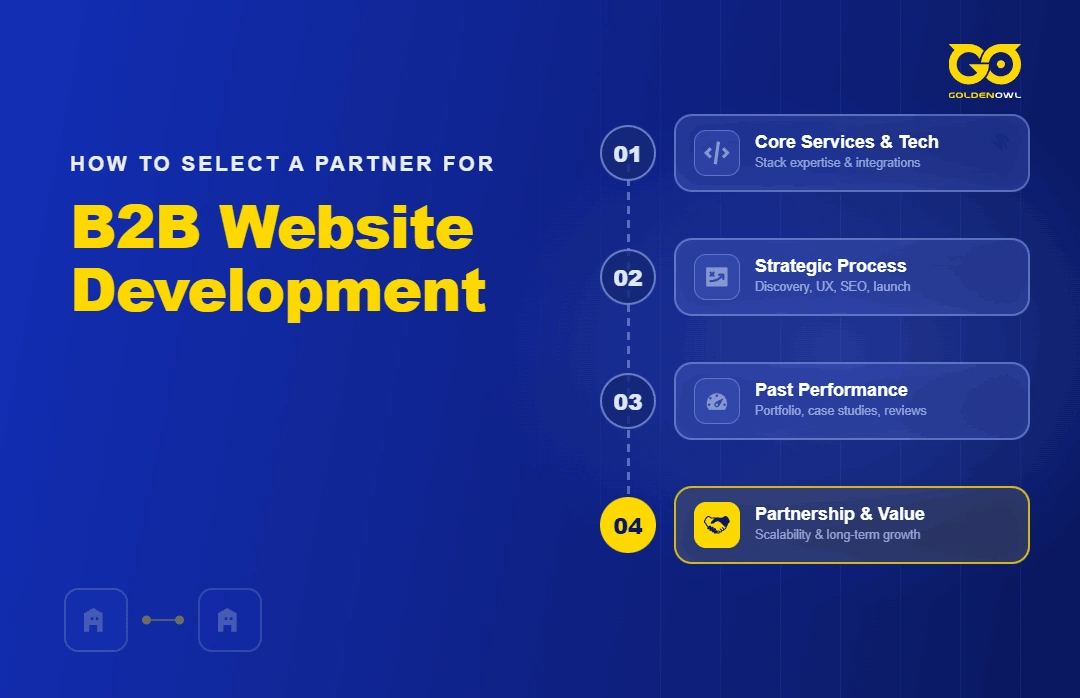
When evaluating law firm web design companies, look for legal-specific portfolio work, client references that speak to communication and problem-solving, and clear project management processes. Look for partners who understand attorney advertising rules. They should explain how their process handles compliance requirements in your jurisdiction.
- Before shortlisting any vendor, use these questions as a baseline filter:
- Have you built websites for law firms in our practice area?
- How do you handle attorney advertising disclaimers and jurisdiction-specific compliance requirements?
- Who owns the website, code, hosting, and content after the project is complete?
- Do you provide SEO migration support if we are moving from an existing site?
- What happens if a CRM or call tracking integration fails after launch?
Verify Specific Experience in the Legal Industry
Legal marketing has ethical rules that general agencies may not be aware of. Most state bar associations regulate how attorneys present services online. Rules cover outcome claims, disclaimers, and testimonials. A developer without legal experience may produce good-looking work that still needs expensive revisions to meet bar requirements.
When checking an agency's track record, look for work in your practice area. An agency with personal injury clients understands urgency-driven UX and intake flow. One who has worked with corporate transactional teams understands the importance of discretion and expertise-based positioning. The needs are genuinely different.
Scrutinize Their Portfolio and Client Reviews
Portfolio review must go beyond aesthetics. Look at the law firm sites the agency has built. Check how fast they load. Are they mobile-responsive? Do the practice area pages have a clear structure? Do the sites appear in local search results?
For client reviews, ignore the star ratings. You are looking for stories about how the agency handles failure. A review that details a specific problem, like a broken tool, and explains how the team fixed it is worth more than ten generic five-star ratings.
Check for Industry Awards and Recognition
Industry recognition adds third-party validation. Legal technology awards from organizations like the American Bar Association or recognized web design programs add useful context when paired with portfolio quality and client references. They are not a final deciding factor. But they show that the agency has submitted its work to outside review.
Meet the Team and Understand Their Process
The people who sell you the project are rarely the people who build it. Before you hire anyone, ask to meet the project manager and lead developer for your site. Ask who owns quality control and how they handle scope changes.
Process shows maturity. An agency that uses a process like Agile or Scrum builds in review cycles, which helps catch problems early. A fixed-scope waterfall plan can work for smaller sites. For a large build, it needs a huge amount of upfront planning to avoid costly changes later.
Finding Law Firm Web Design Companies That Fit Your Budget
Law firm web design companies operate across a wide range. At the budget end, you have templated WordPress providers. In the mid-market, you find marketing agencies that bundle custom design with SEO retainers.
At the enterprise end, full-service builds start above $50,000. For firms that need deep technical skill with legal-sector knowledge, these tech-focused firms offer an engineering depth that marketing-only agencies cannot match. You aren't just paying for a better design; you're investing in a stable, secure asset.
Post-Launch Management and Growth

A live website is not a finished product. It is a business tool that needs regular maintenance to keep performing well.
Ongoing Maintenance and Content Updates
A professional law firm site needs steady attention to stay secure and sharp. This isn't about optional tune-ups, it is the work that protects your initial investment. The monthly or quarterly work should cover several areas.
You should test all updates for the CMS and plugins in a staging area first, this prevents a bad update from breaking your live site. Check that your contact forms and CRM setups are working right, since a broken form (a surprisingly common issue) means lost leads.
You also have to monitor page speed and Core Web Vitals to fix slowdowns before they hurt your search rank and run regular checks against WCAG 2.1 Level AA standards. And of course, keeping practice area pages fresh. Stale information kills credibility.
You should also review monthly reports on ranks, traffic, and conversions to confirm your marketing is working and that analytics track sources correctly.
Firms that treat this work as optional make a huge mistake. They see the website as a one-time expense, and the result is predictable: a site that looked great at launch will quietly atrophy and become ineffective, often within just 12 to 18 months.
Golden Owl Asia's web development team works with clients who get this across the US, Australia, and Europe. They get direct engineer access. Their process is built for long-term needs, not just a template and a handshake.
Further Learning and Resources
For firms that want to go deeper into law firm website development, these resources cover related topics:
- The American Bar Association covers web accessibility and advertising compliance rules for legal practices: americanbar.org
- FindLaw's annual Consumer Legal Needs Survey tracks how clients research and choose attorneys: findlaw.com
- Justia's guide to law firm web presence covers search strategy and technical SEO for attorneys: justia.com
Getting Started and Next Steps
Before you call a developer, though, your firm must answer three questions. Answering them honestly helps you avoid the "build and forget" trap. What must the site do in the next 12 months? Who is your ideal client? And what is a real budget for the initial build and the first year of upkeep?
A good law firm website is a tool for turning your firm's reputation into a steady stream of new clients. Golden Owl's team works with professional service firms on this whole process, from technical design to post-launch growth.
FAQ
How much does a law firm website cost?
Costs for the initial law firm web build vary, but it's not the whole story. Small firms might spend $3,000 to $10,000 on templates, while mid-size firms with custom needs invest $15,000 to $35,000. Large firms can spend $40,000 to $100,000 or more. The real cost includes ongoing upkeep, you have to budget for it like any other business expense.
What are the essential requirements for a law firm website?
The basics are a professional design, mobile-friendly layout, SSL/HTTPS, and fast load times. Key pages include a homepage, practice areas, attorney bios, a contact page, and a privacy policy. However, what you really need is a plan for keeping the site compliant with ADA/WCAG and competitive in local search.
Can I build my own law firm website for free?
You can, but it's a mistake. Free builders have weak security and poor SEO controls, and they lack a good way to add state-specific ad disclaimers. This approach supports the wrong idea that a website is a one-time task. Rebuilding the failed DIY site always costs more than doing it right the first time.
How long does it take to develop a law firm website?
A template-based solo practice site can launch in 4 to 6 weeks, while a custom mid-size firm site takes 12 to 16 weeks. Large enterprise websites with complex setups can take 6 months or more. Remember, that timeline only gets you to launch day, which doesn't include maintaining the website.
What is SEO for law firms?
SEO is the ongoing work of making your site visible in search results when potential clients look for your services. It covers technical work (site speed, schema), content, and local listings. For most firms, local SEO is the best investment they can make. It's maybe the clearest proof that a website is never really "done."
Share this page


Table of Content

Subscribe to Golden Owl blog
Stay up to date! Get all the latest posts delivered straight to your inbox