Stop treating your store like a brochure. Learn how to budget, evaluate costs, and choose the right ecommerce website design company.


How to Choose a B2B Website Development Company in 2026
Jun 15, 2026
about 13 min read
70% of B2B buyers research online before buying. Learn how to choose a B2B website development company, plan costs for revenue growth.
By 2026, your B2B buyers will do roughly 70% of their research online before they contact a vendor, so for any decision-maker hiring a B2B website development company, the stakes are higher. Choosing the wrong agency doesn't just get you a bad website. It can mean technical debt, weak lead generation, and paying for a costly rebuild in 18 months.
This guide is a direct framework for checking technical skill and spotting common red flags. It helps you find a partner who can connect your site to your CRM, your SEO, and your actual revenue goals. A partner focused on your business.
Key Takeaways
|
Your B2B Website Development Agency Choosing Checklist

A structured evaluation checklist helps businesses compare agencies
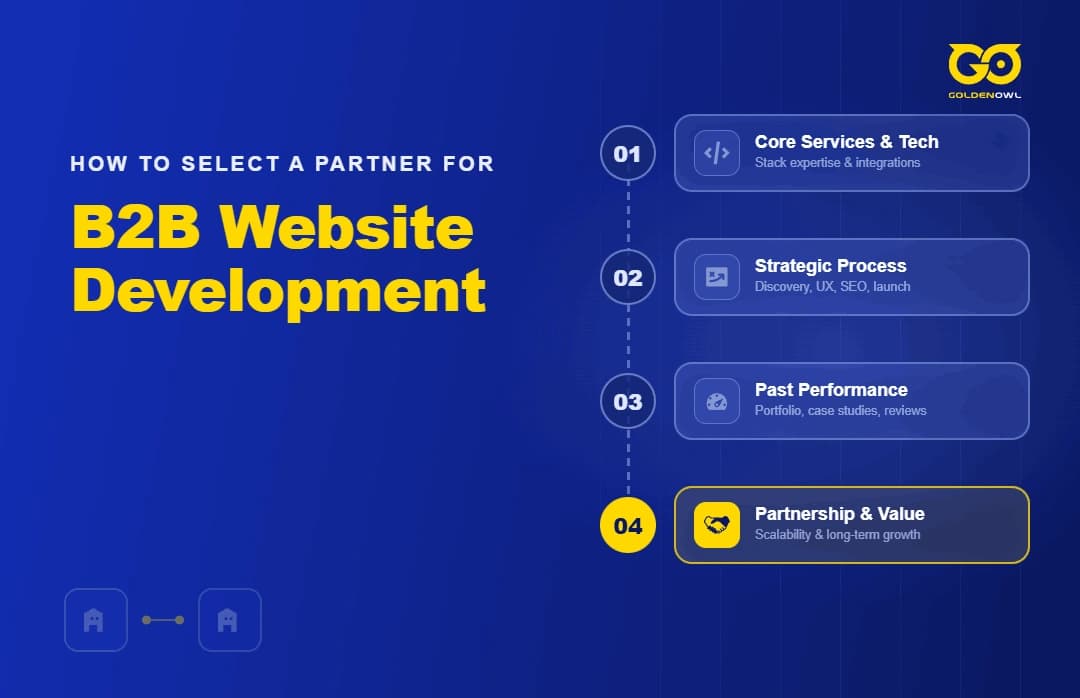
A structured review is the only way to compare agencies fairly. Screening is easier when you focus on four pillars: technical skill, strategy, proven results, and team fit. Use this checklist to cut through the noise during your selection process.
Category | What to Evaluate | Green Flag | Red Flag |
| Technical Capabilities | Tech stack depth, in-house dev, integrations | Deep expertise in 1–2 CMS platforms | Claims to be expert in 10+ platforms |
| Custom Features | Product configurators, client portals, quoting engines | Has built these before, shows examples | Talks in theory without demos |
| Strategic Process | Discovery depth, UX methodology, SEO integration | Paid discovery phase ($5k–$15k) | Free, same-day scope document |
| CRM/ERP Integration | API experience, data flow architecture | Documented integration case studies | Vague answers about "supporting most tools" |
| Proven Performance | Case studies with quantified results | Specific metrics: lead volume, conversion rate | "Client was very happy" testimonials only |
| Post-Launch Model | CMS usability, support SLA, CRO roadmap | Your team can edit content independently | Every change requires a dev ticket |
| Partnership Fit | Communication style, B2B specialization | Regular reporting, shared KPIs | Hands over site at launch, then disappears |
A strong B2B website development agency should comfortably explain each area with examples, not just marketing promises.
Assessing Core B2B Website Development Services and Technical Capabilities
A B2B website is not a brochure. It's a sales engine, a lead nurturing tool, a credibility signal, and in many cases, a direct integration point for your business systems. When evaluating a potential partner, the breadth and depth of their web development capabilities matters more than how nice their own homepage looks.
Here's what to dig into.
Custom Design and Branding vs. Template-Based Approaches

Custom website architecture supports complex buyer journeys
There’s some truth to the appeal of pre-built templates. They promise lower upfront costs and a faster launch. However, they almost always fail to meet the demands of a serious B2B operation.
- Template-Based Approaches: These force your sales process into a rigid grid. They are often bloated with unused code, which kills mobile speed and creates security holes.
- Custom B2B Development: A custom build adapts to your sales cycle and buyer personas. This lets you create unique user journeys for different people during a long, complex decision.
| Evaluation Parameter | Template-Based Websites | Custom B2B Engineered Websites |
| Code Efficiency & Speed | High code bloat, slower performance, lower Core Web Vitals scores. | Clean, lightweight code optimized for maximum rendering speed. |
| Security Risk Profile | Vulnerable to shared plugin exploits and open-source template hacks. | Highly secure, custom-written endpoints with restricted vulnerability windows. |
| Scalability & Upgrades | Highly restrictive; code breaking occurs frequently during core system updates. | Infinite scalability, modular code blocks built to expand with corporate growth. |
| UX & Intent Alignment | Forced alignment; user journeys must fit preset template layouts. | Tailored alignment layouts are built completely around user search intent. |
When you review an agency’s portfolio, look past the visuals for strategic thinking. Does every site look vaguely the same? A strong partner makes clear design choices for a specific audience, but you have to look past the surface to see it.
Additionally, always test how portfolio sites perform on mobile devices. B2B buyers increasingly rely on smartphones for deep research, even on highly complex corporate purchases. Ultimately, investing in bespoke corporate website development keeps your brand looking completely unique, while making your site incredibly easy to navigate for the entire corporate buying committee.
In-House Development and Technology Stack Expertise
An agency’s staff model directly impacts your site's security and upkeep. An agency with a full in-house dev team means better accountability and consistent code quality.
Be cautious of any agency that claims expertise in more than ten CMS platforms. This is often a red flag. Real technical depth comes from focusing on one or two systems (like WordPress or a headless setup), not from being a jack-of-all-trades.
For example, a mid-market firm once hired a "platform-agnostic" agency. The project launched on Craft CMS. But a later review showed the agency's developers mostly knew basic WordPress. A security review found exposed API endpoints and unstable database setups. The client had to spend an estimated $18,000 just to rebuild core parts of the site.
To minimize these performance risks, look for partners who are completely transparent about their primary technology stack. For more information on how choosing the right stack impacts web performance and security infrastructure, check out our insights on digital engineering strategies at Golden Owl Solutions.
Advanced Feature and Tool Development
Enterprise B2B buyers expect interactive, self-service tools that streamline their research phase. Your chosen b2b website development company must possess the engineering capability to build advanced features that handle complex business logic, including:
Advanced Feature Type | Business Value & Core Application |
| Custom product configurators | Essential for manufacturing, industrial, and engineering sectors where clients need to build specs in real time. |
| Quoting engines | Speeds up the sales cycle by letting buyers generate project-specific estimates instantly without waiting for a sales rep. |
| 3D or CAD model viewers | Crucial for product-heavy B2B niches, allowing engineers to inspect physical goods directly in the browser. |
| Secure client portals | Gated dashboards dedicated to long-term account management, order tracking, and private resource libraries. |
| Multi-Tier dynamic pricing | Delivers account-based catalog visibility and personalized contract pricing, which is non-negotiable for scaling B2B ecommerce website development. |
| Gated content funnels | High-converting lead capture flows built to sync cleanly with your backend marketing automation tools. |
For every capability on this list, ask to see a live example. A claim in a proposal is not enough.
Critical System and Third-Party Tool Integrations
A B2B website that doesn't connect to your core business systems creates manual work and data silos. Integration capability is non-negotiable for most mid-market and enterprise B2B companies.
You should plan for the most common integrations. These are your business-critical systems (Salesforce, HubSpot), ERPs (SAP, NetSuite), and marketing automation platforms (Marketo, Pardot). Live chat and chatbot tools are also becoming standard as buyers demand self-service.
When assessing an agency, ask specifically about API integration experience. Can they build custom middleware if a direct integration doesn't exist? Have they handled bi-directional data sync, not just one-way pushes? And critically, how do they handle integration testing before launch?
Analyzing the Strategic B2B Website Development Process

Digital strategy team planning enterprise website discovery
A high-performing web asset is the result of a disciplined, transparent execution workflow. When evaluating potential partners, look past generic milestone timelines and critically analyze their core underlying methodology.
Upfront Discovery, Research, and Planning
The discovery phase lays the foundation for the web development project․ Discovery will eliminate the guesswork and bring business objectives and technical architecture into alignment before any code is ever developed or layout is designed․
However‚ conducting the discovery process in a hurry or as part of a no-cost sales proposal can cause business needs to be overlooked and rebuilding the solution is often costly․ In contrast‚ addressing a focused‚ paid discovery phase leads to a shorter technical scope for on-time and scalable implementation․
Some digital agencies offer a free planned meeting to attract clients‚ but a true discovery involves more in-depth stakeholder interviews‚ competitor analysis‚ technical systems audits and user journey mapping as part of a long-term planning process․ A discovery sprint for complex mid-market or enterprise projects generally lasts 2 to 4 weeks and costs between $5000 and $15‚000․ An up-front investment in a blueprint is good development partner practice and a sensible way to minimize scope creep and avoid surprise costs later in the project lifecycle․
For example, a global logistics firm that relied on a rushed, free discovery session missed an enterprise ERP data sync requirement. This single oversight broke their checkout flow post-launch, resulting in a costly emergency rebuild during Q3 that exceeded their initial budget by 40%.
Brand-Aligned User Experience and Design
B2B website design should be more than just dry, uninspired corporate grids. A good agency wrestles technical needs into intuitive user experiences (UX). They do this by building detailed wireframes, visual style guides, and responsive layouts.
The UX design workflow should move from discovery data to user flow diagrams. These then inform wireframes before the final UI design is made. This process is not about looks; it is about mapping the exact paths for different members of a buying committee. An executive buyer needs high-level business case overviews, while a procurement officer or engineer needs quick access to deep spec sheets. The final interface should reflect your brand identity, though its main job is to ensure smooth navigation on all devices.
SEO-Integrated Content and Development
Search Engine Optimization (SEO) cannot be a post-launch checklist item. It must be built into your site’s structure from day one. This needs close work, almost a partnership, between content strategists and the development team.
Technical SEO Frameworks. This includes proper internal linking and a clean URL structure, and it also means automated XML sitemap generation and optimized schema markup.
Core Web Vitals Optimization. You should expect work on cutting server response times, which includes using next-gen image formats and optimizing code to meet Google's performance standards.
Persona-Targeted Content Hubs. This means creating structured content templates that natively target high-intent search queries and industry semantic clusters.
Launch Protocol and Post-Launch Management
A good launch depends on a strict deployment checklist. Your partner’s plan must include wide cross-browser Quality Assurance (QA) testing, precise 301 redirection mapping to keep search rankings, and a complete setup of analytics tracking (like Google Analytics 4). You should also check their post-launch support. A reliable agency gives clear Service Level Agreements (SLAs) that outline guaranteed support hours, server monitoring, and fast response times for security patches.
How to Verify a B2B Website Development Company's Past Performance

Reviewing case studies helps validate real project performance
Reviewing case studies helps validate real project performance
So, when you narrow your choices, you need to verify an agency’s real-world track record. You can use these validation strategies to confirm their skills.
Reviewing B2B Website Portfolios and Examples
When reviewing a portfolio, look past the visuals and focus on function. Open their live client websites on multiple devices to check real-world usability. Can a user find deep sub-product pages in three clicks? Do contact fields and multi-step quoting paths work correctly without lag? Does the site load complex images and data tables quickly over standard mobile connections? A key point for usability.
Analyzing Case Studies for Measurable Results
Review case studies with a critical eye, looking for specific, quantifiable business outcomes. Do not accept vague claims like “improved modern look” or “enhanced user engagement.”
There's a specific question you can add to your agency interviews. "What was the lead-to-qualified-lead conversion rate before the new site launched, and what was it six months after?" This question is hard to answer with vanity metrics. It's easy to buy traffic, but qualified leads are different. An agency that can answer this with numbers has been paying attention; an agency that deflects to pageviews or bounce rate probably has not.
Confirming Specialization in Your Industry or a Related Niche
Every industry has unique rules and audience needs. An agency that designs consumer brands will struggle with the technical needs of a deep enterprise niche. Choosing a partner with proven experience in your sector means they can start work without a long education on your business model. For instance, if you work in complex industrial sectors, a partner that specializes in [manufacturing website development ensures your team already knows how to structure technical data sheets. A team with a track record in industrial website development will have the experience to build advanced tools like equipment configurators and secure compliance portals.
Checking Client Testimonials and Requesting References
On-site testimonials offer a quick look at client satisfaction, but you should always request direct reference contacts. Ask to speak with two or three past clients who managed projects of a similar scale. During these talks, ask targeted questions about their experience. How did the agency handle unexpected technical issues or scope changes? Did the team stick to the agreed budget and timelines? Is their post-launch support team responsive when issues come up?
Considering Awards and Accolades
While industry awards (like the Webby Awards or CSSDA recognitions) offer third-party validation, you should treat them as a secondary point. They should only support more direct forms of proof, like detailed case studies and direct client references.
Evaluate the Partnership Model and Long-Term Value
Building a modern website is not a one-time deal. You're really starting a long-term partnership. Your platform must always evolve to support your business as it grows.
The Strategic Advantage of a Specialized B2B Agency
Consumer-focused B2C agencies build for quick, emotional, single-stage buying decisions. A B2B web strategy agency, however, knows the details of complex business sales and designs platforms for corporate buying habits.
To address long sales cycles, a B2B agency builds lead nurturing hubs and gated content funnels that keep buyers engaged for months. A necessity for complex buying committees. Development teams build targeted persona paths for executive, technical, and procurement teams. To support sales, the platform adds direct CRM syncing and real-time tracking tools, which gives sales reps instant views of prospect behavior.
Scalability and In-House Management Post-Launch
Your marketing team must be able to manage daily website updates without calling a developer for small changes. You should ensure your partner builds on an open, scalable foundation with modular layout engines (like Gutenberg blocks in WordPress, for example) or flexible content fields in Umbraco.
To see the risks of closed systems, consider a common case. A mid-sized manufacturing firm signs a contract for a site built on a proprietary, closed-source Content Management System. Though it was promised to be easy to use, the marketing team quickly hits a wall.
Changing a homepage banner or adding a new product page requires a paid developer ticket, it might cost $200 per request with a three-day turnaround. This kind of friction stalls marketing and creates a major operational block. The real cost isn't just the ticket price; it's that the marketing efforts are completely stalled. Businesses often scrap the proprietary system within 18 months, and migrating to an open, custom WordPress block editor can cost another $45,000. So the business ends up paying for its website twice just to get basic editing control back.
Ongoing Strategy for Conversion and Growth

Ongoing optimization helps improve conversions and lead quality
A good website development agency offers support that goes far beyond the launch. This goes back to the idea of a long-term partner, not a one-off job. The right partner provides growth services like conversion rate optimization (CRO), running A/B split tests on key landing pages to improve form rates. They also analyze user behavior with tools like heatmaps to find and fix navigation friction. Finally, they offer continuous feature updates, building new platform tools based on user feedback and market demands.
Preparing for Future Digital Trends
As search tech changes, your web platform must be built to adapt to new standards. To prepare for AI Overviews and Search Generative Experience (SGE), sites need a structured JSON-LD schema with clean, semantic API sprints. At the same time, optimizing for voice and intent search means development teams must add conversational long-tail architecture and detailed FAQ modules.
A forward-thinking partner builds your site with lucid, semantic code and structured data. This quality engineering ensures your brand's ideas and product data are easy for modern AI engines to find, and it helps future-proof your organic search results.
FAQ
What is the typical cost for a custom B2B website development project?
In the 2026 market, a fully custom enterprise B2B website project can range from $25,000 to $150,000+. The total cost really depends on the project scope. This includes technical needs (CRM/ERP), the number of unique page layouts, custom features like product configurators, and the depth of the discovery and content strategy phases.
How long does it take to build a B2B website?
Most well-scoped B2B website projects take 4 to 6 months from signed contract to launch. Here's a rough phase breakdown:
- Discovery and strategy: 2–4 weeks
- UX design and wireframing: 3–4 weeks
- Visual design: 3–4 weeks
- Development: 6–10 weeks
- Content production: runs concurrently with development
- QA, testing, and launch: 2–3 weeks
Projects that compress this timeline, particularly by skipping or rushing discovery - tend to encounter expensive problems during development.
What makes B2B website development different from B2C?
B2C web platforms focus on quick, single-user checkouts and high-volume consumer sales. B2B platforms have to support long sales cycles that last months and involve multiple corporate buyers. Because of this, B2B sites need deep educational content hubs, gated lead-capture funnels, custom pricing tiers, and strong links with internal sales systems.
Should I use a template or invest in a custom B2B website?
Templates can work well for new startups that need a quick web presence on a tight budget. But scaling enterprise brands usually need custom development. A custom build gives you the design flexibility, page speed, advanced features, and deep API support needed to scale your operations and support a complex buyer journey over time.
Conclusion
Choosing the right B2B website development company is a strategic choice, not just a procurement task. The partner you choose determines if your site becomes a top sales asset or an expensive project you have to manage around for years.
This framework gives you tools to check four dimensions that matter: technical depth, process rigor, proven performance, and partnership quality.
Agencies that score well on all four are rare. But they exist. The result of finding one is a site that earns trust with smart buyers, links cleanly with your business systems, and brings in qualified leads at scale. It is worth the careful search.
If you're ready to start that conversation, Golden Owl Solutions 's web development team works with B2B companies across Southeast Asia and beyond. We build sites that perform commercially, not just aesthetically. Get in touch to discuss your project.
Share this page


Table of Content

Subscribe to Golden Owl blog
Stay up to date! Get all the latest posts delivered straight to your inbox