Stop treating your store like a brochure. Learn how to budget, evaluate costs, and choose the right ecommerce website design company.


How to Hire the Best Website Developers for Small Business
Jun 18, 2026
about 9 min read

Choosing website developers for small business? Avoid the portfolio trap. Compare DIY vs. professional options, real costs, and foundational SEO in 2026.

Picking the right website developers for small business is harder than it looks. The most common mistake is getting seduced by a pretty portfolio, it's a trap many fall into. You might end up with a gorgeous site that does terribly on search, a complete non-performer. Or you get a beautiful design with no CMS, meaning you can’t change a single word without a new invoice. A wrong hire at this stage will cost you a lot of money.
This guide is about the choices that actually save you money. We'll look at DIY versus professional work, the correct platforms for your business, and what a good build process entails. You should get multiple quotes, but simply picking the cheapest one is how you get burned later on. We will also cover how to properly dissect a price quote.
Comparing Website Developers for Small Business Options
Your three realistic paths are a DIY builder, a freelance developer, or a development agency. When looking for the best website developers for small businesses, here is how they compare at a glance:
Path | Typical Cost | Time to Launch | Technical Skill Required | Best For |
DIY Website Builder | $15 to $50 per month | 1 to 4 weeks | Low | Simple brochure sites or very tight budgets |
Freelance Developer | $2,000 to $8,000+ per project | 4 to 10 weeks | None | Custom features with a moderate budget |
Development Agency | $5,000 to $25,000+ per project | 6 to 12+ weeks | None | Complex sites needing long-term support |
These are market estimates, not firm quotes. Costs will vary based on your location, the project's complexity, and the provider. Always check pricing directly before you budget a dollar.
DIY vs. Hiring

There isn't one right answer, but some choices are definitely wrong for most businesses. The choice isn't just about saving money on a $50-a-month plan versus a multi-thousand dollar project, it comes down to what your site must do.
When a DIY Website Builder Makes Sense
DIY builder is a reasonable starting point when your site has one clear, simple job. A drag-and-drop builder handles your opening hours, what you offer, and how people can contact you, all without any code. Monthly costs are typically low, with most major platforms' pricing plans ranging from $15 to $50 per month, depending on the tier and features selected. You can be live in a few weeks if your content is ready.
The problems start with custom work. Most builders prevent access to the site's code. If you need a unique booking flow or a special tool that isn't in their app store, you're stuck.
Out-of-the-box SEO is also a weakness. You can fill in meta fields, sure. But the site's structure isn't really built for search.
When to Hire a Professional Developer
You need a professional if your website is supposed to generate revenue, not just display information. This goes for e-commerce stores, service businesses booking appointments online, and any company that relies on search traffic.
Here’s a pattern we see constantly: A small retail business spends a few months and a few hundred dollars on a DIY site. It looks okay. But it has no custom product filter, it's slow on mobile, and SEO was an afterthought. Traffic is flat for six months.
After moving to a professionally built site with clean architecture, on-page optimization, and a custom feature set, online inquiries increase noticeably in the first quarter after launch. That outcome is not guaranteed, but the gap between a convenience-built site and a performance-built site is real.
Pro website developers for small business clients give you things a template can't.
They give you code-level freedom so you are not locked into a template's limits. A professional build also provides a path for future growth, built on a technical base that can actually scale with your business.
A Guide to the Top DIY Website Builders
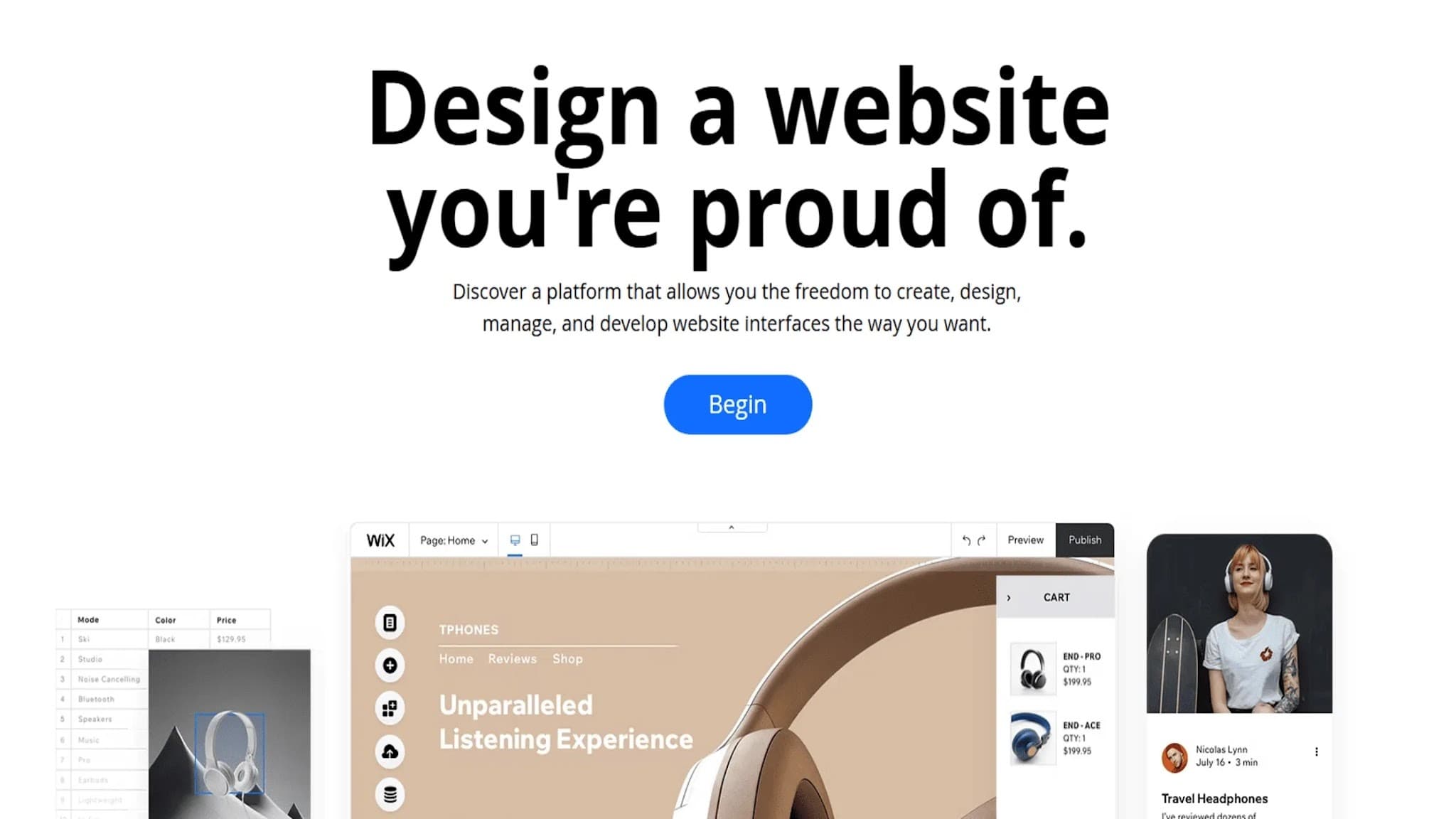
If the DIY path is right for you now, picking the right platform is key. It's as vital as finding good website developers for your small business for your business later on. The table below breaks down the common choices.
Platform | Best For | Approx. Starting Price |
Wix | General service businesses, local companies | ~$17/month |
Squarespace | Design-led businesses, photographers, and wellness | ~$16/month |
Shopify | Product-based e-commerce | ~$29/month |
Square Online | Businesses already using Square in-person | Free tier available |
Ghost | Publishers, newsletters, subscription content | ~$9/month |
Kajabi | Online courses, coaching, memberships | ~$55/month |
WordPress.org | Advanced customization, scalable builds | Free (hosting separately) |
Webflow | Designers needing precise layout control | ~$14/month |
Hostinger | Budget-friendly, basic online presence | ~$3/month |
Note: Prices are estimates and can change. Check current prices on each platform's site before you sign up.
For most service businesses, Wix and Squarespace are fine. Shopify is the clear leader for selling products. WordPress gives you the most power, but it also has the steepest learning curve. If budget is the only factor, Hostinger gets you online cheaply.
But if your site needs to generate leads or grow through search, you will hit the ceiling of a DIY platform. The next step is a pro build. It's key to know what that really means.
The Small Business Website Development Process With a Professional

When working with website developers for small business projects, knowing what each phase involves helps you contribute better feedback and avoid the delays that most commonly derail projects.
Discovery and Goal Setting
Before any design work starts, a real pro needs to learn your business. They should ask about your customers, what you want visitors to do, your branding, your budget, and your timeline. The result is a project brief and a defined scope. In other words, a roadmap for the whole project. If a developer sends a proposal without this talk, that's a big red flag.
Planning, Wireframes, and Mockups
With a brief in hand, the developer maps the site structure (a sitemap) and creates wireframes. These are just black-and-white layout sketches. Once you approve the structure, the team creates detailed mockups. These show the final visual design.
Here's a tip that saves projects: Collect all feedback from your team into one document. When five people send separate notes over three days, it creates chaos. On a six to eight-week project, that kind of split feedback can easily add a full week to the timeline.
Website Build and Development
Once the designs are locked, development begins. The developer turns approved mockups into working pages, connects any required tools such as a CRM, booking system, or payment gateway, and builds out the CMS so you can make content changes after the site is handed over to you.
If you want to see what a well-structured build process looks like in practice, Golden Owl's web development service page covers the full stack and how each phase is managed from kickoff to launch.
Quality Assurance and Testing
No pro site should launch without structured testing. This step gets skipped most often on budget projects. It means checking the site on all major browsers, a whole menagerie of them like Chrome, Safari, Firefox, and Edge. It also means testing on phones and tablets, making sure forms work, and checking speed with a tool like Google PageSpeed Insights. This is slow work, and while it might seem like an easy place to save time, it is the first thing dropped when a project is behind schedule.
Website Launch and Post-Launch Monitoring
Launch means updating your DNS to point to the new site. A pro will watch the site closely for the first few days to catch any issues. You should expect a warranty period, often one to two weeks, for fixing any bugs that appear after launch. Confirm this is in your contract before you sign.
What Small Business Website Development Services Should Include

Professional packages should deliver more than a working website. Here is what to expect.
Custom Design and CMS Development
Custom design means the site is built for your brand, not just a tweaked version of a common template. Most developers use a content management system (CMS) like WordPress. This lets you update pages and write blog posts yourself, the handoff should always include a training session or guide on how to use it.
Responsive Design and Modern Coding Practices
Responsive design isn't an optional extra, it's a core requirement now that mobile-first indexing is the standard for all websites. Google's Search Central confirms mobile-friendliness is a direct ranking factor. The data is clear, as mobile devices have driven over half of all global web traffic since 2017 according to Statista. Any site that fails on mobile just won't be seen by half the audience.
Foundational SEO and Website Speed Optimization
"Foundational SEO" gets thrown around loosely in a lot of proposals. Installing a plugin does not count. A genuine foundational SEO package covers:
- Keyword research for core pages before any content is written
- Custom meta titles and descriptions for every page
- Correct heading hierarchy across all pages
- Image alt text throughout the site
- Compressed images and clean code for fast load times
- Google Analytics and Google Search Console are connected and verified
Ask the developer to confirm exactly which of these items are in scope. Their answer will tell you a lot about how they think about search performance.
Content Creation and Graphic Design
Some agencies will write copy and create visuals. Others offer it as an add-on. If you plan to provide your own content, you must be realistic about your timeline. Content delays are the single most common reason web projects blow past their deadlines. Get a firm agreement on who is delivering what, and when.
E-commerce and Database Integration
For any business selling online, the scope should include a full setup of an e-commerce system like WooCommerce for WordPress. If your site needs to show dynamic data from a database (like a product catalog or member list), that work must be scoped and priced clearly. Never assume it's included.
Website Hosting and Security
Many agencies offer managed hosting in a monthly plan, which usually covers automated backups, security patches, and software updates. Hosting a WordPress site yourself is an option, though it's only a good one if you are comfortable with the technical side.
You should get it in writing who is responsible for backups and know the exact recovery procedure before you sign anything.
Understanding Costs for Website Development for a Small Business
Pricing for small business websites varies, but the logic behind the numbers is consistent. The sticker price is rarely the full story.
DIY Website Builder Costs
The figures below are based on public pricing and are subject to change. Always check the platform’s own pricing page.
- Basic plans are roughly $10 to $20 per month.
- Business or e-commerce plans are roughly $25 to $65 per month.
- Advanced or scale plans are roughly $80 to $150+ per month.
Most platforms give a 20% to 30% discount for paying annually. While the monthly cost is low, the trade-off is your own time spent fighting with templates and the performance limits you will hit.
Professional Website Pricing Tiers
Professional work generally falls into three tiers.
- A core package is roughly $2,000 to $6,000 for a five to eight-page site with custom design, CMS, foundational SEO, and mobile optimization.
- A growth package is roughly $6,000 to $15,000 for sites needing e-commerce, custom functions, or content strategy.
- An enterprise or custom build is $15,000 and up for complex applications or large-scale e-commerce.
These are market estimates, not quotes. Your final cost depends on the developer’s location, the project’s complexity, and (most importantly) how clear the scope is.
If a quote comes in far below these ranges, it is a major red flag. A developer who underprices their work has almost certainly misjudged it. That leads to cut corners, scope arguments, and surprise costs later. The discovery process is more important than a 15-20% price difference.
Frequently Asked Questions
How long does it take to build a small business website?
Most professional builds take between six and twelve weeks. The timeline depends heavily on project size, revisions, and how quickly you provide feedback and content.
Will I be able to update the website myself?
Yes. A key reason developers use a CMS like WordPress is so you can make your own updates without code. The handoff should include training.
Do you provide website hosting?
Many agencies offer it as a managed monthly plan. You can also host it yourself with a provider like WP Engine or Kinsta. Our team at Golden Owl can discuss which option is right for you.
Will my website be optimized for search engines?
Foundational SEO (site structure, speed, metas, tags) should be part of the build. Ongoing SEO is a separate, continuous service that builds rankings over time.
What happens after my website launches?
Post-launch warranty for bug fixes is standard. It is typically for one to two weeks, though some offer 30 days. Confirm the terms in writing.
Can you help with content for my website?
Many agencies offer copywriting and visual assets, sometimes as an add-on. Settle this during discovery, as content is the most common source of project delays.
Can you redesign my existing website?
Yes. Golden Owl often handles redesigns. The process starts by assessing what is working, then rebuilding on a modern platform for better performance and SEO. With proper redirects, your existing domain authority is preserved.
What is the difference between a web developer and a web designer?
A designer handles the visual layout and user experience while a developer builds the working site from that design. Professional agencies provide both skill sets.
Conclusion
So, hiring the right website developers for small business starts with knowing what the site needs to do. If your needs are simple and your budget is minimal, a DIY platform can be a starting point.
But if you need your site to generate leads, sell products, or grow with search traffic, a professionally built site is the right investment. At Golden Owl Solutions, our team builds websites that perform. Whether you’re starting from scratch or fixing a site that isn't working, we can help you find the right path.
Share this page


Table of Content

Subscribe to Golden Owl blog
Stay up to date! Get all the latest posts delivered straight to your inbox