Types of Outsourcing: A Complete Guide for CEOs & Enterprise Leaders
For Startups
Types of Outsourcing: A Complete Guide for CEOs & Enterprise Leaders
Dec 17, 2025
about 10 min read
Types of outsourcing explained for enterprise leaders, from engineering and cloud ops to managed services, BOT, and AI-driven delivery models.
Enterprises outsource to access global talent, accelerate AI adoption, strengthen resilience, and scale faster than internal teams can handle. But with so many types of outsourcing: onshore, offshore, nearshore, managed services, talent cloud, AI-augmented delivery, and BOT models. Most leaders face real decision overload.
Choosing the wrong model slows innovation and inflates budgets. Choosing the right one unlocks speed, agility, and capability. Our blogpost breaks down all major types of outsourcing, explains how each works, and shows CEOs and enterprise leaders how to match the right model with their business goals, technology roadmap, and budget.
Key Takeaways
Outsourcing is a strategic engine for AI adoption, modernization, resilience, and global scalability.
Three dimensions define every outsourcing decision: location (where), function (what), and engagement model (how).
Nearshore, smart-shoring, and dedicated teams are now the fastest-growing models for real-time collaboration and scalable delivery.
AI, cybersecurity, cloud, data engineering, and automation are the most outsourced capabilities due to global talent shortages.
CEOs choose the right outsourcing type by aligning business outcomes, risk levels, capability gaps, and time-to-value.
What Is Outsourcing? A Clear Definition for Business Leaders
Outsourcing is a business practice where a company hires an external third party such as a vendor, contractor, or service provider. So the service can perform specific tasks, services, or business processes that would otherwise be handled internally by its own employees.
today blends human experts with AI augmentation, giving enterprises access to hybrid teams that deliver at a pace traditional hiring cannot match. For leaders, outsourcing is now a core lever for growth, innovation, and long-term resilience.
Outsourcing for small businessis structured across three major dimensions: function-based outsourcing, location-based outsourcing, engagement models. These dimensions create more than 15 common outsourcing types. The following sections break down each type clearly so leaders can select the right model for their business strategy.
The 3 Dimensions of Outsourcing: Where, What, and How
CEOs and enterprise leaders must understand all three to choose the right model: function-based outsourcing, location-based outsourcing, engagement models.
1. Function-Based Outsourcing Types
This dimension focuses on which functions move outside the organization. It defines the scope of work: software development, cloud operations, cybersecurity, QA, data engineering, helpdesk, product design, or full product teams.
2. Location-Based Outsourcing Types
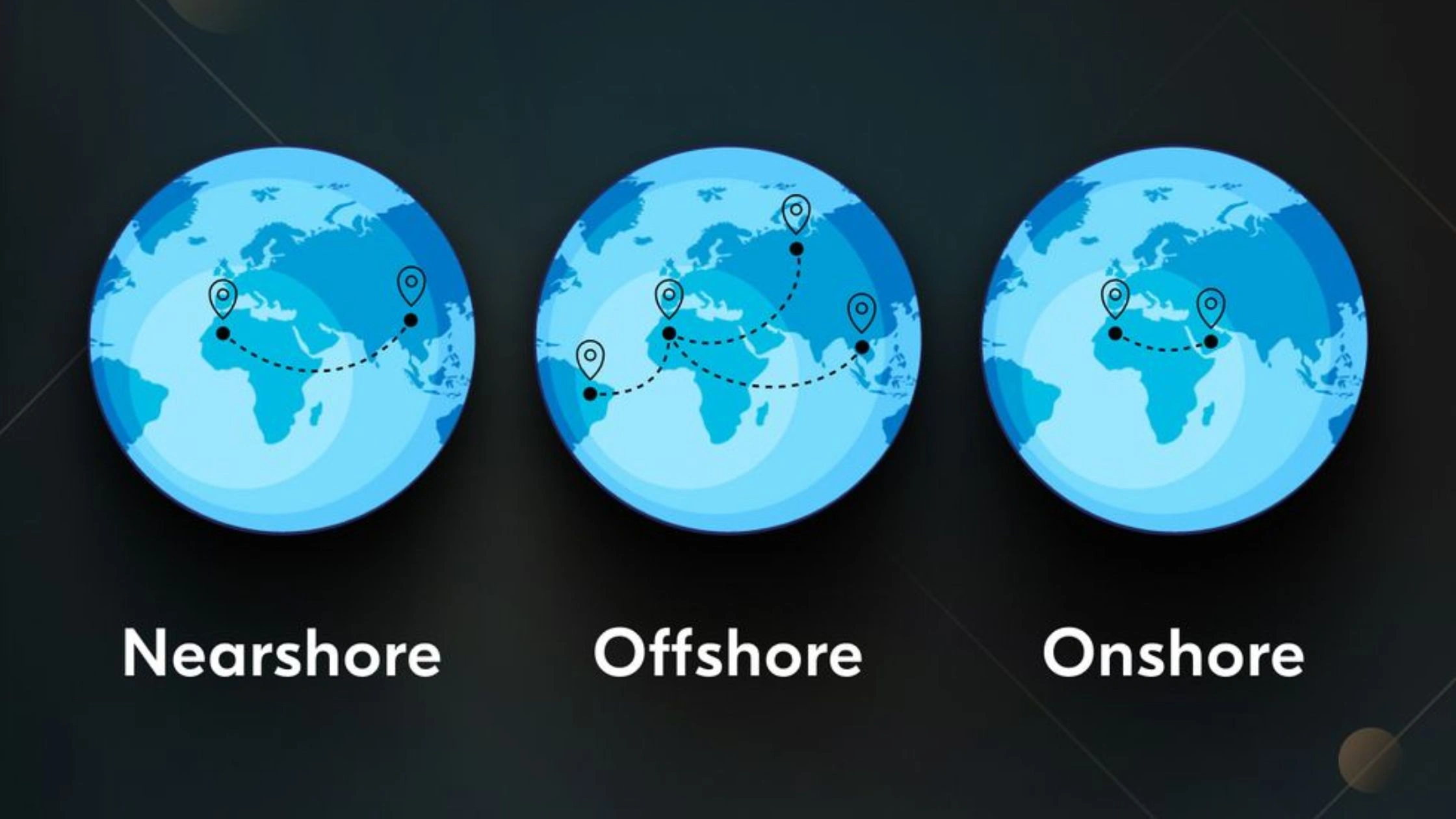
This dimension defines where your external teams sit: onshore, nearshore, offshore, or fully distributed. Each location model affects cost, collaboration speed, time-zone alignment, and regulatory complexity.
Location is the “where” of outsourcing: balancing talent availability, communication needs, and budget.
3. Engagement Models
This dimension defines how you structure the relationship: dedicated teams, managed services, project-based work, outcome-based contracts, AI-augmented delivery, or Build-Operate-Transfer (BOT).
Engagement models are the “how” of outsourcing: how risk is shared, how work is executed, how performance is measured, and how deeply the vendor integrates into your organization. The right model determines predictability, accountability, and long-term scalability.
Location-Based Outsourcing Types
Location defines how your outsourced teams collaborate, communicate, and scale. Enterprises don’t choose a single geography, they combine models to balance cost, compliance, and delivery speed.
Onshore Outsourcing
Onshore outsourcing means you hire external providers within the same country to deliver IT or business services. You and your vendor share the same legal environment, language, business culture, and (usually) time zone, so communication and compliance are much easier to manage.
For example, a US-based bank can outsource cloud modernization or cybersecurity operations to a specialist provider in New York or Silicon Valley, instead of building an in-house team.
Best for: AI governance, cybersecurity, cloud architecture, regulated industries (finance, healthcare, government), product discovery, and rapid iteration.
Why enterprises choose it:
High trust, shared regulations, and zero language barriers
Faster feedback loops for agile sprints
Higher quality for architecture-level work
Trade-off: Onshore remains the most expensive model, but delivers the lowest risk.
Nearshore Outsourcing
Nearshore outsourcing means working with vendors in neighboring or time-zone–aligned countries, giving you real-time collaboration at a lower cost than onshore while keeping communication smooth and efficient.
For example, US companies often nearshore software development to Mexico, Colombia, or Costa Rica, where teams work within 1–3 hours of US time zones.
Best for: Agile development, DevOps, mobile engineering, AI/ML workloads, product teams that need real-time collaboration.
Why enterprises choose it:
Strong cultural fit + same working hours
Better communication for iterative projects
Large talent pools in LATAM, Eastern Europe, and Southeast Asia
Trend: Nearshore + onshore hybrid squads are becoming the default for modern delivery.
Offshore Outsourcing
Offshore outsourcing means hiring vendors in distant, lower-cost countries, usually with a large talent pool and a bigger time-zone difference. For example, a global SaaS company may run its support and back-office operations from the Philippines to provide 24/7 coverage.
Best for: Large engineering teams, 24/7 development cycles, QA, automation, data labeling, AI fine-tuning, long-term maintenance.
Why enterprises choose it:
Ability to scale engineering talent quickly
Mature markets now deliver higher quality due to AI augmentation
Considerations: Time-zone gaps increase governance needs. Nearshore prioritizes real-time collaboration and cultural alignment while offshore requires strong processes for communication, documentation, and security.
Smart-shoring Outsourcing
Smart-shoring combines onshore, nearshore and offshore into one coordinated model. This is the enterprise standard for complex digital transformation and AI modernization programs.
Best for: Large-scale cloud migration, AI adoption, product engineering, global operations, multi-team delivery pipelines.
Why enterprises choose it:
Onshore provides strategy and compliance
Nearshore ensures collaboration speed
Offshore delivers cost and scale
Reduced geopolitical and talent-churn risk
Optimal balance of capability, cost, and agility
Outcome: Smart-shoring gives leaders a resilient, multi-region workforce that adapts to changing business needs without sacrificing quality or economics.
Function-Based Outsourcing Types
.The main function-based outsourcing categories include software development outsourcing, IT infrastructure and cloud operations outsourcing, technical support and helpdesk outsourcing, front-office outsourcing (customer-facing functions), back-office outsourcing (operational functions), and high-value knowledge process outsourcing (KPO).
Software Development Outsourcing
Software development outsourcing means hiring external engineering teams to design, build, test, and scale digital products: web apps, mobile apps, platforms, or AI demand forecasting systems. Enterprises outsource engineering to scale capacity, accelerate roadmap delivery, and access specialized skills like AI/ML, cloud-native development, and automation.
Benefit: The type shortens time-to-market, reduces engineering bottlenecks, and gives access to global talent without long hiring cycles.
Watchpoint: Requires strong architecture governance to maintain quality and consistency.
IT Infrastructure & Cloud Operations Outsourcing
The outsourcing includes system administration, cloud management, SRE/DevOps operations, network monitoring, and cybersecurity. As infrastructure becomes more complex: multi-cloud, edge, hybrid. Outsourcing brings stability and deep platform expertise.
Benefit: Outsourcing ensures 24/7 uptime, compliant architectures, predictable operations, and stronger resilience against cyber risks.
Watchpoint: Must ensure the provider meets regulatory and data-residency requirements.
Technical Support & Helpdesk Outsourcing
Technical support outsourcing type covers L1–L3 support, incident management, troubleshooting, and ongoing maintenance. Enterprises use this model to reduce operational load, maintain SLA-driven support, and improve response times without expanding internal teams.
Benefit: The type improves customer satisfaction, keeps systems stable, and frees internal engineers for higher-value work.
Watchpoint: Needs tight knowledge-transfer processes to avoid inconsistent responses.
Front office outsourcing includes customer service, onboarding, account support, CX operations, and sales enablement. B2B companies increasingly outsource high-volume or multilingual support tasks.
Benefit: The type lowers operational cost while expanding service coverage across time zones and markets.
Watchpoint: Must maintain brand consistency across outsourced agents.
Back-Office Outsourcing (Operational Functions)
Back office outsourcing Includes HR ops, payroll, finance & accounting, invoicing, procurement, and admin workflows. These tasks require precision but not internal ownership.
Benefit: Outsourcing back-office functions improves accuracy, reduces overhead, and lets enterprises focus on core revenue activities.
Watchpoint: Needs rigorous controls to protect sensitive financial and employee data.
High-Value Knowledge Outsourcing (KPO)
KPO is the fastest-growing segment. It includes R&D teams, business intelligence, analytics, data engineering, AI model training, market research, and product strategy support. Enterprises use KPO partners to accelerate innovation without expanding internal headcount.
Benefit:The outsourcing gives leadership access to specialized, hard-to-hire expertise especially in AI, cloud, and data, while reducing risk and expanding strategic capability.
Watchpoint: Requires strong IP protection and clear ownership agreements.
Engagement & Contract Models
Choosing the right engagement model shapes cost, delivery speed, governance, and long-term scalability. Below are the five models CEOs and CIOs rely on most today:
Staff Augmentation
Staff augmentation adds external engineers, designers, analysts, or AI specialists to your internal teams. Remote-first work makes it easier to tap global talent markets, and AI copilots boost augmented engineers’ productivity, allowing smaller teams to deliver more.
Dedicated Team (ODC)
A dedicated team acts as a long-term, integrated engineering unit essentially an external extension of your product organization. Modern ODCs run with shared KPIs, velocity metrics, and delivery OKRs, giving enterprises predictable output and lower total cost of ownership.
Project-Based Outsourcing
Project-based outsourcing provides packaged execution for clearly defined work: app modernization, migration projects, MVPs, modules, or integrations.
AI-assisted workflows: spec analysis, code generation, automated QA now make fixed-scope projects faster and more predictable.
Managed Services
Managed services transfer full responsibility for running operations: cloud infrastructure, DevOps, cybersecurity, support desks, SRE, FinOps under defined SLAs or XLAs. Enterprises adopt this model for reliability, lower operational cost, 24/7 monitoring, and defined uptime guarantees.
Build-Operate-Transfer (BOT)
The BOT model allows companies to establish their own engineering or innovation center: offshore, nearshore, or regional without the overhead of building it themselves. BOT increasingly covers AI labs, cybersecurity operations, data engineering hubs, and cloud platform teams.
Specialized Outsourcing Types
Specialized outsourcing is now the fastest-growing segment of the global IT services market. Below are the seven specialization areas shaping enterprise strategy:
AI & Machine Learning Outsourcing
AI engineering is driven by generative AI adoption, digital transformation, and the shortage of AI talent. Outsourcing AI is the fastest path to automation, personalization, and productivity gains across the organization.
Why it matters
AI engineers, ML ops, and data scientists remain the most expensive and hardest roles to hire internally.
Enterprises need rapid PoCs, model fine-tuning, and production-grade AI systems.
Vendors now offer Co-Intelligence Delivery, blending AI copilots and human engineers for faster delivery cycles.
Cybersecurity Outsourcing
Cyber threats increased by more than30% YoY, and 76% of U.S. states now outsource SOC operations. Security is too mission-critical and too understaffed to manage alone.
Why it matters
The global shortage of cybersecurity professionals exceeds 3.5 million.
New regulations (EU AI Act, DORA, HIPAA updates) demand continuous compliance.
Multi-cloud and hybrid cloud are now standard for modern enterprises. Internal teams cannot keep up with the complexity.
Why it matters
82% of enterprises run multi-cloud workloads.
Cloud optimization and FinOps can reduce cost by 20–40%.
Kubernetes, serverless, and IaC require deep hands-on experience.
Cloud & DevOps outsourcing accelerates modernization and avoids multi-cloud misconfiguration, a leading cause of downtime.
RPA & Hyperautomation Outsourcing
RPA is entering maturity stage, with the market projected to reach $30.8B by 2030. Hyperautomation, RPA, AI and workflow engines delivers enterprise-scale efficiency.
Why it matters
Businesses automate finance, HR, logistics, procurement, and compliance tasks.
Outsourcing partners provide pre-built automation accelerators, slashing deployment time.
AI agents now manage rule-based and judgment-based workflows.
RPA outsourcing eliminates repetitive costs and shifts staff to higher-value, revenue-generating work.
Data Engineering & Analytics Outsourcing
Data engineering is the backbone of AI, automation, and decision intelligence.
Why it matters
Outsourcing provides modern data stack skills (Snowflake, Databricks, BigQuery, Lakehouse).
Predictive analytics, real-time dashboards, and governance frameworks require specialized teams.
CEO takeaway: Without outsourced data engineering support, AI adoption stalls and decision-making remains reactive instead of predictive.
Product Engineering Outsourcing
Product engineering has shifted from “build features” to “build scalable platforms.”
Why it matters
Enterprises need continuous delivery pipelines, modular architectures, and platform APIs.
Product engineering partners support modernization, refactoring, UX, quality, and integration work.
AI-assisted development accelerates delivery and reduces time-to-market.
Industry-Specific Outsourcing
Vendors are niching down and offering domain expertise that generic firms cannot match.
High-demand verticals
FinTech: compliance automation, AML/KYC systems
HealthTech: HIPAA-compliant systems, AI diagnostics, EHR integrations
Vertical outsourcing reduces domain onboarding time and increases delivery accuracy, critical for regulated or complex industries.
How CEOs Should Choose the Right Outsourcing Type
Choosing the right outsourcing model is a strategic decision, not an operational one.
The goal is simpl: match the right type with your business priorities, risk tolerance, talent gaps, and growth horizon. Use this framework to make a clear, defensible choice.
1. Start With the Business Outcome
The decision begins with the result you want: cost reduction, faster delivery, stronger security, or AI validation. So, each outcome aligns with a different outsourcing model.
2. Map Work to the Right Dimension (Where / What / How)
Outsourcing delivers value when it fills true capability gaps: architecture, AI, DevOps, security, data, or delivery oversight. If you lack more than one of these areas, choose a specialized vendor or a managed model.
4. Align Risk Zones With the Right Contract Model
Use specialized partners for AI, cloud, or security; dedicated teams for delivery risk; managed services for financial stability; onshore teams for compliance. Choose the model that best mitigates your primary risk.
5. Optimize for Time-to-Value
Speed is now a board metric. Staff augmentation deploys in days, dedicated teams in weeks, managed services ensure ongoing predictability, and BOT builds long-term capability. If time is critical, choose augmentation or dedicated models.
6. Measure Total Cost of Ownership, Not Vendor Rates
Low hourly rates often hide higher rework and governance costs. Evaluate productivity, seniority mix, sprint velocity, rework rate, compliance overhead, and hidden risks. The most cost-effective partner is the one with the lowest TCO, not the lowest rate card.
7. Prioritize Strategic Partners, Not Task Vendors
Modern outsourcing requires partners who co-drive your roadmap. Look for advisory strength, co-innovation, transparent governance, strong compliance, and proven results. If a vendor can’t influence your strategy, they’re not a strategic partner.
Conclusion
Outsourcing is a strategic engine for speed, innovation, and resilience. The right outsourcing type helps CEOs unlock global talent, accelerate digital transformation, de-risk large initiatives, and scale technology roadmaps without overstretching internal teams.
As AI, cloud, cybersecurity, and automation reshape enterprise operations, choosing the correct outsourcing type will determine who leads, who lags, and who gets left behind. The future belongs to organizations that build hybrid teams, co-innovate with specialized partners, and use outsourcing as a long-term competitive strategy.
FAQs
1. What is the most cost-effective outsourcing type for enterprises?
Offshore or smart-shoring models paired with dedicated teams or managed services deliver the best cost–value balance. Hourly rates are lower, but quality stays high when governance is strong.
2. What outsourcing model is best for fast delivery?
Staff augmentation for immediate capacity. Dedicated teams for sustained velocity and roadmap execution. Both models deploy in days or weeks, not months.
3. How do I reduce risks when outsourcing?
Use SLA-driven governance, clear IP ownership clauses, secure development environments, retention benchmarks, and region-specific compliance controls. Managed services reduce operational risk; dedicated teams reduce delivery risk.
Share this page
Table of Content
Subscribe to Golden Owl blog
Stay up to date! Get all the latest posts delivered straight to your inbox