Choosing a React Native mobile app development company? Learn how to pressure-test technical depth, evaluate pricing models, and avoid budget bleed.


A Founder's Framework for Vetting an Android Mobile App Development Company
Jun 11, 2026
about 14 min read
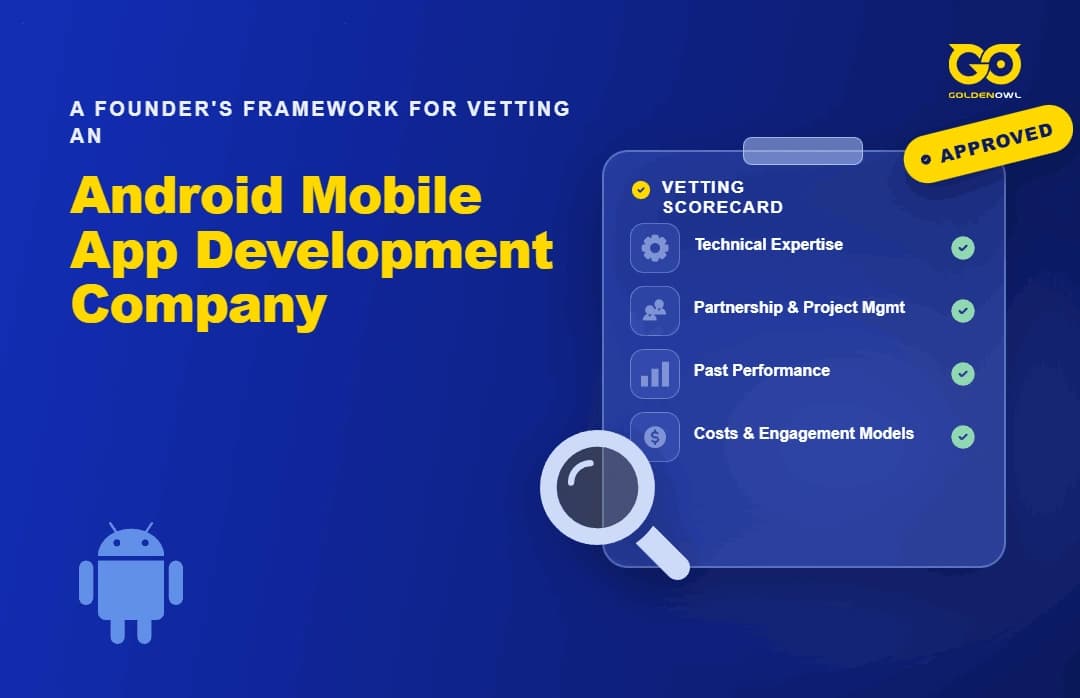
Vetting an Android mobile app development company? Learn how to evaluate technical expertise, modern tech stacks, costs, and security.
With over 5.7 billion smartphone users globally, the scale of the Android market is hard to ignore. Projections show it holding 67–72% of the worldwide mobile OS market share into 2026. This is why so many businesses still build for Android first. They might be launching consumer apps, enterprise tools, or AI-powered platforms.
But choosing the right android mobile app development company is a common failure point for founders. You’ll see a lot of agencies promising speed and low costs, but they don't tell you about the real cost. Six months later, you’re often left with missed deadlines and an unstable codebase. And the bill for an expensive rebuild.
This guide offers a practical way to check potential partners. It's not just a technical checklist. It’s about understanding how a great team approaches mobile app development services. A good partner focuses on the work from the first conversation all the way to long-term growth.
Key Evaluation Criteria at a Glance

Checklist for choosing an android mobile app development company
Before signing any contract, compare potential partners across four major pillars.
Evaluation Pillar | What to Check | Questions to Ask |
Technical Expertise | Android tech stack, architecture, testing | How did you decide which tech to use on your last project, and what were the tradeoffs? |
Partnership Process | Project management, communication, and security. | What project tools do you use? How do you handle intellectual property (IP) and data protection? |
Proven Performance | Portfolio depth, references, and industry focus. | Show me a project that struggled. What went wrong, and how did you fix it? |
Cost & Engagement | Pricing models, budget ranges, and quote details. | What is included in your ballpark estimate? Which engagement model fits our scope? |
Security & IP | NDA, compliance, ownership | Who owns the source code after launch? |
Scalability | Team expansion capability | Can the team grow if the project expands? |
This checklist helps founders avoid emotional decisions based only on sales presentations or visual portfolios.
Evaluating the Technical Expertise of an Android Mobile App Development Company
Any agency can write code. Very few can act as a true partner. A real partner gets product scale, handles Android ecosystem updates, and guards your budget.
Core Android Mobile App Development Services Offered
A professional android mobile app development company must offer end-to-end ownership, so you should avoid agencies that only handle the coding. This almost always creates gaps down the line.
A complete service model starts with product discovery and strategy, which, to be blunt, refines your concept and maps a clear product roadmap. It also includes UI/UX design for creating wireframes and accessible user interfaces.
Then comes native app development for the Android OS. Quality assurance and testing are also key, with tests run on a wide range of physical devices.
A good partner also manages the Google Play Store submission and post-launch upkeep, keeping an app alive with updates.
When strategy, UX, and testing are treated as afterthoughts, they become your problem. A full-service partner takes ownership from the first idea through post-launch support.
For example, an eCommerce founder needs more than just an app. They need payment gateway setup, inventory sync, push notification flows, analytics, and ongoing feature releases. Without a skilled Android team, these systems quickly become a nightmare to scale.
If you plan to grow, reading about custom software development strategies can help you prepare.
Custom Android Mobile App Design and Development Process
Around 71% of users churn within 90 days of installing an app, and a poor user experience is a primary cause. Good design is really just a tool for user retention.
The process begins with User Research, transitions into Wireframing, moves forward to Material Design UI, and culminates in Usability Testing.
A serious custom android mobile app design and development team will insist on this process. They follow Google's Material Design 3 rules. They build interactive mockups before writing code and run usability tests with real users. They change things based on feedback.
A common mistake is approving beautiful mockups without testing the actual flow.
For instance, one fintech startup saw its user onboarding rates fall because their KYC check flow had too many steps. The interface looked modern, it was bleeding users. After they made the flow simpler, onboarding time fell by 38%. Completion rates jumped and support tickets dropped, which is a real business result.
The Modern Tech Stack for Android Mobile App Development
Tech choices affect everything from performance to future support costs. But founders often mistake a long list of new tech for skill. A modern android studio for mobile app development company should have experience with these tools:
Technology | Purpose |
Kotlin | Official Android programming language |
Java | Legacy Android support |
Jetpack Compose | Modern UI toolkit |
Room + SQLite | Local database and offline storage |
Hilt | Dependency injection |
WorkManager | Background task scheduling |
Kotlin Coroutines / Flow | Asynchronous programming |
Android Studio | Primary development environment |
Firebase | Analytics and backend services |
REST & GraphQL APIs | Data communication |
CI/CD pipelines | Faster testing and deployment |
When you check a team, ask *how* they use these tools, not just if they can list them. Jetpack Compose is a perfect example. While many agencies claim experience, their actual skill can vary wildly. You don't want a team that is more excited about using a new tool than building your business, because they are essentially learning on your dime.
You can ask for a recent Jetpack Compose example during your review. A good team can walk you through a live screen and explain their state management approach. Ask them why they chose it and what problems they hit. If they say it was flawless, they are probably either new to it or not being honest with you.

Modern Android tech stack for scalable applications
Advanced and Emerging Technology Integration
Advanced features are often a distraction. Does your app really need AI or IoT on day one? A disciplined partner will often be the one to say "no." They will advise you to focus on the core product first.
- Artificial Intelligence & Machine Learning: On-device processing with TensorFlow Lite or cloud-based Generative AI for smart features.
- Internet of Things (IoT) Connectivity: Connecting to hardware via Bluetooth Low Energy (BLE), Wi-Fi, or NFC.
- Enterprise Database Security: Using encrypted local databases like Room SQLCipher to protect user data.
- Cloud Infrastructure: Setting up backends on Amazon Web Services (AWS), Google Cloud Platform (GCP), or Firebase.
Not every app needs these. But watch out for a partner who agrees to build a complex AI feature into your MVP. They might be more interested in a cool portfolio piece than your long-term success. Their ability to say "no" is a good signal of a mature team.
Assessing Partnership and Project Management
Technical skills alone are not the point. The most expensive projects don't fail because of the tech, they fail because the team built the wrong product. Weak communication and poor project visibility are symptoms of this deeper problem of misalignment.
The Development Process from Discovery to Launch
A transparent workflow is supposed to prevent this. Most agencies will show you a similar map from discovery to production. They’ll talk about user personas and a product requirements document (PRD), and will also cover planning architecture, API contracts, and running sprints. You’ll see builds on Firebase App Distribution and do User Acceptance Testing (UAT), a critical step, before you launch to the Google Play Store.
But the list of steps is meaningless by itself. Ask them how each stage forces alignment. If they struggle to explain it, they probably see their process as just a checklist. They’re making it up as they go. A factory assembly line.

Android app development from discovery to launch
Communication, Transparency, and Project Management
Most project failures aren't technical, they're communication failures. It’s the slow drift of missed expectations and unclear scope. It's the silent developers who only surface a major problem after weeks of work have already gone down the drain. This is how you end up with the wrong product.
You should be able to get clear answers to basic operational questions like how often you will meet and if you will have direct access to the project manager. You also need to know where you can view the live source code repository.
A common disaster starts when the client and the dev team think they agree on what’s needed. The gaps seem small at first, but they only become clear months later. The first working version reveals a deep disconnect between what was expected and what was built. Delays, rework, and frustration are the unhappy result.
One effective way to avoid that is through weekly product demos. Instead of just talking about progress, developers should present working code that you can actually test. Frequent demos make it easier to spot issues early and adjust priorities.
But these demos are useless if they become theater, just showing off features without connecting them back to the business problem they solve. Every sprint ought to end with a live feature demo so you can check progress for yourself.
When evaluating an android mobile app development company, pay close attention to communication habits. Strong teams don’t wait for problems to become serious. They create regular opportunities to review progress, get feedback, and make sure everyone is still aligned on the same goals.
Team Structure, Expertise, and Scalability
A dedicated android mobile app development company needs specific roles, but titles matter less than their mindset. A team of brilliant engineers who aren't aligned is still a problem. The key is a structure that demands questions and clear ownership. A standard team includes a few key roles.
- The Project Manager: The PM or Scrum Master is your main contact, and their job is to coordinate tasks to keep the business goal on track.
- Android Software Engineers: You need senior and mid-level developers who write clean Kotlin, but they must also ask "why" before they build.
- The Backend Developer: This person builds the API layer and database schema, ensuring the server can scale with the product vision.
- The UI/UX Product Designer: As your user's advocate, this person focuses on mobile habits to ensure the app solves a real-world problem.
- QA Test Engineers: They do more than find bugs; they confirm the product works as a user would expect. The
- DevOps Engineer: This role sets up the CI/CD pipelines that enable fast, reliable feedback loops.
When evaluating a partner, ask how the team is structured. Are developers in-house or outsourced? Who reviews architecture? You can also ask if they can add resources as the project grows, which helps show if a firm is built for a long-term relationship.
Enterprise-Grade Security and IP Protection
Security and IP protection are not afterthoughts, these talks should happen before any work begins. They are your final protection if that alignment fails.
Every contract must clearly define who owns all assets, including source code, designs, docs, and app data. Most deals should also start with mutual NDAs. This protects your product ideas and your business methods.
Data protection is another critical point of alignment. Your app may need to follow certain rules (like GDPR in Europe or the CCPA in the United States) that affect everything from logins to data storage. A partner who isn’t fluent in them is a liability.
You should also ask how the team manages source code access. A professional team uses platforms like GitHub or GitLab with strict role-based controls and multi-factor authentication. This isn't just a technical detail; it's a sign of discipline.
IP disputes are expensive. Clear contracts and documented ownership terms are your safety net, and they prevent costly mix-ups long before a product ever reaches the market.
Verifying Past Performance and Industry Experience
Every android mobile app company claims a proven track record. But a slick website and a few glowing testimonials are just marketing. You need to see real proof of engineering skill. The truth is, most review methods are flawed. The best way to know what you're getting is a small, paid trial project. Other signals are less reliable.
How to Analyze a Company's Portfolio

Analyze portfolios based on business impact
When you review an agency's case studies, focus on their approach to problems, not just the screenshots. But even that gives you a limited view.
Here’s what to check:
What to Check | Why It Matters |
| Business outcomes | Shows strategic thinking |
| Scalability | Indicates technical maturity |
| App complexity | Reveals engineering depth |
| Industry similarity | Reduces learning curve |
| User retention metrics | Reflects UX quality |
Many founders focus on visual polish when reviewing case studies. In reality, business impact often provides a much clearer picture of a team's capabilities.
Ask them, "What business metric did this app improve, and what was the result?" A strong partner will have a clear answer. They'll explain how they cut onboarding time or boosted repeat buys, while a weaker one will talk about features like the login page.
But even a great answer is just a story about the past. It doesn't tell you how they’ll handle your project’s inevitable surprises.
Industry-Specific Application Experience
Domain knowledge accelerates delivery and reduces risk. An agency that has built healthcare apps before understands HIPAA compliance. One that's built with fintech apps knows transaction security patterns.
Key verticals to look for experience in:
- FinTech: This includes digital wallets, payment processing, and investment tools.
- Healthcare: Think patient management, telemedicine, and wearable integrations.
- E-commerce and retail: This covers product catalogs, cart flows, and loyalty programs.
- EdTech: This means learning management, gamification, and offline content.
- On-demand services: This is for real-time tracking, booking systems, and push notifications.
A partner without direct domain experience isn't a dealbreaker, it can even be a plus. A smart team without fixed ideas may find a better solution than one using old patterns. You can pay a premium for "experience" only to get an ossified approach.
A partner needing more time to learn your context is a measurable cost, while a partner who can't adapt is a much bigger risk.
Interpreting Client Testimonials and Company Reviews
You should check an agency's standing on independent sites, never rely on the curated reviews on their own site. Platforms like Clutch.co and GoodFirms offer verified reviews that cover project management, communication, and timelines.
Video reviews are also useful, as founders often talk about real challenges. Asking for client references is another good step, but you must treat all of this as heavily filtered data. No agency will ever point you to an unhappy client. A curated list of their successes. When reading reviews, look for clear stories of how problems were handled, not just vague praise like "great team."
Awards, Certifications, and Partnerships as Trust Signals
Certificates and partnerships aren't proof of quality, though they can signal process maturity or just be expensive marketing.
You can look for official credentials. An ISO 27001 cert is for information security. A Google Developer Expert award shows community work. AWS or Google Cloud Partner status is for cloud architecture. Industry awards come from places like Clutch, Manifest, or Webby.
You should treat these as supporting evidence, not the main criteria. An ISO certificate proves they can follow a checklist. It doesn't prove they can innovate.
Understanding Costs and Engagement Models
The budget is where things get serious. You need to know market rates. More importantly, you need to structure a deal that protects you from risk.
Ballpark Cost Estimates for Android Apps

Estimated Android app development pricing ranges
Costs vary wildly based on complexity and team location. The table below gives you a realistic starting point for a full project with a Southeast Asian or Eastern European agency. North American or Western European teams will be 1.5–2x higher.
Here are realistic ranges:
App Complexity | Estimated Cost Range | Typical Timeline |
Simple MVP | $25,000–$50,000 | 3–4 months |
Mid-Level App | $50,000–$120,000 | 5–8 months |
Enterprise App | $150,000+ | 9+ months |
Flexible Engagement Models Explained
The way you structure the contract matters more than the initial price. A dedicated team from an agency is a full-time group. This is great for long-term products but a huge first step. With staff augmentation, you add their developers to your own team. This gives you control but means you manage them directly. A Time & Materials (T&M) contract has you pay for hours worked. This is the most flexible model and is perfect for a small, defined trial project.
Many founders want a fixed-price contract for predictability. This is often a mistake. If user testing shows your onboarding is broken, a fixed-price deal forces a painful change order. A flexible model lets you adapt. The best way to start is with a small T&M contract for a two-week trial sprint.
How to Get a Precise Project Quote

Preparing project requirements for android mobile app development quote
To get a useful, accurate estimate for a trial project, you must provide a clear brief. Avoid vague requests. Instead, prepare structured documents.
Your brief should include a focused list of user roles and features for the trial. You should also provide any design assets, wireframes, or Figma prototypes. Include API specs for any systems the trial feature needs to connect to. Finally, note any hard deadlines that impact the trial.
Clear documents allow a team to give you a precise scope for a trial. This is far more valuable than a vague quote for an entire app.
If you are planning a custom Android product, you can contact our Golden Owl Solutions team to discuss scoping a trial project that aligns with your business goals and technical needs.
Frequently Asked Questions
What's the difference between native and hybrid Android development?
Native Android apps are built for the platform using its own languages (Kotlin or Java) and tools like Android Studio. This gives them the fastest performance and smoothest animations. They also get total access to hardware like the GPS, Bluetooth, and biometric sensors.
Hybrid apps use frameworks like React Native or Flutter to run one codebase on multiple platforms. Businesses often consider a hybrid build when they need an app for both Android and iOS. They weigh their budget and timeline against the performance needs of a dedicated iOS app.
While hybrid apps can reduce initial development work, native apps deliver much better performance. Especially for anything demanding, like graphics-heavy features or deep hardware links. The right approach depends entirely on your product goals. A good partner helps you make this decision based on your business needs, not just the technology.
How long does it typically take to build an Android app?
Development timelines depend completely on the complexity of your features.
Simple apps: 3 to 4 months.
Mid-level apps: 5 to 8 months.
Complex enterprise apps: 9 months or more.
This timeline should cover the whole process, it includes initial product research, UI/UX design, mobile development, automated testing, and Play Store approval.
Do you provide post-launch support and maintenance?
Yes. A professional company provides structured, post-launch support through service-level agreements (SLAs). This is not an optional add-on. Ongoing support is needed to fix bugs and patch security flaws, but it's also critical for keeping your app compatible with new Android OS versions. You should expect a team to stick around after the launch.
How is app submission to the Google Play Store handled?
An experienced partner manages the whole Play Store submission process for you. This includes setting up your Google Play Console account and preparing promo graphics. They also wrangle SEO-friendly descriptions and ensure you follow all of Google’s review guidelines before the release.
What makes one Android development company better than another?
Technical skill is just a baseline requirement. The best agencies work as product partners who understand your business model and long-term goals. A strong Android app company delivers with clear updates and a focus on real results.
In practice, firms with steady delivery processes (and you see this in public reviews) stand out more than those that only show off technical skills. For example, Golden Owl Solutions is a trusted choice for many global clients. Their public reviews on Clutch.co often point to communication quality and flexibility, not just code.
Make Your Decision with Confidence
Choosing a trusted android mobile app development company
Choosing the right Android app development company is a business decision that directly affects your product quality, launch speed, and long-term costs. The strongest teams mix modern Android engineering skill with clear updates and business thinking. When you compare options, focus on four core pillars: their technical skill, their partnership process, their proven performance, and the cost fit. This helps you judge a company on their ability to deliver.
At Golden Owl Solutions, our teams work with startups and large firms to build scalable Android apps. We balance performance, usability, and long-term upkeep. From product research and UI/UX strategy to full-cycle android mobile app development service, we build products that support real business growth.
If you are planning a new Android product or scaling an existing one, see how our mobile app services can help. We can turn your idea into a reliable, production-ready app.
Share this page


Table of Content

Subscribe to Golden Owl blog
Stay up to date! Get all the latest posts delivered straight to your inbox