Stop forcing your team into rigid models. Learn how to harvest the best parts of digital transformation frameworks to build an outcome-driven strategy.


How to Choose Partner for Digital Transformation for Small Businesses
Jul 21, 2026
about 18 min read
Software is the easy part. Learn how to choose the right partner for digital transformation for small businesses that focuses on real outcomes.
Talk about digital transformation for small businesses and most owners brace for some pricey, drawn-out tech project. But the software was never the hard part. The hard part is getting your team to do their daily work in a new way.
Owners tend to obsess over which platform to buy, when the messier job is walking your people through a different way of working that fits how your business actually operates.

Anybody can install software. What you're really hiring is a guide for that shift, which is why the person matters far more than whatever tool they're pitching.
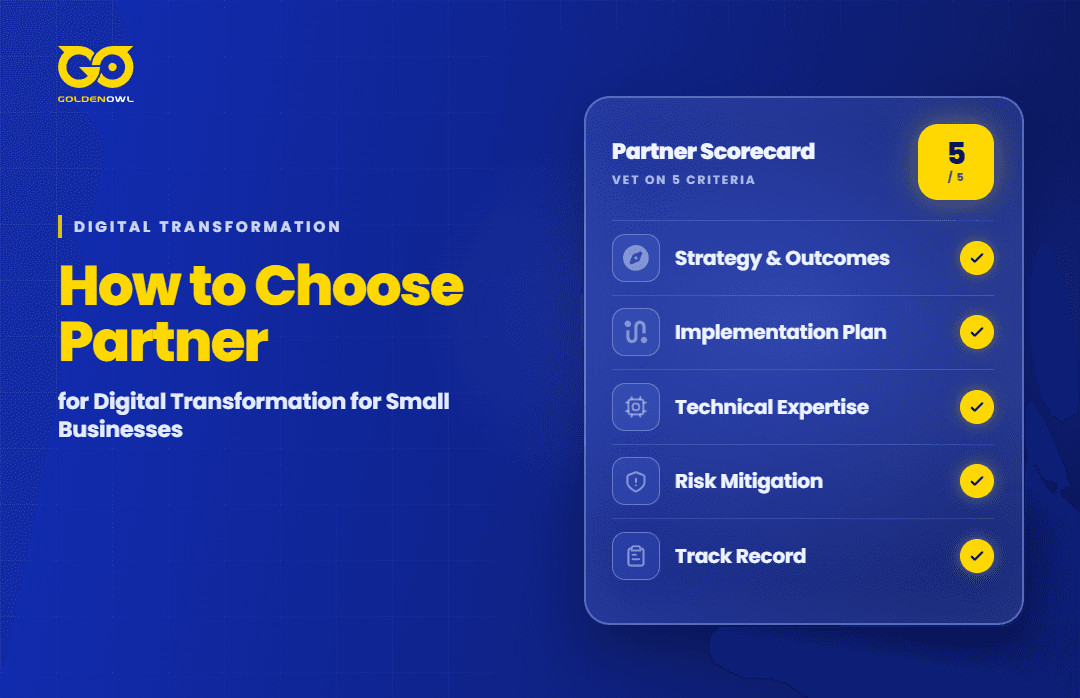
So here's a five-part way to size up those partners. And it kicks off with what their summary should push you to do before anything else.
Evaluating a Partner's Strategy for Digital Transformation for Small Businesses
Pay attention to the first ten minutes of any conversation with a candidate, because that's where the mask slips. If someone spends that time asking how your business actually works, day to day, you're probably talking to a strategist. If they can't wait to fire up a product demo, you're talking to a vendor. The partner you want will pick apart your process before they name a single tool.
What a Realistic Outcome Looks Like
Forget the big dramatic launch. Real transformation tends to show up as small, boring fixes to the stuff people do every day. A distributor I advised is a good example.
In barely a quarter, they pulled their purchase approvals out of tangled email chains and dropped them into one shared queue. A wait that used to run three days now wrapped up the same afternoon.
That's the shape of it almost everywhere. Data keyed in once instead of twice. Work that keeps rolling even when the one person who knows the process is home sick.
Teams that can check progress without bugging anyone. One less duct-taped spreadsheet holding the operation together.
The Business Outcomes They Should Promise
A real partner promises to rethink how the business makes money, not just run today's steps a little quicker. Zemmel puts it plainly: focus on where the money is and how you're going to reimagine the business to really create value. So ask a candidate flat out: where's the money, and how would you redesign this business to actually create value? The sharp ones will tell you straight away that transformation isn't about grabbing a stack of existing processes and doing them a bit better.
Here's where most owners get stuck. They treat transformation as one purchase and call it done, but effective digital business transformation services focus on how your team works. The software is just the instrument they play it on.
How They Plan for Cultural Change
Notice how the best partners in digital transformation for small businesses treat the technology as the least interesting piece. If people would just change their habits on their own, any decent tool would do the job. I watched one rollout where the software sat untouched for two months, until a manager finally walked each shift through the new steps by hand. Then it stuck.
Think about a seasoned kitchen crew getting shown a smarter way to prep. The fancy new knife was never the point. The point is the whole crew picking up the better method and sticking to it, every single service, no shortcuts when it gets busy.
Quantifying the Impact with Hard Data
How do you spot a strategist? They measure success by what it does to your business, not by whether they hit a delivery date. And the numbers back this up.
Business Research Insights found that moving workloads to the cloud trims infrastructure costs by 29%, that switching to SaaS platforms bumps operational efficiency up by 31%, and that for 68% of SMBs, automating IT functions has produced documented productivity gains. Those are business results, not software features.
So when you interview them, put a few pointed questions on the table. Which specific slowdown in your operation do they think digital tools could fix best, and why that one? Then push harder. Ask for a time they told a customer not to buy a particular technology, and what made them say it.
Anyone willing to talk a client out of a sale is thinking about your business, not their commission. But the answer that carries the most weight is this one: how will they judge the project by its effect on your business instead of a checklist of dates, and how do they plan to handle the training and the staff who dig in their heels? Listen closely to that.
What a Comprehensive Strategy Must Cover
Since the real test is what happens to your business, no single piece of software can carry a strategy on its own. A solid plan has to work across five areas at the same time: the customer journey, organizational culture, data and analytics, potential shifts in the business model, and the nature of digital operations.

All five have to fit together from the start. If one of them gets tacked on later as an afterthought, the whole thing starts to wobble.
The glue holding it together is integration, which is what turns a pile of separate tools into one working system. Say a customer buys something on your site. That sale should knock the item off your inventory on its own and land in your accounting records without anyone retyping it.
Every manual handoff between departments is a spot where things break, so those are exactly what you want to wipe out. What you're after is one record everyone trusts and works from. Get that single source of truth in place and the little data silos, the ones quietly sabotaging your decisions, simply stop existing.
Can the strategy actually change how you make money? Three questions get you there fast. Does your revenue show up in lumps and dry spells?
Does your product lean on constant hand-holding? Are you handing out expert advice for free? Wherever you answer yes, that's a spot where technology could turn a one-off into something recurring and paid.
Analyzing the Proposed Implementation Plan
Most projects live or die at the moment strategy becomes an actual plan. So watch what your partner hands you. A serious one shows up with a roadmap that names who owns each step, when it's due, and what it'll take to pull off.
Now, tell them to pick a single starting project that scores high on impact and low on effort. High-impact means it kills a headache you deal with daily, the kind of thing that jams up your shop floor or irritates your customers. Low-effort means a small, motivated crew can ship it without first stitching together five other systems.
Everything else is a trap. Low-impact work gives you no momentum to build on, and high-effort work is far too shaky to lean a first win against.
Vetting Their Technical Expertise
The most telling moment with any partner comes right after the strategy talk ends and someone actually has to build something. That's when the pretty slides about transformation turn into real invoices, real subscriptions, and skills you didn't know you'd suddenly be hiring for. Saying "AI" costs nothing. Shipping it costs plenty.
So the question that matters isn't how futuristic their pitch sounds, it's whether the tech they're steering you toward fits the money you have and solves the problem sitting on your desk right now. Flashy technology always hides a second price tag the demo skips over: the meter that keeps ticking long after launch day.
Think ongoing fees, integration headaches, and staff who now need training just to keep up. A dull tool your team actually opens every morning beats a brilliant one gathering dust every single time.
Core Platforms like Cloud and SaaS
SaaS means you skip the big upfront hit of buying software licenses and server hardware, and the trade you're making is a stream of payments that basically never stops.
You can spot genuine cloud and SaaS know-how in one simple test: does the partner help you figure out what a system really costs over three to five years, not just the tidy monthly number on the quote?

An effective partner will sit down and calculate the total cost of ownership across multiple years for you, rather than fixating on the monthly fee alone. Research shows 57% of small business owners already feel they need to shore up their IT, which is exactly why the subscription trap deserves a good hard stare before you sign anything.
Here's another signal to watch for. A good partner can rattle off specific, battle-tested tools for the ordinary jobs your business already handles every day. Plenty of vendors would love to talk you into a custom build, and sure, that's the right move if your workflow is genuinely one of a kind.
But most small businesses run on the same short list of functions, and mature software already nails every one of them. For a CRM, that's naming HubSpot, Zoho CRM, or Salesforce Essentials.
For project and task management, Asana, Trello, or Monday.com. For accounting, QuickBooks Online, Xero, or FreshBooks. For talking to your team and your customers, Slack, Microsoft Teams, or Dialpad.
And for cloud storage and collaboration, Google Workspace or Microsoft 365. Every last one is proven, priced for a small team, and already humming along inside thousands of businesses.
Practical Automation and AI Capabilities
Real AI, used well, is narrow and easy to explain in plain words. Take Dialpad. Its AI can predict how satisfied a customer was on a call without ever making that customer sit through a survey.
Their Real-Time Assist cards do something just as concrete. They listen for specific keywords during a call, and the second a pre-set word or phrase shows up, a card with the right info pops onto the agent's screen.
For most small businesses, though, the real wins come from plain rules-based automation that any owner can wrap their head around in five minutes. So when a partner leaps straight to some elaborate AI setup, treat that as a red flag. Saving true AI for the problems that simple automation genuinely can't crack is what keeps your budget honest.
A basic routine that flags overdue invoices costs a sliver of what a custom model runs, and it starts earning its keep on day one.
Their Stance on Emerging Technologies
Emerging tech is where a lot of partners quietly lose the plot. It's easy to get dazzled by the latest sme digital transformation news or when someone sketches out a shiny future built on the technologies supposedly driving digital change. That list usually reads Cloud computing, Internet of Things, Advanced data analytics, 5G networks, Extended Reality (XR), and Blockchain. For a small business today, only a couple of those actually pay off any time soon.
So when a partner starts waving around Blockchain or Extended Reality, ask them straight: how does this fix a problem I've got this quarter? That one question does a beautiful job of splitting the proven from the purely speculative.
Cloud computing and Advanced data analytics tend to earn their keep right now, while the Internet of Things and 5G networks only start to matter once your operation genuinely leans on them. Nobody hands you a prize for buying next year's technology to solve a problem you already sorted out last year.
Reviewing Their Risk Mitigation Plan
Here's the question that quietly sorts the real partners from the vendors: when a project hits trouble, and every project does, who's on the hook? Ask it plainly and pay attention to the answer. A partner who shares the load will walk you through their plan. A vendor will nod, mumble something reassuring, and leave you holding every risk yourself.

If they can't show you a written risk plan, that silence is the plan. It means you absorb the failures alone. A solid one covers five things, and each deserves a hard look.
Avoiding the 'Technology-First' Trap
Consider the classic mistake: bolting shiny new software onto a process that was already broken. You pay for the tool, flip it on, and then wait for the magic that never shows up, because the software was never what was wrong in the first place. Owners fall for it constantly, treating the go-live day as the finish line when it's barely the starting gun.
Too many of them wrongly assume the transformation is finished the moment the technology gets implemented. Roughly 70% of these projects never hit the goals they were meant to hit. So put the question to your partner directly: what's in your plan that keeps me out of that 70%?
Addressing Budget and Financial Constraints
Money is the wall most projects crash into first. When the Enterprise Development Department ran the numbers, 60.1% of companies pointed to not having enough cash for investment and applying new technology as a serious roadblock. That's why you should never pay top dollar for bells and whistles your team is never going to touch.
There is no sense in paying a premium for capabilities that your team will never use. A partner worth their fee builds the budget around what you'll actually use day to day, not around some glossy feature list designed to inflate the invoice.
Before you put your name on anything, hit them with four blunt questions. It's a short, unglamorous list, but it does the job. How will they help you spend on the most important outcome first? How do they track what's actually being spent against the budget?
And how will they prove, with real numbers, that the money paid off over time? Push for specifics backed by data. Vague comfort is not an answer.
Now the money question gets practical. When funds are tight, don't spread them thin across a dozen problems. Dump everything into the single worst bottleneck in your operation and fix that one first. Nail it, and you get a quick, visible win, and that momentum makes the next round of spending an easy sell to yourself and everyone else.
Handling In-House Skill Gaps
What sinks a project just as fast as an empty wallet? A thin bench of skills. I've watched it happen: a project of ours ran way over budget and fell apart, all because the partner never once accounted for how green our team was on the tech side.
The cheapest way around this is a fractional team. Think developers, designers, strategists, and analysts you bring in part-time or per project. You rent the expertise exactly when the work needs it, instead of carrying full salaries and overhead for people who sit idle half the year.
A good partner won't tell you to run out and hire. They'll train up the people you've already got first, then help you draw in and hold onto new talent. Once that base is solid, the priority becomes the recruitment, attraction, and retention of new talent.
Anyone who assumes you can simply staff your way out of the problem is ignoring reality, since a VCCI survey found 77% of companies flat out lack the specialized people to run digital technology, and 65% have no line to experts or firms they can actually trust.
Minimizing Business Disruption
Nobody ever writes the real cost into the plan: the chaos it causes for the folks still trying to keep the lights on and the orders shipping. That damage shrinks a lot when the work gets rolled out in stages instead of dropped on everyone in one big bang.
What that looks like in practice: touch the systems nobody depends on early, and save the ones your staff and customers actually live on for the very last phase. Do it that way, and if something goes sideways, the stumble lands on a spare part instead of your lifeline.
Their Approach to Security and Compliance
Say nothing about security and your risk plan is only half written. When you're weighing two partners against each other, this is where it gets clear fast, because one gives you specific answers you can actually verify and the other gives you the ones that just sound nice.
The real test is a checklist you read out loud and make them answer on the spot. Start with data handling: where is our corporate and client data going to be kept, and which individuals will be granted access? Where will our company and client data actually live, and who can get to it? How are permissions set up so each employee sees only what their job needs and nothing more?
Do they know the rules that govern our field, like GDPR or HIPAA, and can they show how the system meets them? What's the backup and recovery plan when a system crashes or gets attacked? And once we're live, how do they patch holes and keep watching for new threats? If any answer starts with "we'll figure that out later," you have your answer already.
Verifying Their Track Record and Past Work
That read-aloud checklist shows you what a partner is willing to promise. Their past work shows you what they've actually built and shipped. A wall of client logos means nothing by itself.

Those logos only earn their spot when each one comes with a real business problem and a number that proves the fix worked. When a case study spends all its energy bragging about the software that got installed but never bothers to name the problem it solved, that's the partner telling on itself. It thinks it sold you a piece of software, when what you were actually buying was a result.
What to Look for in a Case Study
A good case study works more like a measurement than a story. The first thing worth hunting for is a clear "Before" picture backed by a baseline number, something like manual order processing that swallowed 20 hours each week. Then the "After" has to be every bit as specific.
In that same example, automation would drop the task to 2 hours per week, a 90% reduction you can point at and defend. It should also give a straight account of the particular obstacles the team ran into during the project.
A strong write-up also owns the mess along the way. The dirty data, the employees who dug in their heels, the process nobody had ever bothered to document. If a study glides straight from "here's the problem" to "here's the trophy" with none of the friction in between, you're reading a brochure, not a case study.
Success Story: LeadSigma's Sales Efficiency
What does buying an outcome actually look like? LeadSigma brought in Dialpad and then did the part most companies never get around to. They took the platform's AI call transcripts and pumped them straight back into sales training, so every recorded call became coaching material for the next rep.
The payoff was a demos-to-calls ratio that doubled. That's the move you want to spot in a portfolio, a feature quietly bent to serve a workflow, not just a subscription somebody switched on. These days LeadSigma is running 10,000 custom reports a month.
Success Story: Strawberry Hill Bakery's Cloud Migration
Watch a company grow fast and its communications setup is usually the first casualty. The Strawberry Hill Baking Company, run by Marc O'Leary and turning out baked goods since 1903, found that out the hard way, juggling three separate phone systems that were basically working against each other. Now, three systems could've limped along just fine if the shop had stayed tiny with steady call volume.
But as the staff kept growing, that duct-taped setup started dropping the very calls it existed to route. Dialpad wiped out all three and dropped a single cloud platform in their place.
So when the crew went from four people to 50, the phones grew right alongside them without a hitch. The one thing that never turned into a ceiling on the bakery's growth was its communications.
Success Story: PadSplit's Rapid Scaling
A company that's growing fast has to bet on a partner that can keep pace, or it'll blow past its tools inside a year and be stuck shopping all over again. PadSplit sidestepped that trap. In just three years, they left their early tools completely in the dust.
Erin Willbanks, their head of customer experience, needed call recording and tracking that wouldn't crack under real volume, so the team landed on Dialpad. Picking a platform built to stretch is exactly what carried PadSplit from five employees to 80.
Examples from Other Industries
This same pattern isn't stuck inside communications software. You'll see it anywhere someone aims real data at a real decision. Take the boutique clothing seller over in Portland that started digging into its Shopify analytics.
What it found was that 62% of its online orders were coming from mobile shoppers on weekend nights. Once the shop pointed its marketing squarely at that window, sales jumped 40% over the next three months.
Red Flags in a Partner's Portfolio
In a weak portfolio, the warning signs tend to travel in packs. A partner that keeps bolting on fresh systems that never actually touch the core problem, that automates a workflow nobody has cleaned up first, that tries to digitize every corner of the business all at once, and that quietly lets the vendor steer the whole direction. Line those up together and you're staring at a pattern.

The only honest way to test that pattern is to pick up the phone and call their past clients. Don't waste the call asking whether they were happy though. There are five questions worth reading almost word for word off a page. Ask for a quick rundown of the project and the actual business results the client walked away with.
Ask how the partner communicated and steered the work when something unexpected blew up. Ask what the single hardest snag was and how the partner handled it when it hit. Ask what advice the client would hand you before you sign anything. And ask, plainly, whether they'd hire that partner all over again.
Frequently Asked Questions
What does digital transformation for small businesses means?
Digital transformation for small businesses just means using digital tools and cleaner workflows to make the place easier to run. You're not trying to become a software company. You're trying to have a smoother, less chaotic Tuesday.
The real work gets done by the applications and the workflows themselves. They clean up your operations, make your customer relationships less of a headache, and free up the space you need to actually grow.
What is a real-world example of digital transformation for small businesses?
Consider a small, traditional retail store that launches an e-commerce site, then watches what moves online and uses that to decide how the physical shelves get stocked. Suddenly the two sides of the business are talking to each other.
Online, you might drop in personalized product suggestions and a "click and collect" option so people can order and pick up in person. Then the in-store shelf layout follows the same sales numbers.
That back-and-forth between the digital and the physical is what pulls customers in closer and cracks open a new revenue stream you didn't have before. This strategy combines online and offline elements to boost customer interaction and open up new sources of revenue.
What are the guiding principles for a successful transformation?
What do people tend to underestimate here? A transformation lives or dies on your company culture as much as on the tech or the processes you modernize. The whole thing grinds to a halt the second your team decides the new tools are somebody else's problem.
Keep three principles nailed to the wall. Use technology to make complicated procedures simpler. Hand your non-technical staff the power to actually use that technology for their own benefit and the company's. And turn your data into something practical, something you can reach for when it's time to make a call.
What are the key technologies driving transformation today?
The list of technologies powering digital change today is genuinely long, and honestly most of it won't touch your business this year. It stretches from Cloud computing and the Internet of Things through Advanced data analytics, 5G networks, Extended Reality (XR), and Blockchain.
For a small business, the whole game is picking the one proven tool that fixes a problem you're staring at right now. When a vendor rattles off that entire list in one breath, they're handing you the menu, not the meal. Chase every buzzword and you'll burn through a budget you can't afford to lose.
What are the first steps to take on a tight budget?
Money is scarce, and that's exactly why the first move should be a small one. Find the one corner of the business that's obviously wasting your time, and go fix that first. You don't need a sweeping master plan to get in the door.
Pick a single project you can control, give it a clear goal, and make sure the result is something you can actually measure. Kick things off with small, controllable projects that carry distinct objectives and quantifiable results.
Going small does double duty, though. It lets you see what a change really does without draining what little you've got, and once you see it paying off, you widen the scope one careful step at a time. Once favorable outcomes start showing up, you can progressively increase the scope of your initiatives.
None of this demands a huge check up front. It starts with cutting out the manual, slow tasks that quietly eat your whole week. And let's be real about the pressure here.
Small firms often can't reach the newest tools at all, because tight budgets and thin resources make the advanced stuff that big corporations buy without a second thought tough to justify. Constrained budgets and limited resources make it challenging to invest in the advanced solutions.
Run through these nine sections and you've got a working framework for a decision most owners make on gut feel and end up regretting later. You can spot the partner who leads with software instead of your operations, read an implementation plan and gauge whether the pace is honest, push on a track record until you find the real business problem it solved, and kick off your own effort on one painful task instead of some grand rollout.
The thread tying it all together never changes. The technology is the easy part of digital transformation for small businesses, and the guide who keeps dragging your attention back to your process is the one worth paying.
Share this page


Table of Content

Subscribe to Golden Owl blog
Stay up to date! Get all the latest posts delivered straight to your inbox