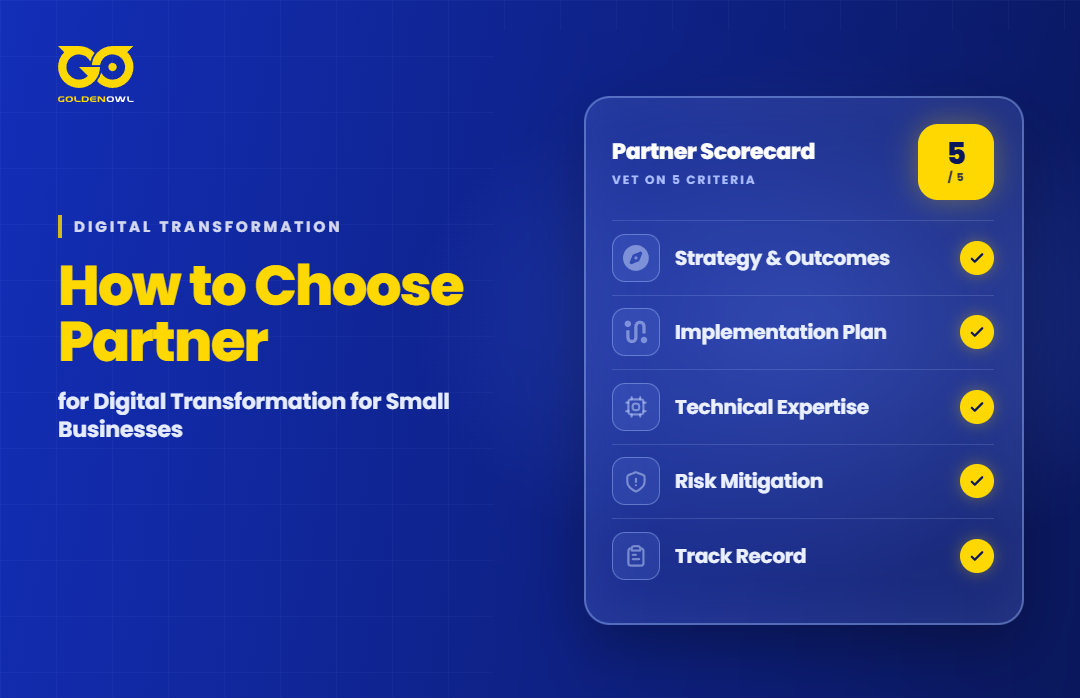
Software is the easy part. Learn how to choose the right partner for digital transformation for small businesses that focuses on real outcomes.


Retail Digital Transformation Examples That Drive Real ROI
Jul 17, 2026
about 28 min read
Stop wasting money on flashy tech. Explore real-world retail digital transformation examples that solve operational bottlenecks and drive massive ROI.
Genuine retail digital transformation only works when you reach for specific tools to clear out exact operational roadblocks and obvious buyer friction. Upgrading your tech stack isn't an optional e-commerce add-on anymore. If you ignore it, you'll lose your zero-patience shoppers to agile competitors who adapt faster. This is the difference between guarding your core margins when the market shrinks and quietly bleeding cash on flashy features nobody actually wants.
One of the best ways to kickstart this shift is to list your worst fulfillment delays before you even take a single vendor call. A pretty website redesign won't accomplish anything if your backend systems still force your daily floor staff to count inventory by hand. Structural overhauls strip away that surface-level novelty. They replace disjointed systems with a modular architecture that directly speeds up inventory turnover.
As you read the retail digital transformation examples ahead, pay close attention to how specific tech choices map directly to the exact problems they permanently fix (think abandoned carts, slow shipping times, broken checkout loops etc). Stack-rank your own internal setup against these exact models.

Why Retail Is Transforming (And What It Means)
The reality on the ground is brutal right now. Survival means wiring agile software straight into the daily heartbeat of your retail floors. Constantly rebuilding your basic structures is necessary to keep up with how fast today's buyers change their minds.
The second a laggy warehouse scanner creates a mismatch with your digital storefront, you lose ground. Relying on hand-counted inventory audits just creates massive pockets of phantom stock that quietly drain your cash, all while the executive team sits around waiting for stale quarterly reports.
This specific operational choke point sends those zero-patience shoppers running straight to faster competitors who promise immediate shipping.
Key Drivers Forcing Retailers to Evolve
Aggressively pushing modern systems into production is required to survive against competitors who fine-tune every single transaction. The absolute baseline standard now requires stripping every ounce of manual friction from the warehouse floor long before the customer ever clicks buy.
Grab your physical logistics logs from the last few months and trace the exact moments where internal inventory counts fall behind the real-world movement of boxes. Those specific bottlenecks tell you exactly where a digital fix will actually improve your bottom line.
When you anchor emerging tech to those precise pain points, tools like AI and AR, along with IoT, bring totally new capabilities and highly practical rollouts to the table. Weaving these tools into your daily operations replaces managerial gut feelings with cold, hard data across the entire supply chain.
Core Benefits of a Successful Transformation
Going deep on these structural overhauls unlocks massive operational advantages, provided you treat them as complete tear-downs instead of surface-level patches. Buying a generic vendor upgrade might make sense if a slow website was your only problem (though temporary fixes almost always cost more in the long run).
But in this scenario, genuine transformation means ripping out the operational core and rebuilding it entirely from scratch.
Getting everyone on a unified architecture gives you crystal-clear insights into shopper habits and market trends. This provides a deep analytical understanding of shopper habits and commercial shifts, fostering intelligent choices.
Targeted promotions based entirely on individual buying preferences can finally be pushed, while offering world-class customer support via 24/7 automated problem-solving and multi-channel helpdesk routing. Teams will move wildly faster as automated workflows take over warehousing and shipping duties, dropping manual mistakes and overhead costs out of the equation.
Tighter control over your physical stock naturally eliminates giant surplus piles and embarrassing empty shelves, which fuels buyer satisfaction and drives conversion rates, keeping customers coming back.
The High Stakes and Reality of Implementation
When these projects blow up, it almost always traces back to internal office politics and broken corporate structures rather than technical code defects. Ignoring those operational roadblocks just leads to incredibly expensive software that never delivers a financial return.
Stop buying things today and force your department heads to write down every single workflow silo they manage. The grim truth is that most modernization programs completely miss their targets despite the board throwing massive budgets at them.
Global investments tied to these system upgrades are projected to reach roughly $4 trillion as we approach 2027. Yet a 2024 investigation by Bain estimates the failure rate reaches 88%, which mirrors data published by The Parker Avery Group showing tech modernization initiatives falling short at 70%.
Pulling the trigger on a massive software overhaul requires gauging actual readiness across data silos and hardware limits, plus staff training. Build a strict readiness checklist right now. Secure two distinct funding streams so you budget for employee adoption instead of just buying software licenses.
To figure out your baseline readiness, ask whether your company uses one single centralized hub for buyer profiles, or if crucial customer data sits isolated across different legacy platforms. Auditing if current point-of-sale hardware actually connects easily to external APIs is also required.
Finally, confront the reality of your team managers. If you see hesitation about learning new systems, address it immediately. Dropping advanced tech onto resistant employees permanently fractures your daily operations.
Retail Digital Transformation Examples for a Unified Customer Journey
When your daily operations workflows are broken, that mess bleeds directly into the buyer's physical experience on the floor. Fragmented systems actively alienate returning buyers, forcing them to awkwardly recite their purchase history to an in-store clerk who has absolutely no visibility into their mobile app data.
You have to map out your customer journey and eliminate this exact friction. Treat every touchpoint across your brand as a single, continuous conversation.
Sephora's Seamless Omnichannel Experience
Isolated databases might survive if your buyers only used desktop browsers, but today you must connect the real-world visit to the digital profile.
For example, Sephora uses a CDP to stitch together web browsing history, loyalty accounts, and brick-and-mortar receipts. With this combined data, their mobile app generates recommendations based purely on actual tastes and past transactions.
In physical outlets, proximity-based signals recognize exactly when app users enter the building and send custom phone alerts.
Beauty brand Sephora essentially builds an entirely fluid connection. They treat the digital screen and the physical aisle as the exact same environment for the shopper.

Nike's Direct-to-Consumer Brand Ecosystem
A decoupled, API-driven architecture ultimately allows massive brands to launch highly localized storefronts without risking their core databases. Before you push another monolithic update, draft a headless CMS roadmap and isolate 100% of your front-end presentation from your back-end logic.
When footwear manufacturer Nike overhauled their system, they implemented a headless CMS alongside a React-based development environment. APIs then effortlessly routed the new regional data straight to local storefronts.
Relying on these external APIs within a modular setup completely uncouples the visual presentation from the server logic. This structural change accelerates region-specific rollouts and permits rapid design shifts ... (think seasonal layouts, local product drops, flash sales etc) ... without risking core databases.

Solving In-Store Inefficiency and Inventory Blind Spots
Manual stock audits create a costly illusion called phantom inventory. Store workers count items by hand, and operations managers trust those outdated numbers instead of investing in continuous visibility. This revenue drain happens silently behind the scenes.
I saw this firsthand during a 2019 store visit where I watched floor associates double-counting items on paper clipboards. At that exact second, corporate headquarters was looking at a glossy dashboard showing perfect stock levels, totally disconnected from physical reality.
Running a modern business on data that lags days behind the actual floor leads straight into a death spiral. Real-time operational tracking is an absolute baseline requirement to fix this gap. Your physical reality must dictate your digital records.
Walmart's AI-Powered Inventory and Fulfillment
Automated systems completely remove the human travel time from physical order fulfillment. Walmart shows us exactly how to transform a traditional warehouse into a high-speed engine. They map out the floor and rely on AMRs for real-time inventory right on the store shelves.
To handle the heavy lifting for online order gathering, they brought in Alphabots that hold 20,000 different items for faster delivery. This huge capacity wipes out manual picking errors during peak shifts.
Instead of having a worker walk down an aisle and guess which item to swap when something is out of stock, they changed the whole process. Walmart taps into deep learning AI to instantly weigh nearly 100 factors when making product substitutions.
The old way relied strictly on manual decisions made by the picker. Now, the software automatically looks at details like brand, price, size, and type.
Because the technology processes all those details instantly, it helps store associates make better choices. The Alphabot works perfectly to guarantee faster packing and delivery for complex online grocery orders.

Zara's Real-Time Inventory with RFID
Running a large-scale ship-from-store model requires automated scanning across your entire physical footprint. So why do customers actually trust this setup? Because the digital fulfillment record routes to headquarters the exact moment a shopper buys through the app for an in-store pickup.
Inditex launched the direct store fulfillment strategy for Zara by entirely substituting human inventory reviews with digital tools. To pull it off, they rolled out RAIN RFID across 2,000+ locations. Wiping out the illusion of phantom inventory requires serious hardware.
Introducing these tags into the workflow enables the radio frequency setups to boost information precision to 95% and above.
That is a massive jump from the baseline of about 65% to 70% accuracy we normally see in traditional manual inventory audits. Relying on those outdated paper checks leaves retail companies highly vulnerable to unexpected stockouts and the persistent problem of phantom inventory.
Your own teams can follow the playbook of Staples Canada. They used smart data capture to automate the price checking process, completely replacing manual audits. This move saved them thousands of hours across 20,000 weekly audits.
Instead of being stuck on tedious counting tasks, this shift directly reassigned employees who were itching to get back into high-value customer service roles right on the sales floor. Getting them out of the aisles and in front of shoppers immediately begins reducing returns and boosts online conversion.

Boosting Online Conversion and Reducing Returns
Shoppers freeze at the checkout screen for one simple reason: they just don't know if the thing will actually fit. That hesitation actively destroys your operating margins. When people buy high-ticket goods online ... (think premium furniture, specialized appliances, or heavy dining tables) ..., flat pictures on a glass screen don't tell them enough about scale or texture.
They're effectively flying blind. And when they guess wrong? You eat the cost of reverse logistics, and those huge return rates drain your profit pool. The only way to stop this is to bring the physical showroom directly into their residential living room. Visual technology bridges this exact gap by giving buyers absolute certainty before they pull the trigger on a purchase.
Giving customers a digital reality check right away beats hoping a gallery of highly polished studio photos will magically win a hesitant buyer over.
IKEA's AR App for Confident Purchases
Moving bulky, expensive items over the web requires giving your buyers rock-solid confidence, and AR technology is how you get there. Measurements on a webpage are fine in theory, but in practice, most consumers have terrible spatial awareness.
You literally have to show them the exact physical fit. The global furniture giant IKEA tackled this specific bottleneck by tapping into the IKEA Place app to display 3D models via AR. The software perfectly scales a couch or bookshelf right inside customers' living rooms. By using the mobile camera, it dynamically adjusts ambient light and surface texture to give them an incredibly accurate visual preview.
Giving people that interactive digital preview immediately drives up checkout conversions for larger items. The effectiveness of this approach at scale is proven by a forecasted 2026 industry report from Business Research Insights, which shows that deploying AR solutions decreases standard product returns for retailers by 27%.

Amazon's AI-Powered Recommendation Engine
Ok so what does friction look like? It looks like forcing your buyers to endlessly hunt for what they want. You can remove that exhausting process by putting predictive intelligence in place. Instead of sitting back and waiting for explicit search inputs, an active digital storefront anticipates what the customer needs next.
Sit down, map out your top 50 past purchase patterns, figure out where the navigation breaks down, count exactly how many clicks a standard checkout takes, and task your engineers to eliminate at least half of those manual browsing steps.
This is why Amazon dominates: they built their core architecture around predictive AI. As a result of this infrastructure, the enterprise drives more than a third of its revenue through AI customization delivered directly by its highly effective recommendation engine.
Physical retail environments need that exact same ruthless efficiency to shorten individual in-store journeys and strip away front-door wait times. Amazon proved this operational model works at the Amazon Go store format by rolling out Just Walk Out technology to bypass traditional cashiers entirely.
As soon as physical shoppers walk in and scan their QR codes, advanced network cameras and weighted shelf sensors track every piece of picked-up inventory in real time. Customers literally grab their goods and leave the building without stopping to pay, letting the system automatically calculate their charges and fire off a digital receipt a few minutes later.

Improving Forecast Accuracy and Supply Chain Resilience
All those front-end digital wins mean nothing if you can't actually ship the physical product to your buyer. Supply chain breaks will quickly ruin a great digital experience. In highly volatile markets, guessing future demand based entirely on historical sales is a massive liability.
Looking strictly in the rearview mirror only works if consumer habits never change. In reality, buyers shift their routines fast. You need predictive analytics to spot sudden demand surges early so you don't run dry.
Tesco's Modernized Supply Chain Intelligence
Live data across your logistics network gives operators the power to reroute inventory long before the aisles go bare. To handle the sudden spikes in shopper needs during crises, Tesco revamped its technology to create immediate oversight throughout both manufacturing and retail.
The grocer fed past purchases, live tracking metrics, and physical store sensors straight into forward-looking algorithms to close the operational loop.
By catching those behavioral transitions early, they managed to shift their stock coordinates right on time to avoid leaving shoppers with empty shelves.

Starbucks' 'Deep Brew' AI for Store Operations
Now that you have the necessary context to lock down backend logistics, you can bring this same predictive logic straight to physical operations. AI engines can monitor local demographics and traffic flows to adapt offerings in real time.
The coffee brand picked up huge gains by launching an intelligence framework named Deep Brew. Before opening in a new market, planners map out a geographic plan and feed four or five local variables into a predictive engine to update store displays automatically.
Company representatives explain that the organization depends on Deep Brew to evaluate factors such as earnings and vehicle flow, which helps determine the best store placements and instantly update digital drive-thru menus.
Every day, the algorithm processes live inputs (think neighborhood density, median household income, and nearby rival density) so those physical drive-thru lanes always push the right localized recommendations.

More Retail Digital Transformation Examples by Sector
Looking across the landscape, you'll realize pretty quickly how structural advantages translate across totally different retail categories. A stalled checkout line hurts a high-end boutique just as badly as it hurts a neighborhood grocery store.
In both cases, the business bleeds cash when its underlying platforms fail to connect the buyer directly to the inventory. Custom builds solve these isolated operational bottlenecks by placing technology much closer to the metal of the actual user journey.
A strategy doesn't matter unless you act on it. Before you spend a single dime, map out your buyer's exact path and pour 100 percent of your deployment budget directly into those specific, known points of friction.
Fashion and Apparel
If you're looking to turn passive window shopping into an active social journey, high-end clothing labels offer a great playbook full of gamified tools. Before rolling out a new seasonal collection, write down your digital engagement strategy and aim to incentivize 100 percent of your foot traffic with some kind of digital reward.
Gamifying the buying cycle using platforms like WeChat provides a massive hook for driving physical store visits. Burberry followed this exact model to craft a fresh premium buyer journey using a specialized WeChat application.
Customers book styling sessions and browse online to collect digital tokens that incubate a virtual pet. Once the creature hatches, those shoppers unlock exclusive physical store incentives.
Setting up interactive fitting rooms equipped with RFID scanners automatically creates natural cross-sell moments that measurably drive up sales. You simply install RFID hardware throughout the physical locations to speed up transactions, and program smart mirrors inside the fitting alcoves to display matching wardrobe suggestions whenever a shopper brings an item nearby.
Over a specific testing window, the premium apparel label Rebecca Minkoff tracked these automated wardrobe nudges. By the end of the trial, the brand ended up logging a 30% jump in its overall revenue thanks to the smarter tech.

Grocery and General Merchandise
We know for a fact that baking voice search capabilities directly into a grocery platform captures a huge chunk of extra top-line sales. Standard cart upgrades do the job if your buyers only shop on desktop computers (though a lot of legacy systems still struggle there).
For mobile users, you absolutely need an audio integration to catch people on the go. The supermarket enterprise Carrefour partnered up with the tech giant and search partner Google to build an audio-based search function. That simple voice integration alone drove a 20% bump in revenue.
Handling extreme traffic spikes requires a completely different flavor of backend flexibility. Target shifted its database processes over to Google Cloud to prevent holiday crashes. By setting up containerized systems and microservices, the retailer ensured its computing environment expands processing capability on demand during Black Friday rushes.
Once the peak shopping waves pass, operations managers actively lower the retail infrastructure bills by shrinking those idle computing hosts back down.

Food Service and Specialty Retail
Pushing hard into mobile and voice-activated hardware turns standard tech platforms into your primary sales engines. To do this right, your engineering team has to build custom software, like the famous Anywhere App, and route 100 percent of remote orders through it.
The pizza giant Domino's Pizza understood this early. The chain has captured more than 60% of its order volume through phones and digital dashboards dating back to 2016. They pulled this off by linking those exact order tools straight into smart device hubs like Google Home and Amazon Echo.
Sometimes the fastest path to modernization is buying your way in. Through strategic acquisitions in Silicon Valley, McDonald's purchased Dynamic Yield in 2017 to push live personalization of food selections directly into its drive-thru lanes.
Why does a burger chain need tech startups? Faster order entry equals higher volume. The company followed up by buying Apprente in 2019 to bolt advanced voice recognition systems onto those same drive-thrus. Executing a transformation through these targeted tech acquisitions allows a massive brand to scale its physical restaurant capabilities without needing to build completely new real estate footprints.

Innovative In-Store Concepts
The sharpest retail players are now launching brick-and-mortar spaces run almost entirely by software frameworks and robotics. A flawless example of an integrated buyer environment arrived when the brand Alibaba rolled out its Hema physical stores.
Backed by modern backend systems, the floor plan lets shoppers instantly check food origins and ingredient lists just by scanning barcodes printed on the items. Over in the dining sections, this same digital framework handles all seating logistics.
Automated machines even transport plates directly to tables by deploying a fleet of mobile tray robots to deliver cooked meals to guests.
Automation is also replacing traditional floor fixtures. Inside the & Other Stories boutiques located in Paris, large computerized retail machines have appeared so buyers can locate items and pick their selections directly from an automated display unit instead of digging through messy clothing racks.
Meanwhile, shoppers visiting the compact self-contained market Bingobox gain entry simply by scanning a mobile code at the door. They pay at an RFID self-checkout counter that automatically locks the exits if unpurchased inventory is detected.
Physical upgrades like this completely redefine the floor plan. You can clearly see this shift in action by looking at prominent companies such as SHEIN, Under Armour, Home Depot, Kroger in 2018, Target utilizing Google Cloud for Black Friday, Nespresso, Alibaba with Hema stores, Bingobox, & Other Stories in Paris, Porsche with Porsche Consulting Innovation Labs integrating IoT, and LEGO recovering since 2003.
Lessons from Other Industries
Legacy manufacturing turnarounds offer a clear blueprint showing how IoT and total digital overhauls can save a brand from financial distress. If you review more digital transformation company examples like the toy manufacturer LEGO, you literally have to map the exact digital workflows that yanked the brand back from the brink of failure.
However, before you blindly copy brand groups like Home Depot or the Porsche Consulting Innovation Labs, mandate your engineering team to fully audit your existing factory data. There is a straight line between retail survival today and the complete operational overhaul that rescued the brand Porsche and LEGO in 2003.
Building Your Transformation Roadmap

A step-by-step rollout plan is what actually protects your daily operations. Buying flashy software without anchoring it to measurable business metrics and pushing the frontline team through extensive training guarantees a massive, highly visible operational failure.
Mapping out how work gets done right now and spotting the exact friction points before signing a single vendor contract is essential. This disciplined setup ensures that every tech upgrade directly expands margins and accelerates growth.
Audit Current Technology and Processes
Jumping straight into vendor pitches might make sense if the backend was perfectly pristine. But legacy environments require digging into current architecture to figure out exactly what is dragging down the daily workflow.
Putting everything on paper first is crucial. Document the specific operational failures (think poor logistics tracking, ancient cash registers, outdated checkout registers, isolated databases, and slow customer service handoffs) before buying new systems.
Connect Initiatives to Measurable Business Goals
Another trap involves picking a tool before defining the specific problem requiring a fix. A frequent error involves choosing a tool first (such as deploying a chatbot). Write down exactly 1 or 2 bottlenecks and build the project around those targets instead of the desired software. Nailing down the actual operational gap matters wildly more than picking a deployment mechanism before signing a contract.
Set a firm commercial goal first. Say the goal is to handle off-hours buyer questions without adding overnight staff. Once establishing that baseline requirement, it becomes possible to gauge whether deploying a chatbot or a different fix actually bridges the gap.
Develop a Phased Roadmap
Ripping out an entire network overnight is a fast track to technical instability. If a company ran a single website with zero physical footprint, an overnight global switch would be completely safe. But omnichannel reality means organizations must refrain from deploying unproven platforms across the entire network until they A/B test their tools on 1, 2 pilot segments.
This localized step reveals what worked and what didn't, handing local teams validated playbooks that guide them safely through a manageable rollout. Roll out in manageable waves by store cluster, product line, or geography. Capture what worked, what didn’t, and why because those insights are important.
Building momentum early is key. Companies must plan for early successes in Phase 1 of their modernization roadmap. Focus on easy targets like digital receipts or basic SMS notifications while entirely ignoring high-effort, low-value projects.
This discipline saves massive core overhauls for later stages once central databases hit total stability.
Invest in Training and Expert Partners
Even great tools fail on the floor if workers lack active training and a voice in the design. So why do staff abandon expensive new interfaces? Because they reject systems they don't understand. Managers must spend at least 10, 15 hours training the team and write down their primary complaints.
Taking onboarding seriously pays off, since 42% of businesses note increased revenue following the implementation of digital educational hubs.
Adoption will still flatline if staff suspect the software is watching them instead of helping them. Pair a mobile stock tool launch with a direct suggestion box so floor clerks can request interface updates. This setup turns them into active co-creators, clearing out the organizational hurdles waiting just ahead.
Anticipating and Clearing Implementation Hurdles

The biggest trap in any retail digital rollout is rarely the code itself. Most deployments stall out long before a single piece of software hits the store floor because shiny new apps crash into API-hostile legacy environments and deep operational friction.
You can't just build a new tool in a vacuum and expect floor associates to automatically adopt daily workflows they didn't help design. This wild misalignment silently bleeds modernization budgets dry and pushes timelines back indefinitely.
Technical Debt and Legacy Systems
Trying and connect modern tools to outdated core platforms is an exhausting, expensive mess. Writing custom, hard-coded connectors made sense back when companies lived completely on isolated internal servers, but doing that today guarantees trouble.
Corporate merchants suffer from the Integration Tax, which eats up 45- to 65-percent of modernization budgets, and Decision Latency that stalls action by 24 to 48 hours, along with the Drain of the Talent. Highly skilled developers refuse to spend their careers patching up dinosaur databases.
Soon enough, teams figure out that ripping the old system out from the root feels a lot like blowing up the foundation of an active warehouse while inventory is still moving.
When analyzing the data, calculating the total cost of ownership across 3 years indicates a 40% greater probability of encountering integration problems during a full central system replacement. I once watched a major retailer completely freeze their supply chain for a week because an untested payload from their warehouse software choked out a legacy mainframe during a massive rip-and-replace project.
Instead of gambling with daily transaction flow, wrapping the old system in APIs acts like building a modern storefront around a sturdy older frame. This strategy protects your core transactional systems while breaking massive expenses into manageable operating costs over time.
Budget Constraints and Funding
You instantly lower the financial barrier to adopting advanced retail tech when you convert heavy upfront investments into predictable recurring costs. The smartest play is to review your infrastructure plans every quarter and shift large storage upgrades directly into cloud setups.
In the end, companies have the ability to shift capital expenditures into operational expenses through the adoption of SaaS or managed service agreements.
Before authorizing a global rollout, run a tightly targeted pilot program in a single store or regional cluster to prove genuine ROI. Smart operational leaders usually combine these trials with simple workflow upgrades, like quick scanning fixes, to rack up fast savings.
Those quick wins then immediately self-fund the more complex software projects waiting on your roadmap.
Employee and Organizational Resistance
Workforce pushback basically vanishes when executives bring field teams into the creation, trial runs, along with deployment stages right from the start. Dictating a new interface from the top down might work if store employees functioned like mindless machines.
Realistically, a successful deployment requires you to employ rapid-testing and agile techniques to gauge workflows deeply before rolling anything out across the chain.
You also need to roll out detailed, hands-on training that clearly explains how the update simplifies their daily tasks. Talk to them straight. When you spend a mere two hours on training, does it genuinely rank among your top three priorities? They need tangible proof that the new system exists to eliminate tedious labor, not just to add more buttons for them to click.
Talent Gaps and Skill Shortages
The most obvious hurdle is that traditional merchants rarely have the internal programming depth to launch advanced analytical tools on their own. Try and conduct a formal skills assessment to pinpoint your exact hiring needs, and then direct 80% of your training budget straight into upskilling your existing staff.
Before you dive into building custom applications from scratch, consider partnering with an experienced software firm or choose to hire a provider for digital transformation services to bridge those immediate engineering gaps. If advanced tech like AI, AR, along with IoT still feels too far off, just reach for low-code or no-code software solutions to push powerful analytical capabilities straight to the store floor.
Data Silos and Security Risks
Pulling together scattered customer data requires strict adherence to mandatory privacy frameworks well before any analytics platform goes live. Anytime you handle payment data or rich consumer profiles, you need incredibly strict controls, especially under GDPR, CCPA, along with PCI DSS.
This strict compliance becomes non-negotiable simply because security risks grow exponentially as your digital footprint expands across multiple online channels. A properly architected system ultimately minimizes raw data exposure and keeps your customer base safe.
Identifying and Avoiding 'Quiet Failure'
After months of development, a flawless technical launch is functionally useless if your staff refuses to drop their old, inefficient habits. A project might launch exactly on schedule and look like a massive win on internal slide decks, but it remains a complete commercial loss if it fails to change real-world behavior. Keep in mind that a completed rollout is known as a quiet failure whenever staff behaviors remain unchanged.
Imagine you just spent an entire year building a great new inventory management tool for your store staff. It is an undeniable failure if you check in six months after launch and find most associates are still using their familiar paper-based methods to track stock. You get to claim a true victory only through actual software adoption, stable daily workflows, along with faster decision-making across the entire retail floor.
How to Measure the Real ROI of Transformation

Want to know if your tech upgrades actually matter? Look at your bank account. Flashy screens and pretty front-end apps carry zero financial weight unless they actively defend profit margins or speed up operational choices. They're just vanity projects draining your budget.
Stop writing checks for any tech deployment that lacks hard validation metrics. You've got to abandon the surface-level trends for structural overhauls, because a slick user interface can't save a company from bleeding stock out the back door.
How to Evaluate Transformation Success
You've got to base your financial models purely on realistic growth estimates instead of sunny best-case scenarios.
E-commerce directors love to project massive overnight payoffs the second new software goes live, but you have to anchor your cash savings around a highly conservative 5, 10% improvement target for bringing down your days' inventory outstanding.
Getting a real integration uplift takes a while, usually tracking somewhere between 12 to 24 months.
Measuring Revenue Impact and Margin
Leaning on a fixed pricing playbook guarantees you leave money on the table whenever market conditions shift. You need agile analytical pricing systems to aggressively protect your margins.
Early testing might try to convince you dynamic pricing will kill your volume, but making active adjustments actually lets you scoop up the seasonal surplus. Jot down your highest-margin products, plug them into agile price-adjustment tools, and map every ongoing market fluctuation to your daily parameters.
Over a busy seasonal window, this kind of analytical tracking elevates profit margins by 20, 30 percent. Use this to your advantage.
Measuring Inventory and Supply Chain Efficiency
You lose massive amounts of money when you lack clear stock visibility, which makes intelligent tracking mandatory. When you put together a working capital investment model, figure out your current days' inventory outstanding and crunch the numbers on potential contraction across a handful of outcome ranges.
Multiply that reduced DIO by your internal cost of capital to find your raw cash savings, and combine those capital improvements with the cash saved by dodging last-minute rush shipping fees.
Obscured stock tracking and inaccurate demand calculations lock up valuable cash reserves and weaken service reliability. Upgrading to predictive systems gives you clear, undeniable financial wins. By rolling out precise tracking, you can drive down rush transportation fees by 5 to 15 percent right in the middle of high-traffic events.
Broad industry statistics demonstrate that missing merchandise siphons away upwards of $100 billion every year.
However, just getting back to fundamentals and assessing your present days' inventory outstanding enables intelligent live monitoring tools to cut stock loss by 40, 80 percent when measured against standard security configurations.
Measuring Decision Speed and Labor Costs
At a structural level, linking connected data systems directly shrinks the painful lag between market shifts and executive response. If you want to gauge the financial return of compressed operational timing, isolate major choices currently bogged down by manual workflows (think updating prices, reordering merchandise, launching promotions etc) and figure out the current duration of those cycles.
Forecasting your updated cycle times to hit immediate or daily targets lets you connect the shortened latency directly to recaptured sales or dodged costs like price markdowns. This clearly validates recent corporate advisory polls indicating that organizations utilizing integrated information networks execute strategic choices twice as fast.
As a reminder, decision latency is just the exact time gap separating a fresh market indicator from your company's actual operational response. Delayed actions simply drain corporate capital. You hit true market responsiveness by speeding up these choices, routinely deploying ML-powered scheduling tools to force reductions in staffing outlays of 10, 15 percent.
The Future of Retail Transformation

Once you automate those scheduling decisions, you finally have the mental whitespace to tackle the real problem. The underlying tech stack needs an overhaul. Giant, monolithic legacy suites are killing your ability to adapt. If your engineers have to spend three months unraveling spaghetti code just to add a simple checkout button, you are already losing.
Building on concrete (where any change requires dynamite) must stop, and teams must start building with interchangeable parts that let them shift direction overnight.
Unified Commerce and Composable Architectures
Going modular means you can rip out a bad piece of software without tearing down your whole business. To start, map out your current bottlenecks and rank the top three workflow killers (such as inventory syncing, payment routing, order fulfillment etc) that drain your team.
From there, you want to build an API-first setup that lets you plug and play different tools as buyer habits evolve. Doing this puts you in good company, since data proves headless frameworks are already run by 72% of US-based merchants.
Think of those old all-in-one software suites like buying a die-cast toy car. It looks great on the shelf, but you can't change the engine or the wheels. A composable API architecture, on the other hand, is a bin of LEGOs. Builders snap together exactly what they need today.
When tomorrow brings a wild new market challenge, you just take off a few blocks and swap in new ones instead of buying a whole new platform.
Generative AI and Advanced Analytics
Old-school inventory planning works fine if you run a single shop where the weather never changes and the exact same customers walk in every Tuesday. Real life is messier. Heavy-duty machine learning is required to chew through billions of data points and spit out hyper-local demand forecasts that a human with a spreadsheet could never match.
Modern models look at hundreds of operational variables to figure out exactly how much buyer interest exists for every single SKU at every individual location. That level of precision pays off in a massive way. Neontri research calculates that GenAI tools capture a forecasted $390 billion in financial value across the retail industry.
Hyper-Personalization at Scale
Why do generic blasts fail? They actively damage your brand in the eyes of modern buyers. Before firing off your next campaign, carve your audience up into specific segments and tweak at least three message variables based on their past purchase history.
According to McKinsey reports, 71% of consumers demand intensely personalized experiences, while 76% become frustrated when companies fall short of this standard. By going deep on proper segmentation, you dodge that backlash completely and keep your customers engaged.
Immersive Commerce with AR and VR
Another tactic you should be looking for is mixed-reality previews. Shoppers hesitate because they cannot physically touch what they see on a screen. Immersive environments must be built to bridge that gap, letting a customer see exactly how a jacket drapes on their body or if a new coffee table actually fits their living room layout before they pay.
Putting these interactive features straight onto your product pages strips away buying friction. Indeed, Shopify metrics demonstrate that products showcasing immersive media achieve a 94% greater sales conversion rate than those relying on static images.
Sustainable and Green Technology
All this digital infrastructure comes with a huge energy bill, and consumers constantly track corporate responsibility today. Audit your hardware vendors this quarter. Force them to hand over their power usage logs, and walk away from any contract that lacks clear reduction targets.
While you do that, consolidate your own server loads to kill off wasted power draw. Treating a tech upgrade strictly as a revenue project is a dangerous game. The 2024 Dental Lace report highlights an ~6% annual growth rate in the environmental footprint.
This directly compounds the global GHG emissions from electronic computing systems, which currently sit at 3.5%. Start fixing your supply chain now before the market punishes you for ignoring it.
Frequently Asked Questions
What is a realistic ROI timeline for a retail transformation project?
A realistic timeline completely depends on the initial target. Pointing resources at one localized workflow delivers a return massively faster than trying to revamp the entire core setup in one go. Focus on one isolated sales medium before attempting larger rollouts.
Thinking one giant software launch will instantly fix the corporation is a huge miscalculation. Be smart. Model initial payback estimates around one specific sales channel or a single geographic region before going wide across the whole network.
Highly focused applications drive up purchase rates to show quick wins. For instance, Sephora rolled out an AR element and actually hit positive returns in just 3-6 months. On the flip side, larger foundational changes take longer to digest. Putting a completely fresh stock database in place removes a ton of operational waste and opens up new sales paths, generating escalating financial payback over 12-24 months.
How can we start without a massive upfront budget?
Why continue buying heavy infrastructure? To minimize initial expenses, shift those heavy CapEx requirements into manageable OpEx payments by adopting SaaS tools or external subscription services. Locking in early savings suddenly frees up the cash flow to pay for harder structural upgrades down the line.
It is infinitely safer to chop up the budget. Run a small test in just one branch or a single region to prove the numbers work before committing to a full-scale network release. Batch fast-payback initiatives together so they throw off enough cash to fund the more complicated updates desired next.
How do we overcome employee resistance to new systems?
Staff adoption of new tools happens naturally when managers bring them in early to solve real daily headaches.
Include front-line personnel throughout the design, trial periods, and eventual deployment of new software. Management absolutely must talk openly with the affected staff about what is coming while giving them A+ training.
The pitch that actually works focuses entirely on how the new tech reduces the daily grind, not some lofty corporate revenue goal.
What is the best way to deal with outdated legacy systems?
Picture a decades-old database sitting at the center of modern operations. Teams must build a wall around it. When dealing with large transactional records inside ERP/Order Management networks, building pipelines around those old mainframes avoids a total operational blackout.
An API-first framework envelops aging mainframes, pulling out necessary information and introducing updated features without fracturing central databases.
By standing up immediate message feeds and solid pipelines, teams can pull required data almost instantly and add modern features without breaking the core system. Then, developers just sunset the older parts slowly.
Deactivate older components in an extended transition schedule, substituting the most problematic legacy feature with a modern utility first.
How can we ensure data security during transformation?
A successful security strategy bakes compliance into the very bottom layer of the architecture before anything goes live. That means mapping out access tiers to specific employee roles and strictly limiting what is actually stored keeps GDPR and CCPA regulators happy.
The setup has to mandate encryption for files whether they are moving or sitting still, complete with strict user trackers and rock-solid logs showing exactly who looked at what. By creating totally separate sandbox environments, system tools can figure out buying habits and parse transaction files without handing raw, unmasked identity codes over to secondary analytics programs.
How can we avoid getting locked into a single vendor?
Surviving this market requires total flexibility. Building an independent modular commerce framework connects specialized microservices directly through open APIs. It also employs universal APIs to make sure software components remain simple to swap out years from now.
Giving the keys to the entire operation to one giant vendor would only make sense if the business stood perfectly still forever. That is simply not happening. Remaining independent requires keeping total ownership of primary database structures (think buyer profiles, product catalogs, transaction logs, and warehouse quantities).
Protecting the system means separating where data lives, how it is processed, and how it is executed. Keep core operational rules locked strictly inside directly controlled databases. Map out a precise extraction strategy for critical software selections before signing long-term service agreements.
As these retail digital transformation examples demonstrate, modernizing the tech stack lives or dies on pure discipline. It has zero to do with having the flashiest tools.
Nailing modern retail takes a cold, calculated view of operations where teams apply specific apps to exact friction points, bypass legacy systems instead of blowing them up, and guard vendor neutrality at all costs.
When viewing tech just as a localized wrench to lower costs and speed up decisions, the business stops reacting to the market and starts dictating how its own commercial infrastructure runs. The result is a much lighter operation, completely free of crippling technical debt, and permanently ready to scale.
Share this page


Table of Content

Subscribe to Golden Owl blog
Stay up to date! Get all the latest posts delivered straight to your inbox