Mobile App Development Tips 2026: Best Practices for Scalable and High-Performance Apps
Mobile App Development
Mobile App Development Tips 2026: Best Practices for Scalable and High-Performance Apps
Mar 17, 2026
about 8 min read
Build smarter mobile apps in 2026. Explore proven tips for strategy, tech stack, UX, and scalability to create high-performing, user-focused apps.
In 2025, mobile apps sit at the center of how people work, shop, and make decisions. Over the past year, mobile users spent a combined 4.2 trillion hours on apps, and consumer spend reached $150 billion for the first time. That’s why mobile apps are no longer optional, they’re essential for businesses that want to stay competitive and grow in 2026. Today’s users expect speed, simplicity, and constant improvement, whether the app is for customers or internal teams.
With fast-changing technologies, multiple platforms, and rising performance standards, mobile app development can quickly become complex. In this guide, we share practical tips to help you plan strategically, build efficiently, and launch scalable, high-performing mobile apps.
1. Mobile app development tips for strategic planning
1.1. Develop a strategy before you start development
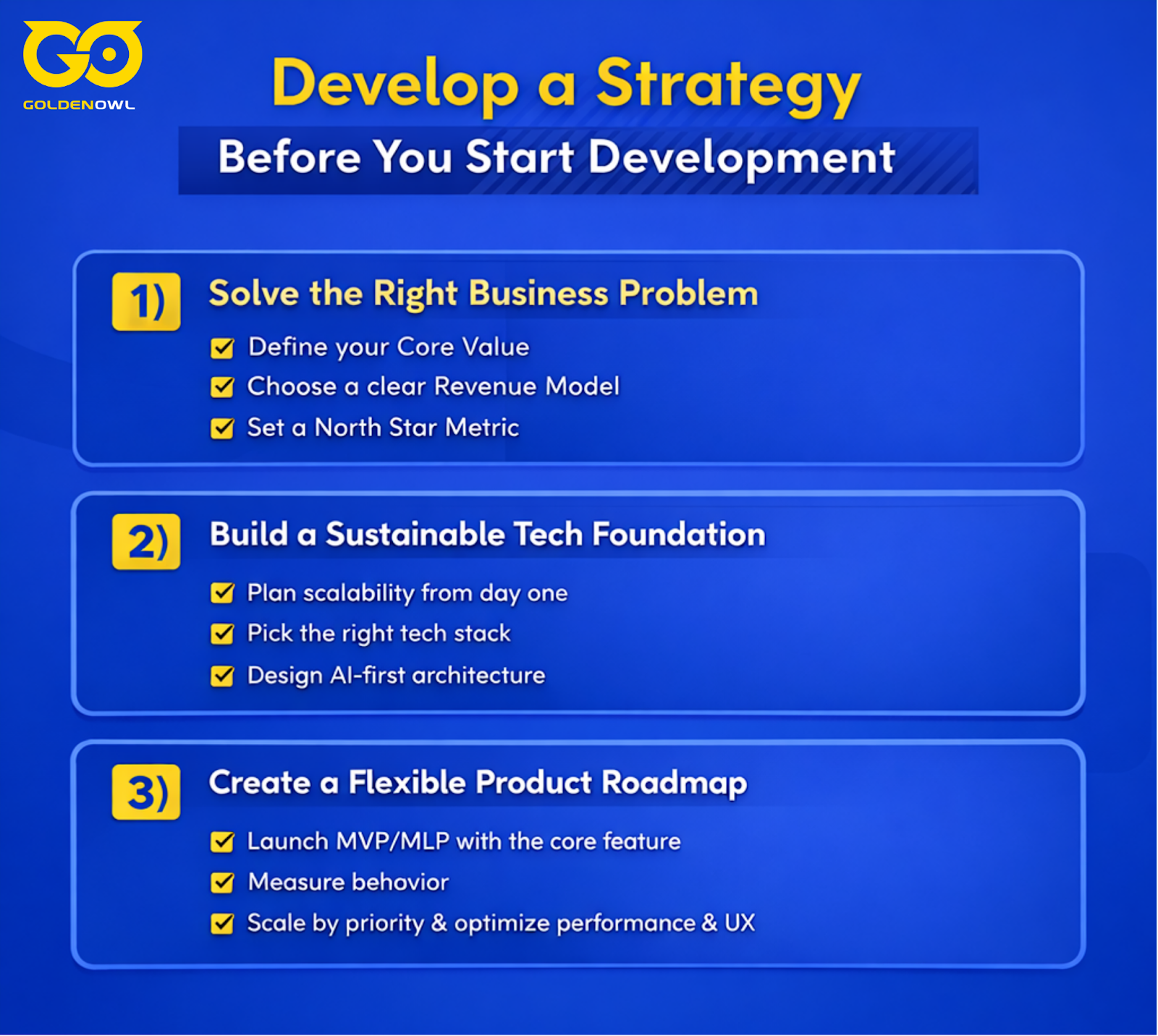
In 2026, strategy is no longer a static plan written on paper. It is a smart combination of Big Data, scalability, and hyper-personalized user experience. Instead of setting vague goals, your mobile app strategy should be built on three core pillars
Solve the right business problem
Don’t just ask, “What will this app do?”. Use practical frameworks like Lean Canvas or Value Proposition Canvas to clarify:
Core Value: What is the one feature that gives you a real competitive advantage?
Revenue Model: Will you use Freemium, Subscription, or a Hybrid model?
North Star Metric: What single metric truly reflects growth? (For example, daily transactions, not just downloads.)
Build a sustainable tech foundation
Scalability must be planned from day one. In 2026, you cannot build an app first and worry about scaling later. Choosing the right tech stack is critical:
Mobile Development: Swift, Objective-C (iOS), Kotlin, Java (Android), React Native,... enabling high-performance native and cross-platform apps.
Front-end: HTML5, CSS3, JavaScript, TypeScript, and frameworks like React or Angular,... ensuring modern UI, cross-platform compatibility, and long-term maintainability.
Back-end: Ruby on Rails, Node.js, PHP, Python, Go,...ideal for building powerful APIs, handling complex logic, and optimizing system performance at scale.
Beyond that, AI-first integration is becoming the new standard. AI features such as smart chatbots, recommendation engines, predictive analytics, and automation should be designed into your data architecture from the beginning, not added later.
Create a flexible product roadmap
Instead of locking yourself into a fixed feature list, build your roadmap in clear development stages:
MVP/MLP: Launch the core feature that delivers clear value and tests market demand.
Measure Feedback: Track user behavior and key metrics (activation, retention, funnel) to make data-driven decisions.
Scale by Priority: Expand features based on real impact on growth and revenue.
Optimization & Growth: Improve performance, UX/UI, operational costs, and expand your ecosystem through integrations.
At Golden Owl, we don’t just ask what app you want to build. We ask what your technology ecosystem should look like in five years. The right strategy in 2026 is one that allows your application to evolve alongside AI and emerging technologies, without tearing everything down and starting over.
1.2. Understand your business needs
Before moving into development, businesses must first understand their core needs and how a mobile application will support broader organizational goals.
What are you trying to achieve? Increasing sales? Improving efficiency? Streamlining customer service? There are a lot of possible reasons your business needs an app, so get specific.
Who will be using this app? Know your audience. Employees in the field repairing equipment have different needs than customers checking order status.
What existing systems does the app need to connect with? Maybe it needs access to customer data or sales projections. Maybe you have a quirky legacy system that’s still vital. Understanding the mandatory connectivity needs of your app is crucial.
1.3. Identify your target market
Effective market research helps businesses clearly understand their target audience. By leveraging big data, AI, and machine learning, companies can analyze data more accurately, segment users effectively, and personalize in-app experiences to better meet specific customer needs.
How they think (personality, attitudes, values, interests, behaviours),
Their desired action (buy, donate, advocate, etc.),
Their challenges (that you can solve),
Motivations (for engaging with your application), and
How best you can reach them (what channels do they use?)
It doesn't matter whether you are a startup or a globally recognized brand, paying attention to your audience is crucial when ensuring your application has product/market fit.
1.4. Validate your idea before development
If I could give founders one piece of advice, it’d be this: validate like your runway depends on it. Every week spent building the wrong thing burns cash and morale. Start with the smallest signal that proves demand - a landing page, a 30-second demo, a fake-door test. Run ads for 48 hours and watch behavior, not opinions. If users don’t click or sign up, the market just saves you months of wasted effort.
White infographic with tips on how to validate before coding. Define one “aha” moment that predicts retention and make that your only test. Forget nine-feature MVPs; investors want traction, not volume. Deciding on the scope of app features is critical to avoid overcomplexity and potential user confusion. Ship one sharp feature that proves the problem is real.
If you’re not sure how to approach building and validating your MVP, it’s worth working with professionals who specialize in MVP App Development. They can help define the right scope, minimize risk, and ground decisions in data rather than intuition. A well-designed validation loop always beats guesswork and remains one of the most underrated practices in mobile app development.
2. Mobile app development tips for technical architecture
2.1. Choose the right platform and tech stack
Once you clearly understand what your mobile app needs to achieve, the next critical step is selecting the right development approach and technology stack. This decision directly impacts scalability, performance, hiring flexibility, and long-term maintenance costs.
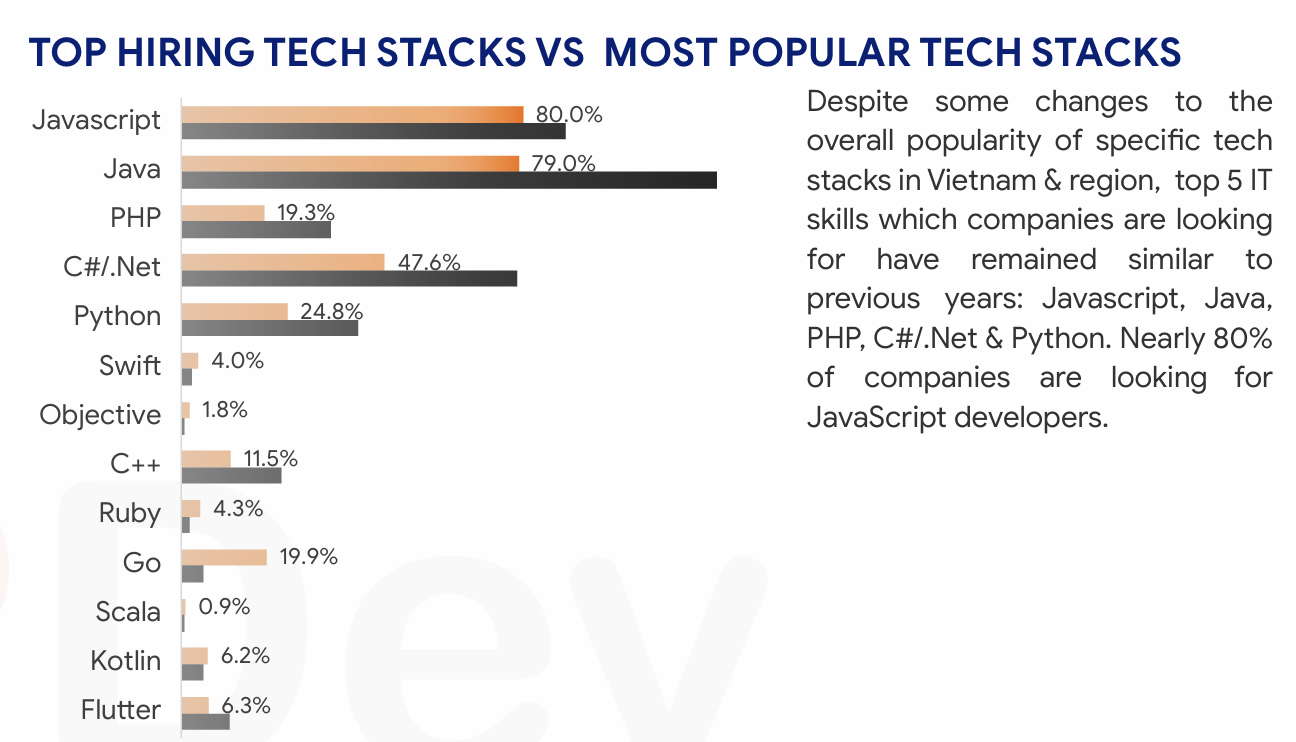
According to the Vietnam IT & Tech Talent Landscape 2024–2025 Report, the most in-demand technologies remain consistent with global standards. Nearly 80% of companies are hiring JavaScript developers, followed closely by Java (79%), while C#/.Net (47.6%) and Python (24.8%) continue to play key roles in backend and enterprise systems.
When choosing your development path, consider the following:
Cross-platform frameworks (Flutter, React Native): Ideal for startups and growing businesses that need faster time-to-market, lower development cost, and scalable performance across iOS and Android.
Native development (Swift, Kotlin): Best for performance-intensive applications requiring deep platform integration.
Backend technologies (Node.js, Java, .Net, Python, Ruby on Rails): Critical for building scalable APIs, secure systems, and cloud-ready infrastructure.
2.2. Don't over-engineer your app
When it comes to enterprise mobile app development, the key is to avoid overengineering. Just because you can build a highly complex system doesn’t mean you should. The primary goal is to deliver an app that is simple, intuitive, and focused on solving a real business problem effectively.
One practical approach is to start with a Minimum Viable Product (MVP). This means developing only the core features necessary to validate the concept and deliver immediate value. Once the MVP proves traction and stability, additional features can be introduced strategically based on real user feedback and business needs.
Another smart strategy is to leverage existing solutions whenever possible. For instance, if your app needs to integrate with a CRM, there is no need to build one from scratch. Instead, integrate with a reliable, established CRM system. This reduces development time, lowers costs, and allows your team to focus on building differentiated value rather than reinventing existing tools.
3. Mobile app development tips for user engagement
3.1. Design for the user experience
What makes a good app? A successful app is one that works exactly the way users expect it to. At its core, user experience determines whether an app succeeds or fails.
Users typically look for:
A clear and intuitive UI with easy navigation on small screens
Fast loading speeds and responsive performance
A logical, familiar design that aligns with your brand identity
Easily accessible support resources, including a well-structured FAQ
A built-in feedback mechanism to report issues or share suggestions
When you place users and their needs at the center of your design decisions, you naturally apply many mobile app development best practices. Keep this principle in mind - along with the other strategies outlined in this guide and you’ll be well on your way to building a truly successful app.
3.2. Design for retention
Most apps don’t fail because they’re poorly built, they fail because users stop using them. Many users uninstall an app within the first 30 days. The real challenge isn’t downloads; it’s staying relevant every day.
Retention doesn’t come from push notifications. It comes from good UX. Fast onboarding, clear value within seconds, and simple flows that fit naturally into real life make the difference. When users feel progress from the first interaction, they stay.
In 2025, UX is centered around clarity, smooth motion, and accessibility. Features like dark mode and subtle feedback are now standard expectations. Your interface should guide users, not overwhelm them. To measure success, track D1, D7, and D30 retention instead of focusing only on installs. Tools like Mixpanel or Amplitude help identify where users drop off and what brings them back. Use that data to improve continuously. Retention is built through smart design, real insights, and a deep understanding of your users.
4. Mobile app development tips for testing and iteration
4.1. Test your app under multiple conditions
Once your app is up and running, thorough testing is essential. An app cannot be considered successful if it crashes or frustrates users under foreseeable conditions.
Make sure to test across:
Multiple devices
Different operating systems and versions
Various geographic locations
Limited bandwidth conditions
Heavy resource loads
Some of these factors can be checked through functional testing, such as making sure the user interface works correctly. Others can be tested in a lab that simulates real network conditions. However, the most helpful insights come from real users. By combining functional testing, lab testing, and user testing, you can discover real-world issues, find pain points, and improve the overall user experience based on real feedback.
4.2. Get user feedback
After your first round of testing is done and the main issues are fixed, it’s time to see how your app performs in the real world. You can hire a testing company, or release the app to a small group of employees or customers to collect feedback and spot any remaining problems.
Remember, testing is not something you do once and forget. Improving your app should be an ongoing process. Users expect regular updates and better performance over time. Even after launch, keep tracking how the app performs and listen to user feedback. Continuous improvement is the key to long-term success.
5. Conclusion
Building a successful mobile app in 2026 requires more than just coding. It demands clear strategy, smart architecture, user-focused design, and continuous improvement.
The best apps aren’t the most complex. They’re focused, scalable, and built around real user needs.
If you're planning your next mobile app, start with a structured approach from day one. Golden Owl Solutions helps businesses build scalable, high-performance apps with long-term impact. Contact us to turn your idea into a product ready to grow.
Share this page
Table of Content
Subscribe to Golden Owl blog
Stay up to date! Get all the latest posts delivered straight to your inbox