
Forward deployed engineer vs software engineer: compare daily work, skills, career paths and pay, and see which path fits you.


What Are Agent in AI?
Oct 19, 2026
about 8 min read

What are agent in AI? Learn what an AI agent is, how agents work, how they differ from chatbots, and the five main types, with research examples.
If you typed “what are agent in ai” into a search bar, you probably want the plain version first. Here it is: an AI agent is software that picks its own next step and looks at what happened before choosing again.
The looking-back part is what people skip. A chatbot answers and stops. A script does only what its author predicted. An agent keeps going until the goal is met, so a task that changes halfway through doesn’t break it.
None of this started with ChatGPT. AI textbooks were sorting agents into types decades ago, and those old categories still explain today’s systems better than most vendor pages manage to.
What are agents in AI?
So what is it, exactly? It’s software that chases a goal you give it and works out the route on its own. You say “get this invoice dispute resolved,” and the agent figures out which records it needs and what to do with them. If you still have to approve every single move, what you’ve built is a very slow assistant.
Agents see the world through inputs. For a robot those are sensors. For the invoice agent it’s whatever the APIs expose, probably the billing system and the customer’s email thread. Each time, it looks for what changed and updates its picture of the situation.
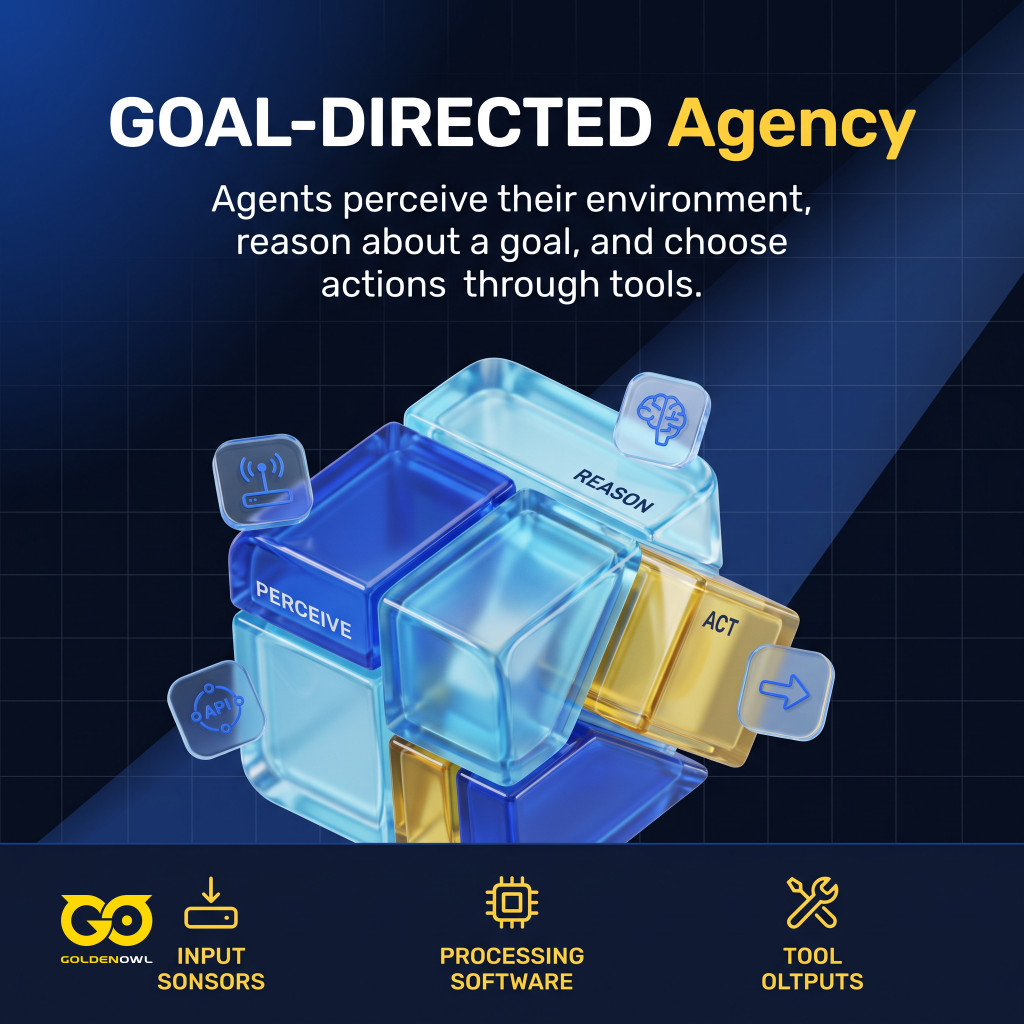
Then it reasons. Say the customer has just replied with a screenshot of a bank transfer. The model holds that up against what it already knows, including whatever it tried two steps ago, and goes with the move most likely to close the case.
A plain language model only predicts the next bit of text. Put that model inside a loop, though, and feedback from outside starts deciding what happens next, so when step three goes wrong the agent can notice and try something else. Ordinary software usually can’t. It waits for a person whenever something falls outside the code.
How do AI agents work?
Inside the agent is a large language model, GPT or Claude for example. That’s the part that reads your instructions and thinks them through. It’s also stuck with whatever was in its training data, which stops at a cutoff date, so on its own it can describe how to finish a task without being able to finish it. Planning, memory and tools, wired together in a loop, close that gap.
You can see all of this working together in the Voyager implementation, which plays Minecraft. It writes its own skills as code and keeps the ones that work. When a skill fails, the error message goes straight into the next prompt.
Planning is the part that breaks a goal into steps and puts them in order. “Refund this customer” turns into an order lookup first and a payment later. Developers can get there by prompting the model to split the task, or with older planning methods such as Hierarchical Task Networks (HTNs), where people write the rules for breaking a task down. I’d start with prompting, because when the plan turns out wrong it’s the cheapest thing to change.
Memory is what lets the agent pick up where it left off. There are two kinds. Short-term memory is the last few messages in a chat. Long-term memory holds customer records or past actions, usually in a vector database, which finds records by meaning rather than exact words. Without it, the customer explains the dispute from scratch every time they write in.
Tools are what let the agent do things rather than describe them. With API access it can send the email or query the database itself. When the model runs into something it doesn’t know, it calls a tool to find out, whether that’s a web search or another agent. A parsing step, code that turns the model’s words into a proper tool request, handles each call and feeds the result back into the loop.

Once a tool sends back what was missing, the agent updates what it knows and looks at its plan again. Most self-correction happens right here. Did the output actually solve the problem? The agent can check that itself, or take corrections from a person or an automated test. Some systems go further and learn first from the examples they’re least sure about, a trick called active learning.
Reinforcement learning (RL) teaches an agent in a different way: the agent tries something, gets a reward or a penalty, and over many rounds learns which actions pay off. That’s why it shows up in robotics and games, where few examples come with the right answers already marked.
Most LLM agents today don’t learn by trial and error like that. They follow one of two patterns. The first is ReAct, where the agent is told to “think” after every action and tool response before picking the next tool, so it works through the problem one step at a time. The approach works, too: ReAct beat older imitation and reinforcement learning methods by 34 percentage points in success rate on ALFWorld, a text game built around household chores, and by 10 points on WebShop, a simulated online store.
The second pattern, ReWOO, plans everything up front. It decides from the prompt which tools it will need, runs those calls, and then combines the plan with the outputs. Because the plan doesn’t wait on tool outputs, the agent avoids redundant calls. A person can also approve the plan before anything runs. On the HotpotQA benchmark, Xu et al. found that ReWOO used 1,986.2 tokens, the chunks of text a model is billed by, against ReAct’s 9,795.1. That’s about a fifth of the tokens, and tokens are what the bill is based on.
The test I find more telling breaks the tools on purpose. When every tool returned “No evidence found,” ReAct’s accuracy fell from 40.8% to zero. ReWOO dropped too, from 42.4% to 13.2%, but its plan was written before any tool replied, so the empty answers didn’t derail it the same way. ReAct still wins when each step depends on the last tool’s answer, since it can change course mid-task.
How do AI agents differ from chatbots?
A chatbot uses conversational AI and natural language processing (NLP) to understand your question and answer it. That’s a description of how you talk to it. Agency is about what it can do once you stop talking, so a chatbot can be an agent, but most of them aren’t.
A basic chatbot has no tools, memory or reasoning loop. It needs you to type something every time it acts, and it handles common questions well because they look like its training data. Questions about you are another story. In the MemGPT evaluation, GPT-4 answered 32.1% of questions about earlier conversations correctly without memory and 92.5% with it. That is a huge gap for one missing piece.
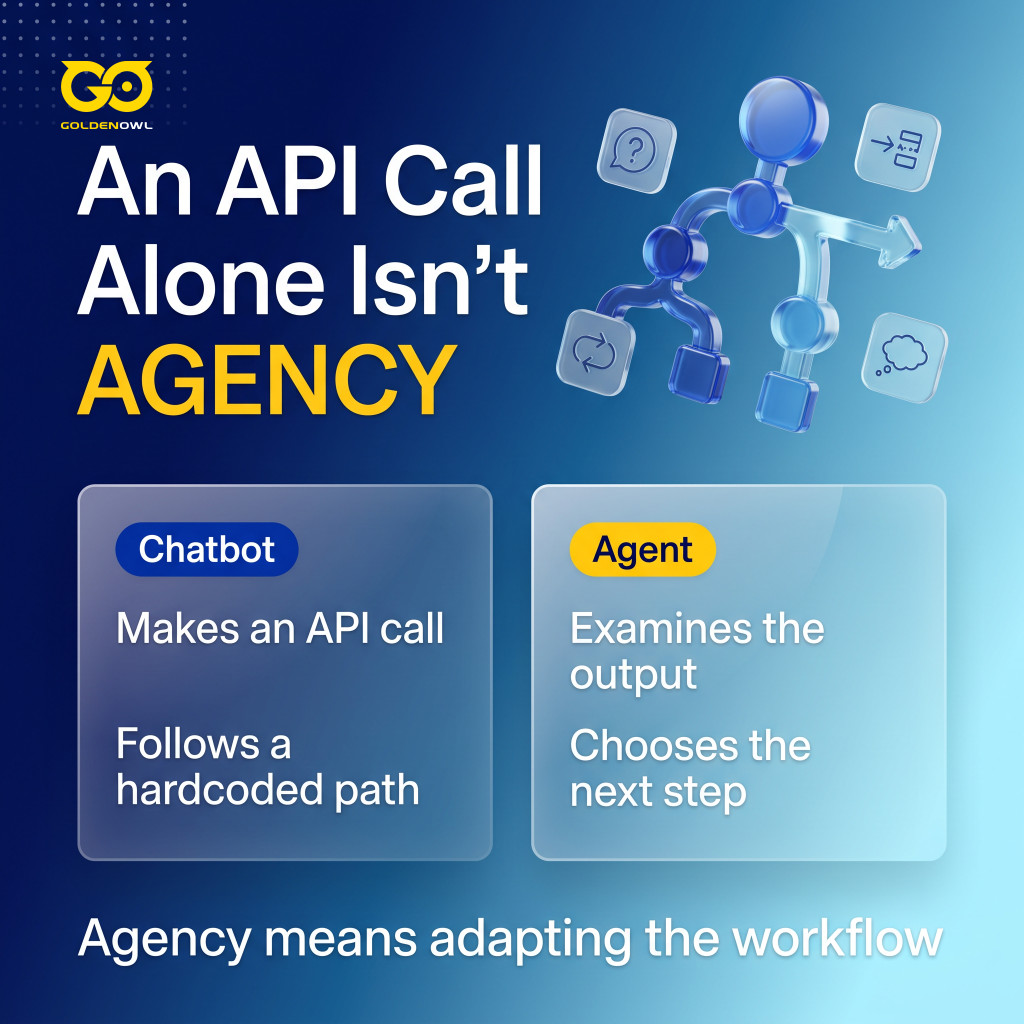
Calling an API doesn’t turn a chatbot into an agent either. What counts is what happens after the call, when a real agent looks at the result and decides its next step from it. SWE-agent does exactly this while fixing issues in real code repositories. Each command it runs comes back with output, or maybe a syntax error, and that feedback picks the next command. A hardcoded path can’t do that.
A chatbot that does have agency, sometimes called an agentic chatbot, works differently. It gets better at handling a particular user over time. Hand it a messy request and it’ll split it into smaller tasks, then change the plan if one of them fails, without anyone signing off on each step. Anthropic’s Building effective agents draws the line clearly: workflows run “through predefined code paths,” while agents “dynamically direct their own processes and tool usage.”
What are the main types of AI agents?
There are five main types of AI agents: simple reflex, model-based reflex, goal-based, utility-based and learning agents. Each one hands more of the decision to the machine. More isn’t automatically better. For a simple goal, a simple agent is cheaper and easier to trust, and Anthropic’s advice to builders is the same: find the simplest solution possible and add complexity only when it’s needed.
Simple reflex agents are the most basic kind. They react to what they sense right now and nothing else, with no memory, just preset condition-action rules. Think of a thermostat: the room drops below the set temperature, and the heat comes on. Anything its rules don’t cover, it simply can’t handle.
Model-based reflex agents add memory. They keep an internal model of the world, update it as new information arrives, and act on that model along with their rules. That makes them usable in places that change and can’t be seen all at once, though the rules still limit them. A robot vacuum is a good example: it steers around furniture and remembers which areas it has already cleaned, so it doesn’t keep going over the same patch.
Goal-based agents add a destination. Before acting, they search for sequences of actions that reach the goal and plan them, which makes them better than reflex agents at anything with more than one step. A navigation app is the familiar case. It compares routes to your destination and recommends the fastest, switching if a quicker one opens up.

Utility-based agents ask a harder question. Plenty of routes reach the goal, so which one is best? A utility function gives each option a score for how useful it is against criteria such as progress toward the goal or computing time. Your navigation app does this when it trades time in traffic against a toll, and the route it picks has the best overall score, which isn’t always the fastest one.
Learning agents can do everything above, and they keep adding what they experience to what they started with, so they cope better with situations they haven’t seen. Under the hood the reasoning might be goal-based or utility-based. Four parts make the learning work:
- Learning: Improves the agent’s knowledge from what it perceives.
- Critic: Tells the agent whether its responses meet the performance standard.
- Performance: Chooses actions based on what has been learned.
- Problem generator: Suggests new actions to try.
Recommendations on e-commerce sites are the everyday example. The system learns from how each user reacts to its suggestions, so the picks get better the longer someone shops.
Autonomy isn’t free, though. Anthropic puts it plainly: agentic systems “often trade latency and cost for better task performance,” and their autonomy brings “the potential for compounding errors.”
Conclusion
The answer to “what are agent in ai” comes down to one loop. An agent doesn’t stop at a single response. It acts, checks what happened, and keeps going until the goal is met. Which of the five types you need depends on what the system has to decide when things change. A heater gets by on a fixed rule, but a billing dispute won’t, because it needs memory and a plan. Pick the simplest type that can make your decision, since every step up adds latency and new ways for the loop to fail.
Share this page


Table of Content

Subscribe to Golden Owl blog
Stay up to date! Get all the latest posts delivered straight to your inbox