
Learn how to hire forward deployed engineers in 6 steps: define the role, benchmark pay, source candidates, screen for delivery and run a four-round loop.


How to Implement AI for Lending
Nov 9, 2026
about 8 min read

See how AI for lending works in practice: where to apply it across the loan lifecycle, how to implement it step by step, and what controls to keep.
AI for lending gets hard when a faster workflow changes the documents and data a credit decision rests on. Speed is easy to show in a demo. The real test comes later, when an underwriter has to rely on what the system pulled out of a file.
If you run lending operations, the question is less whether to use AI than where to start. This guide covers where it fits in the loan process, the guardrails it needs around fraud, policy limits and explainability, and how you’d know it paid off. Pick one product, find the spot where documents pile up and time how long that work takes now. Then run the software on your own files, not the vendor’s samples. People keep making the decisions, and nothing expands until the controls have held.
Using AI for lending across the loan lifecycle
It’s tempting to picture AI as one black box: an application goes in, a loan comes out. It works better spread across the loan process at separate checkpoints, a bit like inspectors on an assembly line, where each agent owns one evidence task and the lender still makes the credit call. The stages of a loan don’t change. Agentic AI (software that can take several steps on its own) makes the handoffs between systems and teams less rigid.
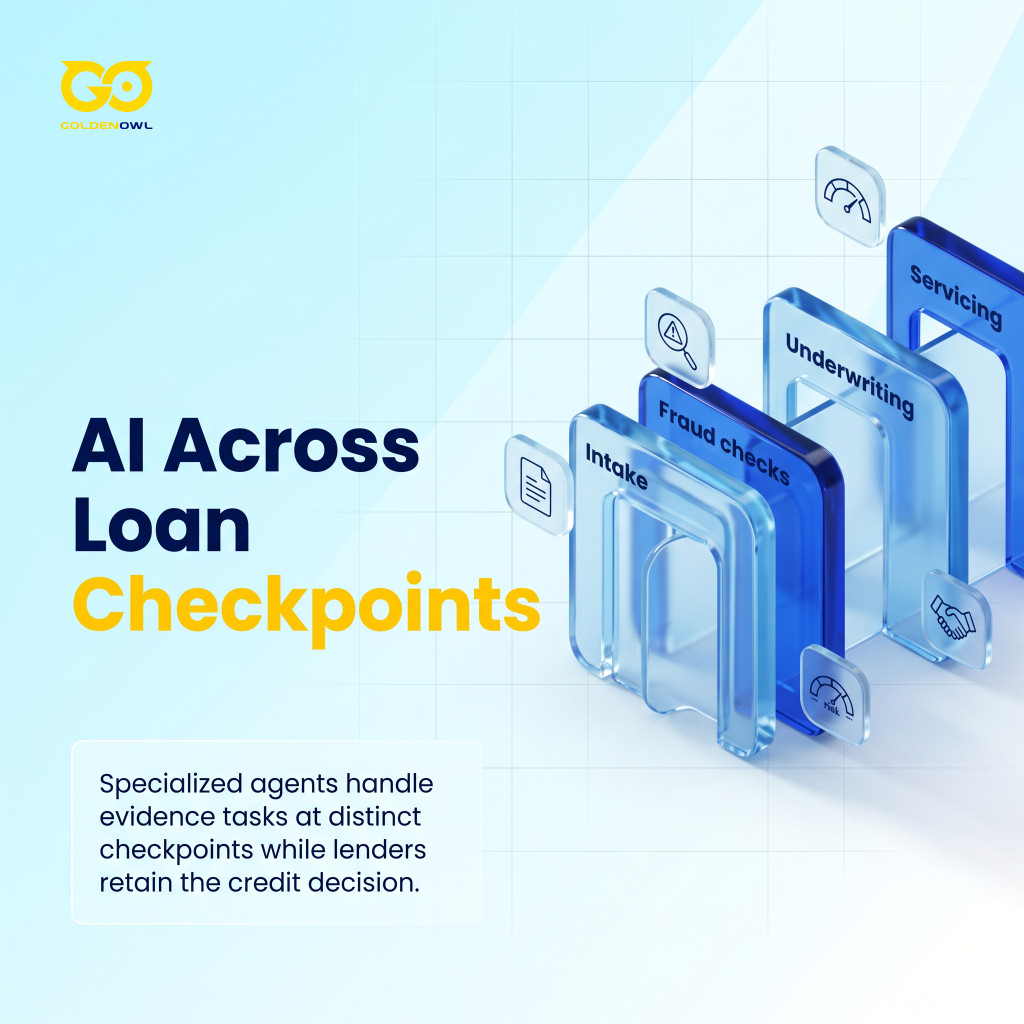
Because these agents work in the background and in real time, some steps can run side by side instead of waiting in line.
Application intake
Intake is where the paperwork lands, and at first it’s mostly sorting. The software works out which page is which, breaks a long PDF into separate documents and goes back to the borrower for whatever is missing. Only then does it read numbers: the transaction table on a bank statement, the totals on tax returns and the profit and loss statement. Every value comes with a confidence score, the software’s own guess at how sure it is. That score decides what a person has to look at.
What lands depends on the loan. With AI in mortgage lending you’d expect tax returns, salary slips, pension statements and proof of funds; a small business loan leans toward balance sheets, P&L statements and cash flow projections. So the checklist gets built per credit type, inside the bank’s online application flow, and customers can see what’s still outstanding.
The sorting and the chasing of missing pages can run on their own. Reading the data correctly is a different job. Mismatches, complex cases, covenants (conditions the borrower agreed to) and footnote details still get flagged for a person to judge, and for now that’s the right split.
- Fewer mistakes in extracted data, with error rates on fields falling sharply.
- Application data that a relationship manager fills in within minutes rather than hours, or that the customer enters directly.
Fraud detection
Fraud checks start with the document itself. Do the fonts match? Has the metadata been edited? Do the balances add up? Then the software looks across documents. That’s where a lot of fakes fall apart. Payroll should line up with the bank statement and the pay stub, and the employer named on the application should be the one actually paying the borrower.
Software doesn’t get tired, so these checks can run on every application rather than a sample. That includes catching synthetic identities, made-up people stitched together from real and fake details, before any money goes out.
Give alerts a defined review queue and a clear rule for when a case goes up to a human investigator. Count false alarms by alert type; otherwise the team ends up loosening thresholds just to keep up. Before the loan pays out, the finding, the reviewer’s decision and the evidence behind it go into the loan file.
One document automation vendor reports 64% lower fraud from checking documents against each other. That’s their number, not yours, until your own files back it up.
Credit underwriting
In underwriting, AI sorts and structures the evidence, and the lender sets the rules for the decision. Real-time cash flow data can show that an applicant is creditworthy even without a long credit bureau history. Cash flow data is less stable than years of credit records, though. Lenders still need to check the data pipeline often to keep final exposure inside credit policy limits.
About 40% of a credit analysis team’s time goes to working through data by hand and checking whether a client fits the organisation’s standards and risk appetite. Bank statements are where much of that work lives. The software tags each transaction (payroll, a transfer, a loan payment, an NSF fee for a bounced payment) and from there works out the average daily balance, monthly inflows and recurring debts, while flagging deposits that look odd. Income, cash flow and ratios like the debt service coverage ratio (DSCR, whether income covers the loan payments) come out of the same pass. For commercial loans it also copies the figures from the financial statements into the lender’s template, a step called spreading. The software can also score an application, but only inside limits the lender sets. Anything outside them goes to an underwriter. The output can also be more useful than yes or no. Take an application whose debt-to-income ratio breaks policy. A plain model would reject it. A better system shows the client the gap, “Debt-to-income ratio is 40% (policy limit: 35%),” and what would close it: more monthly income, lower existing expenses, a smaller loan, or more cash or collateral up front. It also marks the key decision and control points and gives guidance on edge cases, so the underwriter isn’t starting from nothing.
- Time-2-Yes (the time from application to approval) can shrink from days to a couple of hours.
- Decisions can get more accurate and conversion can rise, since fewer applications end in a flat rejection.
Loan servicing
Later in the loan’s life, the same software can read borrower letters and hardship documents, which helps loan servicing and collections teams decide whom to contact first. Ongoing monitoring can catch early warning signs before a problem shows up. Some signals come from internal data, such as changes in how someone pays, income that swings, or too much exposure in one place. Others come from outside: public records showing a new job or a move, or market trends hitting the client’s industry.
By reading a borrower’s financial behavior, AI models can flag likely loan defaults before they happen. That early notice buys time to restructure the loan, offer financial counseling or allow a short pause in payments (forbearance). When the risk shows, real-time signals can trigger the response right away (mitigating actions, impairment processes or margin calls) instead of waiting for the next quarterly review.
- Credit risk management can improve, with problem loans flagged well before they default.
- Regulatory reporting can take less time and cost less, and risk-weighted assets (RWA, the risk-adjusted total that sets how much capital a bank must hold) can fall.
Operational benefits of AI lending solutions
The business case for AI lending shows up first in what each loan costs to make. The MBA reports that independent mortgage banks spent $11,898 to produce each loan in Q1 2026.
Speed is the next gain. AI loan underwriting with agentic workflows can cut processing times by a wide margin, and some lenders report approval cycles shrinking even further. Faster approvals help a lender reach borrowers who are ready to commit before a competitor answers. Some cost categories could drop sharply, while the overall cost base falls by less.

With AI agents, a lender can handle many more applications without hiring at the same pace. Over time, that can lower cost per loan.
Accenture’s 2024 report found that AI adoption can cut loan processing costs by up to 50% and improve risk assessment accuracy by 15-25%. Lower costs and better risk calls can mean quicker approvals and a better experience for borrowers. For relationship managers, agentic AI can take a large share of manual processing off their plate.
AI Explainability, Adverse-Action Reasons, and Governance for Lending
Being right about who will default isn’t enough when the model says no. The borrower and the examiner will both want to know why. Every outcome has to trace back to the inputs that produced it, the way a receipt’s line items show how the total was reached. That’s the job of explainable AI (XAI): it shows which variables and which logic led to a credit outcome.
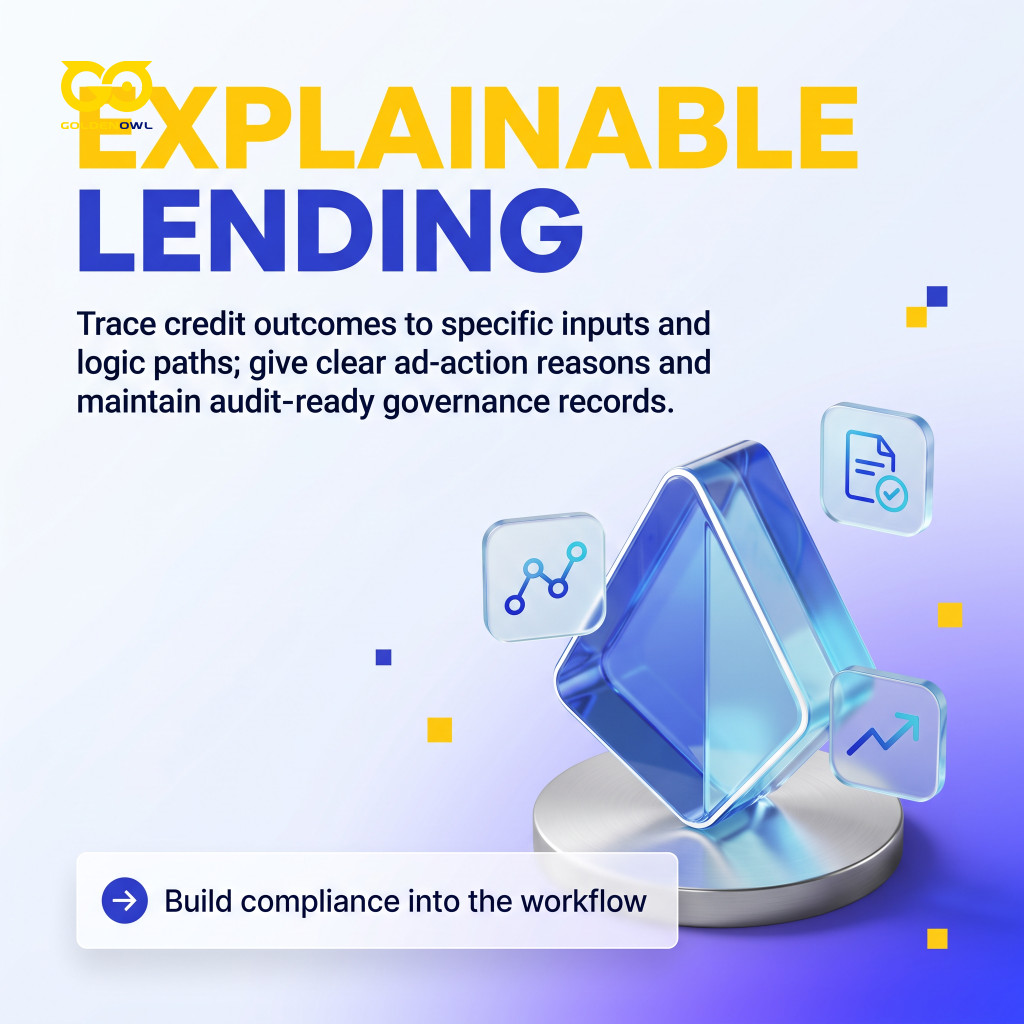
Clear explanations, governance and regular review are what let a lender meet the Equal Credit Opportunity Act and CFPB rules on adverse action (telling a declined applicant why), and EU AI Act obligations where they apply.
- Adverse action reasons (Regulation B):
If you deny credit, the applicant is owed a statement of the specific principal reasons. A model that can’t give clear reasons can’t be the basis for the denial.
- Freddie Mac AI governance:
Guide Bulletin 2025-16 took effect March 3, 2026. Since then, sellers and servicers need AI governance with specific controls and audits, and they have to watch their models for bias and for drift (a model slowly getting less accurate).
- Fannie Mae AI governance:
Lender Letter LL-2026-04, effective August 6, 2026, asks for a formal, written governance framework for AI and machine learning. It reaches any AI used in origination or servicing, including systems bought from vendors, and the framework has to be reviewed every year.
A Phased Plan to Implement AI in Lending
Start smaller than feels useful: one product, one bottleneck, a contained use case.
- Pick one product and one bottleneck. Bank statement review for small business loans is a good place to start. So are income documents for mortgages.
- Measure the baseline. Track minutes per file, error rate and time to decision. Also track how many files end up with late conditions.
- Test on your own documents. Check field-level accuracy on a few hundred real files, poor scans included.
- Have a person make every decision. At first, also have someone check the fields the software is unsure about. Let only low-risk evidence tasks run without manual review, such as pulling clear fields from documents, and only while accuracy and error rates hold at the level you measured. Credit judgment, exceptions and anything outside lender-set limits stay with people.
- Write it into your governance. The system goes on your AI inventory, with its purpose, controls and monitoring written down, and someone reviews it at least once a year.
- Expand. Move to the next document type or product once the first one is stable.

When you test, start with your messiest files, not the tidy ones: a phone photo of a pay stub, a long bank statement, a page filled in by hand. Those are the files your team fixes today, and a clean file proves little.
Frequently asked questions
How can banks ensure regulatory compliance when they adopt AI?
Mostly by being able to explain each credit decision. Explainable AI helps banks produce clear reason codes for credit decisions under the Equal Credit Opportunity Act, which matters because Regulation B requires you to state the specific principal reasons whenever you deny someone credit. The other half is testing: run the model on representative data, compare outcomes across groups and keep a written record of what you found.
How does commercial lending benefit from artificial intelligence compared to consumer?
Commercial lending offers more room for AI per deal than consumer lending. Deals are more complex, documents vary more and there are more risk variables, and all of it adds manual work that limits volume and slows each deal down. Intelligent document processing (IDP), automated financial spreading and covenant monitoring go after that work: less analysis time, more frequent covenant reviews, and data pulled together across several related companies. Pulling figures out of complex spreads, a job that eats analyst hours, can take seconds at intake.
So AI for lending follows one pattern from intake to covenant monitoring: the software takes the evidence work, and people keep the credit judgment. Reason codes from explainable AI answer the examiner’s first question, which is why the model said no. Your test results and documentation answer the second, which is how the system actually behaved. And if you’re choosing where to start, commercial lending usually has the most manual work left to remove.
Share this page


Table of Content

Subscribe to Golden Owl blog
Stay up to date! Get all the latest posts delivered straight to your inbox