
How to use AI in real estate: automate lead follow-up, speed up valuations and marketing, and keep every step compliant with Fair Housing rules.


AI Solution Architect Salary Guide
Oct 13, 2026
about 6 min read
AI solution architect salary: compare pay by experience, location, skills and contract rates, plus how it stacks up against traditional architect roles.
An AI solution architect salary can differ a lot between two jobs with the same title. One job is wiring components together. The other is designing AI systems for a whole enterprise. Salary data rarely tells them apart, so every range below blends both. I’d read it that way when you weigh an offer.
This guide covers pay by experience, city, skill, and contract rate, then compares AI architects with traditional ones. US figures are in US dollars. Australian figures are in Australian dollars. I keep the two apart throughout.
AI solution architect salary by experience level
The 2026 average AI solution architect salary in the US comes to $210,435 a year, though I’d hold that loosely. Glassdoor lists roughly $214,000 and Orbyt Jobs roughly $195,000. Because this figure falls between them and matches neither, I’d call it a ballpark.
Level matters too. Orbyt puts mid-level at $166,000–$205,000 and senior at $215,000–$254,000, so even its senior floor sits above its mid-level ceiling.
Here is how that looks in Australia, in Australian dollars, with base salary next to total package at each level.

| Level | Experience | Base salary (AUD) | Total package (incl. 12% super, AUD) |
|---|---|---|---|
| Junior | 0-2 years | $120,000–$150,000 | $134,400–$168,000 |
| Mid-level | 3-5 years | $160,000–$210,000 | $179,200–$235,200 |
| Senior | 6-10 years | $210,000–$270,000 | $235,200–$302,400 |
| Principal / Lead | More than 10 years | $270,000–$340,000+ | $302,400–$380,800+ |
Mixing base and total pay, or US and Australian dollars, can create a gap that isn’t real, so check both before you compare with the US numbers. The 12% in the last column is the Australian super guarantee, and since 1 July 2025 employers have owed it on top of base pay for most employees.
Treat these bands as indicative, since independent benchmarks run lower. Robert Half’s 2026 guide puts Australian solutions architects (not AI-specific) at $165,000 to $195,000, and Payscale’s average is about $151,000. Part of the gap may come from the AI specialization. Part may come from each source measuring pay differently. I’d read the table as the optimistic end of what’s plausible.
Geographic compensation variations
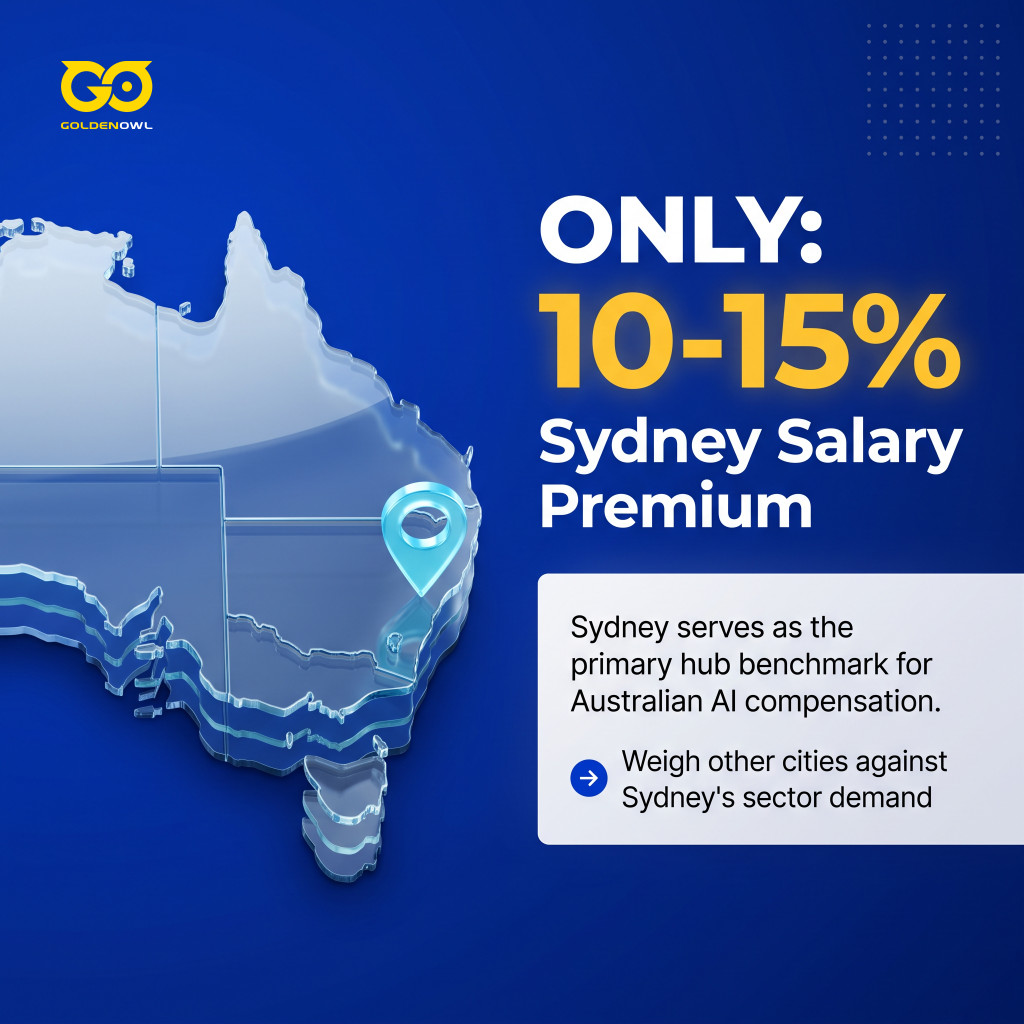
Sydney pays the most on this table, with Melbourne and Canberra close behind. Brisbane and Perth sit lower. Remote roles land near hub-city rates, which suggests employers are paying for the skill more than for the postcode. The table gives the base range for each city, in Australian dollars.
| City | Base salary range (AUD) | Notes |
|---|---|---|
| Sydney | $175,000–$280,000+ | Financial services and enterprise tech dominate. Its ranges run about 8–9% above Melbourne’s at both ends. |
| Melbourne | $160,000–$260,000 | Strong enterprise and government demand. |
| Canberra | $165,000–$260,000 | Government AI investment driving demand. Strong permanent pipeline. |
| Brisbane | $150,000–$240,000 | Growing defence and resources AI spend. Sydney’s ranges sit about 17% higher at both ends. |
| Perth | $150,000–$235,000 | Mining and resources AI projects add a domain premium for relevant experience. |
| Remote | $155,000–$255,000 | Remote-eligible roles command close to hub-city rates in a competitive market. |
High-value skill premiums
LLM integration tops the table, and I’d expect that. Few people have run LLMs in production, so an uplift of $20,000–$40,000 a year is what scarcity looks like. The other four skills add less, and the table gives each range. They are estimates in Australian dollars, so use them to rank skills against each other rather than to price yourself.
| Skill | Why it commands a premium | Salary uplift (AUD, estimate) |
|---|---|---|
| LLM integration (OpenAI, Anthropic, Google Vertex) | Few people have run LLMs in production | +$20,000–$40,000 |
| RAG architecture & vector databases | Critical for enterprise AI search and retrieval systems | +$15,000–$30,000 |
| Cloud AI platforms (AWS Bedrock, Azure AI, Google Vertex AI) | Major enterprises build on hyperscaler platforms | +$15,000–$25,000 |
| MLOps and model lifecycle management | Production reliability requires MLOps expertise | +$10,000–$20,000 |
| Responsible AI / AI governance frameworks | Regulatory requirements driving board-level demand | +$10,000–$20,000 |
RAG pipeline design. Many enterprise AI systems use Retrieval-Augmented Generation (RAG), and the work starts with a question that sounds boring: how do you chunk documents? Fixed-size and semantic chunks behave differently, and the choice carries into everything after it, from the embedding model to hybrid retrieval with BM25 keyword matching and reranking. When a RAG system disappoints, I’d look at chunking first, because a stronger LLM won’t always rescue bad chunks.
LLMOps. LLMOps is the work of keeping LLMs running in production. It covers versioning prompts, testing model variants against each other, and tracking token costs, with canary deployments and rollback for the day something breaks. Classic DevOps training doesn’t cover how LLM costs behave. A single misconfigured prompt can double token output. Without monitoring, nobody gets an alert before the bill arrives. Employers hire architects to prevent exactly that.
Prompt engineering alone rarely earns the premium, because the hard parts come after the prompt. Enterprise packages pay for latency tuning and model evaluation, and for getting a system through governance compliance.
Contract and day rates
A day rate looks huge next to a salary until you remember what it is: gross Australian dollars, before tax, insurance, and the weeks between contracts. The table lists the estimated day rate for mid-level and senior roles.
| Seniority | Day rate (AUD, estimate) |
|---|---|
| Mid-level | $1,400–$1,800/day |
| Senior | $1,800–$2,500/day |
Defined project and specialist needs
A contract makes sense when the work has a clear scope and a finish line, like a cloud AI platform migration or a responsible AI framework build, and when you can’t wait for permanent recruitment to finish. It can also fill a skills gap, such as RAG or AI governance, that a project needs but a headcount doesn’t.

The effective premium
The gap between a day rate and a salary shrinks once you count what each one includes. A contractor gets no superannuation, paid leave, or employer-funded benefits. They also pay their own insurance and tax, and earn nothing between engagements. A permanent employee has most of that covered, and a permanent role can shield you from corporate budget freezes. I’d put the effective premium well below what the headline rates suggest, and it shrinks faster the longer the gaps between contracts run. None of this makes contracting a bad deal. For a short, niche engagement, the higher gross rate per billable day is exactly what you’re paid for.
AI vs. Traditional Solutions Architect Salary Comparison
AI solution architect listings in 2026 ask for AI-specific skills on top of standard system design, and pay follows. Orbyt Jobs lists a US average of $195,000 for AI solutions architects, while jobspipe.dev lists a US median of $169,000 for solutions architects in general. That compares an average with a median, so the gap of roughly 15% is a rough guide at best. I still think a premium is plausible. The role of an ai solution architect needs fluency in two scarce disciplines, enterprise architecture and applied AI, and employers rarely find both in one person.
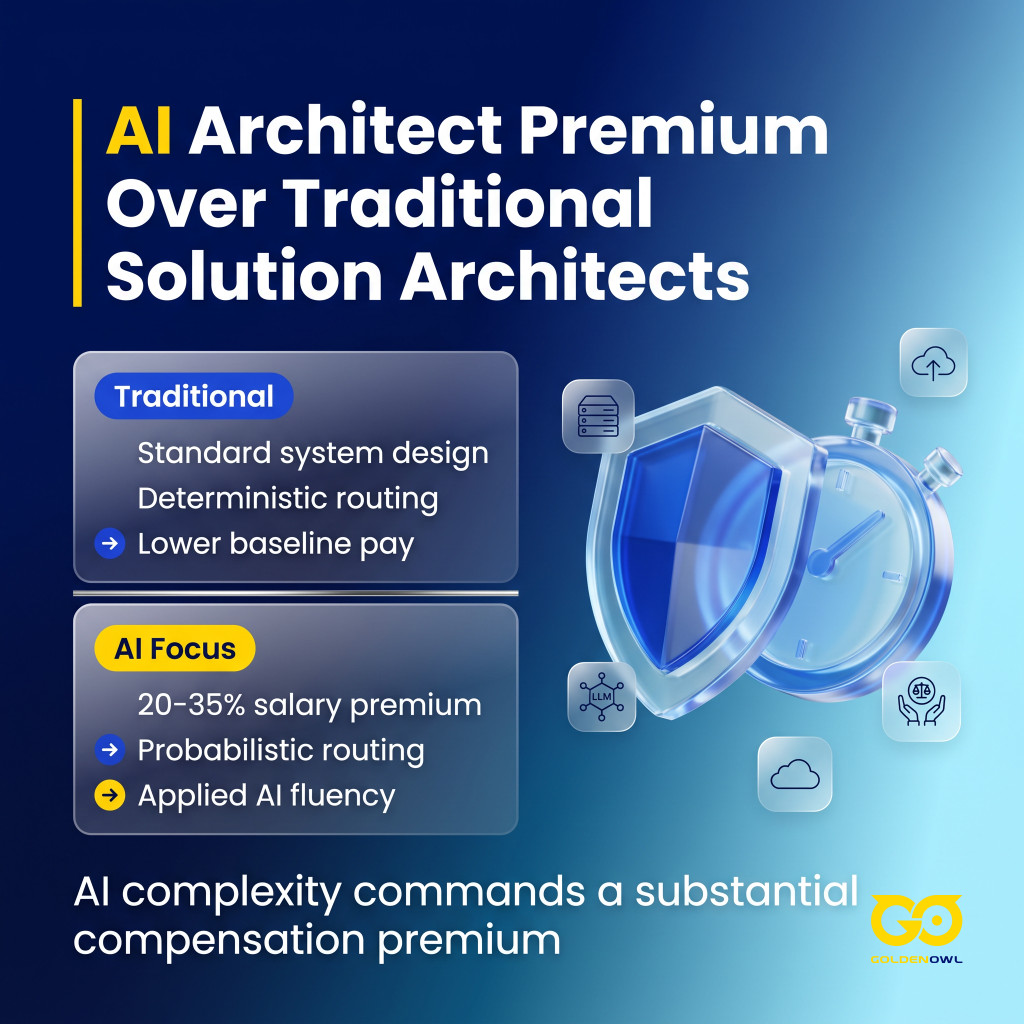
Moving from web architecture into AI, an architect keeps API design, security, scaling, and cost control, and I’d count those as most of the toolkit. The part that doesn’t carry over is how the system behaves. A traditional system is deterministic, so a passing test tells you something. An AI system produces probabilistic outputs that can be wrong without raising an error, which is why the problems tend to show up in production rather than in planning.
Frequently asked questions
How much does an AI Solution Architect earn in 2026?
Plan around $210,435 a year in the US, though the sites I checked range from about $195,000 to $214,000. In Australia, this guide’s base bands run from AUD $120,000 to AUD $340,000+. Where you land depends on experience and how deep the AI specialization goes.
How does an AI Solutions Architect salary compare to a Data Architect?
Public data rarely splits the two titles cleanly, so I wouldn’t trust any exact gap you see quoted. The direction is clear, though. An AI solution architect has to combine enterprise architecture with hands-on LLM and cloud AI platform skills. That is a rarer mix than data architecture alone. The skill table above shows how much individual skills can add in Australia.
Do I need a machine learning degree to become an AI Solution Architect?
A machine learning degree isn’t always necessary. In 2026, many enterprise AI systems are built on pre-trained foundation models reached through an API, so training from scratch is rare. That shifts what companies hire for. Proven production experience with AI systems that have shipped carries more weight than formal credentials. Degrees still matter more in foundation model research. Enterprise roles that connect retrieval systems to inference on company data ask for a record of shipped systems.
Conclusion
Treat these AI solution architect salary ranges as a starting point. Before you compare offers, ask what the role will actually deliver. It may be wiring components together, or it may be designing AI systems for the whole enterprise. The same title can cover both, and the data can’t tell them apart. Then weigh the full package: base pay, super or bonus, and how much the employer values shipped systems over credentials. I’d finish with one last check, which is where any number came from. The sources in this guide already differ by tens of thousands of dollars.
Share this page


Table of Content

Subscribe to Golden Owl blog
Stay up to date! Get all the latest posts delivered straight to your inbox