An AI legal assistant does the first pass of legal work. See what it can and can’t do, and which legal AI tools fit research, contracts, or practice management.


AI Solutions for Patent Analysis
Oct 13, 2026
about 9 min read
Explore AI solutions for patent analysis: what the tools do, the main platform types, how to evaluate them and where attorney judgment still matters.
Most AI solutions for patent analysis sound alike on the sales page, and they do quite different jobs. One finds documents. Another maps those documents to claim language. A third drafts the reply to an examiner. The difference matters, because a search hit can look useful and still say nothing about whether the reference covers every element of the claim.
I’ll split the tools into search, analytics, drafting, and legal AI, then go through six platforms. After that come the checks I’d run before trusting any of them, and a note on where an attorney has to step in.
Capabilities of AI solutions for patent analysis
AI tools for patent analysis help IP teams get through claims, prior art, and portfolios faster. Modern ai turns raw patent data into structured findings. A good tool should tell you what a claim covers. It should find prior art and tie it to specific claim language, and it should show where a patent is weak or open to an invalidity attack. After that, I’d value comparisons across families and competitors, and a view of white space. Every finding needs a citation, so an attorney can check it.
Semantic search is the first real change from keyword tools. Natural language processing lets a system match ideas instead of shared words. A patent that describes your invention in different terms still turns up. A plain keyword search would miss it.
Prosecution history is the second. A good platform puts office actions, amendments, examiner reasoning, and applicant arguments in one place, so you can see how claim scope shifted over time. I’d test this early, because that history often explains why a claim reads the way it does.
Keep one distinction in mind from here on. Search finds documents that might matter. Claim-level analysis checks whether a document addresses each element of the claim, and a product that’s good at the first isn’t automatically good at the second.
AI patent analysis software
Start from the work your team does, not from a vendor list. Platforms fall into four groups, shown below, and many teams end up with tools from more than one.
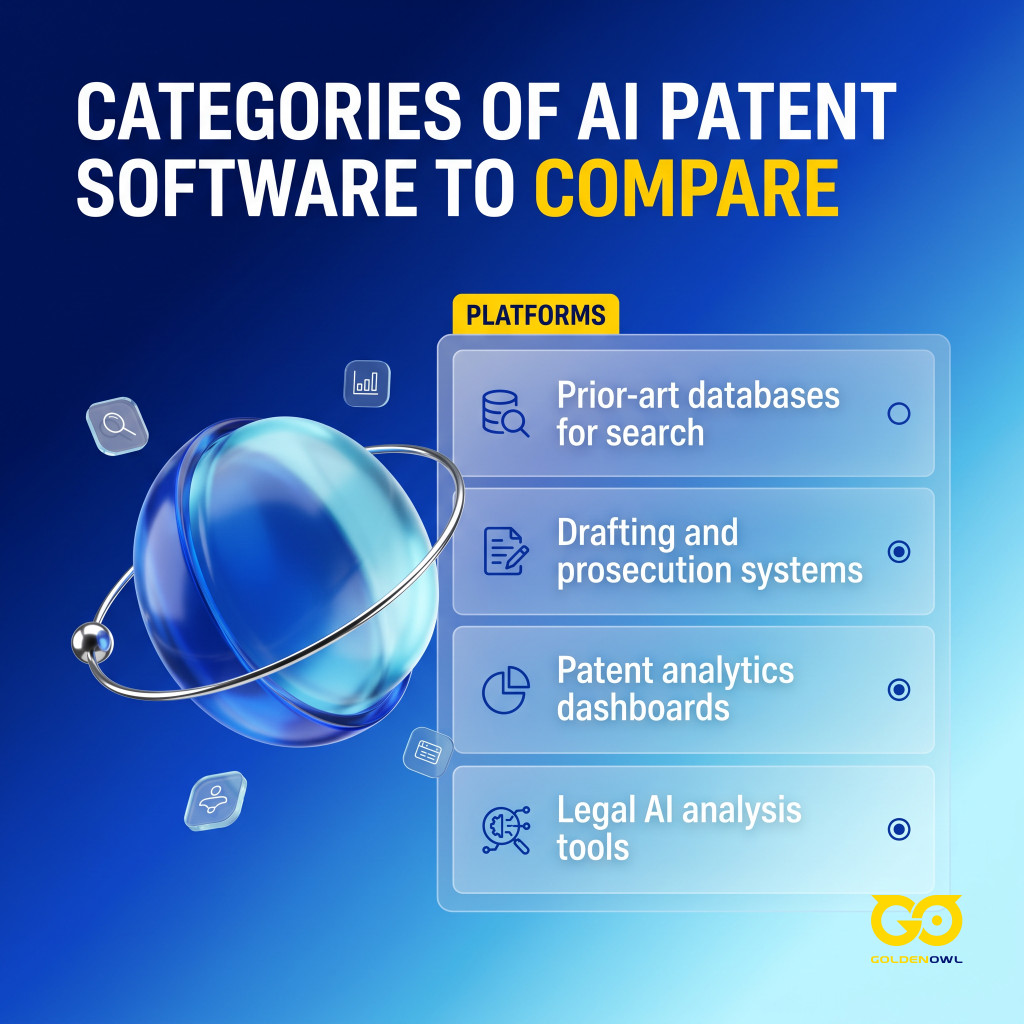
Prior-art databases cover patents and non-patent literature worldwide, and they search by meaning and by image as well as by keyword. Reach for one when the question is whether something already exists, as in a novelty check or an invalidation search. The same goes for freedom-to-operate (FTO) work.
Drafting and prosecution tools write and check claims and specifications, and many of them live inside Word. They also read office actions. If that’s your main need, ai solutions for patent generation in legal industry goes into it in more depth.
Analytics tools turn filing data into dashboards and landscape maps. They show technology trends and what competitors hold, which is how you spot white space.
Legal AI tools read the file history and cited references alongside the claims. Their output is usually a first-draft claim chart or memo for invalidity or infringement work. I’d read every line of it, because the attorney owns the conclusion.
Patlytics
Patlytics calls itself an AI-native patent intelligence platform, and the pitch is breadth: most of the patent lifecycle in one workspace, from claim-level assessment and prior art review to infringement and invalidity work. If your team touches every stage, that breadth may be worth having. If you only need one step, it’s probably more than you need.
Its claim breakdown turns dense claim sets into structured hierarchies that flag key terms and dependencies. For prior art, Patlytics says it combines multimodal similarity models with citation networks and structural comparison. It also summarizes office actions, amendments, and citations into a readable account of how the claims evolved. And it shows where a patent sits within its family and competitor filings. I’d ask for a demo on a claim set you already know well, since the claim breakdown is the easiest feature to judge.
Security claims deserve a closer look than feature claims. Patlytics says it holds SOC 2 Type 2, ISO 27001, and ISO 42001 certifications, and that it never uses customer data to train models. It also says that data is encrypted in transit and at rest and kept segregated. All of that is the vendor’s own account, so I’d ask to see the audit reports before relying on it.
IP Copilot
IP Copilot works earlier in the process than the other tools here. It looks for inventions inside the tools engineers already use, such as Slack, Jira, and GitHub, and it scores ideas as filing candidates.
For patent analysis, that makes it a fit for early intake: organizing disclosures and deciding what to file. Its public materials also list prior art search and eligibility checks. They don’t pitch it for claim charts, invalidity, infringement, or reviewing the file history. So I wouldn’t buy it for those jobs.
DeepIP
DeepIP is built for drafting and prosecution, and it runs inside Microsoft Word. That’s a real advantage, because practitioners stay in the document they already use. Beyond drafting, it covers review, prior art analysis, and office action work.
Its analysis works best when it feeds a drafting or prosecution task, like claim review or an office action response. It also suggests amendments. For chemistry and life sciences, it handles Markush structures, sequences, and experimental data. If you want infringement analysis, claim limitation mapping, and patent-to-product mapping in one system, ask for a demo of those specifically. DeepIP’s public material centers on drafting and prosecution.
Derwent Patent Intelligence
Clarivate’s Derwent Patent Intelligence pairs patent search and analytics with human-edited data from the Derwent World Patents Index (DWPI). Clarivate says every DWPI invention summary is written by a subject matter expert. That human layer is the reason to consider it.
Clarivate frames it as patent data, AI tools, and expert services behind decisions on patents, innovation, and strategy. I’d put it on the shortlist for teams that rely on curated data and structured search. What Clarivate describes is data and search, not one workspace for drafting, prosecution, and claim-to-element comparison, so pair it with another tool if you need those.
Patsnap
Patsnap sells an innovation intelligence platform to IP and R&D teams, and it names Eureka as its flagship product. It’s broad, with patent analysis sitting next to competitor tracking, prior art search, and market intelligence. That makes it most useful where patent analysis meets R&D strategy.
Patsnap lists prior art search, FTO analysis, and patent landscaping among Eureka’s features. For claim comparison, prosecution, invalidity, infringement, and portfolio trimming, ask in a demo what the platform does and what needs a separate tool.
Black Hills AI
Black Hills AI provides docketing, renewals, and paralegal services to IP practices. Its AI product, Otto IP, was built by IP attorneys. Black Hills says it offers more than 70 “Guided Skills.” They walk a user through a task once the documents are uploaded, such as drafting office action responses, claims, and amendments.
That mix suits firms with steady prosecution volume, where the same kind of office action response gets drafted again and again. If your main need is first-draft applications, compare Otto’s drafting skills with a drafting-first tool such as DeepIP before you decide.
Platform evaluation criteria
Begin with semantic prior-art search, since it anchors any platform review. Pick a search-first platform when finding prior art is the main job, and an analytics-first one when the portfolio is. Then run the search on cases you’ve already closed, where you know the right answer. Ask why each result ranked where it did, because a ranking nobody can explain is hard to defend.
Security comes next. Patent work means unpublished applications and invention disclosures, plus confidential client files. I’d treat security as a requirement before you compare features.
Ask what controls sit around your documents: who can open them, how they’re encrypted, and what the audit log records. Then ask for the audit reports and put one question plainly: do my documents ever train a model? A vague reply should count as a no, since a firm yes or no is easy to give.
If you work in chemistry or life sciences, check that the platform handles chemical structures, biological sequences, and experimental data. A text-first tool can miss them.
Last, tie the platform to the question you’re really asking. For infringement exposure, you want citations that map straight back to the claims. For a decision about where the maintenance budget goes, you want an engine built around portfolio pruning and maintenance trends.
Legal boundaries of patent AI
Patent AI can organize the review. It can’t make the calls that carry a signature: how a claim is construed, whether it holds up or is infringed, and what gets filed. Those stay with the attorney.
A model can lay out claim structure, dependencies, and defined terms without much trouble. Reading the language is another matter, because one word can change how a claim is construed. Choosing which reading carries legal weight is a judgment call, and I wouldn’t hand that to software.
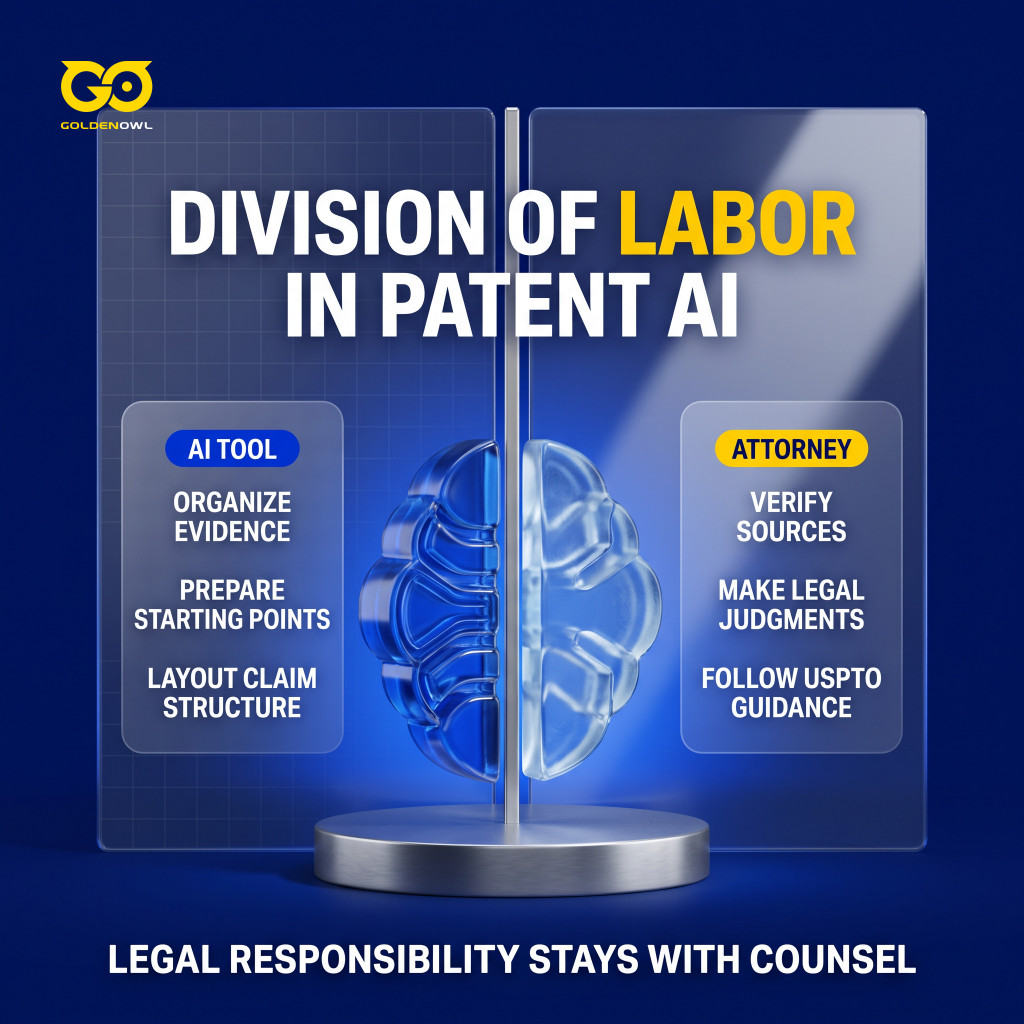
Check AI-drafted analysis against the claims and the cited references before you rely on it. I’d treat it like an associate’s memo: a good starting point, but one you test against the source documents before it shapes your position.
In April 2024 the USPTO issued guidance on AI tools in practice before the Office. It applies existing duties, including candor and the signature certification, to AI-assisted work. An AI tool can’t sign a filing, so a person answers for every statement in it. That’s why you review everything an AI produced before you submit it.
An automated clearance report is not legal sign-off, even when someone treats it that way. Pattern matching can flag potential overlaps, but it can’t establish that a patent is valid.
Frequently asked questions
What is the difference between patent search software and patent analysis software?
Search software answers one question: what already exists, and where might it threaten novelty? Analysis software starts after that and asks what the prior art means, legally or strategically, how strong the claim position is, and what to do next.
Can AI analyze patent claims?
Yes, with attorney review. It can split claims into limitations and compare them with prior art or evidence of use. It can also draft claim charts for invalidity, infringement, and FTO work.
How is patent AI different from general legal AI?
Patent documents are an odd mix of legal wording, dense technical disclosures, and figures, with claims in a rigid format, and patent AI has to handle all of it. It can also follow a thread across patent families, file histories, and prior art, rather than staying inside one document. Unlike ai legal solutions, which cover broader legal workflows, these tools focus on patent work.
Can AI handle patents in multiple languages and jurisdictions?
Many platforms can search patent documents across languages and jurisdictions with one query. Don’t assume full coverage, though, because it differs by product, so check which languages and patent offices yours includes. The legal arguments still need a human, since every office applies its own standards for novelty, inventive step (non-obviousness in the US), and claim scope.
Can AI handle patent docketing and deadlines?
No, docketing software works out deadlines from each jurisdiction’s rules, which analysis platforms generally don’t do. The two run side by side: docketing shows what’s due, and AI helps prepare the work. A generative model can parse an office action and suggest a response strategy. A statutory deadline needs a deterministic rule engine instead, because one miss can cost you your rights.
Is AI-drafted patent content accepted by the USPTO and EPO?
Generally yes, as long as a person takes responsibility for it. The USPTO’s April 2024 guidance sets no general duty to disclose that you used an AI tool. It does require you to disclose anything material to patentability, and a person must sign and stand behind every filing. Inventorship is where the line is firm. In November 2025 the USPTO said AI systems are tools, not inventors, and the EPO’s Legal Board of Appeal held in the DABUS cases (J 8/20) that a machine can’t be an inventor. This area is still moving, so read the current text of each office’s guidance before you file, and confirm the EPO’s position on AI-assisted drafting yourself.
AI solutions for patent analysis are good at finding prior art, reading claim language, and structuring the work. They’re much weaker at saying what any of it means. Most platforms are strong at one or two of search, analytics, and drafting, so choose by the question you ask most often. An attorney should check every conclusion before it goes anywhere, and deadlines belong to a rule-based docketing system, not to a model.
Share this page


Table of Content

Subscribe to Golden Owl blog
Stay up to date! Get all the latest posts delivered straight to your inbox