How to use AI in real estate: automate lead follow-up, speed up valuations and marketing, and keep every step compliant with Fair Housing rules.


Evaluating AI Solutions in Supply Chain Management
Oct 13, 2026
about 8 min read
Evaluate AI solutions in supply chain: where demand forecasting and planning agents pay off, the architecture behind them, and how to roll out safely.
AI solutions in supply chain management earn their keep when something goes wrong, not when the forecast happens to be right. A late container or a missing customs form is a harder test than a tidy demand curve, and it’s the test most demos skip.
The rest of this guide covers where AI helps, how platforms coordinate decisions across teams, and how to test the results. If I had to pick one test, it would be whether a system helps people act on an exception or only flags it.
High-Value AI Solutions in Supply Chain Operations
Most of what AI does in a supply chain comes down to three jobs: it answers messages, it reads data, and it carries out routine tasks. A copilot that can reply to a supplier inquiry or confirm an order saves someone the back-and-forth, which matters because every update has to hop from one link in the chain to the next. The reading job is pattern-spotting, with machine learning models watching data from many sources as it arrives for the first sign of a delay or a bottleneck. The doing job is plainer still: raise purchase orders, track shipments, and tell whoever is affected when something slips.
Paperwork is the first place I’d look, since that’s where the volume sits. Freight data is locked in forms that someone has to read and key into an operational system, and that someone can lose hours to PDFs, bills of lading, and customs forms. Every new format makes standardizing harder. Computer vision and natural language processing now do that reading, at a volume that once took a large team.
A large supply chain can see thousands of exceptions a day: a wrong freight code here, a duplicate invoice there. No human reads all of them with care. That’s the opening for AI solutions in supply chain operations, which can spot the exceptions, rank them by business impact, and settle the routine ones without waiting for anyone. Whatever is left needs judgment, and people can give it their full attention. That’s narrower than the broad industrial ai solutions people usually discuss, because these deployments go after one bottleneck at a time.
Demand Forecasting
A static forecast leans on past sales, promotion schedules, and the team’s instinct about next quarter. It works until conditions shift mid-cycle, and then it misses. Demand sensing flips that around. It reads fresh sales and market signals in short cycles, so a team can re-forecast as soon as demand moves instead of waiting for the monthly or quarterly update.
Signals and patterns
The models draw on past sales and market trends, along with weather and social media sentiment. To my eye, the real value is in correlations between signals that an analyst wouldn’t think to cross-check. Firms can use those to set stock levels and production plans.
Prediction accuracy
A 2018 study compared Long Short-Term Memory (LSTM) networks, a type of deep learning model, with the traditional ARIMA model, and LSTM cut average forecast error by 84–87%. Before you quote that to anyone, check the data: it was economic and financial time series, not supply chain datasets. So I’d read it as a sign of what deep learning can do, and a poor promise for your own network.
Inventory Optimization
Safety stock is a cushion, and cushions cost money to keep. AI inventory systems keep an eye on demand, lead times, and supplier swings, and they resize that cushion across a large distribution network as things change. The aim is to keep carrying costs and stockout risk in balance.
In McKinsey’s comparison of early adopters of AI in supply chain management with slower-moving competitors, the early adopters improved logistics costs by 15%, inventory levels by 35%, and service levels by 65%. Those are comparisons between companies, so they can’t tell you what your own numbers will do after a rollout.
In normal times, adjusting safety stock automatically can free up cash that sits in stock. The risk is going too far. Trim buffers hard and a sudden failure at a key tier-one supplier has nothing to cushion it.
Logistics Network Routing
Routing is the easiest place to see AI at work: the system reads package data, delivery stops, traffic, and weather as they change, and it picks routes from that. Shorter routes mean fewer driving miles and lower fuel and operating costs, and they make delivery times easier to predict. UPS said its ORION routing software would remove 100 million miles of driving a year once fully rolled out.
Network adjustments
The same watching works at network level, using shipment volumes, carrier reliability, and current route conditions to spot a better path. If a fulfillment center slows down, inventory can move before orders fall behind, and a drop in delivery performance in one region gives planners time to shift capacity. Both are really inventory calls, which is why this section overlaps with the last one.
Core Architecture of Modern Supply Chain AI
Modern supply chain AI sits on top of the systems you already run. Those are ERP (enterprise resource planning), WMS (warehouse management), and TMS (transport management), plus internal models, and together they feed risk dashboards, data analysis, and automated planning in one place.
Large language models (LLMs) power the generative AI (GenAI) layer, so users can ask a question in plain language and get a summary and advice back. The part I’d care about sits behind the chat box. The system takes in internal and external data, including ERP records, supplier signals, and market shifts, and puts the risks and opportunities it finds on live dashboards. If something doesn’t add up, it flags the discrepancy and adjusts the plan in real time.
Agents draw on the same models, logic, and data as human planners. That’s what lets them weigh trade-offs, recommend an action, and coordinate decisions inside planning rules and constraints. Staff set the guardrails, and explainable logic keeps people in control: if you can’t see why an agent said what it said, you can’t really supervise it.
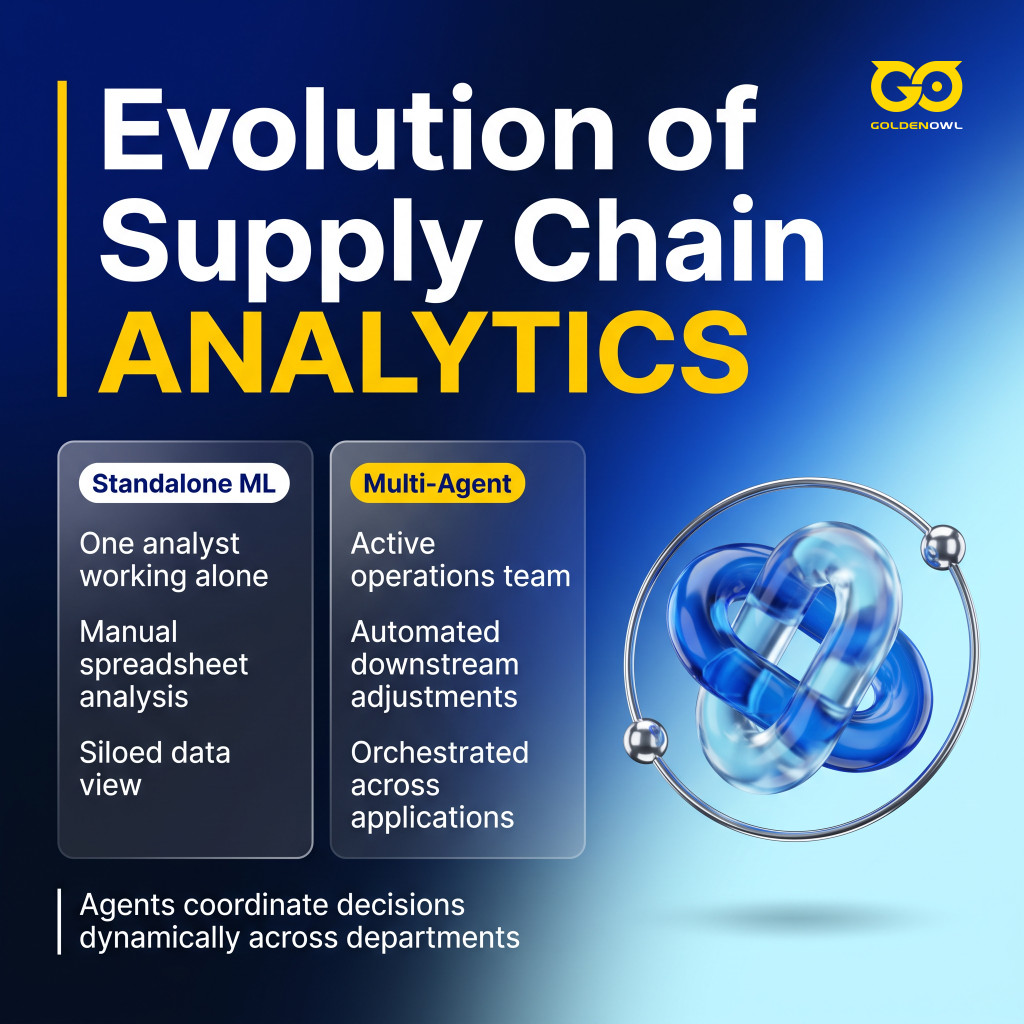
The daily load is the reason this matters. Supply chain teams can face thousands of routine choices a day, from which orders to prioritize to whether to share a shipment delay. Where monitoring is manual, people may spend much of the day just watching dashboards and reacting. Orchestration software changes that by running AI agents across stock-control, transport, and customer support tools. When an exception comes up, the agent gathers the data and proposes a fix, then hands the case to a person if it needs one.
A digital twin, a virtual copy of a site or a whole network, lets teams rehearse a layout change or a disruption before it happens.
Standalone machine learning is like one analyst alone with a spreadsheet. A multi-agent setup is closer to a busy operations team, where an update at one desk can set off changes in procurement and dispatch.
Criteria for Selecting Supply Chain AI Solutions
Model sophistication is only half the question. The other half is plumbing: how well each tool connects to your current systems as updates move from procurement to dispatch, which demos tend to gloss over. At the start of a pilot, an ai solutions consultant can turn your integration needs into a workable scope.

Run the pilot against a live bottleneck rather than a clean test case, and watch three things: do routine tasks get handled, do exceptions reach the right person, and do big decisions stay with someone accountable? Data should flow both ways too. When you evaluate an enterprise ai procurement software solution, check whether it connects your data pipelines to daily dispatch tools. A broken pipeline can make an advanced algorithm less useful than a simpler model, so ask about the pipes before the algorithm.
Older and on-premises systems may not work with generative AI right away, so expect integration problems. Expect the security questions to grow as platforms connect to more systems and take in outside data, especially when control over IP and supplier data has to hold across regions or partners. Rules on AI use, privacy, and security keep changing too. Write down which tools may touch which data, and who signs off before a new one goes live.
Then there’s money and time. Ask what the tool costs to run and how long it takes to show results. Ask, too, what happens to your data if you switch vendors, because that’s the answer you’ll want in writing.
Measurable Business Outcomes
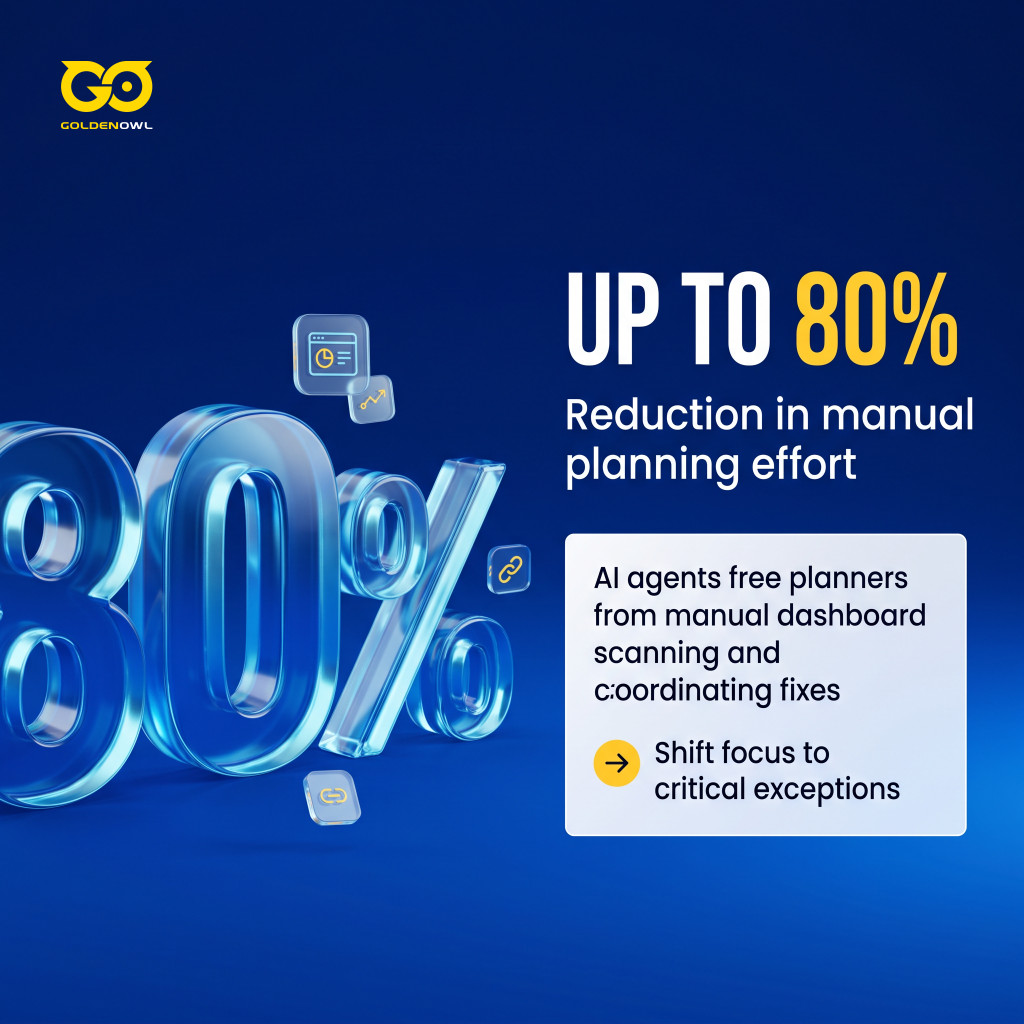
Planning time is one number worth tracking. Hanu Gadila is Senior Director of Global Supply Chain Planning at Merck & Co. In a Kinaxis piece, Gadila said planners often spend more than 50% of their time on dashboards and filters, hunting for late supplies, alternatives, and fixes. Gadila estimated that AI agents could cut that effort by up to 80%. That’s one practitioner’s estimate rather than a measured result, so test it in your own pilot.
Beyond planner time, I’d track five metrics, each tied to a decision you can actually change. Record every one before the pilot starts, because without a baseline a good quarter proves nothing.
- Stockout rate: how often products run out of stock. Better demand forecasting and earlier inventory adjustments should help reduce shortages.
- Transportation costs: shipping spend, plus how often you pay for expedited freight. Improved routing and planning often lower both.
- Fulfillment cycle time: the time from order placement to delivery. If decisions get faster across forecasting, inventory, and logistics, this is where it would show.
- Inventory turnover: how fast stock moves through the network. When you buy closer to real demand, turnover usually improves and excess stock falls.
- Service level performance: on-time delivery rate and order accuracy. Steadier operations often mean steadier service for customers.
Frequently Asked Questions
How do AI agents support supply chain processes?
An agent reads current conditions, weighs trade-offs across teams, and recommends the next best action inside real planning rules. Traditional systems may flag a problem or show KPIs, and then planners are left to work out the response themselves. That gap is the whole pitch for agents.
How does AI improve demand forecasting?
Mostly by using more data, more often. Predictive models look past historical sales to current order trends and regional demand signals, along with other things that shape buying.
What is a digital twin in supply chain AI?
It gives teams a virtual version of their network. They can simulate a disruption on it and see what happens to inventory, fulfillment, or cost before it happens for real.
What are the risks of AI in the supply chain?
Some AI agents are black boxes: they make decisions without showing how, and that’s a real problem. Planners need to see which data was used, which constraints applied, and how the agent balanced cost, labor, and service KPIs. Poor data is the other big risk, since an agent working from stale or wrong records can make confident mistakes.
Conclusion
The AI solutions in supply chain that pay off are the ones aimed at a real bottleneck, such as late documents or exceptions nobody owns. So choose the bottleneck that eats the most time or money today and pilot against that one. Track the five metrics above before and after, so you know whether it worked. Planners will only trust a recommendation if they can see the data and constraints behind it, and that same view lets them overrule it when it’s wrong.
Share this page


Table of Content

Subscribe to Golden Owl blog
Stay up to date! Get all the latest posts delivered straight to your inbox