
How to use AI in real estate: automate lead follow-up, speed up valuations and marketing, and keep every step compliant with Fair Housing rules.


Best AI solutions for ecommerce
Oct 13, 2026
about 9 min read

Compare the best AI solutions for ecommerce by workflow, data needs, and team fit, and learn how to choose and test the right tool for your store.
The demos make AI solutions for ecommerce look easy to pick. In practice, a prediction can look sharp and still miss how your customers really shop. That happens most often when behavior, purchases, and marketing results sit in separate systems. A small catalog makes it worse, because you can’t tell whether a personalization model has enough data to learn from.
I’ll go through five tools by the job each one does. For each, I’ll say what it needs from your data and your team. After that come six criteria for judging any tool. Last is a way to set a baseline, so you know whether a workflow deserves more budget.
Top AI solutions for ecommerce
Each tool has one main job: personalization, predictions, search, marketplace feeds, or campaign automation. I’d judge them by what they ask of you, since data, traffic, and team capacity decide how well any of them works. They all sit inside the wider field of ai retail solutions.
Dynamic Yield
Dynamic Yield rewrites your site and your email around what each visitor is doing right now. It’s a Mastercard company, and it relies on machine learning to sort visitors into groups. Each group gets its own promotions and product carousels, so nobody has to hand-write the rules.
A single visit can reshape the whole homepage, from the products shown to the promo banners. The calls are made on the fly, from what the visitor browsed, what they bought before, and where they arrived from. Two methods sit behind the recommendations. Collaborative filtering suggests what similar shoppers bought. Content-based filtering suggests items that resemble ones this shopper liked.

Testing is built in, both A/B and multivariate. That matters because you can set a personalization approach against a control group and see whether conversion rate or average order value actually moved. Connecting your ecommerce platform takes a JavaScript tag or an API.
Pricing is custom and quoted through sales. I’d get a number before building a plan around it. A tool you can’t afford to roll out stays a demo. Setup also needs a front-end developer to add the tracking scripts and set the personalization rules.
Segments are only as good as the data behind them, and the data has to keep arriving. Before Dynamic Yield can build accurate ones, website behavior and purchase history have to sit in one place. I’d add email engagement from your marketing platform as well, since it fills in what the site can’t see.
Traffic matters as much as data quality. With a small catalog or a low-traffic site, the model may never see enough signal to find real patterns. The same goes for A/B tests: on a trickle of visitors, I’d assume the winner could be luck.
Klaviyo
Klaviyo is an email and SMS platform, and its predictions are the reason to look at it. It reads past purchases and engagement. From those, it estimates each customer’s lifetime value and churn risk, plus when they’re likely to buy again. Then it groups customers and triggers campaigns.
Those predictions drive simple flows. As an illustration, a win-back email could go to high-value customers who haven’t bought in 60 days. A discount could go to customers forecast to churn within 30 days. I like this setup because the rules are easy to read and easy to change.
Klaviyo plugs into ecommerce platforms and imports customer profiles, orders, and product details on its own. Pricing starts at $20/month for up to 500 contacts and then climbs with contact count and SMS usage.
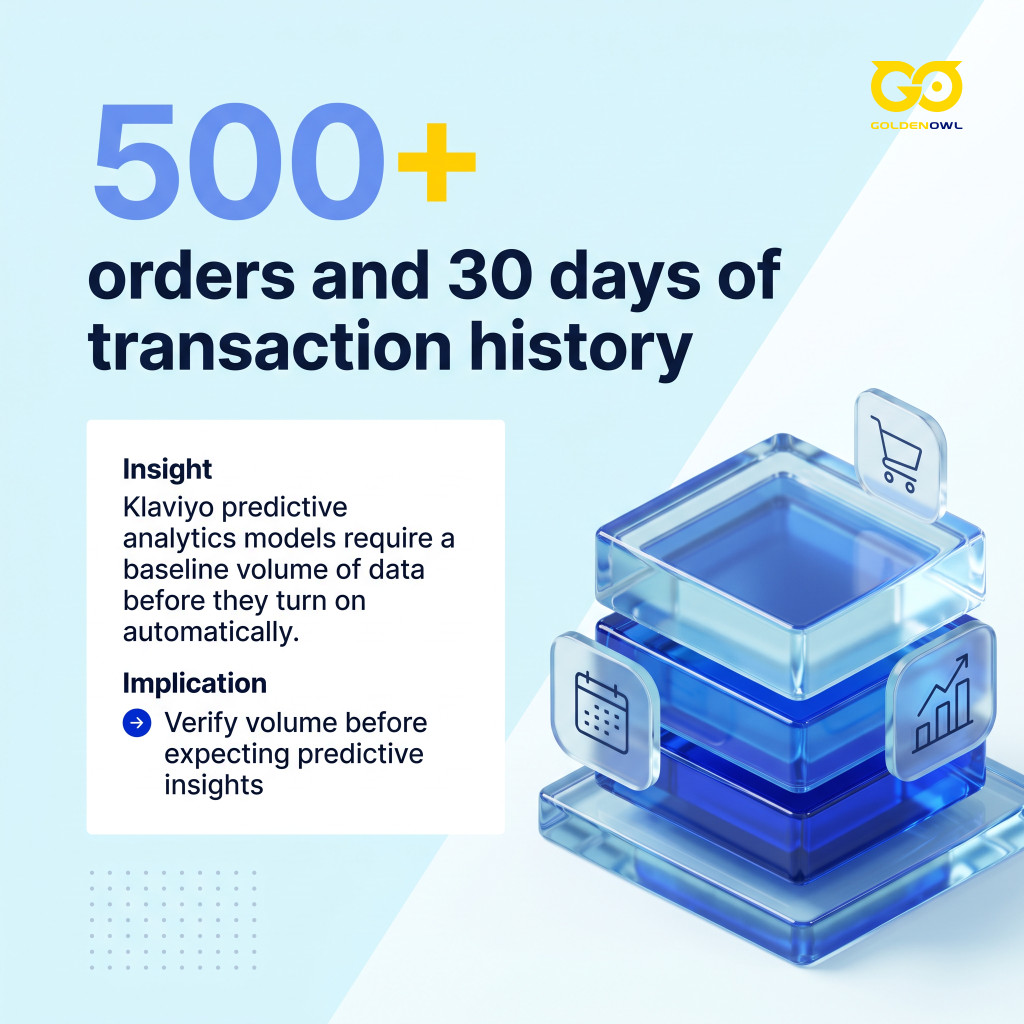
Install the integration first and let purchase records build up. The models turn on by themselves once your account meets Klaviyo’s data minimums. Those minimums are the catch.
Klaviyo’s help center lists them. You need at least 500 customers who have placed an order. You also need at least 180 days of order history and one order in the last 30 days. A new store or a low-volume catalog can wait months for predictions. So I wouldn’t choose Klaviyo for its predictions alone while you’re still small.
The predictions are also built for email and SMS. Want those scores for ad targeting, website personalization, or support? You will likely need to move the data out through an API or an integration.
Algolia
Algolia does one job, site search, and does it well. A shopper who mistypes a word, uses a synonym, or asks in plain language still gets sensible results. The ranking then leans on relevance, popularity, and how likely each product is to convert.
Algolia says its searches return in under 50 milliseconds, even across catalogs with millions of SKUs. That’s the vendor’s own figure, so I’d test it on your catalog before you count on it. NLP is what lets it read intent. Search “blue sneakers” and you should get blue sneakers, not any shoe with “blue” somewhere in its description.
Ranking mixes text match with business signals such as popularity and inventory status, plus your own rules. Merchandisers can adjust those signals in a visual interface. For example, they can push high-margin items or new arrivals up, with no code.
An API connects your ecommerce platform to Algolia. Pricing is usage-based and grows with search requests and indexed records. Committed contracts come with volume discounts you negotiate with sales.
Setup needs developers. Someone has to maintain the product feed pipeline, set indexing rules, and add Algolia’s JavaScript library to the site. Without engineering help, that can take weeks. Algolia also solves site search only, so segmentation, demand forecasting, and ad optimization need other tools.
Channel Pilot Solutions
Channel Pilot Solutions is for sellers who list on several marketplaces. Its AI manages the product feeds and adjusts prices, with the aim of winning more visibility and profit on each channel.

It ties three jobs together. Feed optimization formats your product data so listings stay accurate on each platform. Dynamic pricing changes prices on its own as the market, competitors, and demand move. The predictive side reads channel performance and suggests ways to lift sales.
I’d run two checks before committing. First, is your product data consistent across the channels you sell on? Feed optimization can’t fix contradictory data. Second, decide who approves price changes. The platform adjusts prices automatically, so a bad rule can run across every channel before anyone notices. I’d also want to see the performance data behind its recommendations before trusting them.
Emarsys
Emarsys is a marketing platform that works across channels, with AI built in to predict behavior and write content. It guesses what customers will do next and sends them content on each channel, aiming for more sales and repeat buyers.
Machine learning builds its segments from predicted behavior, affinities, and lifecycle stages. Product suggestions draw on historical and real-time data. On the campaign side, it writes email subject lines, personalizes offers, and picks send times.
Like the other tools here, Emarsys needs unified customer and product data first. Its segments and recommendations are only as good as the history feeding them.
Evaluation criteria for ecommerce AI solutions
Put data hygiene and your team’s capacity ahead of a vendor’s headline algorithm claims. The six criteria below show what a tool needs from you and what it can realistically deliver.
1. Data integration requirements
Start with how the tool gets its data. Some read from a warehouse you already run, some from a customer data platform (CDP), and some through direct API links to your ecommerce platform, ad accounts, and CRM. Many also want clean, normalized data on day one. If that’s the case, estimate how long your team will spend building ETL pipelines (jobs that copy and clean data between systems) before the AI makes its first recommendation. And if your product catalogs and behavioral analytics lack clean historical tracking, normalize the data before you buy customer-facing predictive tools.
2. Time to value
Count the days between signing up and the first insight you can act on. Then ask what “just connect your data” really involves. It can mean building a data warehouse, mapping dozens of fields, and waiting a couple of billing cycles for enough training data. Klaviyo’s 180-day minimum shows how long that wait can get.
3. Transparency of AI models
Ask whether you can see why the tool made a specific recommendation. A black box may be fine for product recommendations. It’s a risk for inventory forecasts and pricing. If you can’t see the logic, you can’t debug a bad prediction. You also can’t trust it when the stakes are high.

4. Compatibility with existing tech stacks
Check that the tool connects to what you already run: your BI platform, CRM, email service provider, and ad platforms. A tool that forces a new dashboard and new reporting steps gets adopted slowly, because it pulls your team away from routines they already follow. If your engineers have little spare time, an ai solutions company can help you assess what implementation would take.
5. Measurable business impact
Name the exact metric the tool is supposed to move. Phrases like “better customer experience” and “AI-powered insights” aren’t metrics, and they can add overhead with no clear ROI. I’d only take a vendor seriously when it ties a claim to something you can count, such as conversion rate, stockouts, or analyst time saved.
6. Cost structure and scalability
Find out what makes the price move: usage, data volume, or the number of SKUs. A cheap entry price can climb fast as your catalog grows or traffic rises. Klaviyo’s contact-based pricing and Algolia’s per-request pricing both show this. Work out the cost at twice your current size before you sign.
Here’s where I’d start: with one bottleneck you can measure, whether that’s conversion rate, stockouts, or analyst hours. Write down today’s number before you buy anything. Then pick the tool whose data and team needs you can actually meet, and judge it against that number after 30, 60, or 90 days. If you can’t meet its needs yet, fix the data first. A good tool on bad data only produces confident mistakes.
Frequently asked questions
What data do AI tools for ecommerce need to work effectively?
They need clean, normalized data that arrives in real time or close to it, and it comes from three places. The first is customer behavior: clicks, product views, and cart additions. The second is transaction history, meaning purchases, order values, and SKUs. The third is marketing attribution, which tracks ad clicks, email opens, and referral sources.
How do I measure ROI from AI solutions for ecommerce?
Pick one metric and record it before the tool goes live. Then compare it with the same metric afterward, over a window of 30, 60, or 90 days. A store with few orders needs the longer window, because a short one won’t show a real change. Conversion rate, average order value, time spent on manual reporting, and stockout frequency all work.
What is the difference between SEO and AEO in ecommerce?
SEO tunes your pages around keywords so they show up in standard search results. AEO, short for Answer Engine Optimization, is the newer cousin. It shares your brand data in an organized way, so AI engines can mention and suggest your products in chat-based answers.
Can small or growing brands benefit from AI in ecommerce?
Yes, if they start with tasks that need little data. A small team can use AI to write product descriptions, produce marketing content, and tune the store for search, none of which takes technical expertise. Prediction and personalization tools are different. They need order and traffic volume a small store may not have yet, as the Dynamic Yield and Klaviyo sections show. A lean team can also look at an AI chatbot to automate customer service.
What is the difference between generative AI and machine learning in ecommerce?
Generative AI creates content: product descriptions, blog posts, and email campaigns. Machine learning works from customer data to forecast behavior and tailor the shopping experience, for example through product recommendations and dynamic pricing. If that’s hard to hold in your head, think of machine learning as the analyst who works out what a shopper may need, and generative AI as the copywriter who writes the pitch.
What is the biggest challenge with AI for ecommerce?
Customer data split across tools. The ad platforms, email service provider, ecommerce platform, analytics tools, and CRM each hold a piece of the picture. AI tools can only make accurate recommendations or predictions once those pieces are unified and clean.
Share this page


Table of Content

Subscribe to Golden Owl blog
Stay up to date! Get all the latest posts delivered straight to your inbox