
How to use AI in real estate: automate lead follow-up, speed up valuations and marketing, and keep every step compliant with Fair Housing rules.


Enterprise AI Banking Solutions for Financial Institutions
Oct 12, 2026
about 7 min read

AI banking solutions explained: how banks choose, deploy and govern AI for credit, fraud and compliance, with institutional case studies.
Why do so many bank AI projects stall after a good demo? Often because the bank chose the product before it chose the problem. "AI banking solutions" is a label stuck on very different tools, and a fraud engine has about as much in common with a customer chatbot as a smoke alarm has with a thermostat. Pick the job first. Then the platform question gets a lot easier to answer.
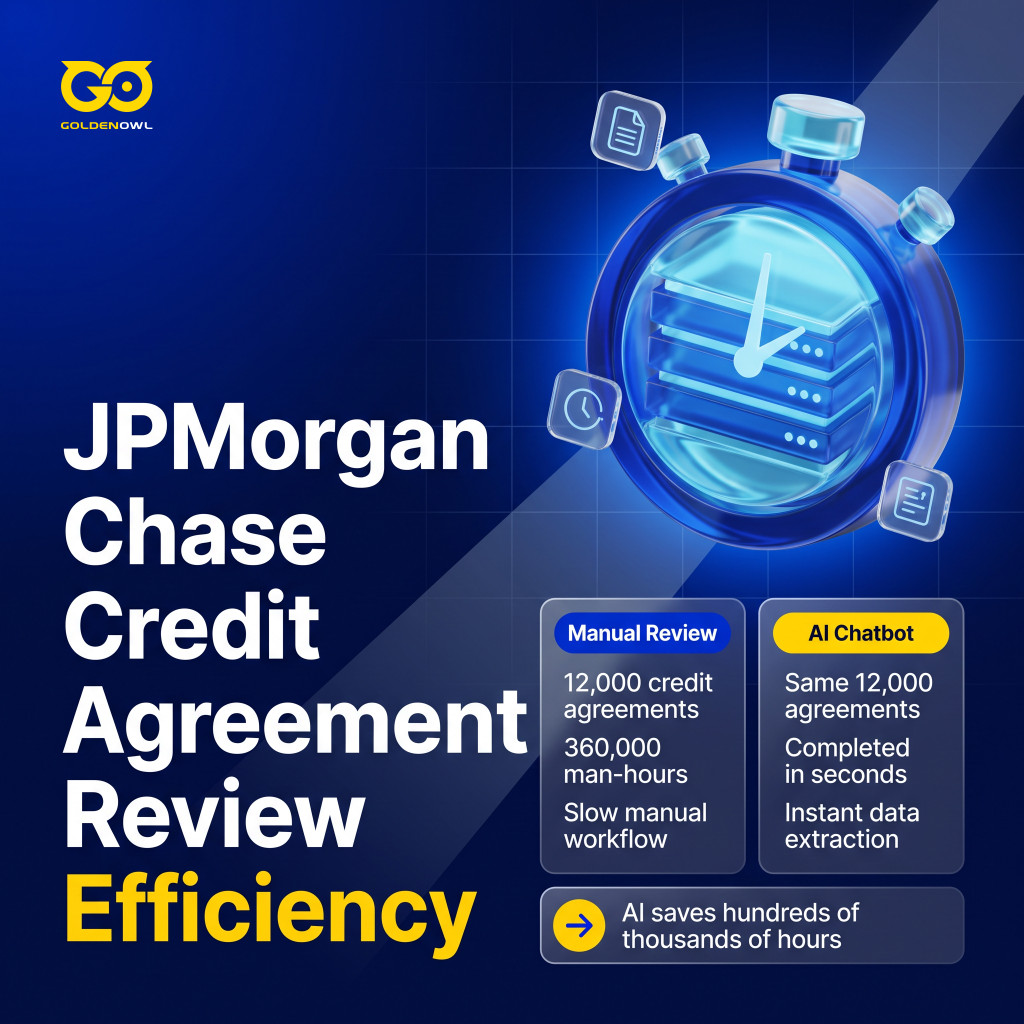
When the job is narrow, the payoff can be striking. JPMorgan Chase reported in 2017 that its Contract Intelligence software took over work that had cost lawyers and loan officers about 360,000 hours a year. The rest of this guide covers how to choose a platform, where banks use AI now, and what two institutions did with it.
Enterprise AI Banking Solutions
Some platforms watch transactions for fraud and money laundering. Others score and price credit risk, and others answer customer questions. You’ll compare them badly if you line them up by brand, so shortlist by job. Then ask each vendor to prove itself on that single job, with references, measured results and governance papers. A glossy profile that never says which workflow it improves hasn’t proven anything.

Selection Criteria for Banking AI Solutions
Start with the pain your bank feels most, whether that’s fraud, slow onboarding or credit decisions. Each one points to a different platform. If you lack the people to run a pilot, an experienced AI solutions company can run it alongside your team. That beats finding out after a full rollout that the fit was wrong.
What are other banks doing? Fraud is the safest ground: about 58% of banks use AI extensively there, and about 54% use it intensively in IT operations. Ambitions get smaller from there. Only about 17% plan to add AI-assisted personalized investment strategies, and fewer still expect better credit scores or portfolio optimization. Nobody named the survey behind these numbers, so use them to sense direction and nothing more.
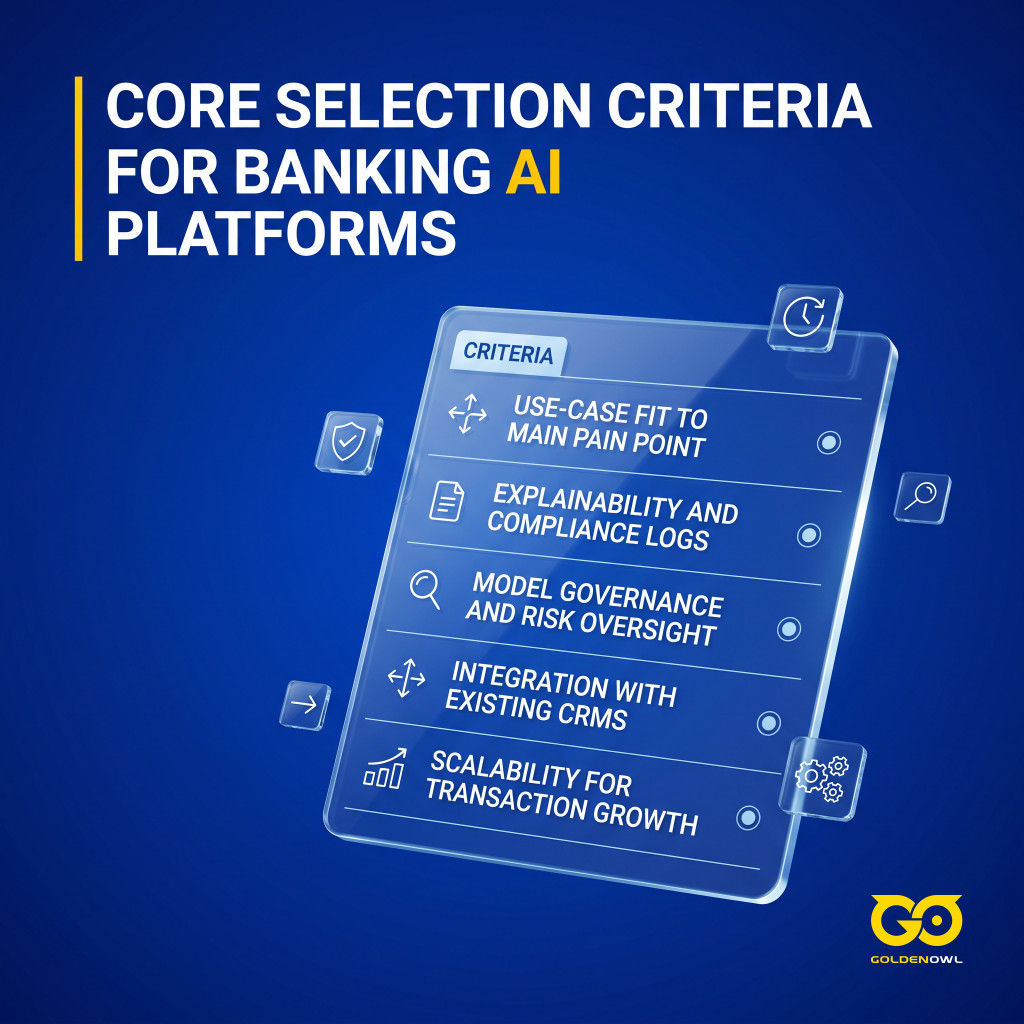
Compliance is where a bad choice costs real money. Financial institutions in the United States and Canada spend around $61 billion a year on financial crime compliance, and nearly all of them saw costs rise in 2024. So can a risk officer take a vendor’s results, audit logs and model governance to a supervisor and defend them? Hawk AI and NICE Actimize both sell AML monitoring, and asking each for its reporting papers is reasonable. Whatever ai compliance solutions a vendor offers, check them against what your own supervisors demand.
A demo will never show you integration, and integration is where projects get stuck. Will the platform connect to your CRMs, payment gateways and risk tools without a mess? Run a small pilot and you learn that and the ROI together, before anyone has to change how they work. Then ask whether it can keep up when transactions double and monitoring never stops. Feedzai and Elastic are two names to look at for scalable monitoring of suspicious activity.
Operational AI Solutions for Banking
Bankers are optimistic about where this goes. About 80 percent see room for savings and profit, and more than three in four call AI a deciding factor in whether the industry succeeds. That’s a lot of confidence for something many haven’t tested. After a pilot works, AI banking solutions can spread into specific workflows across departments, and the claim that they cut costs and improve service is one you can check yourself.
Fraud Prevention
Behavioral biometrics are a good example of a tool that does one narrow job well. At one bank, a third-party RegTech provider helped lift fraud detection rates above 90% and cut false positives by 66%. Don’t treat those numbers as a promise: they come from a single deployment and show what’s possible, not what you’ll get. Ordinary changes in a customer’s behavior can also set off alerts, so the bank has to tune the approach to its own customers and keep watching.
Once the first alert fires, the useful features are the dull ones. The system combines behavioral signals with transaction patterns, flags odd activity and ranks alerts inside the review workflow the bank already uses. Triage is fast, and each case is resolved or escalated automatically. Fraud never stands still, so the models need constant monitoring, and the rules need to move with them.
Turning AML Rules into Detection Scenarios
Writing a new AML scenario has often been slow, manual work. The delay slows the response to new risks, leaves documentation vague and floods analysts with false positives. Agentic AI suggests another way: take a rule written in plain text, turn it into a detection scenario a system can run, then validate and back-test it and recalibrate alert scoring against historical data.
A prototype makes this concrete. Team Consortix’s AURORA came out of the SAS Hackathon, so it’s a hackathon project and not a bank in production. The design is still worth studying. Because it needs little manual coding, a scenario takes less time to design, test and launch, and the bank can react sooner to new typologies and regulatory change. Back-testing on historical data cuts false positives before launch. It can also re-score alerting models from past behavior without re-engineering the core models, and it explains scenario logic and alert scoring in terms investigators and regulators can follow.

Compliance teams stay in charge, though. They review, approve and oversee each step, and the controls, documentation and traceability sit inside the process so audits are easier to pass. That matters more than speed. A fast scenario that nobody can audit is a liability.
Credit Scoring
Credit scoring is crowded with techniques. Machine learning, LLMs, NLP and agentic AI can work alone or together on structured and unstructured data, and between them they can judge creditworthiness, flag early signs of deterioration and portfolio risk, and support decisions in real time. Banks use that to speed up onboarding and approvals. They also use it to adjust credit limits and loan pricing as conditions change. Lending can also get more consistent and clear, provided the models stay explainable and auditable.
Alternative scoring models can widen credit access while the economy is stable. A sudden macroeconomic shift is different. It can upend past spending patterns and make these models misjudge borrower risk. A model trained on calm years has only learned calm years, so ask how yours behaves when the pattern breaks.
Model Lifecycle Documentation
Nobody enjoys model documentation, yet every audit asks for it. Automate it and you save effort and keep records consistent over the model’s life, because each change lands in one standard, traceable format. Audits get easier as a result.
Two features matter most. The first is an audit trail of model changes and decisions that updates in real time. The second is automatic tracking of versions, data lineage and metadata. Add human review, and people can catch and correct the model’s decisions over time. Data science, risk and compliance end up working from one record. Approvers can see clear summaries of how the model is doing.

Institutional Case Studies
Both cases date from 2017, and they do very different jobs: one talks to customers, the other reads contracts.
Capital One
In 2017, Capital One built an intelligent assistant that customers can reach through a mobile wallet app, a desktop, text messages or email. It warns them about fraud and handles routine jobs like paying a credit card or checking a balance. Small, frequent tasks that people would otherwise do by hand are where assistants like this earn their keep.
JPMorgan Chase
JPMorgan Chase introduced its Contract Intelligence (COiN) software in 2017 to analyze legal documents and pull out key data points and clauses. The workload was huge. Reviewing about 12,000 commercial credit agreements a year had required around 360,000 hours of lawyer and loan-officer time. JPMorgan reported that the software gets through them in seconds. Document review suits AI. The work is repetitive and high-volume, and a person can spot-check the output.
Frequently Asked Questions
What are AI solutions in digital banking?
They take over work people once did by hand, like analyzing credit data and monitoring transactions. They work through huge volumes of information in seconds and notice unusual activity that a person could easily miss.
How do AI solutions improve fraud detection in banking?
A rule-based system catches only what someone has already written a rule for. AI models learn from new data and adapt as fraud methods change, so you get faster detection, better risk checks and fewer false positives.
What are the main benefits of using AI in digital banking transformation?
Handing repeat work like data entry and transaction processing to AI can cut costs and improve accuracy. Real-time insights help banks decide and plan better too, but only if someone is set up to act on them.
Are AI-based banking systems secure and compliant with regulations?
Don’t take it on trust. Check each system’s encryption and access controls first, then its monitoring, and assess its compliance against the requirements that apply to your bank. Controls and evidence vary by product.
How can banks choose the right AI solution for digital transformation?
Match your business goals to your daily challenges and long-term plans. Then run a pilot or proof of concept before full-scale rollout, so performance and ROI are checked before the big commitment.
How can AI improve credit risk decisions in banking?
Banks can use AI to review spending habits and credit history when judging whether someone can repay a loan. Watch the inputs, though. Limit models to data that is lawful and relevant to repayment, and test for bias, because proxies such as location can create fair-lending risk.
How can AI personalize banking experiences?
AI uses customer data to tailor recommendations for each customer, which can also bring in revenue for the bank. That data needs the same consent and data-protection controls as any other customer data.
Can AI help with AML and KYC compliance?
Yes, it can strengthen Anti-Money Laundering (AML) and Know Your Customer (KYC) compliance. AI helps teams handle incidents more effectively, and they can check the health of fraud rules and models faster. Quicker resolution can improve the customer experience too.
Key Takeaways
Name the bottleneck you want to remove before you look at a single vendor. A pilot will then show whether a tool improves that work, fits the systems you already run and meets your governance rules. Nothing else counts as evidence before a wider rollout, because a vendor profile can’t tell you any of it.
Share this page


Table of Content

Subscribe to Golden Owl blog
Stay up to date! Get all the latest posts delivered straight to your inbox