
An AI legal assistant does the first pass of legal work. See what it can and can’t do, and which legal AI tools fit research, contracts, or practice management.


Enterprise AI Solutions: Top Platforms Compared by Use Case
Sep 8, 2026
about 11 min read
Explore the best enterprise AI solutions across CRM, IT, HR, and finance. Real use cases, vendor comparisons, and pricing to pick the right stack.
Across modern enterprises, rolling out enterprise AI solutions confronts leadership with a steep climb.
These platforms have quickly turned into core toolkits for lowering operating expenses, sharpening judgment at scale, and accelerating broad modernization programs where individual staff see real efficiency gains. If you poll your teams directly, half of all adult workers in the U.S. now use artificial intelligence on the job in some capacity. McKinsey's 2025 State of AI survey finds that 88% of organizations run artificial intelligence in at least one business function today. But systematic scaling has actually begun at only about a third of them.
Inside most corporate offices, the gap between ambition and reality remains brutal, given that 75% of corporate leaders admit their artificial intelligence roadmap serves more for show rather than guiding practical business decisions. When you look at balance sheets, massive spending has delivered demonstrable ROI for less than 30% of businesses, showing how unaddressed organizational and technical risks quickly become root causes of ai enterprise solutions failure.
Audit your daily workflows to spot where fragmented point tools still leave your staff stuck doing heavy manual tasks. Isolated business problems usually spawn siloed tools that don't share context or trigger actions across different environments. You solve this logjam by deploying enterprise platforms that pair integration with orchestration, giving software agents the authority to execute multi-step jobs under clear permissions across every connected system.
We dig into the top enterprise AI solutions by looking at what they actually ship, helping you pick the right stack, commit budget with conviction, and outpace your competitors.
Comparison of Top Enterprise AI Solutions
Comparing top enterprise platforms across their target use cases, core technical capabilities, and pricing models gives you the exact baseline you need to pick the right vendor.
| Solution | Primary Use Case | Key Capabilities | Pricing Model |
|---|---|---|---|
| Microsoft 365 Copilot | Productivity across Microsoft 365 | Embedded in Teams, Outlook, Word, Excel; Microsoft Graph grounding; auto-generated meeting recaps | $30/user/month (free for basic use) |
| Salesforce Agentforce | CRM and service workflow automation | Autonomous agents that plan, reason, and execute tasks; Agent Builder; Data Cloud integration | $2/conversation |
| ServiceNow Now Assist | IT and service workflow automation | Virtual agents; case summaries; code and flow generation; native ITSM, CSM, and HR integration | Contact sales |
| AWS Bedrock | Managed foundation model platform | Access to models from Anthropic, Meta, Mistral; built-in RAG; managed agents; guardrails | $0.04, $6.00/1M input tokens |
| Azure AI Foundry | Enterprise AI development on Azure | Model catalog with OpenAI and 1,600+ open-source models; agent services; Foundry Tools | Contact sales; serverless pay-per-token or dedicated compute |
| Google Cloud Vertex AI | ML and AI development platform | Access to 200+ models; MLOps pipeline; Agent Builder; BigQuery integration | $0.25, $2.00/1M input tokens |
| IBM watsonx | AI governance and model training | watsonx.ai studio; watsonx.governance for bias detection and drift tracking; hybrid deployment | $0.10, $5.00/1M tokens |
| Reclaim.ai | Workforce time orchestration | Enterprise Initiatives; AI Focus Time; Smart Meetings; Workforce Analytics | $22/user/month (free plan available) |
| Fin AI (Intercom) | Customer service automation | Omnichannel resolution across chat, email, voice; Fin Flywheel; Agent Copilot | $0.99/resolution + $132/seat/month |
| Moveworks | Cross-functional workflow execution | Agentic reasoning engine; enterprise search; Agent Studio; pre-built integrations | Contact sales |
Commercial plans here run from per-resolution systems like Moveworks, delivering cross-functional execution using its Agent Studio and agentic reasoning engine, to broad, token-metered cloud access.

Common Enterprise AI Use Cases
Large organizations roll out AI enterprise solutions across their business units to unclog operational bottlenecks, take over repetitive routine work, and expose buried data patterns.
Customer Service and Experience
Autonomous Service Resolution You should wire automated resolution engines straight into your internal operating guidelines before you ever pass routine tickets to human reps. Modern software agents resolve questions entirely on their own, so you don't need people fielding basic tier-one inquiries. Look at Intercom's Fin, which pairs retrieval-augmented generation with reranking and verification steps inside the patented Fin AI Engine to generate accurate answers from company policies.
When Lightspeed put Fin across their support workflows, the agent stepped into 99% of customer conversations. Dig into their operating data before you build your rollout, since that setup handled up to 65% of inbound questions end-to-end, complex tickets included.
Salesforce built a similar architecture by aiming Agentforce at Customer Zero, a support portal taking over 60 million annual visits. Inside that environment, the agent handles 75%+ of incoming requests without human involvement while cutting previous response latencies by 65%.
Knowledge Discovery and Enterprise Search
Unified Cross-System Retrieval Fragmented company files slow down your team every day because formal policies live in one silo while practical institutional knowledge stays buried inside private email threads. Enterprise search tools bridge that gap by crawling structured and unstructured data across disconnected platforms, reading the exact context of your query to pull up operational answers.
Look at how corporate spend management company Ramp replaced 70+ standalone tools by consolidating all company documentation inside Notion. By applying AI search and text generation over that single knowledge repository, they cut software spend by 70% and reduced search time by 60%. That kind of consolidation compounds quickly, helping Ramp accelerate project delivery times by 3x across the entire business.
Developer security firm Snyk built similar operational leverage by launching a Slack bot on Cortex AI to field common internal questions. That system now handles 2,500 questions monthly and gives back 1,250 hours of employee time each month.
AI for Human Resources and Employee Support
Automated Employee Self-Service Internal support desks get buried daily under routine tickets about software access, vacation balances, password resets, and medical insurance coverage. Rather than passing these repeat questions to human coordinators, you should deploy enterprise AI solutions to execute the underlying workflows right inside your core software stack.
Moveworks acts as a front door across IT, HR, finance, and operations, closing out tickets in 100+ languages for distributed global teams. Pay attention to how major enterprise software providers fix their own internal bottlenecks before you hire outside consultants.
ServiceNow rolled out Now Assist across customer care, IT incidents, and HR workflows under an internal initiative called Now on Now. That deployment produced $10M in operational value over 120 days, delivering productivity gains equal to 50 full-time team members.
IT Operations and AIOps
Engineering Acceleration and Code Review AI coding assistants speed up developer output by up to 55%. Tools like GitHub Copilot run natively inside GitHub.com, VS Code, JetBrains, and Neovim to handle code generation, context-aware chat, and multi-file refactoring. You should give your engineers agentic tools that draft pull request summaries and push coordinated updates across multiple repositories at once.
At Baxter International Inc., parallel automation initiatives yielded capacity improvements equivalent to adding 50 full-time staff. When UK payments company allpay introduced GitHub Copilot for boilerplate configuration, database procedures, and inline suggestions, the engineering group saw an overall 10% productivity gain, hitting peaks of 80% efficiency on targeted projects and delivering 25% more software releases within identical delivery windows.
Finance and Fraud Detection
Real-time transaction surveillance uncovers fraud and regulatory risks immediately, shutting down financial leakage well before quarterly audit cycles notice anything wrong. Modern algorithmic systems complete audits in seconds. Point your analytical models at structured accounting ledgers to track portfolio risk, counterparty exposure, and statutory compliance far faster than manual review teams can manage.
For instance, JPMorgan uses its COiN platform to inspect 12,000 commercial credit agreements in a few moments, eliminating 360,000 hours of yearly contract review, while Johnson Controls pocketed $6M in bottom-line savings by automating accounts payable workflows.
Legal and Compliance
Regulatory Parsing and Extended Context Processing Constantly changing statutory requirements across different markets quickly swamp compliance groups that still depend on manual document review. Claude Enterprise supports context windows above 200K+ tokens, which lets your legal and technical teams assess massive regulatory filings, whole code repositories, and vendor contracts in a single prompt.
You should pass new legislative mandates straight into large-context models so your analysts don't have to sift through thousands of pages by hand to check company policies against new laws. At GitLab, rolling out Claude Enterprise across software engineering, RFP responses, and technical documentation drove 25-50% productivity improvements alongside a 98% internal satisfaction rating.
Data Analysis and Insights
Workforce Analytics and Time Optimization Workforce analytics give leadership real visibility into calendar fragmentation, meeting bloat, focus blocks, and burnout, replacing gut feel with clear scheduling data. Consider the rollout at 1Password, where putting Reclaim across Solutions Engineering defended 4.3 focus hours weekly for each engineer and eliminated 18 consecutive back-to-back calendar events. That scheduling automation saved 1.3 hours per person every week and boosted overall time metrics by 44%.
Use Cases by Industry
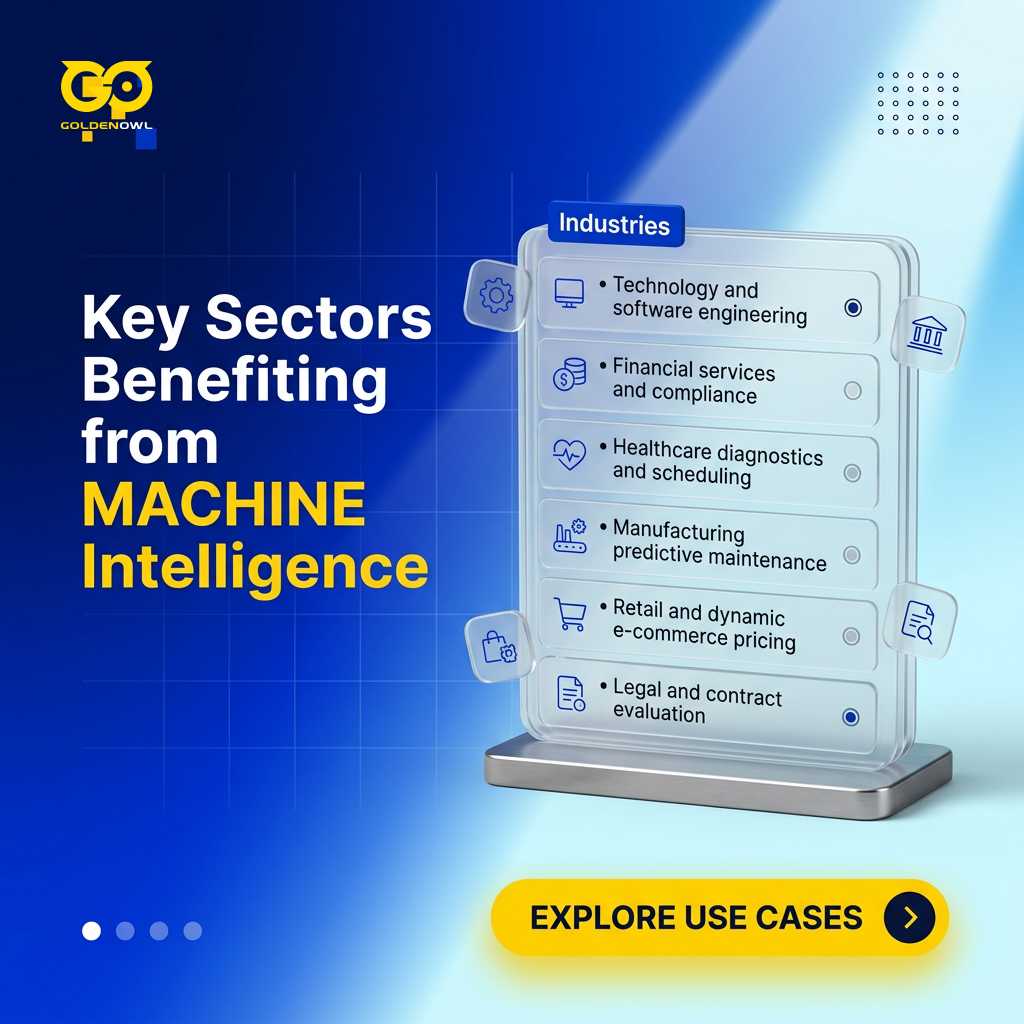
Targeted machine intelligence deployments drive clear operational returns across several key industry sectors:
- Technology: Engineering calendars remain defended because intelligent scheduling assistants book discussions into open calendar gaps and give managers visibility into actual team time allocation, helping developers commit uninterrupted hours to product delivery without context shifting. For front-line support, automated platforms route and resolve tier-1 tickets without staff intervention, with solutions like Intercom's Fin AI resolving up to 86% of user issues autonomously. Code review cycles compress as programming copilots evaluate pull requests, enforce internal styling rules, and flag defects alongside ready corrections.
- Financial Services: Live pattern analysis catches fraudulent transactions before capital leaves the building, mirrored by JPMorgan's COiN platform reviewing 12,000 commercial credit contracts in seconds. To manage portfolio exposure, algorithmic engines calculate credit hazard, market concentrations, and volatility shifts faster and with tighter precision than traditional actuarial models. Compliance baselines stay updated across changing jurisdictional boundaries as automated parsers continuously map incoming regulatory updates directly into internal operating standards.
- Healthcare: Diagnostic turnaround contracts and early detection metrics climb when machine vision assists radiologists by flagging suspected anomalies across medical scans. By scheduling clinic staff, sequencing operating theaters, and managing bed admissions through predictive modeling, regional hospital networks decrease patient waiting intervals and draw higher capacity from existing facilities. Early drug discovery timelines compress from years into months as research teams run automated screening across chemical compounds. Orion Health deployed a Bedrock-based bot that searches through 500,000+ patient files, cutting record retrieval times from minutes down to under one minute and saving 50 hours of clinical staff time each day.
- Manufacturing: Unplanned downtime drops by up to 50% while equipment longevity expands as predictive algorithms evaluate sensor telemetry to catch mechanical failures early, shown by Baxter International Inc. preventing over 500 machine hours of unscheduled halts inside a single production site. Across assembly lines, optical inspection systems monitor high-speed conveyor belts in real time, catching minute product defects that escape human eyes. Factory logistics run tighter as machine learning tracks supply chain disruptions, tallies live inventory, and forecasts shifting customer demand trends.
- Retail & E-commerce: Up to 35% of Amazon's aggregate revenue originates from recommendation engines processing browsing histories, past purchases, and live user actions. Dynamic pricing models update catalogue prices on the fly against demand spikes, consumer segments, warehouse stock levels, and competitor rates. Stockouts and excess inventory fall significantly because predictive models forecast sales volume at the individual SKU level across shifting seasonal cycles and regional fulfillment centers.
- Legal & Professional Services: Multi-hour contract evaluations shrink to brief minutes as automated systems parse agreements against company templates, extract critical clauses, and flag non-standard terms. During legal research, relevant precedents surface in seconds as natural language models query court opinions, administrative rulings, and statutory codes. New associates ramp up faster and advisory consistency stays intact because retrieval engines extract institutional guidance directly out of central corporate repositories without relying on informal inquiries.
Defining AI Solutions for Enterprise
Deploying AI solutions for enterprise means rolling out artificial intelligence systems systematically across an entire corporate organization. While broader commercial ai business solutions serve general workflows, complex platforms built for enterprise scale must handle massive data volumes, meet strict governance rules, enforce SSO, SCIM, and IAM controls, and plug straight into ERP, HRIS, and ITSM infrastructure through direct APIs.
How Enterprise AI Differs from Consumer and SMB AI
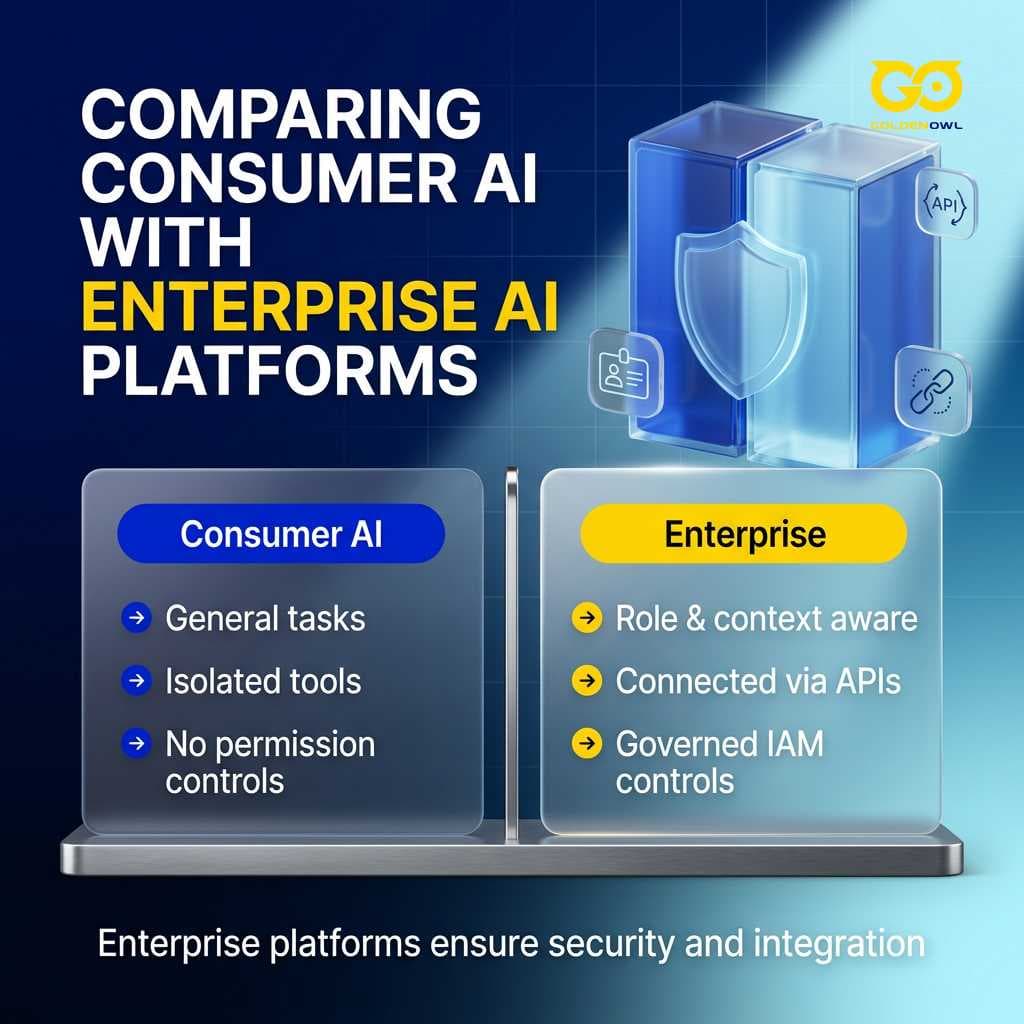
Look across three clear dividing lines when separating consumer software from enterprise platforms: System Integration, Contextual Awareness, and Governed Execution.
| Dimension | Consumer & SMB AI | Enterprise AI Platform |
|---|---|---|
| Contextual Awareness | Designed for general tasks; lacks knowledge of org charts, approval hierarchies, and system signals | Understands roles, responsibilities, and access levels using identity, historical context, and system-level signals |
| System Integration | Operates as isolated tools; unbuilt for global complexity or shared context across tools | Connects directly to HRIS, ITSM, and ERP environments via APIs, integration layers, and SSO/SCIM standards |
| Governed Execution | Surfaces answers and static documents without enterprise-level permission controls | Takes action within permission-aware environments, maintaining audit trails aligned with enterprise identity and IAM controls |
These structural requirements keep company data boundaries secure, satisfy audit compliance, and tie daily tasks to existing organizational relationships instead of treating every prompt like an isolated one-off conversation.
What Is an Enterprise AI Platform?
Integrated technology environment Four core technologies come together to form an enterprise AI platform. If you want to turn raw insights into concrete actions, you must connect data access layers and contextual retrieval straight into cognitive reasoning and workflow orchestration. That setup gives your teams the exact rails they need to build, test, deploy, and manage production applications. Systems built this way stay stable and resilient over time, giving everyone enough room to iterate across technical layers as operations evolve.
Model reuse infrastructure Modern enterprise workflows depend on deep learning architectures at their foundation. Rather than training a brand-new model for every isolated dataset or narrow problem, companies rely heavily on model reuse across daily operations. A proper enterprise platform provides the shared infrastructure you need to adapt, productionize, run, and share these deep learning models across every internal department.
Frequently Asked Questions
What are enterprise AI solutions?
Enterprise software built for large organizations rather than individual consumers defines what makes enterprise AI genuinely useful when you're running complex operations. You wire these engines directly into operational backbones like CRM, ERP, and ITSM to automate multi-step workflows and pull dependable, data-driven insights at scale. Rock-solid internal security alongside strict data governance must anchor every single production rollout you hand over to your teams.
What is an example of an enterprise AI solution?
Automated internal employee support is a clean example. An employee requests access to a shared marketing drive by typing a message into a company chat window. The platform confirms their identity, routes the request to their manager for sign-off, and provisions access automatically inside the target software. Zero IT personnel touch the ticket throughout the lifecycle.
Beyond that, partnering with a vetted ai solutions company can simplify evaluating specialized vendor tools to automate defined operational tasks across other separate business units.
Who are the top enterprise AI companies?
Sort the vendor landscape by looking closely at where each major company sits across your enterprise stack. Hyperscalers like Google (Alphabet), Microsoft, Amazon (AWS), and IBM lead large-scale foundation infrastructure along with deep model research. Meanwhile, specialized enterprise providers including Moveworks, ServiceNow, and Databricks supply essential operational muscle, tackling cross-system workflow orchestration and managing complex data lakehouse architectures across internal networks.
- Google (Alphabet), DeepMind and Gemini position this provider at the forefront of foundational research, enterprise infrastructure, and worldwide software deployment. Through Google Cloud Vertex AI, users can access 200+ models alongside MLOps pipelines, Agent Builder, and direct links into BigQuery as well as the…
- Backing OpenAI as a major investor while operating Azure AI services, the company provides combined access to OpenAI models and 1,600+ open-source selections, complete with agent services, model assessment tools, and built-in connections across Microsoft 365 and Dynamics 365.
- Amazon (AWS), Foundation model access runs through fully managed Amazon Bedrock, model training and deployment operate via Amazon SageMaker, and hardware acceleration relies on dedicated EC2 Trn1 instances built with AWS Trainium chips.
- IBM, Watson and watsonx represent the company's long-standing enterprise focus, bringing together foundation models, generative tools, model development studios, and dedicated governance features built for regulated industries that require explainability and compliance monitoring.
Enterprise AI solutions deliver real returns only when you anchor foundation models to governed internal data and wire them straight into your production pipelines. The vendor you pick, whether a hyperscale backbone like AWS or Azure or a specialized workflow platform like Moveworks or ServiceNow, comes down to matching baseline infrastructure against your specific operational friction points. Audit your daily workflows, target the bottlenecks costing you the most hours, and choose the platform that plugs cleanly into your existing stack. When your systems connect to clean, audited records, everyday work starts yielding verifiable numbers instead of roadmap slides.
Share this page


Table of Content

Subscribe to Golden Owl blog
Stay up to date! Get all the latest posts delivered straight to your inbox