
An AI legal assistant does the first pass of legal work. See what it can and can’t do, and which legal AI tools fit research, contracts, or practice management.


How Can AI Be Used in Healthcare
Sep 8, 2026
about 10 min read
Raising an essential operational question: how can AI be used in healthcare to deliver tangible clinical value?
Machine learning systems have officially moved beyond experimental lab research, raising an essential operational question: how can AI be used in healthcare to deliver tangible clinical value?
Today, these platforms run directly inside the daily workflows of clinical care and hospital administration, where you can't weigh diagnostic precision and administrative gains without balancing them against regulatory rules, integration friction, and algorithmic safety. We'll dig into pragmatic deployment paths, current healthcare tools, and commercial products delivering measurable returns on investment.
How Can AI Be Used in Healthcare Operations
Ambient Clinical Scribing
Natural language processing software transforms ordinary doctor-patient conversations directly into structured EHR records, slashing manual charting time so your physicians can put their full attention back on patient care. Once a patient gives consent, these ambient listening systems capture the exam room dialogue in real time, letting clinicians maintain eye contact instead of typing at a workstation.
Specialized voice recognition tools record spoken dictation while underlying text algorithms structure the notes and extract core clinical concepts. That shift cuts heavy administrative drag and tightens chart precision throughout your organization. Even so, an investigation from last year uncovered instances where hospital transcription systems hallucinated portions of their encounter summaries.
Mid-Revenue Cycle Integrity
Billing inaccuracies drop and chart quality climbs when digital audit systems match clinical charts against billing items, including ICD-10 and CPT, protecting clean claims and locking in proper reimbursement. You can configure individual systems around your hospital's operational priorities without sacrificing accuracy in cash flow or claims management. To plug recurring revenue leaks, vendors now deliver machine learning software that flags missing chart details, confirms documentation integrity, and frees up internal team capacity so your staff can refocus on patient care.
Prior Authorization Automation
Health software teams train machine learning models to smooth out prior authorization so patients get required treatments without unnecessary administrative delays. Health plans set up targeted data pathways that trigger automated pre-approvals for standard care. Bringing clinical insights together with live tracking and responsible AI connects patients, doctors, and insurers in one shared system, while automating repetitive chart notes, billing, and pre-authorizations cuts total operating costs and frees teams for higher-value duties.
Hospital Bed and Capacity Forecasting
Emergency Department Flow Hospital forecasting algorithms project emergency intake volumes, stay lengths, and bed demand in advance, which breaks up bottlenecking and sharpens discharge coordination. Across the UK, emergency crews transport around 350,000 people by ambulance each month. Testing this dynamic in Yorkshire, researchers ran clinical models that correctly flagged which patients required an actual hospital transfer in 80% of the cases they evaluated.
Patient Flow Optimization Predictive models give operators the numbers they need to distribute hospital resources properly, forecasting incoming admissions to balance physical beds, nursing staff, and critical equipment. When one hospital deployed an AI-augmented operational task force to organize patient activity, the floor teams responded immediately. Following the rollout, that facility moved admitted emergency department patients into open beds 38 percent faster than before.

Demand Forecasting Smart forecasting models can map incoming patient volume anywhere from a few hours out to years down the road, covering short-term emergency room surges alongside aging population trends. Combining historical data, demographic shifts, flu patterns, local weather, and large public gatherings lets leadership adjust clinical staffing and department bed capacity ahead of time.
Clinical Trial Recruitment Optimization
Patient Identification Statistical models strengthen study design across preclinical and clinical phases by tracking patient markers for efficacy or safety risks while surfacing ideal participants through biomarker data. Running large patient records through automated pattern-recognition tools lets trial operators pinpoint eligible participants rapidly and catch experimental patterns early, without burning months on manual recruitment screening.
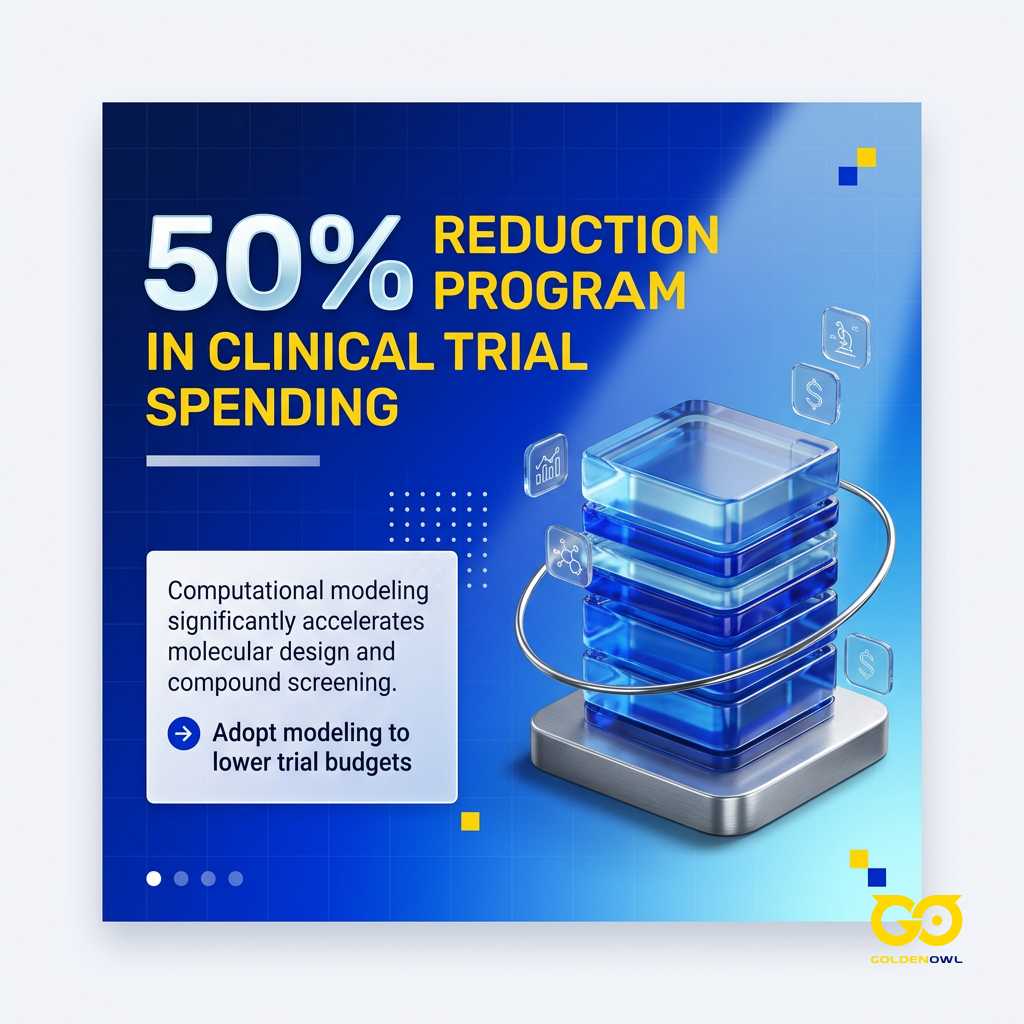
Cost and Time Reduction Computational modeling speeds up molecular design, side-effect forecasting, and compound screening, which can lower overall spending on clinical trial programs by up to 50 percent. Advancing an experimental therapy through human trials demands an estimated average investment of $1.3 billion, and only 10 percent of tested treatments ever reach commercial launch. Under those economics, every operational saving carries massive financial weight.
Patient Monitoring and Virtual Care Infrastructure
Hospital Deterioration and Sepsis Prediction
Tracking patient vitals through automated ICU monitors lets algorithms cross-reference continuous telemetry with fresh lab draws, flagging sepsis hours before a nurse notices clinical signs. Across standard floors, health systems run wider surveillance platforms to predict step-up transfers and flag rising infection threats. Review your bedside monitoring infrastructure this quarter, and integrate these data feeds across every adult bed to strip out manual charting burdens. Catching systemic decline early tackles an acute failure point in domestic facilities, where preventable harm strikes approximately 400,000 inpatients annually and results in 100,000 deaths.
Conversational Symptom Triage
Accuracy and Trust Testing conversational interfaces and ai patient engagement software solutions against real clinical inquiries in a US study showed off-the-shelf foundation models cannot handle daily healthcare questions on their own. Anchoring those questions to a retrieval-augmented generation (RAG) architecture pushed useful guidance up to 58%, blowing past baseline LLMs that sit between 2%-10%.

Factor that performance gap in before signing software contracts, especially since merely 29% of patients in a UK survey trust software for primary advice, even while more than two-thirds back automating administrative overhead. More than two-thirds simultaneously favor using AI to reduce provider workload. This disparity highlights clear boundaries between public tolerance for administrative vs diagnostic autonomy.
Mental Health Crisis Detection
Clinical teams increasingly deploy automated models to track patient behavior and steer proactive mental health interventions.
Scanning user text across SMS logs, online notes, and personal social posts helps language models detect subtle phrasing changes linked to suicidal ideation, depression, or severe anxiety.
Sensors inside consumer smartphones constantly log behavioral shifts, capturing daily movement routines, daily screen time, and how often a patient texts or calls out. Hardware sensors track screen time, physical motion, and communication pauses. Setting up transparent consent safeguards around these personal feeds is mandatory, but capturing this telemetry creates genuine opportunities to intervene long before an emergency room visit.
Upcoming protocols could link clinical records with search histories and messaging habits to identify emerging illnesses, or scan live email phrasing to route rapid crisis support.
Other platforms concentrate entirely on older demographics, serving a cohort that battles wildly elevated rates of loneliness and suicide while receiving the lowest share of mental healthcare resources. Running passive surveillance alongside guided intervention paths allows these tools to deliver structured mindfulness sessions, coping techniques, and cognitive behavioral therapy modules for immediate, private support.
Commercial AI Solutions in Healthcare
Across commercial markets, investments in healthcare AI continue expanding at real speed. When you dig into data from one market research firm, benchmark against a valuation of $36.7 billion in 2025 and track a compounded annual growth rate of 38.9 percent between 2026 and 2033. Adoption trends closely follow this momentum, with another report showing that 22 percent of health organizations implemented "domain-specific AI tools" in 2025, a 7x increase over 2024 numbers. Figures from Deloitte Australia indicate that 75% of leading healthcare providers are actively experimenting with AI solutions in healthcare.

The Accuray Built by Accuray, the CyberKnife system brings robotics and artificial intelligence together to deliver tailored stereotactic radiosurgery and stereotactic body radiation therapy for each patient. Because the robotic arm tracks tumors in real time, doctors and surgeons can focus their treatment on affected areas rather than radiating the whole body.
Enterprise Implementation Framework
Map the path from raw technical potential into everyday clinic operations by checking algorithmic accuracy directly against institutional demands, existing ward routines, and frontline staff training.
Clinical Needs Assessment
The first stage
Center your early rollout on human-focused AI and measured experiments aimed at glaring operational bottlenecks, keeping frontline healthcare staff actively involved in every step of the build.
Hands-on user research lays out baseline operational limits, system requirements, day-to-day ward workflows, and real hurdles to adoption. Running a qualitative study helps you pin down what the breakdown actually is, why it keeps happening, who owns it, and why earlier internal fixes fell short. After mapping these core headaches, inspect local health records to confirm you have enough historical datasets for validation runs. If clean, structured files aren't already sitting in your administrative systems, your engineers can't build or test a viable clinical tool.
Zero in on areas where staff lean on spreadsheets and informal manual fixes during daily hospital runs. When your team burns hours patching around a clumsy process, that manual grind flags a major operational bottleneck you can solve at scale with focused software.
Validating AI Solutions for Healthcare
Checking an algorithm across Statistical Validity, Clinical Utility, and Economic Utility locks down safe clinical performance before hospital-wide rollout:
| Validation Dimension | Core Focus | Evaluation Criteria |
|---|---|---|
| Statistical Validity | Understanding the performance of AI on metrics of accuracy, reliability, robustness, stability and calibration. | High model performance on retrospective, in silico settings is not sufficient to demonstrate clinical utility or impact. |
| Clinical Utility | Evaluate the algorithm in a real-time environment on a hold-out and temporal validation set (eg longitudinal and external geographic datasets). | Demonstrate clinical effectiveness and generalisability. |
| Economic Utility | Quantifies the net benefit relative to the cost from the investment in the AI system. | [NO_SOURCE_CONTENT] |
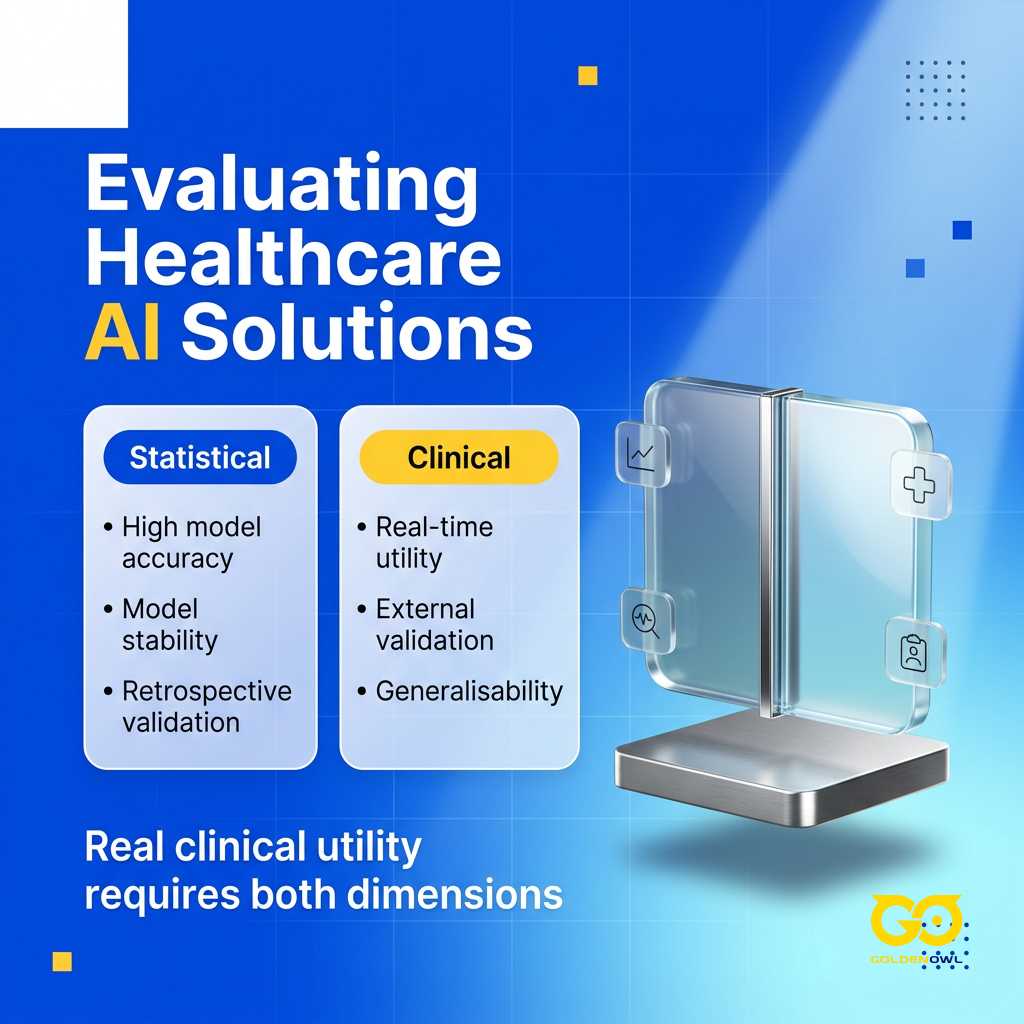
These three testing pillars prove whether AI solutions for healthcare advance beyond paper benchmarks into real clinical utility and measurable operational gains.
Post-Market Surveillance and Drift Monitoring
Live clinical deployments demand ongoing Post-Market Surveillance so you catch hidden workflow hazards, monitor output accuracy, and flag adverse patient safety events across production cycles. Machine learning models shift as they digest real-world data, which can flip a low-risk routine utility into an active clinical liability. Gauge your algorithmic performance shifts every single week. Accuracy drops rarely stem from software bugs; systems degrade when underlying environments change, driven by shifting patient demographics, new diagnostic hardware, and evolving documentation habits across busy hospital wards.
Clinical Workforce Skill Development
Moving translational research into daily care workflows is a required prerequisite if you want to achieve this broader operational future for healthcare delivery. Train your team to work right beside these systems to build direct trust. Health systems have to commit budget toward upskilling leaders and bedside clinicians, giving them the digital confidence to embrace an AI-augmented workplace rather than feeling intimidated by it during routine clinical duties.
Speaking to the BBC, Dr Caroline Green of the Institute for Ethics in AI at the University of Oxford stressed that staff need clear training to manage technological hazards, including algorithms displaying incorrect data. When left unchecked, automated software hands flawed outputs straight to medical teams without human intervention.
Getting healthcare professionals ready for an automated clinic environment demands several core operational competencies:
Soft skills:
- Communication with clarity: Explain complex AI concepts to non-technical audiences, including both patients and clinicians
- Collaborate across disciplines: Work effectively in teams that combine healthcare expertise with modern data science
- Problem solving: Use critical thinking to deploy AI healthcare solutions for complex clinical challenges
- Think critically: Interpret data accurately and make sound, evidence-based recommendations
- Display empathy: Build trust and understanding in patient interactions
- Adaptability: Stay ahead of emerging AI tools and technologies and integrate innovation into your clinical practice
- Project management: Coordinate timelines, manage risks and ensure healthcare compliance
Technical skills:
- Understand machine learning and AI fundamentals: Learn how to read and interpret algorithms, train models and evaluate performance
- Handle healthcare data effectively: Develop skills in data cleaning and managing large datasets to support accurate analysis and decision making
Healthcare knowledge:
- Apply clinical knowledge: Know medical terminology, patient care workflows and how healthcare systems actually operate
- Navigate regulation and ethics: Understand privacy laws, recognise biases in AI systems and ensure ethical deployment in clinical settings
Evaluating Healthcare AI Solutions
Real returns on healthcare AI come down to buying commercial platforms that strip out clinical friction while supporting your value-based care contracts. Don't get distracted by industry reports calling healthcare adoption "below average", because 75% of top health systems are actively piloting these tools right now. Look at how fast deployment speeds changed between years. In 2025, 22 percent of healthcare organizations rolled out "domain-specific AI tools", which marks a 7x jump over 2024 adoption levels across the industry.
Vetting these platforms requires leadership to look far beyond raw benchmark scores and technical specs. Evaluators must confirm real financial gains while securing frontline uptake without disrupting daily patient schedules. To run this evaluation cleanly, your clinical team should test candidates across three distinct pillars: statistical accuracy, clinical utility, and economic return:
- Statistical validity means understanding how the AI performs on metrics of accuracy, reliability, robustness, stability, and calibration, recognizing that high marks in retrospective, in silico environments do not suffice to prove clinical utility or impact.
- Clinical utility requires evaluating the algorithm in a real-time environment on a hold-out and temporal validation set (such as longitudinal and external geographic datasets) to demonstrate clinical effectiveness and generalisability.
- Economic utility quantifies the net benefit relative to the cost from the investment in the AI system.
Run small, phased pilots so your teams learn quickly, leaning on direct feedback loops from bedside staff to make fast adjustments. Software wins adoption only when it fits naturally into existing clinical habits and solves immediate headaches for end users. First, verify the baseline accuracy against vendor datasets, then measure whether the tool actually frees up staff hours during live care routines. Build your core business case around lower operating expenses and stronger revenue capture. Your ultimate financial return arrives through performance-based reimbursement incentives.
Organize vendor evaluations by using the scorecard below, scoring Clinical Validity, Workflow Integration, Economic Utility, Technical Support & Onboarding, and Ethical Framework on a standard scale from 1 to 5.
| Evaluation Criterion | Vendor A Score | Vendor B Score | Notes |
|---|---|---|---|
| Clinical Validity (Peer-reviewed studies, FDA clearance) | Has the solution been proven in real clinical settings? | ||
| Workflow Integration (EHR compatibility, minimal disruption) | How easily does this fit into our current way of working? | ||
| Economic Utility (Clear ROI, aligns with our financial goals) | Can the vendor provide a credible business case? | ||
| Technical Support & Onboarding (Training, maintenance, updates) | What level of partnership can we expect after purchase? | ||
| Ethical Framework (Transparency, bias mitigation, data privacy) | Does the vendor proactively address governance and safety? | ||
| Total Score |
Tallying these final scores shows your leadership team which vendor brings the lowest operational risk alongside the clearest path to clinical and economic returns.
Tech vendors constantly pitch collaborative partnerships to build new healthcare tools, but before you sign with an ai solutions company, your executive team needs to verify a few non-negotiable requirements:
- Processes for ethical and responsible access to data.
- Access to domain expertise and prior knowledge to make sense of information and create the rules applied to datasets to generate necessary insight.
- Access to sufficient computing power to generate decisions in real time.
- Research into implementation: leadership must consider, explore, and research issues arising when taking the algorithm into the real world, building ‘trusted’ AI algorithms embedded into appropriate workflows.
Hospitals get the largest returns when they aim software straight at the administrative grind that drains clinicians and eats up operating margins. Protect clinical bandwidth by demanding statistical rigor, smooth workflow integration, and proven economic value before executing any contract. Rolling out stepwise pilots gets your clinicians tools that actually help while defending cash flow under your value-based care agreements. Ultimately, demonstrating how can AI be used in healthcare requires holding every single vendor accountable to measurable desk hours saved and clear administrative cost reductions across your health system.
Share this page


Table of Content

Subscribe to Golden Owl blog
Stay up to date! Get all the latest posts delivered straight to your inbox