How can AI help small businesses? See where AI saves time on customer questions, proposals, stock, meetings and win-back emails, and where people still check.


Forward Deployed Engineer vs Software Engineer
Oct 19, 2026
about 7 min read

Forward deployed engineer vs software engineer: compare daily work, skills, career paths and pay, and see which path fits you.
The Forward Deployed Engineer vs software Engineer comparison goes beyond code.
Underneath, the two jobs share a technical base. Where they differ is where the work ends up: a software engineer ships a product that many customers share, while a forward deployed engineer makes that product work inside one customer’s messy reality. The title won’t tell you which one fills your week, so look at the work first and the career second.
How do Forward Deployed Engineer vs software Engineer roles differ?
A Forward Deployed Engineer (FDE) makes software work inside one customer’s business, while a Software Engineer (SWE) builds and maintains a product for many users. A quick test is to ask where the work stops. If it stops at a feature every customer gets, that is product work. If it stops at a setup that only makes sense for one client, that is forward deployment. In Palantir’s profile of the role you meet Brian, an FDSE (Palantir’s term for the job) who builds new functionality on top of Gotham, its data platform, for a US Department of Defense customer. Traditional engineers at Palantir, by the post’s account, build one capability that many customers then use.
| Dimension | Software Engineer | Forward Deployed Engineer |
|---|---|---|
| Main Goal | Build scalable products | Make products work for specific clients |
| Work Setting | Internal development teams | Customer-facing environments |
| Success Metric | Code quality and feature delivery | Client success and solution impact |
| Interaction Level | Mostly engineers and product teams | Engineers, clients, and business leaders |
| Problem Type | Technical system challenges | Real-world implementation challenges |
For a software engineer, success means the shared product is good, ships on time and stays up once real users lean on it.
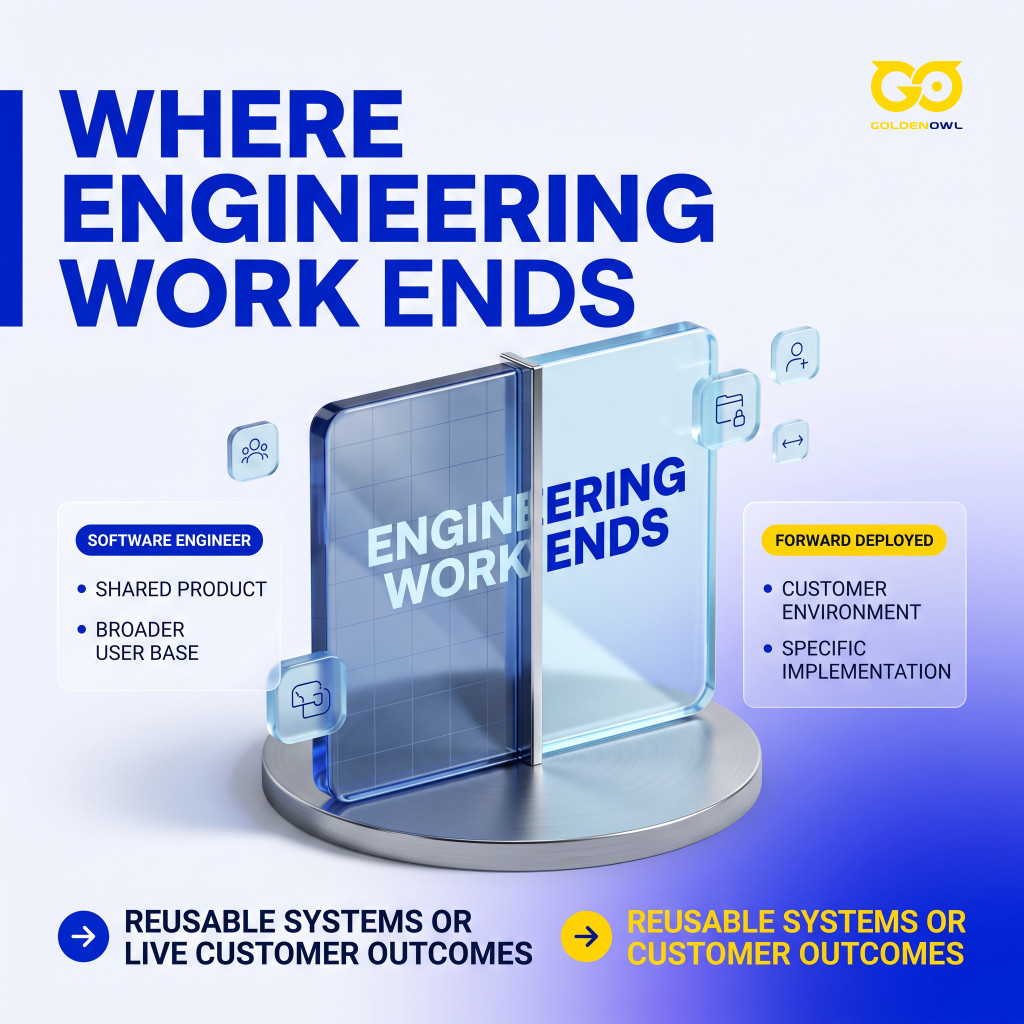
An FDE’s job keeps going after the product exists. Software that worked in a demo still has to solve a real business problem once it meets the customer’s data and staff, and somebody has to stay until it does. Staying is what pulls the role toward consulting. If the client quietly stops opening the tool a month later, nobody will care how tidy the code was.
Picture an AI assistant that lets staff pull answers out of internal documents and customer records. Back at headquarters, a software engineer builds the search service behind it, and every customer gets the same version. The FDE carries that assistant into one company. They learn how people there actually look things up and which records they are cleared to use. Then they wire it into the apps staff already have open all day and test it on the customer’s own systems.
The split shows most clearly when something breaks. A bug in the shared search service goes back to the product team. A permissions problem with the customer’s data lands on the FDE, who may pull the product team in to fix it.
How do their daily workflows compare?
Software engineers usually work in sprints inside a product team, while FDEs split their time between customers, live systems and the product team back home. A software engineer’s day might start with a stand-up and settle into a feature, a few pull requests and a bug that QA sent back. An FDE’s day is harder to predict. A morning call about a client system that is acting up can turn into an afternoon in production logs, and then a talk with the product team about whether the fix belongs in the core product.
For the software engineer, most of the week still goes into building, alongside people who know the same codebase and don’t need things explained twice. Meetings and bug reports cut in, but they cut into building time, and building is the job.

For a forward deployed engineer, code is only part of the day. You also step into the customer’s world, which can mean flying to their site or sitting with their tech team for weeks. You deal with its politics and work out the gap between what they say they want and what they need. A product team exists partly to filter that context out, which is good for focus and is exactly what an FDE gives up.
What technical and soft skills set them apart?
Both roles share a base of programming, databases, APIs and testing. On top of that, software engineers go deep, into algorithms and system design and the slow work of keeping one codebase healthy for years. A newer item on the software engineer’s list is testing AI features whose output changes from run to run, which breaks old habits about what a passing test looks like.
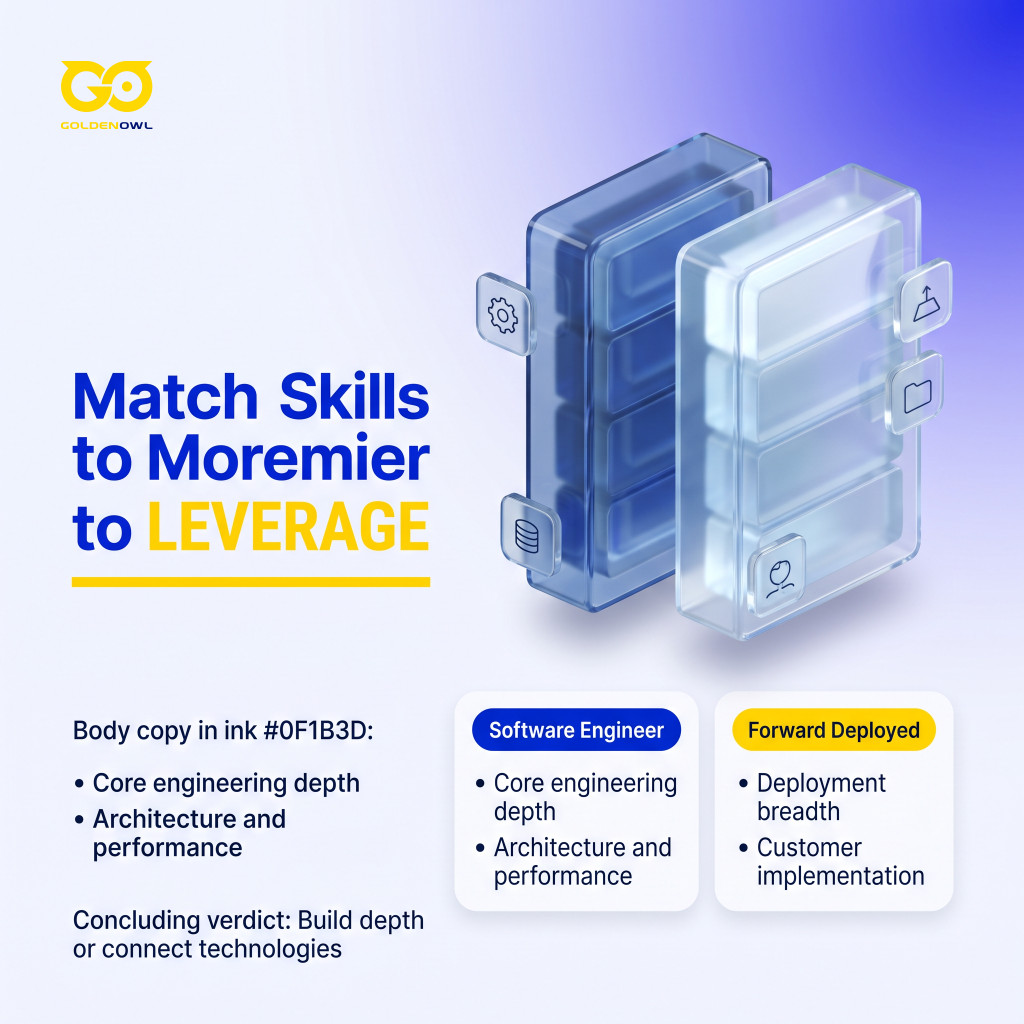
FDEs go wide instead. You build range across many systems, and over time that adds a rarer skill: you learn firsthand how customers adopt technology and where they break it. The job also needs things a product role can often skip, like presenting to a client and knowing how their business runs.
That range is a big reason demand for FDEs has jumped. Companies want AI tools working inside their own operations, and somebody has to sit with them to get there. According to Business Insider, Indeed’s index of FDE job postings rose roughly 729% in the year to April 2026, which is a count of job ads rather than a measure of pay or of how many FDEs there are.
How do their career paths and salaries compare?
Forward deployment pays a premium, at least on paper. On Levels.fyi, reported US median total compensation (base salary, annualised stock and bonus) was $220,000 for FDEs and $197,900 for software engineers. The gap is roughly 11% in this sample, though the sample is small and self-reported and isn’t adjusted for years of experience.
The software engineering ladder looks familiar:
- Junior software engineer
- Software engineer
- Senior engineer
- Staff or principal engineer
- Architect or engineering manager
Climbing it rewards technical mastery and system ownership, usually with a narrower specialty at each step.
Forward deployment usually runs through these roles:
- Implementation engineer
- Forward deployed engineer
- Senior FDE or solutions architect
- Product strategist or technical consulting leader
What gets you promoted on this route is mostly client trust and whether the business can point to something you changed. Knowing the client’s industry helps a lot. You also carry real responsibility on live systems, and the job often comes with travel or calls at odd hours across time zones.
Salaries for these roles ran from $170,000 to more than $200,000 a year, according to the same coverage, which does not say whether that is base pay or total compensation. Some of that is a scarcity premium. Few people can do this job well today, and if more engineers move into it, I would expect that part of the premium to shrink.

Software engineering has the older ladder, and it has its own market risk. Indeed Hiring Lab counted US software development job ads still about 27.5% below their pre-pandemic level in 2026, even after a partial rebound. And the rebound mostly went to seniors, with 71% of the increase between May 2025 and May 2026 coming from senior roles. For someone early in their career, the 71% figure is the one to worry about.
Forward deployment has a different risk. The title is new and getting stretched, so some jobs called FDE can drift from real engineering into coordination, and when that happens your technical value erodes quietly.
Moving from software engineering into forward deployment is usually the easier direction, since you already have the depth and mostly need to learn the customer side. Going back is harder. After a few years with clients, you have to show a product team that your engineering stayed sharp, and too much client-specific glue code can slow your growth in large-scale system design. I would keep some real codebase work in every week for exactly that reason.
Which engineering path should you choose?
Start with the week you want to live. If you like a predictable schedule and the slow satisfaction of knowing one system better every month, software engineering fits. If three years in the same codebase sounds like slow suffocation, and a hard new problem every quarter is what gets you out of bed, look hard at forward deployment.
Forward Deployed Engineer role
You would be a good fit if a vague request like “make this work for our support team” sounds fun rather than frustrating. A lot of the current work is fitting AI tools into workflows a company already runs, and each client shows up with its own systems and limits. When a customer wants something the product can’t do, you are usually the one explaining why.
Software Engineer role
This path fits if you would rather own one product over the long run and become the person others ask about one technical area. Your days go into architecture, scale and reliability, mostly with engineers, designers and product managers inside the company.
A job title tells you less than you’d hope, since two postings that both say FDE can describe very different jobs. In the interview, ask how much of the week is real coding and who gets the call at 2 a.m. when something breaks. Also ask how you will be judged. A team that scores you on customer rollouts builds different habits in you than one that scores you on uptime.

Settle stability versus variety before anything else. Pay and interesting problems can be traded later, but a role that keeps you on planes or on late calls with a client in another time zone wears you down fast if that doesn’t fit your life right now. In that case software engineering is probably the better choice, and a pay premium won’t fix the clash.
If both options give you enough stability, look at temperament. Some people come back from a day of client meetings buzzing, and others need a quiet evening to recover. Long, quiet blocks on core systems are where software engineering pays off, and if you get restless without people around, forward deployment will feel more natural. Only after that should pay and demand break a tie.
Conclusion
Strip away the title and the comparison gets simpler. Someone who wants a steady base and a product many people share will usually be happier in software engineering, while someone who likes new customer problems and fast, visible results will lean toward forward deployed engineering. In the Forward Deployed Engineer vs software Engineer decision, compensation and demand can settle a close call, but they come after the day-to-day work and the life you need to support. When a specific offer lands, ask where its code creates value and how much of the week belongs to customers, and get a straight answer on travel before you sign.
Share this page


Table of Content

Subscribe to Golden Owl blog
Stay up to date! Get all the latest posts delivered straight to your inbox