
How to use AI in real estate: automate lead follow-up, speed up valuations and marketing, and keep every step compliant with Fair Housing rules.


What is The FDE Model?
Oct 12, 2026
about 7 min read
The FDE model explained: how forward deployed engineers embed with customers and run the operational lifecycle to ship real outcomes.
A software demo can look convincing and still miss the customer’s actual environment. The FDE model is built for that gap, especially when an enterprise’s real workflow doesn’t match the process written down.
Read on to judge whether the FDE model fits your delivery challenge. Watch for the everyday workaround along the way, because it often tells you more about the real environment than the documented process does.
FDE Model Definition
Forward Deployed Engineering is a software delivery model. Engineers work directly inside a customer’s live environment instead of building in a vendor sandbox. They connect to real data and write code against the real systems of record, inside the customer’s Virtual Private Cloud.
Shipping code doesn’t complete an FDE engagement. The work is done when the system delivers the intended business outcome.
Forward deployed engineering is the operating model: the overall approach a vendor takes when it sends a specialist into the field to make standard software work under non-standard enterprise conditions. The forward deployed engineer is the person who does that work with the client, writing code, integrating systems and working alongside the client’s people.
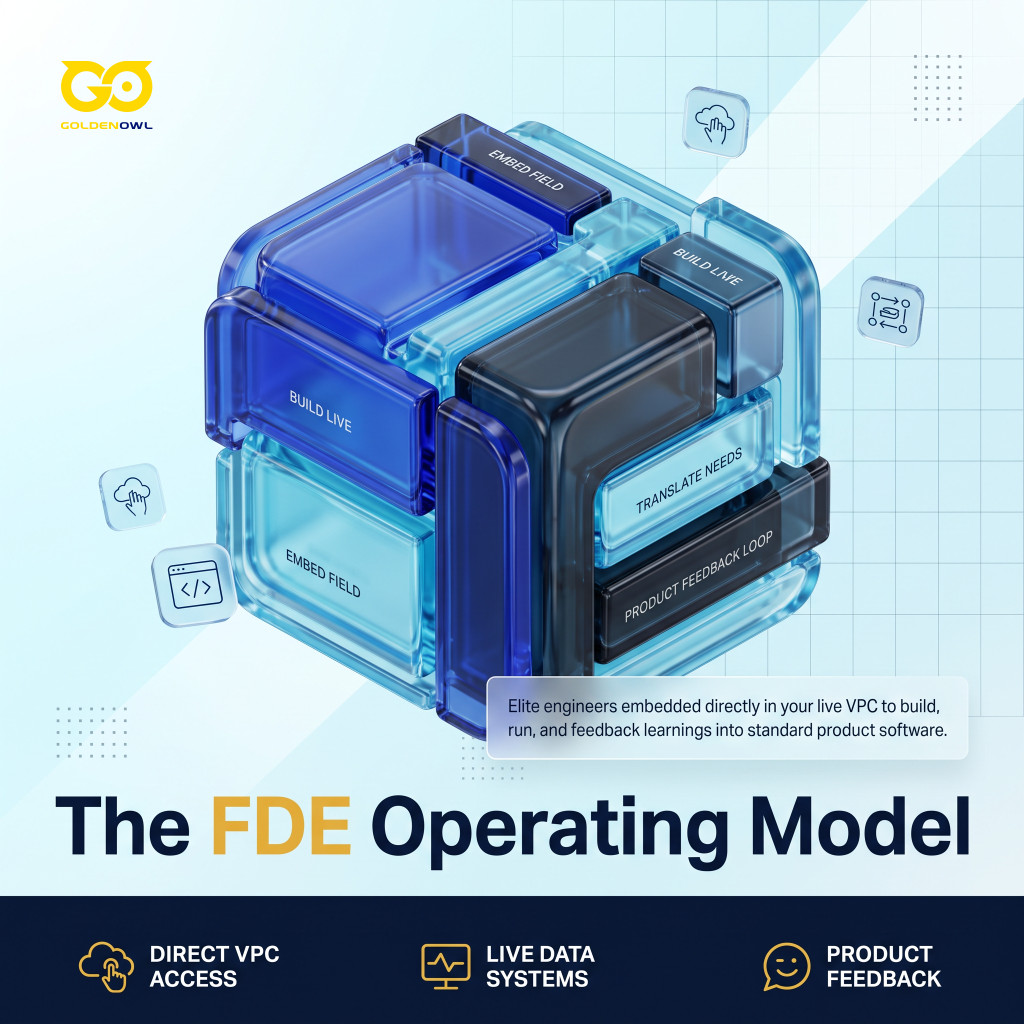
The Operational Lifecycle
In the field, an FDE doesn’t follow a standard agile sprint cycle, or a straight line. The work loops through discovery, scoping, integration, verification and product learning.

Embedded Environmental Discovery
Begin discovery where the customer’s people do the work, inside their environment and not a vendor’s test lab. From day one, the engineer works within the client’s environment, in person or virtually. A traditional consulting engagement may start from the outside, with interviews and a review of documents, and that’s the heart of the forward deployed engineer vs consultant distinction.
You’ll need access to the client’s repository, live data, existing APIs and systems of record, plus both the development and production environments. Use process mining tools to trace how the work really gets done, since the written account often misses details. Shortcuts, manual workarounds and tribal knowledge are exactly what a sandbox demo won’t reveal.
Enterprise AI deployments often hit constraints that no one has spelled out. A procurement team may describe its approval workflow accurately on paper, while years of workarounds for a system limitation have changed what happens day to day. Working inside the environment lets an engineer spot that workaround and build around it. A team that relies on documentation alone may build for the stated process, then find that people quietly ignore the deployed system.
Constraint-Driven Scoping
Start by naming a measurable business constraint, then spell out what success in production will look like. Typical constraints are ordinary ones: a slow procurement cycle that adds weeks to a supply chain, a high support ticket backlog or a manual data cleanup step. Others are a fill rate stuck below target, or a dealer response time that costs bookings.
Turn that constraint into a production outcome. Set acceptance criteria, map dependencies and choose a measurable success metric. What you get is a defined scope, not an open-ended research project.
A powerful model can make an impressive demo, but the forward deployed engineer starts from what’s broken in the business and works backward to what the model must do to fix it. Build around a specific constraint, and the result has a clear path into production.
Live System Integration
Connect the client’s actual ERP, CRM and operational systems. The AI gets added to what’s already there, rather than proposed as a parallel system that would force changes across the client’s operations. If the client wants to keep its existing ERP, running the AI use case inside it can be a design constraint, because replacing a working system for one use case may not be acceptable.
A remote team working from a specification may not see the integration complexity until much later. It can show up after most of the build is done, when a fix means significant rework. An engineer embedded from day one can spot it early, because the work happens inside the system being integrated.
To create one trustworthy source of truth, build Retrieval-Augmented Generation (RAG) pipelines, and sometimes GraphRAG pipelines.
Continuous Production Verification
Ongoing production evaluation verifies system performance by tracking token usage, accuracy and hallucination rates. Safety gates mark the point where autonomous action stops and a human must approve the next step.
In agentic workflows, a small early error can quickly snowball through every later step, which makes these gates especially important.

The arithmetic shows why. Suppose each step in a 20-step agentic workflow is right 90% of the time. With no verification between steps, the chances multiply, and the whole workflow succeeds only about 12% of the time.
Per-step verification is meant to lift each step’s reliability. If it gets each step to 98%, the same workflow succeeds about 67% of the time. These are illustrative numbers, not measured results.
Product Engineering Feedback
Embedded engineers first build rough, fast, pragmatic solutions to a particular customer’s immediate problems. These solutions are called "gravel roads." The core engineering team then examines them, identifies patterns across customers and turns them into standard features. Those are the "paved highways," and they make custom work a product capability.
A useful practice is to pass field learning directly to core product teams. An integration made for one client can become a component used by the next ten clients. That’s how custom work becomes part of a product instead of remaining a one-off consulting engagement.
Frequently Asked Questions
What is forward deployed engineering?
Forward deployed engineering is a software delivery model in which engineers work directly inside a customer’s live environment to build and ship production systems. A forward deployed AI engineer (FDE) is a software engineer who works inside a customer’s organization and uses its own data and infrastructure to build, integrate and ship production AI systems.
What is the difference between forward deployed engineering and a forward deployed engineer?
Forward deployed engineering describes the approach. A forward deployed engineer stays in the customer’s environment until the workflow works, unlike a normal vendor that ships a feature and moves on.
What does a forward deployed AI engineer do?
AI FDEs manage the "stochastic chaos" of generative models with guardrails and evaluations. That LLM-specific work differs from the deterministic data pipelines classic FDEs handled.
Where did the Forward Deployed Engineer model originate?
Palantir pioneered the Forward Deployed Engineer model and still uses it across Foundry, Gotham and its Artificial Intelligence Platform (AIP).
What are Echo and Delta teams in the Palantir FDE model?
Palantir splits the work across three kinds of teams. Devs build the core platform that many customers use, Deltas are the forward deployed engineers who build for one customer, and Echos are the embedded analysts who work out which customer problem is worth solving.
What is the gravel road to paved highway concept in Forward Deployed Engineering?
In the gravel road to paved highway concept, custom work can become part of a larger product. Consulting more often produces one-time efforts, and the consultants move on.
Why are AI companies adopting the Forward Deployed Engineer model now?
AI companies adopt the model when they struggle to define what they want from AI. They need help understanding use cases before building solutions, and that’s the kind of problem the FDE model is designed to solve.
How does OpenAI use Forward Deployed Engineers?
OpenAI’s voice model improvements came directly from collaboration with FDE customers.
How long does a forward deployed engineering engagement last?
A forward deployed engineering engagement takes a named use case from initial discovery to production deployment within a defined 90-day window.
How is forward deployed engineering priced?
Some vendors offer Outcome-Level Agreements instead of hourly billing, which can share risk if the outcome doesn’t land.
How much does it cost to hire a forward deployed AI engineer?
FDE bases run $146K-$385K, with a midpoint near $261K before equity.
What does the client own when an FDE engagement ends?
Ownership develops through code reviews and co-development, rather than a handover at the end. A well-run engagement also trains an internal engineer to run the system alone, without calling the vendor back in.
Is the Forward Deployed Engineer model replacing traditional SaaS?
No, the Forward Deployed Engineer model isn’t replacing traditional SaaS. The two are fundamentally different ways to deliver software to enterprise customers.
Key Takeaways
Skill among a partner’s engineers is only part of the decision. The delivery model has to get software into daily operations.
The model fits when the company has a specific business constraint to solve, can give engineers access to the relevant systems, users and workflows, and has an internal owner ready to support adoption. It’s a poor fit when the constraint is unclear, access is blocked, or no one inside the company can own the software after deployment.
It also depends on the same forward deployed engineer, or a tightly coordinated team, carrying context through every stage. Sourcing that full-time embedded talent can be challenging.
Expect a deliberate pace, since speed isn’t the goal in itself. A longer timeline raises the risk that the original business constraint shifts before deployment, which is one quiet reason enterprise AI pilots stall.
A pilot that works technically but never becomes part of daily operations fails in any meaningful sense, even if the project tracker marks it as delivered.
Judge a forward deployed engineer engagement by whether it carries a named business constraint through to software people use in routine business workflows. Context should stay with one engineer, or pass among a team working in close alignment, from the first stage to the last. Code reviews and co-development build the client’s ownership over time. So assess the FDE model by checking the constraint, the software adopted in production, and who can own it afterward.
Share this page


Table of Content

Subscribe to Golden Owl blog
Stay up to date! Get all the latest posts delivered straight to your inbox