Learn how to hire forward deployed engineers in 6 steps: define the role, benchmark pay, source candidates, screen for delivery and run a four-round loop.


What Does an AI Operational Assessment Cost?
Nov 10, 2026
about 10 min read

What does an AI operational assessment cost? See price ranges by tier, what drives the fee, what the report should cover, and the costs after.
What does an AI operational assessment cost? A small firm’s flat-price review and a months-long company audit are very different purchases. You need enough detail to decide what to build next, and a summary alone may not give you that.
Below are the price tiers and the work each pays for, followed by the bills that come after the review.
What Does an AI Operational Assessment Cost by Tier
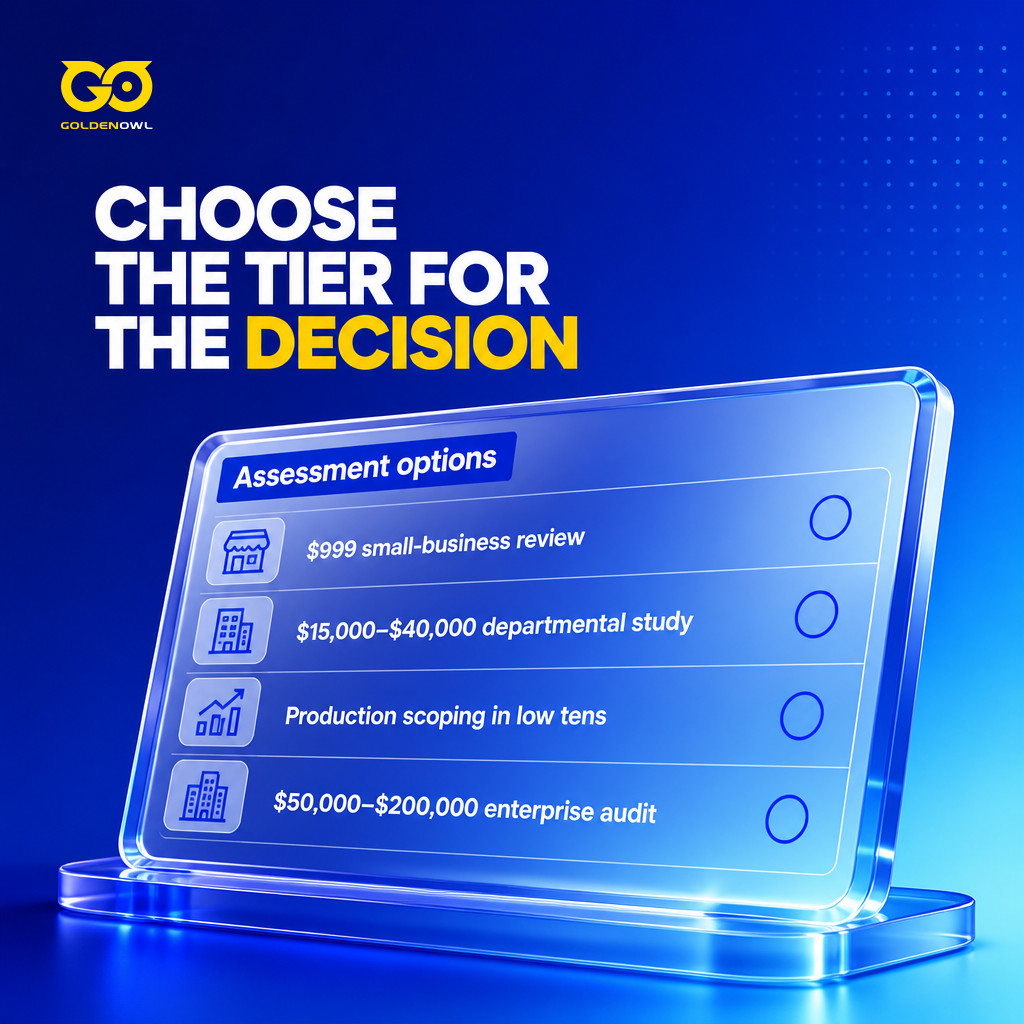
Published price guides disagree, so treat any single figure with care. The guides below cover AI readiness assessments, a close relative of the operational assessment. A focused assessment looks at one process or one department in a medium-sized company. Entrans puts a fixed-scope boutique assessment at $3,000 to $15,000 over one to three weeks, and a mid-market engagement at $15,000 to $75,000 over three to six weeks. Aries Consulting Group quotes $5,000 to $15,000 for a two-to-three-week mid-market audit. Pertama Partners, pricing in Singapore dollars, lists SGD 15,000 to 35,000 for organizations under 100 employees and SGD 40,000 to 85,000 for those with 100 to 1,000. At the end you get a short list of ways to use AI and a basic estimate of what the business could gain from the spend (return on investment, or ROI).
At enterprise level, the review covers several departments and the data they share, with the company’s longer-term goals in view. The same guides diverge here too. Entrans lists $75,000 to $250,000 over six to twelve weeks or more for a multi-unit engagement, and $250,000 to $500,000 or more over three to six months when a strategy consultancy leads. Aries quotes $15,000 to $50,000 or more over four to eight weeks for companies with $100 million or more in revenue or in regulated industries. Pertama Partners lists SGD 90,000 to 200,000 over four to eight weeks for organizations above 1,000 employees. Data scientists and business analysts work alongside people who design systems and help staff adopt them. Their report sets out an AI strategy and a build schedule, with the costs and returns used to justify the investment.
At the small end, AI Workforce Plus, a US provider, sells a $999 flat-price assessment for owner-run service businesses and professional firms of roughly 2 to 20 people. It is meant for firms where the owner or office staff still do work that software could take over. The package has five parts.
- The Lead Response Check: You agree to a test inquiry and a test call; the provider then times the replies and records what happened.
- The 45-minute assessment call: A discussion of the work your business does, including customer requests and where staff time and money go. Recording is optional.
- A written report: Due about a week after the call. For the most costly problems, it names a tool and a change to make, plus the price and setup steps. It also explains what could go wrong and how to check the results.
- A priority order: Which changes to make first, based on how much work they take and how much they could help.
- A 30-minute review call: Time to go through the report with the provider and ask questions.
The fee covers those five parts. AI Workforce Plus says it refunds the $999 if the report does not give you at least 3 specific, ready-to-use improvements.
Not included: You still have to buy the tools and pay to set them up; setup help gets a separate quote. Ongoing support and advice on legal, tax, or compliance matters are outside the stated price too.
What Drives AI Operational Assessment Costs
AI assessment cost depends on the scope of the work you ask for. Are you paying someone to study one process, or to follow work across several teams and their shared systems? Those are different jobs. A review takes longer when the team has to check the data and trace each step of the work; testing how to link systems or model a proposed change adds time too.
A firm with offices in several countries may run the same process in different ways at each site. The assessor has to check those differences. Give bidders a list of the teams and systems in scope, including old software that can’t share data with other tools. Say how much data there is to check and where the work differs from site to site.

If the review needs an expert in AI that reads customer messages or checks product images for faults, you pay for those skills too. The same goes for the output you ask for. The level of detail in the report also affects the price. Settle both the specialist skills and the report detail before you request a quote.
A large, well-kept data store can take less work to check than a small setup where nobody has written down how the systems connect or who has access. Data volume alone does not set the price.
What an AI Operational Assessment Should Deliver
You should be able to use the report to choose what to do first. Look for a proposed use of AI tied to a business problem, a plan to introduce it in stages, and estimates of both cost and return.
First the assessor needs to establish what you already have. Is AI in use, and can your data and systems support more of it? Are staff ready to use it? From there, the report can set out what needs fixing and in what order, including who will oversee AI use. Engineers need more detail: where data stops moving between systems, what software would connect them, and which risks are still unresolved. Ask for the evidence too. You should be able to trace the findings back to interviews, system checks, and measured results.
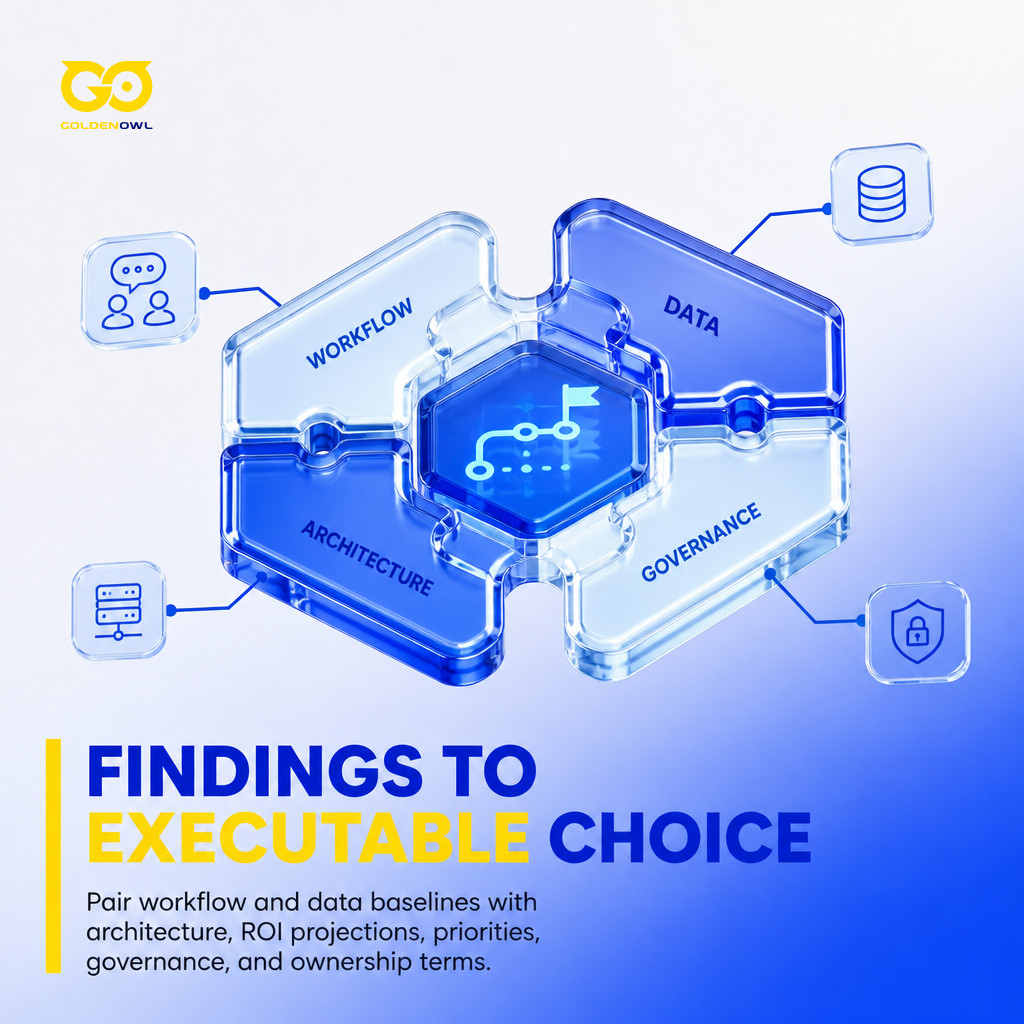
A review may find that private data is exposed, that an AI system treats some groups unfairly, or that someone could break into it. These risks can carry fines or cost the firm people’s trust. The report’s rules for managing AI use—its governance framework—should name who is responsible for the checks and for dealing with failures. It should cover the company’s own policies as well as the laws it has to follow.
The provider also checks vendors’ published terms. Beside each tool it recommends, the report says where that vendor stores data, who gets access, and whether it can use the data to train its models.
For quotes, replies, and records that AI drafts, it recommends setups where someone on your team reviews them before a customer sees them.
How Assessment Providers Differ in Cost and Output
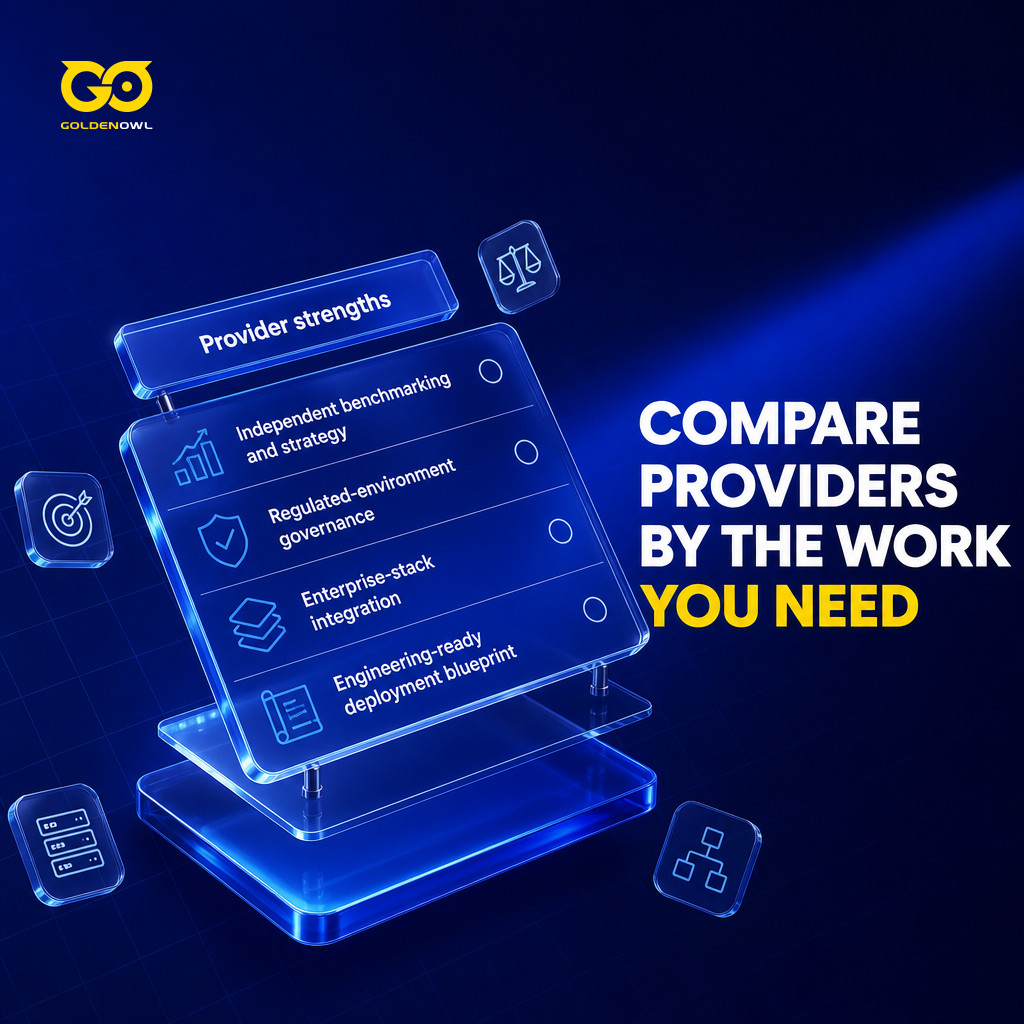
One AI provider, TFSF, writes that a consulting firm charging a six-figure retainer (an ongoing fee that keeps the consultant working for you) may return a maturity model and a strategy. It says a provider focused on building systems may charge less and produce a 30-day build plan instead. The comparison is TFSF’s own marketing, so read it as one vendor’s view. The plan could specify how many AI agents (software that carries out tasks) you need, which systems to connect, and how to handle cases the usual process can’t cover.
A discovery call followed by a summary is also sold as an “assessment.” Before signing, ask what work the provider will do between the first call and the final report.
Ask to see a sample of the final document before you compare quotes. If they need another paid engagement to turn the advice into a build plan, include that in the price comparison.
Ask who owns the report, and whether you could hand it to a different provider. Many platform-based providers describe the assessment in the language of their own tools. If the recommended setup only works on that provider’s own platform, the assessment has picked the vendor for you.
Three months of assessment followed by six months of building takes nine months if one stage waits for the other. Ask when the first AI agent can start work; the full schedule does not tell you that.
TFSF is also an example of a faster model, going by its own published claims. Its Operational Intelligence Assessment uses 19 questions, which it says are benchmarked against HBR and BLS workforce data. It states a turnaround of 24 to 48 hours after the questionnaire is completed. TFSF says the build plan includes recommended agents, the systems they would connect to, and estimates of costs and returns for the client’s actual setup. It describes the plan as the specification for a 30-day rollout that follows right away if the client goes ahead.
Pulse AI is TFSF’s software for running agents; TFSF says it passes those costs on at cost, with no markup, based on how many agents you run. It also says the client owns all the code after deployment, with no platform subscription, ongoing license, or lock-in. It adds that its framework uses benchmarks for 21 specific industries instead of generic observations about processes. Check each of these claims against the contract before relying on them.
Downstream Implementation Costs
The assessment fee is only the first cost: you also need money to put its advice into practice. Set aside that budget before you buy the plan.
Cloud computing and data storage can keep adding to the bill after launch, since charges often depend on usage. More use can mean more to pay. If you run the AI on your own hardware, you may need powerful chips called GPUs as well as storage and network capacity. The assessment needs to account for how you plan to run it.
The build budget has to cover creating or adapting the AI, as well as connecting it to your existing systems. This applies whether you write custom algorithms or configure off-the-shelf tools. Old systems are usually the hard part. A careful assessment should flag where you need new connections, where data needs to move, and what needs rebuilding. That gives the team a chance to plan for the work early.

Who will check the system’s output once it’s running? Who will fix it? You may need to hire engineers to maintain the AI or analysts to make use of its results. Finding and keeping those people can be costly, so ask the assessment team which tasks your current staff could learn to do.
A model trained on old data may get less accurate as the business changes. Budget for checking its results and, when needed, training or adjusting it again. There are also software updates and security fixes to pay for; without that upkeep, you risk losing the gains you bought the system for.
How to Justify an AI Assessment Investment
An AI tool that drafts internal notes may only need a brief review by your own team. Give the review more time and funding when the tool will handle regulated data or talk to customers about their accounts. A mistake there can cost far more than the assessment.
The findings make the case for spending. A review might show which repeat tasks AI could take over and estimate the cost savings in those teams. Or it might show where linking data could help serve customers better and keep them coming back.
Leadership will ask about return on investment (ROI), so lead with it. Cost savings are the obvious part. Put next to them the gains that are harder to count: better efficiency, faster and better decisions, staff freed from repeat tasks. Then translate each into money earned or risk avoided, in terms leadership already uses.
For customer service, estimate what you could save if agents answered some of the calls your staff now handle. For equipment, estimate whether spotting faults early could save repairs and time out of service. AI might also help you earn more by finding promising sales leads or adjusting prices. These are estimates to test, not returns to assume.

Now price the current problem. Suppose, as a hypothetical example, that staff entering data by hand make errors in 20% of entries. What do those errors cost each year? Include the hours spent fixing them and the other work staff have to put off. Compare that ongoing cost with the assessment fee and the likely cost of a fix. The same approach can show what you stand to lose by leaving a known problem unresolved.
Include the cost of dealing with the risks found in the assessment, alongside the returns. Finding a problem early gives the company a chance to address it before it causes harm.
One last trap: hiring a large consultancy for the assessment and then finding a separate deployment partner. The partner has to learn your operation from scratch. You pay twice for the same discovery work.
Frequently Asked Questions
What distinguishes free assessment tools from paid diagnostics?
A paid diagnostic should include data collection, interviews with the people involved, process mapping, and technical analysis of your specific business. Free tools are often lead generation for consulting firms or software vendors. These tools may aim to find potential clients rather than give you a full review of AI readiness.
How long does an operational assessment take to complete?
A focused review takes a few weeks and an enterprise-wide one several months. TFSF sells a faster option: it says it sends a build plan within 24 to 48 hours after the questionnaire. That offer includes proposed agents, a system design, and an estimate of their impact.
Does purchasing an assessment obligate the business to use the provider for implementation?
Not always. AI Workforce Plus says buyers of its $999 package can use the report without hiring it to build the system. It quotes setup work separately and says it credits the $999 toward that work. Other providers may differ, so ask before you sign.
How frequently should an enterprise re-evaluate its operational readiness?
There is no fixed interval for a new assessment. Between reviews, keep checking data quality and AI performance. Use those checks to see when the setup needs to change as the business’s needs or AI tools change.
Conclusion
Before you ask for quotes, write down the decision you need the assessment to help you make. Use that decision to set the scope you ask bidders to price.
Share this page


Table of Content

Subscribe to Golden Owl blog
Stay up to date! Get all the latest posts delivered straight to your inbox