
How do AI agent security solutions reduce enterprise risk? Learn the layered controls and a four-step plan for agent identity, access, and approvals.


AI Claims Processing
Sep 23, 2026
about 14 min read

AI claims processing is changing how insurers handle claims. Apply artificial intelligence to repetitive decisions and document handling
AI claims processing is changing how insurers handle claims.
Apply artificial intelligence to repetitive decisions and document handling, and the claims workflow can become far faster and less costly. Intelligent process automation can shorten claim cycles by 5-10x, cut claim resolution costs by 20-50%, and lift claim specialists’ productivity by up to 50% at the same time.
Structured automation pays off most on simple claims. With AI-powered claim management systems, insurers can move 70-90% of them straight through and reach decisions in minutes rather than weeks. The same systems can flag fraud instantly. They can estimate damage accurately, with recommendations on risk mitigation, helping insurers and claims service providers reduce financial losses and improve customer experience.
Core AI Claims Processing Capabilities
Claims processing moves faster.
Let artificial intelligence take on repetitive decisions and document work, and the claims workflow can become much faster and cheaper. Intelligent process automation can compress claim cycles by 5-10x, lower claim resolution costs by 20-50%, and raise claim specialists’ productivity by up to 50%.
For simple claims, use AI-powered claim management systems to move 70-90% straight through, sending decisions in minutes rather than weeks. They can also spot fraud instantly. They produce accurate damage estimates and recommend risk mitigation, which can help insurers and claims service providers reduce financial losses while improving customer experience.
Artificial intelligence for insurance claims
Start with the target workflow, then compare vendors. AI claims processing might handle one job, like document extraction or damage inspection, or link intake, decisioning, fraud detection, communication, and payment. Point tools and enterprise claims platforms bring different integration, governance, and implementation demands, so the workflow sets the direction.
AI-powered claim management systems
For P&C claims, generative AI is estimated to unlock a $100-billion benefit opportunity through 20-25% lower loss-adjusting expenses and 30-50% less leakage.
Automated Intake and First Notice of Loss
Claims can arrive as scanned PDFs, faxes, EDI files, handwritten forms, and plenty of other formats.
ML-enabled OCR can turn claims documents into organized fields, including patient IDs, diagnosis codes, procedure codes, and provider information.
An AI intake engine can collect claims from phone transcriptions, online forms, mobile apps, email, and other APIs.
ML and LLMs can handle standardized formats such as ACORD and EDI, along with free-form text, handwritten notes, images, audio, and video in real time.
The 2025 Roots State of AI Adoption in Insurance survey put FNOL at the front of carrier pilots, with most carriers reaching 60 to 80% automation within 6 months.
Automated intake can produce these operational gains:
- Processing decrease: Standard claims can see manual intake processing reduced by up to 80%.
- Instant triage: Claims move into processing soon after submission, whatever platform you use.
- Consistent data quality: Extraction precision holds steady through staffing shifts and operational changes.
- Downstream integration: Extracted data flows into routing, booking, and fraud scoring without re-keying.
- Audit trail generation: Each intake decision is logged automatically for compliance and review.
Each document review decision also leaves behind an automated audit trail.
Intelligent Routing and Severity Triaging
Prioritize claims before settlement with policy terms, claim urgency, injury severity, damage extent, financial and reputational risks, plus Severity, Complexity, Fraud Risk, Litigation Probability, and STP Eligibility.
- Severity, Estimated loss magnitude based on loss type and coverage limits
- Complexity, Number of parties, jurisdictions, and coverage overlaps involved
- Fraud Risk, Graph-based anomaly score versus known fraud patterns and networks
- Litigation Probability, Injury type, attorney involvement signals, and jurisdiction history
- STP Eligibility, Composite score determining automated settlement candidacy
AI can automate 70% to 90% of routine claims, leaving adjusters to handle cases that call for human judgment. When every criterion is met, a claim can move straight to approval and payment, while exceptions and high-value claims go to human adjudicators.
Send high-risk claims to senior adjudicators and low-risk cases down the fast lane. At Aviva, over 80 AI models for motor claims lifted routing accuracy by 30%.
Computer Vision for Remote Inspection
An AI agent can review damage photos within minutes, identify affected asset components, judge severity, and produce structured findings for later claims steps.
That computer vision can also monitor insured assets in real time and automate inspections across manufacturing lines and offshore drilling rigs.
- Damage analysis: The agent reviews damage photos and identifies affected asset components.
- Severity evaluation: The system measures damage extent and produces structured findings.
- Complex environments: Automated inspection works across manufacturing lines and offshore drilling rigs.
- Cost reduction: Compensa Poland cut claim processing costs by 73%.
- Cycle reduction: Compensa Poland reduced claim resolution from days to minutes.
- Customer service: The deployment significantly improved customer service quality.
- Damage handling time: The solution delivered up to a 10x reduction in claim resolution and damage handling time.
- Deepfake detection: Real-time detection helps counter increasingly sophisticated fraud attempts.
Policy Coverage and Validation Checking
Before adjudication, an eligibility agent checks coverage conditions, policy limits, deductibles, exclusions, and utilization, then flags claims outside coverage requirements.
Claims teams can get explainable coverage decisions within minutes and spend their time adjudicating instead of checking policies manually. Verification starts during intake, so documentation gaps surface before an adjuster receives the claim.

Most carriers still rely on 4 to 7 separate systems covering policy administration, claims management, billing, underwriting, fraud detection, and third-party vendor applications. When policy data and claims data don't match, reserves can be miscalculated and loss recovery can fail, while compliance rules create more work and risk.
Replacing legacy software could improve efficiency by 40% while reducing IT services expenses by 41%.
That validation work divides into two linked checks:
- Cross-referencing of policies: Policy term verification occurs during intake rather than adjudication.
- Identification of gaps: Documentation gaps are identified before an adjuster is assigned.
AI Reserve Modeling
For carriers using AI-driven reserve modeling, McKinsey projects loss adjustment expenses will fall 25 to 30%, while indemnity spend drops by 3 to 5 percentage point.
A 5% improvement in the accuracy of reserves for a $500M portfolio of claims will free up $25M in capital.
Most AI reserve solutions will cover their cost within 12-18 months after going live, based on that reserve improvement alone.
Expected claim costs are worked out by period, customer, region, and other factors, using payment history, customer risks, force majeure risks, and more. In fintech, ML addresses both reserve failure modes by regularly tightening settlement range estimates.
Overestimated reserves tie up excess capital and quietly squeeze profitability. Underestimated reserves create unfavorable development that weighs on the combined ratio.
Agentic Workflows in Claims Operations
An agentic workflow can pull in missing documents on its own, then carry a claim from intake through coverage review, adjudication, and payment. Use a summarization agent to condense FNOL data and supporting evidence into a clear case brief. An eligibility agent checks whether the claim qualifies, while conversational verification agents ask context-shaped, sometimes ambiguous questions, compare answers with claim data, and record fraud signals. Those agents can also handle phone-based reporting.

An adjuster-facing decision agent reads policy terms, weighs coverage, recommends settlements and reserves, and calls out risks. Multi-document agents compare records for conflicts. Fraud-scoring and investigation-support agents create risk assessments and evidence-backed case reports, with issues surfaced before approval.
Once confidence is sufficient, agents may proceed, while cases that remain uncertain or are high-risk are escalated. Final decisions remain with human adjusters, and every action is logged for transparency and auditability.
Multi-Layer Automation Architecture
Build claims automation in five layers, ranking them by how quickly they return ROI. Use documented enterprise implementations to set the sequence, because each layer raises the usefulness of the next. The rollout order matters just as much as the technology underneath it.

FNOL organizes information at intake, so downstream AI models and straight-through processing receive dependable data.
Everything above Layer 1 requires an event-driven API architecture. Put that connecting infrastructure in place early, or legacy batch processing will constrain every later layer: fraud models won't respond to immediate triggers, reserve engines won't change when documents arrive, and policyholder portals won't show current information. Those limits pass into every system that follows.
Intake Layer
FNOL gives you the most voluminous and automated way to capture information when the claims-handling cycle begins.
What changes operationally with automated FNOL:
A live intake layer should rely on structured exceptions, because some claims will still call for human handling instead of passing through without human touch. An EY case study follows a Nordic insurer using image cleansing, document and layout analysis, OCR, and NLP. Its system turned bills, invoices, pharmacy and local-clinic cash receipts, and medical treatment diagnoses with supporting documents into structured data in the core claims system. Confidence thresholds made the division explicit: the system independently converted and interpreted 70% of claims documents, while agents took care of the remaining 30%. The remaining documents went to agents rather than a black box.
Scoring and Decision Layer
AI routing engines score incoming claims against Severity, Complexity, Fraud Risk, Litigation Probability, and STP Eligibility. Those measures send each claim toward its next processing path.
- Severity, Estimated loss magnitude, based on loss type and coverage limits.
- Complexity, The number of parties, jurisdictions, and coverage overlaps involved.
- Fraud Risk, A graph-based anomaly score compared with known fraud patterns and networks.
- Litigation Probability, Signals from injury type, attorney involvement, and jurisdiction history.
- STP Eligibility, A composite score showing whether automated settlement is appropriate.
Evidence Extraction Layer
Document processing share:
Current document AI can handle police reports, medical records, repair estimates, images, and videos with more than 95% accuracy. After scaling, document processing should account for 20% of claims-handling time, versus 80% at present.
Multi-format handling:
AI handles standardized ACORD and EDI formats as well as free-form text, handwritten notes, images, audio, and video.
Core Integration Layer
API-based ETL:
Modernize claims management with API-based ETL in place of batch ETL.
Real-time event communication:
Send status changes, payment approvals, document submissions, and fraud alerts immediately to policy admin, claims, billing, and analytics systems. Forrester’s 2025 insurance technology forecast anticipates that insurance technology spending will rise 8% in 2025, while integration middleware and cloud native platforms are expected to grow fastest.
Implementation Roadmap
In the rollout, carriers that get to ROI quickly usually sequence initiatives instead of launching them all together; staged delivery tends to win on speed and cost.
Operational Maturity Assessment
Before evaluating vendors, build an internal benchmark for each line of business using the STP ratio, average FNOL-to-disbursement cycle time, cost per standard and complex claim, fraud leakage as a percentage of written premium, reserve ratio for initial and ultimate paid claims, and adjuster satisfaction and decay rates. Taken together, they set the ROI benchmark and establish the sequence for implementation. The benchmark becomes your baseline.

Trace the current claims process from intake through payment, then flag its biggest bottlenecks, including manual data entry and delays involving prior authorizations or denials. Those points offer the highest-value places to apply AI first. Capture current processing-time and denial-rate figures alongside fraud-loss figures so you have an improvement baseline.
Modern Integration Framework Setup
AI can use data after the necessary integration has been established. Without solid integration, the entire automation process stalls.
Initial FNOL Pilot Deployment
FNOL delivers the shortest time to value among insurance claims process automation options. It begins at the front of every claim, where it enables the highest repetition of automations while producing structured data that improves every subsequent level of AI.
Advanced Analytical Modeling Layer
Phase 2 (Months 5 to 10): Document AI + Reserve Modeling
During this phase, manual handling falls 60% and reserve accuracy rises 20 to 30%, freeing adjuster capacity.
Enterprise Scaling and Retraining Loops
After use cases prove value, avoid a big bang approach and connect them to a broader AI agent workflow handling claims end-to-end with minimal manual handoffs.
Create Feedback loops so models keep learning from newly resolved claims and from investigations involving denials or fraud.
Implementation Costs for AI Claims Solutions
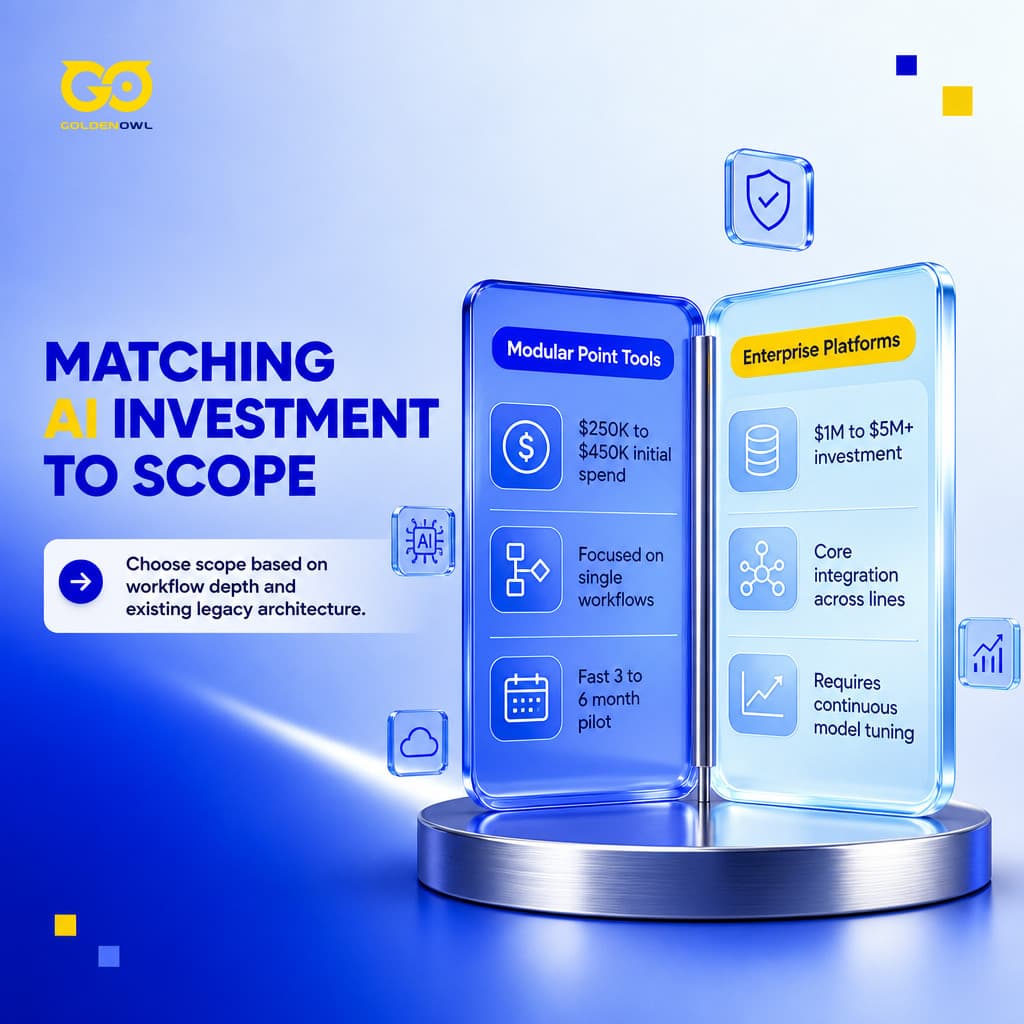
Budget each AI claims solution by component, system size, models, integrations, and delivery method as use cases spread across wider workflows. A fraud analytics model integrated into an existing claims platform, for example, is a specialized AI/ML component that may cost $100,000, $250,000.
For claims specialists, an AI assistant tailored to the organization’s specifics has a variable price ranging between $250,000 and $750,000. A large claims automation system built on traditional AI and LLMs requires $600,000, $1,500,000+.
Solution choices set the total cost:
- The scope and complexity of the solution’s overall functional capabilities.
- The number and type of AI models used for intelligent process automation, including non-neural network ML models, DNN models, and CNN models.
- The solution’s performance, scalability, security, and compliance requirements.
- The number and complexity of system integrations.
- The chosen sourcing model, such as outsourced or in-house development, and the team composition.
Only 5% of enterprises reach substantial AI ROI at scale. Average payoff reaches 1.7x, with 26-31% cost savings. Most documented enterprise deployments show positive ROI within 12 to 24 months.
Modular Component Costs
Modular systems, including FNOL automation and document AI, usually involve costs that vary by implementation. A focused FNOL automation solution for a niche use case takes 3 to 6 months to build and costs $250,000, $450,000.
Enterprise Platform Costs
Enterprise-wide solutions that bring together custom AI models, legacy systems, and multi-line coverage reach $1 million to $5 million and beyond. A claims automation system at substantial scale can also release $25M in capital.
When insurance companies put between $25 million and $100 million into AI each year, they beat their competitors on combined ratios and retention.
Ongoing Infrastructure and Retraining Expenses
Continuous model operation and improvement rely on ongoing support.
A dedicated model management module is needed to design, train, and continuously tune the models, improving their accuracy over time.
Case Studies and Performance Benchmarks
Comparing legacy claims operations with AI-enabled performance means separating routing, intake, image assessment, and settlement, then checking resolution time, claim cost, straight-through processing, and manual document handling.
| Metric | Legacy Baseline | AI-Enabled (2026) | Improvement |
|---|---|---|---|
| Claim Resolution Time | 30 days | 7.5 days | 75% faster |
| Cost per Standard Claim | $40-60 | $25-36 | 30-40% lower |
| STP Rate (Simple Claims) | 10-15% | 70-90% | 5-6x increase |
| Manual Document Handling | 80% of adjuster time | 20% of adjuster time | 75% reduction |
Read the AI-enabled figures through four measures: shorter resolution times, including the fastest outcomes, lower cost per standard claim, higher STP rates for Simple Claims, and less manual document handling.

Lemonade
Lemonade’s AI bot settled the entire claim fully in 2 seconds, its quickest result; the reported automation and company results appear below.
- Full claim automation: 55% of Lemonade claims are fully automated from start to finish.
- FNOL processing: 96% of first notices of loss are processed without human involvement.
- Q4 loss ratio: Lemonade posted a record Q4 loss ratio of 63%, a 12-point year-over-year improvement.
- In Force Premium: In Force Premium grew by 31% to $1.24 billion.
Zurich Insurance
Zurich Insurance used Natural Language Processing Development services, reducing claims review processing time by 58x, from 8 hours per claim down to 8 minutes.
Tractable
Tractable is a UK-based insurtech startup offering AI for insurance claims processing across auto and property lines.
Full claim cycle
From FNOL through settlement, Tractable’s AI solution handles the full claims process, using Deep learning and computer vision to evaluate vehicle and property damage remotely and assess losses instantly. The software also supplies analytics-driven recommendations for the repair operations required.
Funding and adoption
Tractable raised over $119 million between 2014 and 2022; its product is now used by major insurers in the US, UK, Japan, and Europe.
Liability determination
For Complex cases, liability determination time dropped by 23 days.
Regulatory Compliance and AI Governance
Explainable AI Requirements
When regulators require clear denial reasons, choose simpler decision trees, even though neural architectures often predict with greater accuracy.
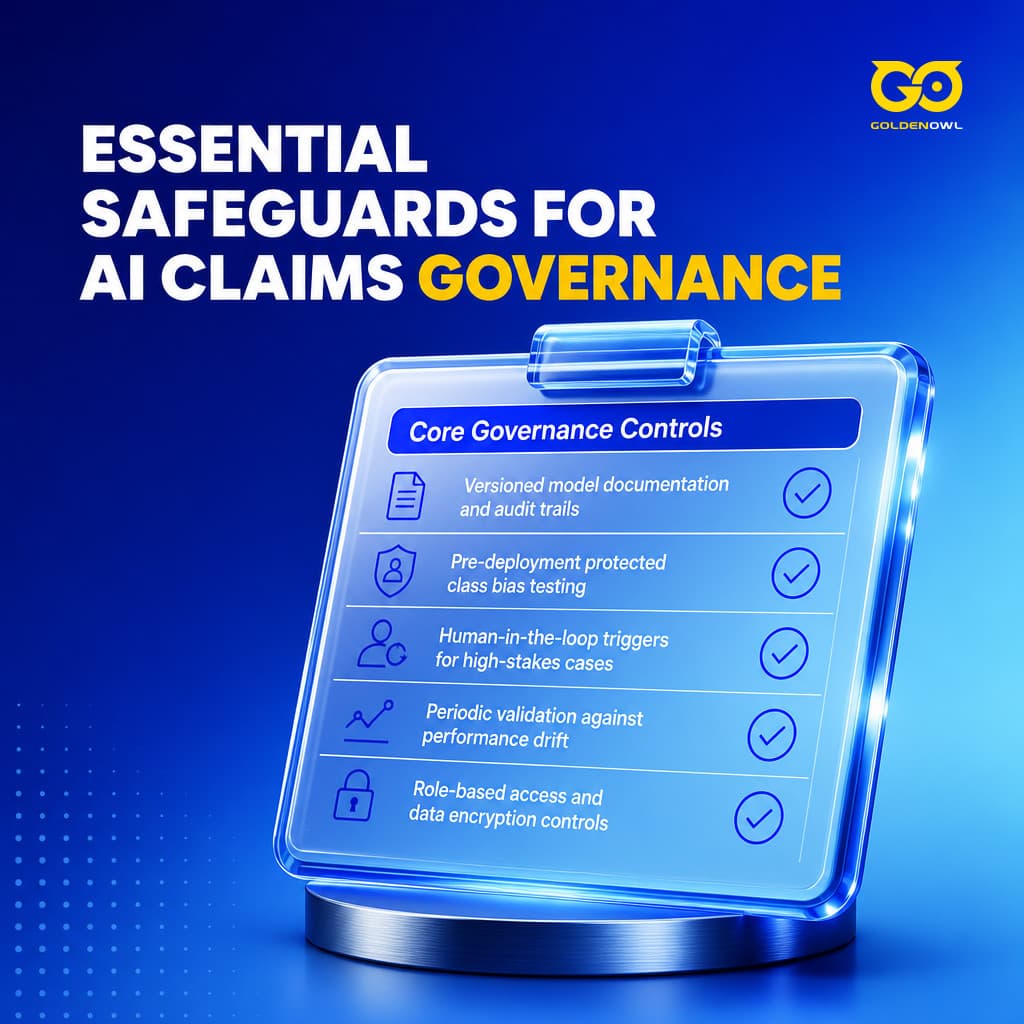
In regulated markets, black-box systems making underwriting or claims decisions can become compliance time bombs. Regulators and courts increasingly expect you to show how an AI system reached each specific decision.
Put these safeguards directly into the workflow.
- Model documentation with clear version control and audit trails
- Bias testing across protected classes before and after deployment
- Human-in-the-loop processes for high-stakes decisions
- Regular model validation to ensure continued accuracy and fairness
- Ethical AI governance frameworks with executive-level oversight
Regulatory Frameworks
Across jurisdictions, insurance AI rules are tightening quickly, making cross-functional governance teams essential.
- NAIC Model Bulletin on AI (2023-2026): The National Association of Insurance Commissioners expects insurers to manage AI risks throughout the lifecycle, with transparency, fairness, and accountability; states are adopting these guidelines into law.
- EU AI Act: Taking effect in phases through 2026, the EU AI Act classifies AI used in insurance underwriting and claims processing as "high-risk," requiring documentation, human oversight, bias testing, and explainability.
- State-Level Regulations: Colorado's SB 21-169 requires insurers to test AI-driven decisions for unfair discrimination, while Connecticut, New York, and other states pursue similar algorithmic accountability requirements.
- Model Risk Management: Regulators increasingly expect model inventories, regular validation, and evidence that policyholders and regulators can understand AI decisions.
Bias Auditing and Model Validation
Make AI governance a shared job for compliance, legal, actuarial, claims, underwriting, and technology leaders.
Together, those groups keep AI decisions grounded in judgment instead of algorithmic optimization.
Sensitive Data Protection
Claim validation puts policyholders’ sensitive personal/business, financial, and health data in AI systems, bringing strict security and compliance requirements with it.
For insurance claims solutions, ScienceSoft reduces sensitive data leakage through layered safeguards: multi-step authentication, encrypted records, permission-based access, and other cybersecurity controls.
Schedule periodic infrastructure vulnerability scanning to reduce the risk of external cyberattacks.
ScienceSoft also helps clients maintain compliance with data protection and AI governance standards, including NAIC (AI Principles), US state-level regulations, Colorado AI rules, NIST AI RMF, GLBA, NYDFS, CCPA, HIPAA (for health insurance), GDPR, AI Act (for the EU), IA (for the KSA), SOC 1/2, and bank-grade model risk management practices (e.g., SR 11-7), and more.
Frequently Asked Questions
What is insurance claims processing automation?
But claims automation brings together AI, machine learning, and workflow tools to handle intake, document review, fraud detection, reserving, payments, and related tasks.
What is straight-through processing (STP) in insurance?
Straight-through processing, or STP, lets an insurance claim move from intake to resolution automatically, without human intervention. For simple claims, AI-enabled STP now handles 70-90%, compared with 10-15% previously, covering the vast majority.
How long does it take to implement AI in insurance claims processing?
Delivering a targeted FNOL automation solution generally requires 3 to 6 months, while an end-to-end claims management system generally requires 12 to 18 months and large-scale enterprise application development.
That broader system includes document AI, fraud analytics, reserve models, and a customer portal, while targeted use cases usually show initial results within 6-12 months.
How much can AI reduce insurance claims processing costs?
On costs, AI-powered claims automation can cut spending per claim by 30-40%, taking standard claims from $40-60 down to $25-36.
After scaling its deployment, Aviva has reported £80 million in run-rate savings attributable to its AI-supported claims transformation.
How does AI detect insurance fraud?
AI fraud detection can spot anomalies human adjusters may overlook by comparing patterns in text, imagery, metadata, and behavioral data, aligning with broader ai solutions for finance.
Modern systems keep fraud intelligence running across the claims lifecycle, catching deepfakes and sophisticated fraud schemes in real time.
Can you develop custom insurance claims automation software?
Yes, custom insurance claims automation software is possible, but start with a maturity assessment to identify the highest-value automation opportunities before development begins.
Use that assessment to decide whether custom development makes sense. McKinsey reports that leading US P&C carriers are divided roughly 50/50 over whether to buy and configure a core system or build one. Build custom software when workflows are highly specialized, proprietary data sources call for deep integration, or the operating model demands major customization. Choose configurable platforms or wrappers when the fit problem is limited.
The right path may involve data scientists building proprietary AI models or integrating market-available LLMs, with accuracy tracked across AI operations.
An experienced AI solutions provider can help you build multi-step agent workflows around specific policy rules instead of relying on generic automation.
What should carriers look for when selecting AI insurance claims management software?
Before selecting software, assess core system compatibility, pre-trained model accuracy, API capabilities, audit trails, and data protection compliance.
Its integration with policy administration systems, including Guidewire, Duck Creek, and Majesco, should also be evaluated.
How does EDI integration work for insurance claims automation?
Through EDI, claims automation exchanges standardized data in real time across medical providers, repair networks, and law firms.
What are AI use cases in healthcare claims processing?
Healthcare claims processing applies machine learning, natural language processing, computer vision, and intelligent automation throughout the claims lifecycle, including specialized medical claims handling alongside broader ai solutions for healthcare; claims status tracking among these applications:
- Automated claims intake
- Fraud detection
- Claims adjudication
- Denial prediction
- Medical coding
- Prior authorization
- Claims status tracking
You can separate AI claims processing into practical layers: begin with intake and document handling, then add fraud analytics, reserve models, payments, and customer-facing tools where the case supports them. Apply STP to straightforward claims, keep appropriate controls around AI operations, and test connections to Guidewire, Duck Creek, Majesco, and EDI. From there, choose software by fit: build for specialized workflows, configure standard ones, and check accuracy, audit trails, APIs, and data protection before committing.
Share this page


Table of Content

Subscribe to Golden Owl blog
Stay up to date! Get all the latest posts delivered straight to your inbox