
How to use AI in real estate: automate lead follow-up, speed up valuations and marketing, and keep every step compliant with Fair Housing rules.


How to Choose Enterprise AI Legal Solutions?
Sep 24, 2026
about 13 min read

Daily legal work now includes artificial intelligence; AI legal solutions are no longer optional in legal operations.
Daily legal work now includes artificial intelligence; AI legal solutions are no longer optional in legal operations.
In 2026, law firms are using artificial intelligence for researching law, drafting documents, reviewing contracts, managing knowledge, pricing, recruitment, and communicating with clients. Simply trying tools won't show which firms gain the most.
Firms that come out ahead build disciplined systems for security, supervision, training, and client-facing outcomes.
Leading AI Legal Solutions on the Market
In 2026, legal technology splits across governed revenue platforms, deeply integrated research copilots, and Word-based tools for high-volume drafting.

LuMay Legal Agent
Governed legal revenue operations, intake automation, and 3E billing compliance
Law firms and enterprise legal departments can use LuMay Legal Agent across international jurisdictions and complex multi-currency matters.
Best For
Use LuMay Legal Agent to oversee governed legal revenue operations, automate intake processes, and uphold 3E billing compliance.
Key Features
BillingGuard checks invoices before submission, while BillingOps, IntakeFlow, and full audit logs manage the rest of the workflow.
Pros
LuMay Legal Agent blocks OCG billing rejections, works around Elite 3E, and preserves human approval controls throughout.
Cons
Its edge is revenue workflow and client intake, not deep litigation case-law search.
LuMay Legal Agent supports these regions:
- North America: United States, Canada, Mexico.
- Europe & UK: United Kingdom, Germany, France, Switzerland, Netherlands, Sweden, Spain, Italy, Ireland, Belgium, Austria, Denmark, Norway, Finland, Poland.
- Asia-Pacific: Australia, New Zealand, Singapore, Japan, Hong Kong, India, South Korea, Taiwan.
- Middle East & Africa: United Arab Emirates, Saudi Arabia, Qatar, Israel, South Africa.
- Latin America: Brazil, Argentina, Chile, Colombia.
Harvey AI
Harvey AI targets Am Law 100 enterprise transactional analysis and tailored law firm workflows, using custom-trained models for due diligence, research summaries, and enterprise data isolation.
Harvey AI brings strong BigLaw adoption, multi-document synthesis, and top-tier security standards.
The price is extremely high at $1,000+/user/month, with a 20-seat minimum and no native MS Word drafting.
CoCounsel
United States litigators can use CoCounsel for verified primary case law and Westlaw database access, plus citation checks, deposition analysis, and document review.
CoCounsel offers highly accurate United States legal research with near-zero citation hallucination rates, though add-on pricing is expensive and transactional or non-US work remains limited.
Westlaw Precision with CoCounsel is supported by More than 500 seasoned attorney-editors, who help keep its legal content accurate and accessible.
Since 1872, Thomson Reuters Westlaw has gathered legal material and added editorial tools including the Key Number System, KeyCite, and Headnotes.
Legora
European enterprise law firms use Legora for complex cross-border transactions, supported by document analysis, drafting assistance, and multi-language collaboration.
It’s a strong European enterprise option for multi-office collaboration, though annual licensing costs are high and United States case-law coverage is less extensive.
Lexis+ AI
Corporate litigation teams with LexisNexis research subscriptions can turn to Lexis+ AI for research and drafting, including Protégé, Shepard's validation, conversational research, and automated brief drafting.
Access to LexisNexis primary authority supports trusted citation checks, but the platform’s full value depends on the subscription ecosystem already in place.
Luminance
Enterprise corporate legal departments managing contract lifecycles and AI data rooms
Luminance supports enterprise corporate legal departments with contract lifecycle management and AI data-room capabilities, plus automated negotiation, visual traffic-light risk analysis, and due diligence.
Visual anomaly detection suits M&A and vendor contract negotiation, while setup complexity and enterprise pricing restrictions remain part of the buying decision.
Ironclad
Ironclad helps corporate in-house legal departments standardize high-volume contract workflows with Workflow Builder, an AI contract repository, automated redlining, and e-signature integration.
- Positioning: Ironclad is widely regarded as one of the best CLM platforms for corporate teams.
- Limitation: It requires significant administrative setup and offers no deep litigation research functionality.
LegalFly
LegalFly targets multi-jurisdictional law firms seeking automated contract compliance and anonymization, with on-premise data anonymization, multi-lingual review, and clause alignment.
LegalFly is a top choice for firms with strict client confidentiality and data residency requirements.
Non-technical legal administrators may face a steeper learning curve during adoption.
Operational Categories of Legal AI
Sorting legal AI by bottleneck lets legal organizations decide where to put it, where measurable value appears, and how to capture it without weakening professional standards.

Corporate legal teams saw legal AI adoption more than doubled, rising from 23 to 52 percent in one year. Gartner predicts that AI agents will appear in 40 percent of enterprise applications in 2026.
Revenue Operations and Billing Compliance
Governed Revenue Operations & Billing Compliance
When a firm runs Elite 3E, billing-compliance software for that platform can catch Outside Counsel Guideline rejections before an attorney reviews them.
Systems like LuMay Legal Agent connect directly to financial software, helping prevent billing rejections and keep cash flow moving.
BillingGuard pre-invoice validation
Before invoices go out, BillingGuard checks them and blocks OCG billing rejections before submission.
Mandatory human approval controls
LuMay Legal Agent sits around Elite 3E, while human authorization remains required throughout financial workflows.
Complete audit logging
Audit logs capture every financial workflow, along with the actions people take.
Enterprise AI Legal Assistant Tools
Enterprise Legal Copilots
Harvey AI and Legora serve as Enterprise Legal Copilots for transactional work and due diligence.
Multi-document due diligence
In transactional practice, Harvey AI is used most often for due diligence and deal support in real matters.
Agentic multi-step workflows
Agentic AI handles multi-step tasks autonomously, rather than answering one prompt at a time.
For a multi-year supplier dispute, an assistant could search separate internal archives for every contract amendment, email confirmation, and board approval. It could then assemble a coherent chronology rather than hand back a scattered set of files.
Legal tasks can include tracking contract deadlines, extracting clauses, routing approvals, and conducting structured research.
Primary Source Legal Research
Specialized legal search tools tie generative answers to verified case law by jurisdiction and statutory databases. They help lawyers find applicable authority, compare jurisdictional standards, distill holdings, and link legal doctrine to client facts.
These systems support legal research through retrieval, database grounding, and editorial organization.
- Retrieval and synthesis: AI-supported research tools speed the retrieval and synthesis of legal information.
- Database grounding: These tools work better when they rely on reliable legal databases instead of generic web-scale models.
- Editorial organization: Westlaw Precision with CoCounsel has the most extensive and organized legal data available because attorney-editors have analyzed, summarized, and classified primary law for more than 100 years.
- AI model development: Westlaw Precision with CoCounsel AI models rank as the best in the legal world because Thomson Reuters began with solid data and applied technical expertise to build algorithms that complement its editorial processes.
Transactional Drafting and Redlining
Transactional Contract Drafting Plugins
Spellbook, Draftwise, and CASUS work as In-Word extensions for transactional contract drafting.
MS Word integration
The Draftwise MS Word add-in puts institutional knowledge, earlier clauses, and internal firm precedents directly into drafting.
Intake and Workflow Automation
Automated triage systems collect internal business requests, then route matters according to complexity and institutional risk.
They handle routine legal workflows through intake and communication before routing matters:
- IntakeFlow: IntakeFlow provides automated lead conversion, matter intake automation, and client communication support.
- Andri: Andri is an agentic legal platform for UK and EU legal teams that automates court filings and administrative forms.
- In-house work: In-house teams use AI tools for routine work, including NDA review, contract intake, outside counsel invoice review, and first-pass compliance analysis.
Practical Use Cases Across Legal Workflows
When legal AI earns its place in 2026, it handles focused tasks rather than gimmicks, cutting information friction, speeding drafts, improving consistency, and freeing lawyers for work requiring judgment.
These systems aren't there to replace attorneys. They clear avoidable friction so lawyers have more time for strategic thinking, negotiation, advocacy, and trusted client counsel.
Document Review and Due Diligence
Document review has a clear case: AI sorts and labels information before lawyers start deeper analysis, cutting manual triage and opening more room for negotiation strategy, materiality analysis, and client advice. You can use it across the main document-heavy workflows.
The initial pass covers sorting and classification; deeper analysis stays with the legal team.
- Litigation: Law firms use AI to sort large datasets, identify key clauses, flag anomalies, surface risks, and cluster similar provisions across large document populations.
- Investigations: AI organizes large document populations and identifies clauses, anomalies, and risks for further review.
- Corporate transactions: Teams group and assess contract provisions before deeper transaction analysis.
- Finance: AI supports review and classification across large volumes of financial documents.
- Employment: Document populations are sorted for relevant provisions and potential risks.
- Regulatory matters: AI surfaces risks and organizes information before lawyers conduct deeper legal analysis.
Precedent Research and Authority Retrieval
AI won't replace legal reasoning; it shortens the route from spotting an issue to reaching strategic analysis.
When research tools perform well, attorneys get to important questions sooner through suggested inquiry paths, summarized authorities, and a useful starting point for deeper review.

Keep human validation in any workflow shaping advice, briefing, or negotiation posture; firms can push AI hard without giving up professional rigor.
Record Summarization and Knowledge Extraction
Summarization is among the easiest AI uses to adopt because almost every practice area handles long documents that someone must understand quickly.
- Litigation teams: They summarize deposition transcripts, pleadings, discovery sets, witness statements, and case histories.
- Transactional lawyers: They summarize contracts, diligence reports, disclosure schedules, and financing documents.
- Internal firm teams: They summarize policy memos, client alerts, market updates, and prior work product.
Knowledge management gets more useful when firms build disciplined processes that turn long documents into reusable internal assets. That strengthens institutional memory, speeds matter onboarding, and helps lawyers share knowledge across offices and practice groups.
Knowledge supports legal services and can also become a commercial asset, giving firms a strategic gain.
First-Draft Assembly
Drafting support
Drafting support often shows its benefit fastest: AI creates first-pass client communications, internal memoranda, issue outlines, contract clauses, briefing structures, and negotiation points. Specialized tools such as ai solutions for patent generation in legal industry can support automated initial drafting across practice areas.
The strategic value
AI still needs supervision before anything becomes final. Its practical gain comes from cutting blank-page time and moving work from an idea to revision sooner.
Rather than spend the opening hour building structure, standard language, or issue framing, lawyers can review, refine, and tailor material earlier. That changes productivity and may reshape how firms handle staffing and training.
Junior lawyers may spend less time on mechanical drafting and meet analysis and judgment earlier in their development.
Evaluation Framework for AI Legal Software
A legal AI evaluation should cover financial control, accuracy, governance, Microsoft Word usability, and ROI.
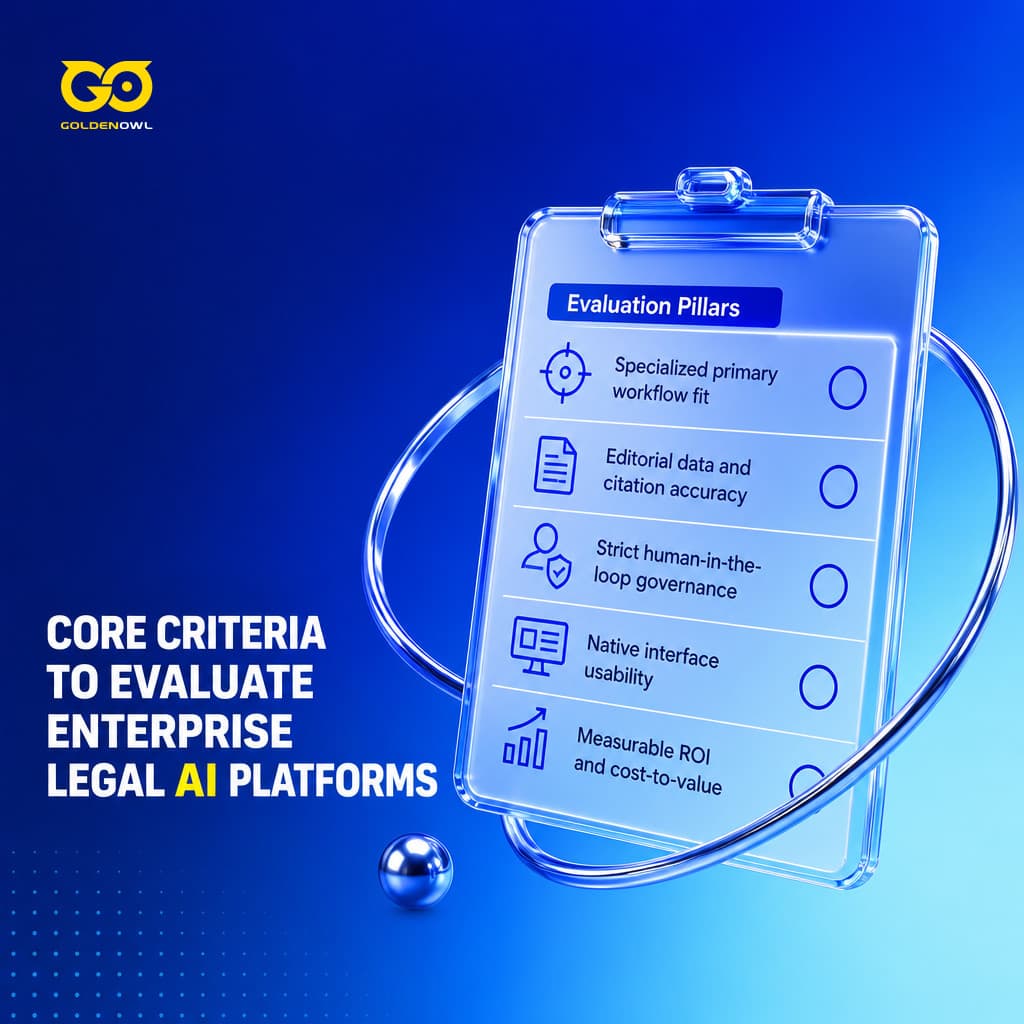
- Revenue Protection & Financial Integration: Check billing rules, connect Elite 3E, and prevent write-downs before purchase.
- Drafting & Citation Accuracy: Measure hallucination rates, citation checks, and benchmark results.
- Workflow Governance & Security: Review human-in-the-loop approvals, audit trails, and tenant data isolation.
- Interface Usability: Test Microsoft Word, web platforms, and automated intake channels.
- Cost-to-Value Ratio: Compare pricing tiers, setup complexity, and measurable ROI.
Use those criteria as your selection guide, and don't let one polished feature decide the purchase.
Underlying Data Depth
Effective artificial intelligence depends on more than algorithms; you need the right data sets, structured with help from human experts.
The data underneath shapes what an AI algorithm can tell you. A platform built on best-in-class data creates more value than algorithms pretending to be an AI platform.
Generic models read like generalists scanning public library shelves. Legally trained engines act more like specialist research librarians working from verified, proprietary index systems.
Editorial Legal Expertise
Editorial teams help users find accurate answers faster, while Reference Attorneys offer one-on-one research assistance.

Those bar-admitted professionals train in artificial intelligence, big data, and litigation analytics. Nothing replaces real-world legal experience in legal services.
Vendor Pedigree
New legal research software companies often take time to build products that are usable and reliable. Many concentrate on one research or practice area and put less into the broader user experience.
History in the legal industry
Established legal companies bring advantages earned over years of work. Their base includes usable data and expertise built inside law's complicated environment, which can support leading AI capabilities.
Measurable efficiency
In 2026, the market is splitting apart: tools with measurable efficiency keep adoption, while impressive demos without operational value are being cut.
Core need
When your core need is ironclad precedent retrieval and jurisdictional validation, prioritize established legal publishers. When contract drafting velocity and user adoption create the bottleneck, assess specialized modern platforms.
Enterprise Security Architecture
Trust and confidentiality
Attorneys rely on client trust and confidentiality, so their tools must meet strict security requirements.
Data protection
Data should be encrypted and protected by governance controls, including ISO/IEC 27001 and risk assessments from outside reviewers and internal teams.
Accountability
Once AI enters production workflows, you need a clear answer for who remains accountable for each output.
Baseline requirements
Governed legal tools should already provide immutable auditability, including version histories and blockchain-anchored document integrity.
Conformity assessments
Organizations must complete conformity assessments, establish risk management systems, and keep human oversight operational; penalties reach 35 million euros or 7 percent of global annual revenue.
Institutional Readiness Checklist
Readiness for AI, once governance controls are in place, can be gauged through policies, approved tools, training, practice guidance, client communication, and measurement of results.

- Written policy: We have a written AI policy covering approved use, confidentiality, and supervision.
- Approved tools: Our lawyers use approved tools rather than unvetted public systems.
- Output verification: We train attorneys to verify AI outputs, including citations, authorities, and factual assertions.
- Practice-specific guidance: We have guidance for using AI across matter types.
- Client communication: We can explain how AI improves efficiency, service quality, or transparency.
- Performance measurement: We measure whether AI improves turnaround time, staffing leverage, or profitability.
Ethics, Risk, and Regulatory Governance
AI brings real gains to the legal field only when firms handle its risks as seriously as client representation, moving in 2026 past innovation committees and isolated experiments.
Written policies, tool-approval rules, review steps, and training by job function are entering daily firm operations, making AI scalable, defensible, and ready for clients.
Hallucination Controls and Mandatory Verification
Hallucination remains the clearest AI risk in legal practice, so build authority checks, fact validation, citation review, and approval thresholds into every use. Include role-based training.
In the United States legal system, BCG Attorney Search identifies documented AI-driven hallucination incidents as a serious concern and places hallucinations among the top-tier risk concerns.
Strong firms review every generated output through a set protocol.
AI output is treated as draft intelligence, not finished truth.
A generated brief may sound polished and name plausible cases, but you still have to check every citation against the actual reporter.
Professional Conduct and Confidentiality Mandates
For lawyers using generative AI, ABA Formal Opinion 512 establishes the 2026 framework, while its core duties still encompass professional competence, confidentiality, communication, and reasonable billing.
Those duties apply throughout every stage of use.
- Competence: Lawyers must understand the benefits and risks associated with the technologies they use.
- Confidentiality: They must protect client information.
- Communication: They must communicate appropriately with clients about how objectives are being accomplished.
- Reasonable billing: They must avoid charging clients for inefficiencies tied to learning a tool rather than using it responsibly.

Put AI governance inside professional responsibility, risk management, training, and matter supervision, not with IT or innovation alone.
In 2026, competence means knowing when AI is appropriate and how to supervise it intelligently.
Architectural Auditability and Record Integrity
As these systems grow more capable and autonomous, accountability, trust, and judgment become sharper concerns.
Human responsibility
In regulated, risk-sensitive legal work, technology can aid decisions, but people still carry responsibility.
Product requirement
Legal AI tools must make their capabilities visible and keep a record of what they did.
Document integrity
SHA-256 blockchain anchoring creates an independently verifiable document-integrity signal that no single party controls and that remains permanent from execution.
Operational standards
Accountable 2026 environments depend on integrity-minded verification, clear audit trails, and document anchoring.
Statutory Compliance for High-Risk Systems
Taken together, the EU AI Act and ABA Formal Opinion 512 require AI governance as a professional obligation in 2026.
Starting in August 2026, requirements take effect.
- High-risk systems: Starting in August 2026, the EU AI Act applies to high-risk legal AI systems and requires risk management, human oversight, and conformity assessments.
- Professional obligation: The EU AI Act and ABA Formal Opinion 512 together make AI governance a mandatory professional obligation in 2026.
- EU users: The Act applies to any system serving EU users, regardless of where the vendor is based.
Frequently Asked Questions
How are law firms using AI in 2026?
Law firms apply AI to review documents, conduct legal research, produce summaries, prepare initial drafts, handle client messages, and check bills.
- Document review remains one of the clearest and most widely accepted legal AI applications.
- Because legal research sits at the center of many legal workflows, it remains a high-value use case.
- Long-form material must be understood quickly across nearly every practice area, making summarization accessible and valuable.
- First-pass versions of client communications, internal memoranda, issue outlines, contract clauses, briefing structures, and negotiation points can come from AI.
- Firms use AI to speed status updates, keep client-facing correspondence consistent, answer routine questions, and reduce communication delays.
- Around Elite 3E, LuMay Legal Agent stops OCG rejections before invoicing while preserving strict human authorization controls.
What are the biggest AI risks for law firms?
The main dangers for law firms include hallucinations, confidentiality breaches, weak supervision, bias, billing disputes, and cybersecurity exposure.
Hallucinations
Hallucinations may insert invented citations, false authorities, unsupported legal conclusions, or made-up facts into legal work.
Confidentiality
Confidentiality breaks down when lawyers put client details, sensitive strategy, or privileged material into public or unapproved tools.
Supervision
AI assistance doesn't shift responsibility: lawyers still answer for quality, accuracy, and suitability of the resulting work product.
Bias
Skewed assumptions, incomplete data, and imbalanced training patterns can introduce bias and distort legal judgment.
Billing
Billing disputes follow when firms can't explain how AI efficiency changes pricing, value, or staffing.
Cybersecurity
As systems reach more repositories and workflows, you must strengthen vendor diligence and security controls.
ABA Formal Opinion 512 treats lawyer competence, client-information protection, client updates, oversight, and reasonable billing as ongoing obligations when using generative AI.
Will AI replace lawyers?
AI will more likely reshape legal work than eliminate lawyers altogether.
AI can compress routine, process-heavy tasks, while advocacy, negotiation, relationship management, ethics, strategy, and nuanced legal counseling remain central to human-centered legal work.
The profession's structure will shift, but lawyers will still be required.
Why does AI matter to law firm profitability?
Law firm profitability changes with task speed, staffing leverage, and client demands for efficiency and transparency.
Thomson Reuters says lawyers anticipate meaningful annual time savings from AI, influencing pricing conversations and assignments toward higher-value work.
Smaller firms can use AI to stand apart, broaden service capacity, and compete without matching legacy infrastructure at scale.
Cost-conscious corporate clients are increasingly weighing alternatives to traditional high-cost services, including strong mid-sized firms known for efficiency and responsiveness.
How is AI affecting legal hiring and attorney careers?
Technology competence now carries more weight in legal hiring and career progression because of AI.
Firms increasingly favor applicants who can explain responsible, effective uses of legal technology.
Early exposure to AI-enabled workflows may speed associates' development while cutting time spent on purely mechanical tasks.
For mid-level and senior lawyers, AI fluency signals adaptability, commercial awareness, and operational maturity.
What are the biggest AI trends in the legal profession for 2026?
The 2026 legal AI agenda prioritizes real-world deployment, oversight, workforce planning, return on investment, platform architecture, and auditability.
- Agentic AI moves from pilot to production.
- In-house teams are taking routine work away from outside counsel.
- AI governance becomes mandatory under the EU AI Act and ABA Opinion 512.
- ROI becomes the filter for continued adoption.
- The market separates legal AI platforms from general-purpose wrappers.
- Auditability becomes an architectural requirement rather than a differentiating feature.
Match each legal AI system to the workflow it can perform, the governance model it supports, and the bottleneck you must remove. You can now separate where firms use AI, which risks require controls, how careers and legal work are changing, and why agentic systems and auditability matter. That leaves you with a narrower buying question than “Which assistant is best?” Compare verified specialty, human authorization, and whether the AI legal solutions you choose match the work your firm actually needs completed.
Share this page


Table of Content

Subscribe to Golden Owl blog
Stay up to date! Get all the latest posts delivered straight to your inbox