An AI legal assistant does the first pass of legal work. See what it can and can’t do, and which legal AI tools fit research, contracts, or practice management.


AI Solutions for Patent Generation in Legal Industry
Sep 24, 2026
about 13 min read

Patent workloads now exceed many legal teams’ processing capacity, increasing demand for ai solutions for patent generation in legal industry.
Patent workloads now exceed many legal teams’ processing capacity, increasing demand for ai solutions for patent generation in legal industry.
With those conditions in place, AI now has a practical place in patent operations. It helps teams run prior art searches faster and reduce the time spent drafting specifications. It provides a starting point for office action responses, while prosecution teams still keep Attorney judgment as the controlling layer throughout the process.
Leading AI Solutions for Patent Generation in Legal Industry
The 2026 patent drafting market includes several distinct operating models. Start by asking who controls the workflow, then check the firms and clients attached to each product. Solve Intelligence serves DLA Piper and Finnegan; Deep IP works within Microsoft Word and reaches 400+ law firms; Ankar AI reports 60% faster drafting for Fortune 500 clients; PatSnap adds drafting to an enterprise innovation suite; Patlytics offers an AI drafting co-pilot with SOC 2 certification; Lightbringer keeps an attorney involved; Specifio/Clarivate centers on claims generation; and Patentia charges $499 per draft to non-attorneys. Each one calls for a different buying decision.

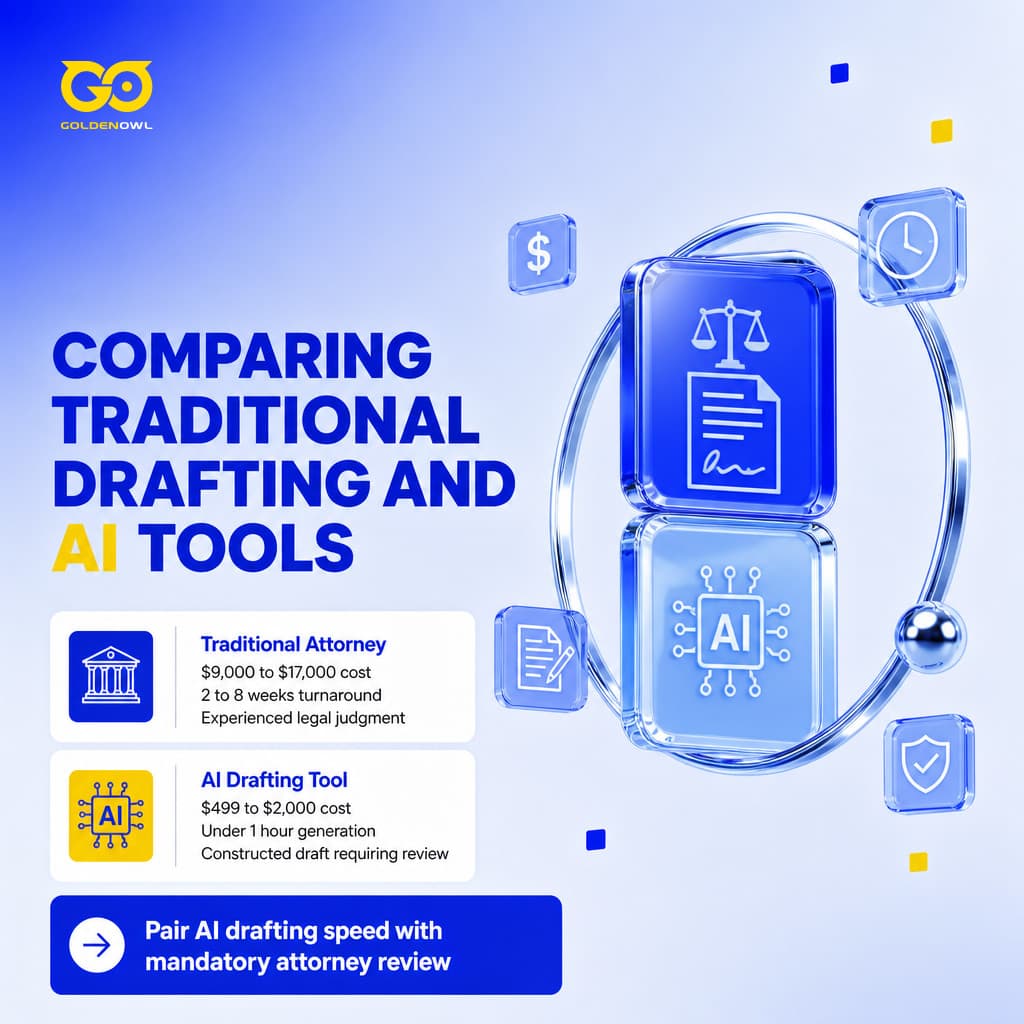
Conventional patent drafting has typically run $9,000 to $17,000 and lasted four to twelve weeks. AI tools may now turn out complete applications in under an hour at a fraction of that price.
Here are the main platform differences.
| Tool | Pricing | Drafting Scope | Best For | Key Differentiator |
|---|---|---|---|---|
| Solve Intelligence | Custom | Full application, figure gen, prosecution | IP law firms | Profitable, Thomson Reuters backed, DLA Piper/Finnegan clients |
| Deep IP | Custom | Full application, office action responses | Law firms | Native Word integration, style-matching AI |
| Ankar AI | Custom | End-to-end patent OS including drafting | Enterprise teams | 60% faster drafting claimed, Atomico backed |
| PatSnap | Enterprise ($15K-$50K+/yr) | Drafting within full innovation suite | Enterprise IP departments | $352M funded, largest IP intelligence product suite |
| Patlytics | Custom | AI drafting co-pilot, figure drafting | Am Law 100, Fortune 500 | SOC 2 Type 2 certified, smart disclosure suggestions |
| Lightbringer | Published (subscription) | Full application with attorney review | Growing tech companies | Transparent pricing, attorney in the loop |
| Specifio/Clarivate | Enterprise | Claims generation | Large IP departments | Part of Clarivate's suite post-acquisition |
| Patentia | $499 per draft | Full application from invention disclosure | Inventors, startups, universities | $499 total, non-attorney accessible, requires completed analysis |
Each tool handles a different slice of the workflow, applies its own review controls, and serves users ranging from law firms and enterprise departments to non-attorneys.
Deep IP
Deep IP works directly in Microsoft Word, the place where most patent attorneys already draft, and it learns each firm's templates and writing style. Before you choose it, list the jurisdictions on your calendar: coverage includes USPTO, EPO, PCT, UKIPO, CPMA, CNIPA, and KIPA. Few platforms match that breadth of jurisdiction coverage.
Deep IP is used by 400+ law firms, including Greenberg Traurig. Its zero data retention policy also speaks to the confidentiality worries that can hold back legal AI adoption.
Drafting scope
Deep IP can draft full applications and office action responses while producing text that follows a firm's established style.
Best for
Deep IP suits law firms bringing AI into their existing Word-based workflow.
Pricing
Custom pricing is not published.
Strengths
Its strengths are native Word integration and style matching, supported by zero data retention.
Limitations
Deep IP serves attorneys, rather than solo inventors or other non-attorney users.
Ankar AI
Ankar AI places drafting inside an end-to-end patent operating system and claims a 60% speed gain. Its data infrastructure draws on Palantir engineering, and its named clients include L'Oreal and Fortune 500 companies.
Funding, institutional backing, a complete workflow, and an enterprise customer base are its broader advantages. Ankar AI has $24M raised with Atomico backing.
It handles full application drafting across claims and specification generation within a broader patent OS.
Ankar AI fits enterprise innovation teams running high-volume patent programs.
Pricing: Custom enterprise contracts.
Custom pricing, a newer market position than Solve and Deep IP, and reduced access for smaller organizations remain its limits.
Funding: $24M raised (Atomico-backed).
PatSnap
PatSnap has the strongest funding and market presence among these platforms, with $352M raised. Its drafting capability sits alongside tools for market intelligence, portfolio oversight, and technology analysis, making it one element of a much larger suite.
PatSnap provides drafting inside a full enterprise IP and innovation intelligence suite.
It fits enterprise IP departments already using PatSnap for portfolio management and competitive intelligence.
PatSnap sells through enterprise contracts, and its pricing isn't publicly available.
Its strengths include broad data coverage and a complete IP ecosystem, supported by a strong market position.
Drafting isn't PatSnap's central focus, and the platform is costly, built for large IP departments rather than individual inventors.
Funding: $352M raised.
Patlytics
Patlytics markets a co-pilot for patent drafting that improves invention disclosures and assists with figure creation. Its SOC 2 Type 2 certification supports procurement by Am Law 100 and Fortune 500 clients with strict security requirements.

The platform strengthens the disclosure before drafting starts, which helps when the source material varies in quality. Its scale remains below Solve and Deep IP.
Its drafting tools offer smart suggestions and guidance for invention disclosures, including help with figures.
Patlytics fits Am Law 100 firms and Fortune 500 IP departments with demanding security and compliance requirements.
Pricing: Custom.
Its strengths are SOC 2 Type 2 certification and enterprise compliance readiness, with tools that improve disclosures.
The platform is smaller than Solve or Deep IP and offers bespoke rates only.
Patlytics has $14M raised, including a $14M Series A.
Lightbringer AI
Lightbringer pairs AI drafting with review from a registered patent attorney before delivery. It prepares the full application first, after which an attorney refines it. Published subscription pricing lets you see the cost without starting a sales conversation.
Drafting scope: AI drafts the full patent application, followed by review and refinement from a registered patent attorney.
Lightbringer suits growing technology companies that want AI speed with attorney review included.
Pricing: Published subscription pricing. Transparent.
Included attorney review and published pricing are strengths, while the service offers a practical option for companies without in-house IP counsel.
The company operates on a smaller scale, and delivery timing depends on attorney availability. Lightbringer has $4.5M raised.
Funding: $4.5M raised.
Specifio
Specifio passed from CPA Global to Clarivate through two acquisitions. CPA Global acquired Specifio, then Clarivate acquired CPA Global, so the claims-generation technology now sits within Clarivate's IP suite.
Before that sequence, Specifio was a standalone product that turned specification text into drafted claims, which helped firms handling high application volumes.
Specifio generates claims from specification text.
It suits large IP departments already using Clarivate.
Pricing is enterprise-based and bundled with Clarivate's IP suite.
Its strength is claims automation at scale inside Clarivate's wider IP workflow infrastructure.
Specifio no longer operates as a standalone product and requires a Clarivate relationship.
Comparative Evaluation of AI Drafting Models
Within the Clarivate relationship, architecture matters. AI-based tools add AI to familiar software workflows; AI-native platforms rely on AI-centered agents to handle several steps involving data models, review controls, and audit trails. Clarivate found IP-profession AI adoption rose from 57% in 2023 to 85% in 2025, so non-adoption now needs explaining.
| Factor | Traditional Attorney | AI Drafting Tool |
|---|---|---|
| Cost | $9,000-$17,000 | $499-$2,000 |
| Time to first draft | 2-8 weeks | Under 1 hour |
| Claims quality | Experienced attorney judgment | AI-constructed; requires review |
| Accessibility | Requires legal relationship | Self-serve or direct purchase |
AI drafting can generate variations fast and cut the time spent on an initial draft, but claim-scope gaps and uneven quality still call for experienced counsel. Have AI create the full first draft, then ask a patent attorney to review and improve it before filing. This process costs 50% to 70% less than fully manual drafting while keeping professional judgment at the key review point.
The risks of unchecked use are documented, with more than 1,500 AI-citation cases reported. USPTO guidance requires practitioners to conduct a sufficient investigation, and they cannot base their work exclusively on an AI tool's asserted accuracy.
Pricing depends on what you're buying. AI-based tools are usually sold per seat on an annual plan, whereas AI-native platforms charge by matter across different tiers. Patentia publishes its pricing and can deliver a draft in under 30 minutes once its patentability analysis is complete.
Check that claims have suitable breadth and reflect prior art, then confirm that the Specifications cover the embodiments coherently. Figure support can consist of descriptions or actual drawings. Different jurisdiction coverage needs also arise under USPTO/EPO/PCT rules.
The Multi-Stage Patent Generation Workflow
Running patent generation through one prompt misses the point; use a staged workflow, while the attorney retains responsibility for every consequential decision.
Ingestion and Structuring
Source materials
The attorney or inventor supplies disclosure documents and technical whitepapers, along with rough drawings. It identifies technical entities for drafting, links components with their functions and relationships, and arranges only the material received, without inventing anything.
Disclosure gaps
Once the submitted material loads, the platform points out incomplete steps and undefined terms, along with results lacking supporting explanations. It then suggests ways to close those gaps, while the inventor remains involved.
Claim Drafting and Anchoring
The claims anchor the patent, and you can start with claims drafted by the attorney or a claim set proposed by AI.
- The attorney drafts the claims first, and the AI expands the specification from those anchors.
- The AI produces a draft claim set, which the attorney reviews and refines before drafting continues.
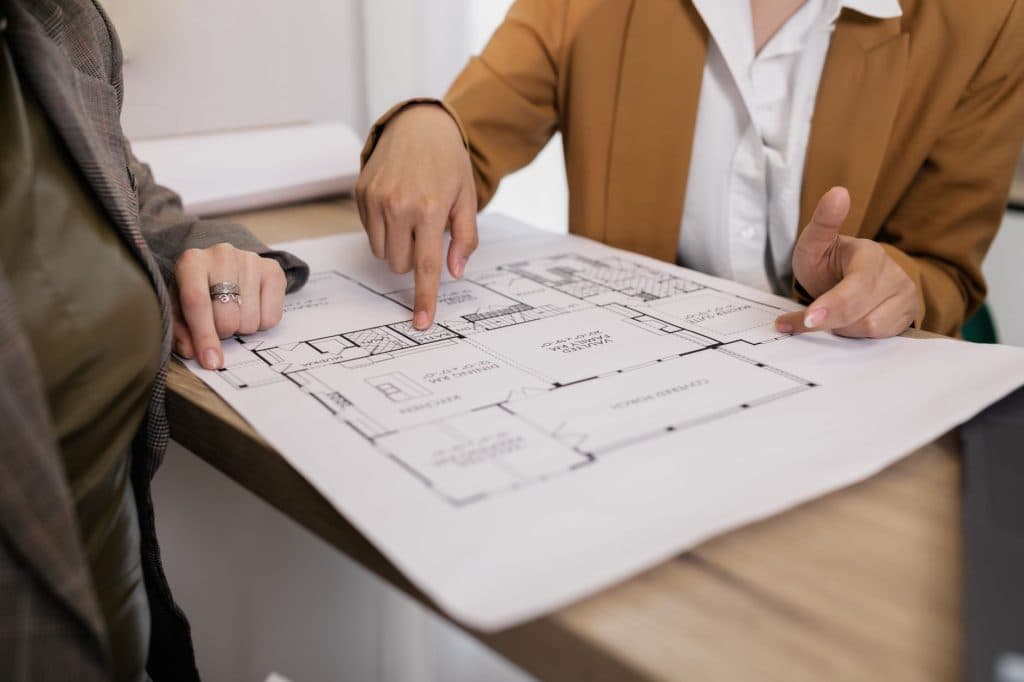
Attorney control remains mandatory at this stage. The claims define the scope of protection, and the Pannu significant-contribution test says that inventive conception must come from a human mind.
Think of the claims as the building's load-bearing frame and the specification as its interior finish; defects in that frame make the legal structure unsound.
Specification Expansion
Validated claim foundation
Once the claims are validated, they set the boundary for AI drafting. The system builds the detailed description, alternative embodiments, and summary sections from those claims, while staying tied to the submitted material. A well-designed tool marks places where it is filling a gap instead of describing disclosed material. That material remains the source.
Figure development
You don't need an existing sketch, photograph, or CAD file to begin. The platform can read the written specification, identify the figures needed, and generate them, while keeping each reference number matched to the related text.
Mechanical Review and Error Checking
Automated checks let you catch mechanical problems before the attorney finishes the review.
- Antecedent basis errors
- Term consistency across claims and specification
- Claim support for all limitations
A separate model compares the document against defined standards and marks sections that may need revision. Provenance sits beside each claim component in the specification and figures, showing exactly where that element came from within the source materials.
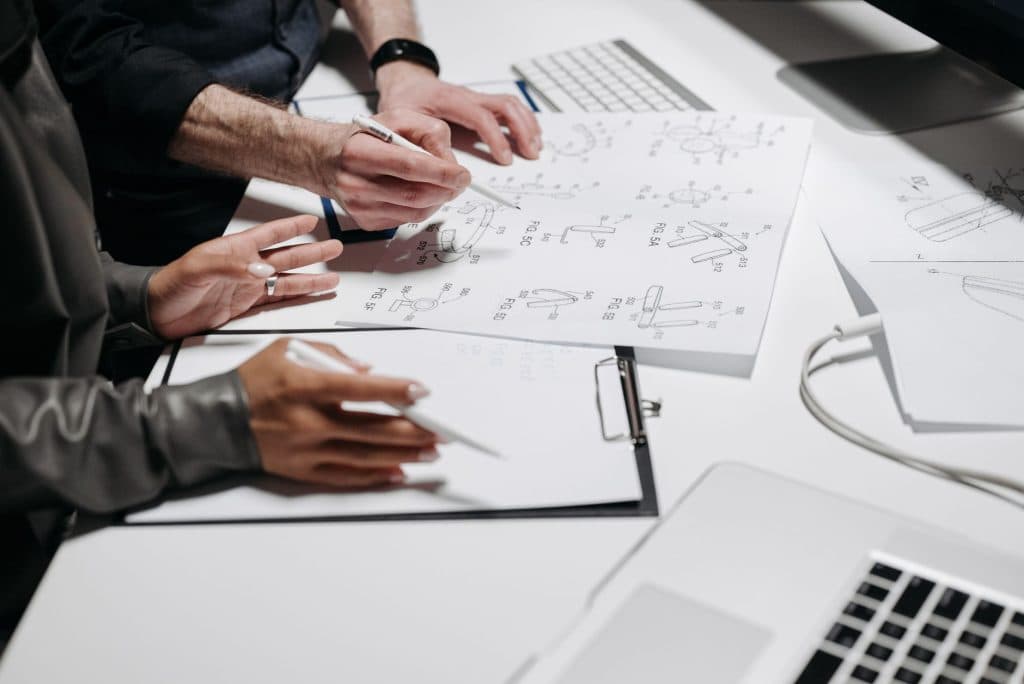
These checks handle mechanical issues efficiently, but they don't cover the full review. During human-in-the-loop (HITL) review, attorneys check for hallucinations and technical accuracy, then confirm § 112 compliance. Human judgment remains part of the process.
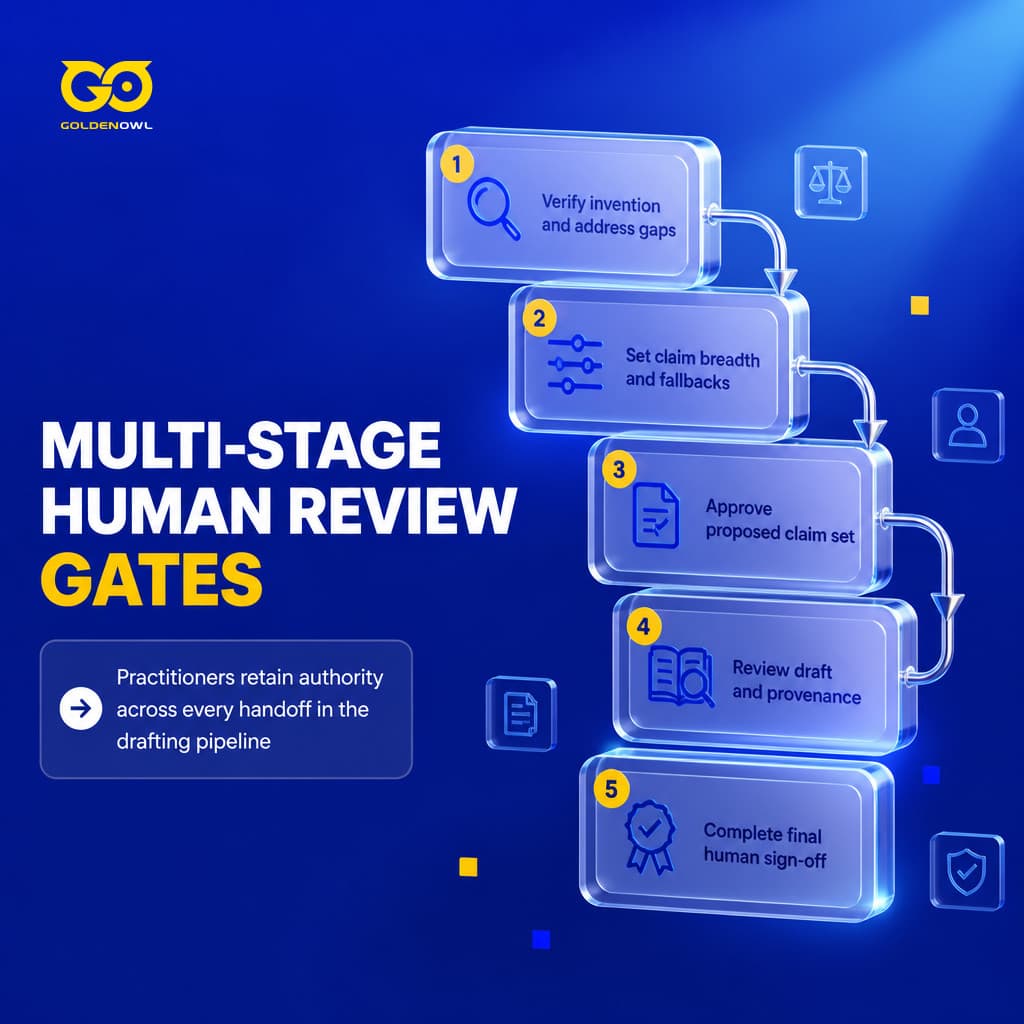
Human Review Gates
Human review starts at intake and continues through sign-off, with a person controlling every handoff.
- Intake: Verify the invention, address technical gaps, and establish relevant jurisdictions.
- Strategy: Set claim breadth with the scope slider and choose the fallback positions.
- Claims: Approve or revise the proposed claim set before the process continues.
- Specification and figures: Review the complete draft and the provenance beside each claim component.
- Sign-off: A human being provides final approval.
The workflow moves attorney time away from sentence construction and toward application strategy, scope, and substance.
Before sign-off, the attorney checks every legal argument and factual assertion. Under 37 C.F.R. § 11.303, the attorney may not knowingly provide the USPTO with a false statement, and a signed submission certifies that the required review took place.
Output and Docketing Integration
Once review is complete, the system outputs final drafts in standard formats, including Word and USPTO-compatible XML, and routes them to existing systems for IP management and docketing. Firms can add this workflow to current operations without rebuilding those operations around a new system.
Core Patent Practice Workflows Transformed by AI
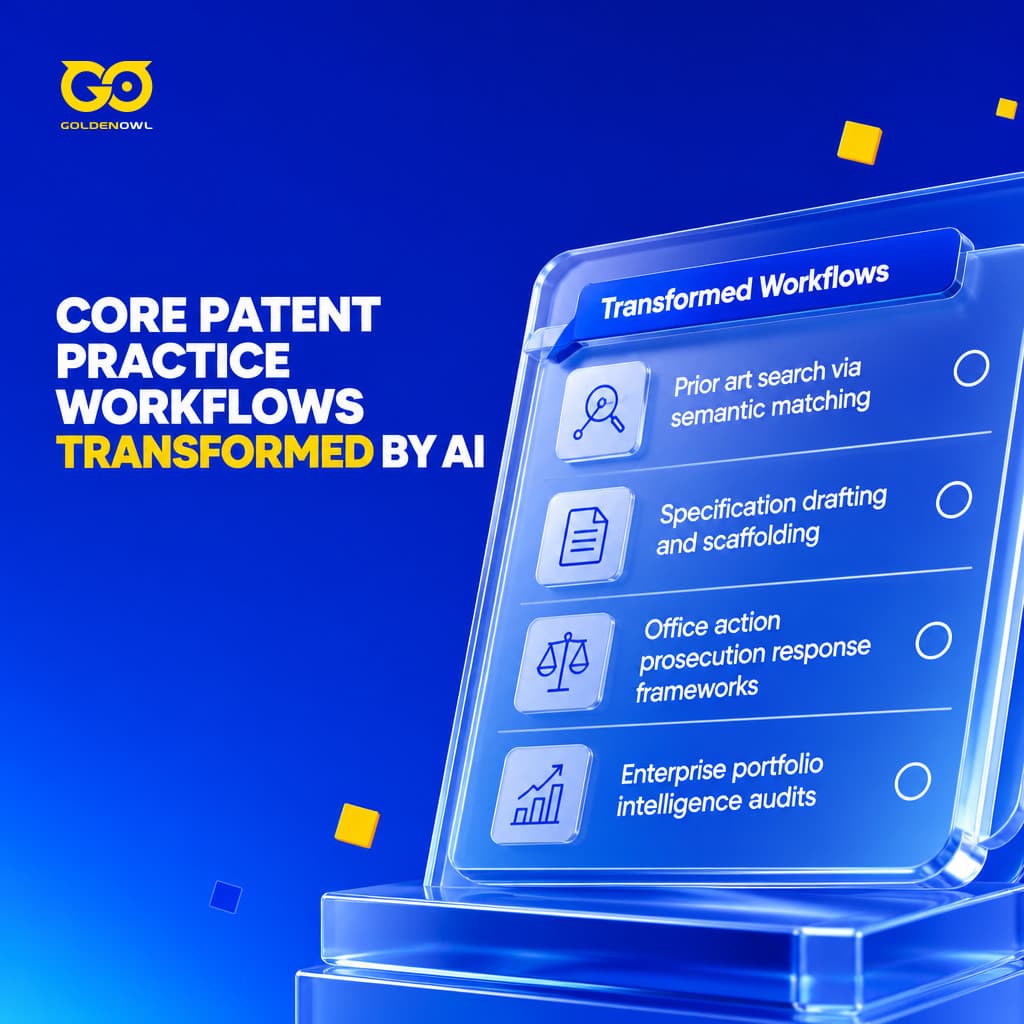
Modern ai legal solutions now cover four time-heavy parts of patent practice: Prior Art Search, Patent Drafting, Patent Prosecution, and Portfolio Intelligence.
- Prior Art Search
- Patent Drafting
- Patent Prosecution
- Portfolio Intelligence
Because every workflow calls for a different kind of attorney judgment, AI serves a different function in each one.
Prior Art Search
Semantic matching
Semantic matching finds related prior art even when the wording doesn't line up exactly. Natural language processing can scan millions of records and rank likely matches for human review. Search by meaning across 220 million documents from 108 jurisdictions, and material described with different terminology becomes available for attorney analysis without taking that analysis away from the attorney.
Agency validation
Some examination settings already use AI-assisted search. The USPTO uses PE2E AI Similarity Search, while its Artificial Intelligence Search Automated Pilot Program, known as ASAP, gives applicants ranked prior art before full examination starts. That shows the method has a place in examination, but it doesn't amount to blanket approval of practitioner submissions.
EPO's Espacenet now includes 160 million patent documents, giving attorneys a far broader set to review while leaving interpretation of those results in human hands.
Patent Drafting
Specification writing
AI can take inventor disclosure documents and turn them into background sections, detailed descriptions, and figure descriptions that provide structural scaffolding for an application—one practical use of ai solutions for patent generation in legal industry. Preparing that scaffolding still takes hours, even when it contributes little legal value.
Claim control
Claims need hands-on attorney control because they define the patent's legal boundary. Have AI prepare a draft claim set, then review its scope and language yourself before it moves ahead. A compliant workflow can't let claims proceed without the practitioner's deliberate engagement at that point.
Patent Prosecution
Since office action responses tend to follow a predictable analytical structure, AI can lay out an initial framework while you complete every required part of the analysis.
- Parse the examiner's rejection reasoning
- Review cited prior art and assess claim scope
- Draft arguments addressing each ground of rejection
It can compare cited references, flag relevant distinctions, and build a response skeleton for the attorney to review.
Portfolio Intelligence
In-house legal teams use enterprise ai-powered patent analysis solutions to audit existing portfolios at a scale that once seemed impractical, covering dormant assets, competitor filings, and continuation deadlines.
- Identifying dormant patents that no longer serve a business
- Flagging potential infringement exposure across competitor filings
- Surfacing continuation filing opportunities before deadlines pass
Those reviews don't require a proportional increase in headcount and shift patent strategy from reactive to proactive, with portfolio audits able to cover more assets.
Legal Guardrails and Regulatory Standards
That portfolio scale does not transfer accountability: AI tools do not replace duties imposed on patent practitioners, as the USPTO has explicitly stated.
Natural Person Inventorship Requirements
The Patent Act treats inventors as natural persons, as the Federal Circuit held in Thaler v. Vidal, 43 F.4th 1207 (Fed. Cir. 2022).
The USPTO's 2024 Federal Register guidance (89 Fed. Reg. 10043)
The USPTO's 2024 Federal Register guidance (89 Fed. Reg. 10043) confirmed that rule and applied the Pannu significant-contribution test. Under it, a human inventor must contribute to conception in a significant manner, with meaningful weight against the full invention.
The U.S. Patent and Trademark Office states that the same legal standard applies whether AI was used. Only natural persons may be named inventors.
Duty of Candor and Reasonable Inquiry
Generating specification language with AI is lawful; filing it still requires rigorous verification.
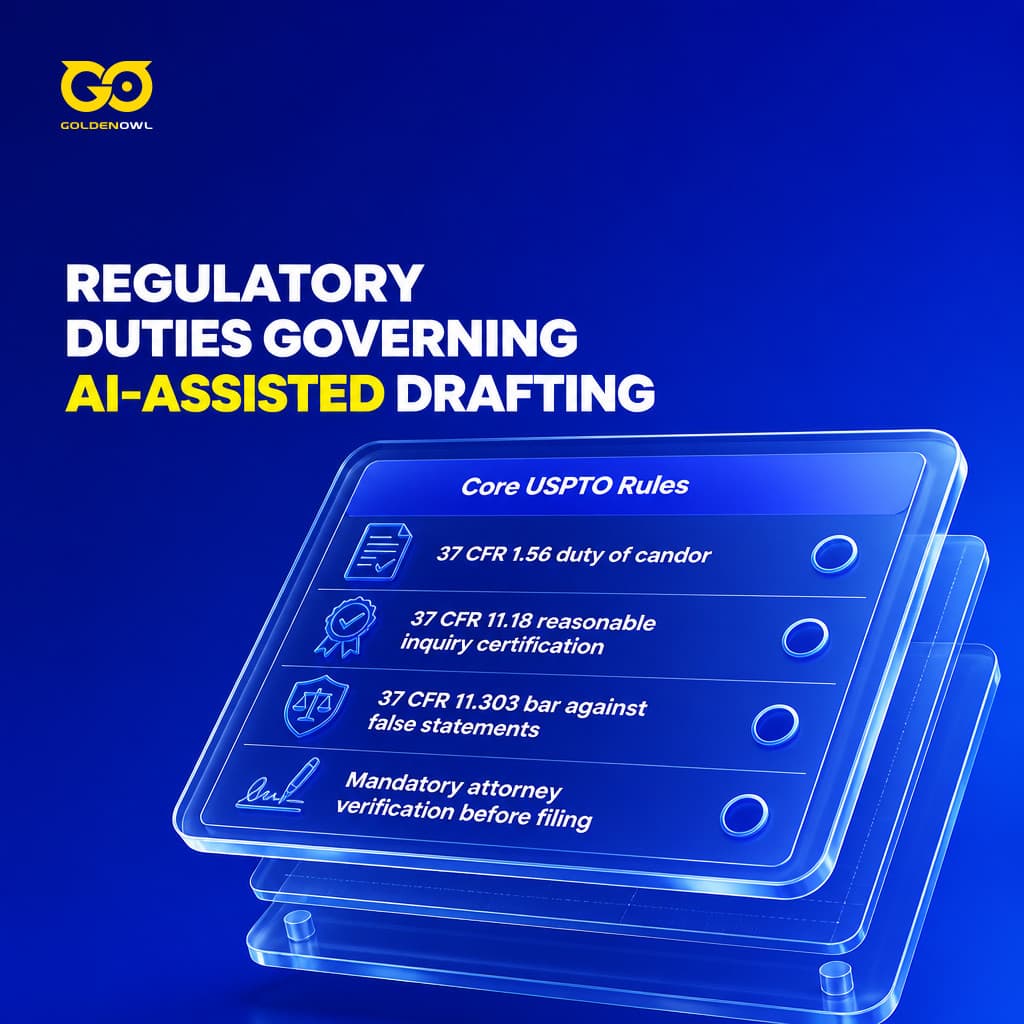
Three rules govern this duty:
- 37 C.F.R. § 1.56 requires everyone involved in filing and prosecution to disclose known material information.
- 37 C.F.R. § 11.18 requires a signed submission to certify reasonable inquiry and evidentiary support for factual assertions.
- 37 C.F.R. § 11.303 bars practitioners from knowingly making false statements to the USPTO.
Unverified AI output creates several consequences:
- Hallucinated prior art citations may be submitted as fact
- Fabricated technical claims may misrepresent the invention
- Unsupported limitations may weaken claim scope
- The practitioner may face disciplinary action and the patent may be invalidated
Every piece of AI-generated content must be verified by an attorney before submission.
Documentation of Human Conception
Keep a clear record of human involvement throughout AI-assisted drafting.
Prompt history and human edits
Preserve the prompt history together with human edits to AI-generated output.
Inventor review records and sign-offs
Retain Inventor review records and sign-offs as evidence of the inventor's involvement.
Contribution notes
Use Contribution notes to identify human contributions at the claim and feature level.
If inventorship is challenged, show precisely where human conception occurred. Be prepared to explain how the invention developed and which human technical choices were made.
Document how alternatives were assessed and where the inventive contribution originated; those records create a clearer development sequence if inventorship, ownership, or scope is later questioned.
Frequently Asked Questions
How much does AI patent drafting cost?
Published pricing
AI patent drafting appears in published price lists from $499, compared with $9,000 for traditional patent drafting.
Traditional patent drafting
Attorney drafting still runs $9,000 to $17,000.
Is AI drafting suitable for provisional patent applications?
Yes. AI drafting tools fit provisional patent applications well because provisionals establish a priority date, and they don't require the formal precision expected from a non-provisional utility application. As a result, a strong provisional can be produced quickly and at low cost.
What is the difference between attorney-copilot tools and autonomous drafting tools?
Attorney-copilot tools
Attorney-copilot tools put AI inside the attorney's workflow, while the attorney directs the process and uses it for tasks such as suggesting claims or completing specification language.
Autonomous drafting tools
Autonomous drafting tools turn an invention disclosure into a complete application, without requiring an attorney to manage every part of the process.
Can AI be listed as an inventor on a patent application?
In practice, the answer is no. The Federal Circuit held that the Patent Act recognizes only natural persons as inventors, so an AI system cannot appear as the inventor on a patent application.
What are the biggest risks of using AI for patent drafting?
Picture an AI-generated application headed for filing: the main risks are hallucinated prior art or technical detail left in a filed application, confidentiality breaches from platforms that retain submitted data, and failures to satisfy the duty of candor requirements under 37 C.F.R. § 1.56 and § 11.18. Those risks arise when AI output is filed without rigorous attorney review.
What is the difference between a generic AI tool and a purpose-built enterprise solution?
Purpose-built platforms draw their tuning from patent corpora, run on private infrastructure, and center on legal accuracy and workflow integration. General-purpose LLMs lack the same patent-focused accuracy, confidentiality safeguards, and prosecution-workflow connections that practitioners need.
Enterprise AI platforms build automated checks for those requirements.
Does using AI in patent drafting violate professional responsibility rules?
AI use by itself does not breach professional responsibility rules. Practitioners remain accountable for checking AI output against their applicable code of conduct, and they must confirm that the chosen tool satisfies confidentiality obligations, including 37 C.F.R. § 11.106 and applicable bar authority guidance such as ABA Formal Opinion 512.
Compare AI patent drafting tools by asking about published pricing, drafting time, provisional readiness, attorney control, inventorship, confidentiality, and review requirements. The right choice among ai solutions for patent generation in legal industry depends on how much of the process you want automated and how much attorney oversight the application requires. Speed is one input; workflow fit and filing controls determine whether the output is usable.
Share this page


Table of Content

Subscribe to Golden Owl blog
Stay up to date! Get all the latest posts delivered straight to your inbox