
How to use AI in real estate: automate lead follow-up, speed up valuations and marketing, and keep every step compliant with Fair Housing rules.


AI Agent Development Solutions
Sep 22, 2026
about 18 min read

AI agent development solutions provide the architecture you’ll use to build, coordinate, and govern software that reasons across several steps, reaches outside tools, and finishes complex workflows.
Platform choice sets the upper limit.
The surrounding platform can decide whether an AI model grows from a polished demo into an autonomous system that handles real enterprise work. AI agent development solutions provide the architecture you’ll use to build, coordinate, and govern software that reasons across several steps, reaches outside tools, and finishes complex workflows.
This guide looks at platform categories, ways to judge them, agent designs, development frameworks, and deployment choices for commercial decision-makers.
AI Agent Development Solutions: Platform Categories
Across the market, Four platform categories now shape most of the market, and category fit says more than the model alone.
Start by judging the platform architecture, not the model you plan to use. GPT-4o, Claude, Gemini, and open-source alternatives can all run within different architectures, while the surrounding platform usually sets the operating limits. Model choice rarely decides deployment.

In regulated industries, governance quickly becomes the constraint. Financial services, healthcare, logistics, and utilities need every agent action involving customer and financial information, as well as connected operational systems, logged, attributable, and open to review.
No-code visual builders
Fast workflow creation: With no-code visual builders such as n8n, Flowise, and MindStudio, non-technical teams can assemble agent workflows by dragging and dropping. You can move quickly on discrete, predictable workflows, though the fit narrows as requirements expand.
Limits at scale: These builders usually fall short when complex, cross-functional work demands coordinated agents and the governance needed for enterprise integration. They fit SMBs, departmental automation, and internal productivity use with minimal compliance requirements.
Automation-heavy teams can now choose from several low-code and no-code tools with agent features. LibreChat handles workflow automation through AI agent nodes, while Langflow and Flowise help you build agents visually and Dify focuses on LLM app development. The tradeoff is less flexibility for speed.
All these tools can send traces to Langfuse, so observability stays consistent across coded agents and agents assembled visually.
Code-first developer frameworks
For maximum control and flexibility, engineering teams can turn to open-source frameworks such as LangChain, LangGraph, AutoGen, CrewAI, and the OpenAI Agents SDK.
LangGraph uses cyclical graph structures for stateful, multi-actor applications, making it suitable when runtimes must revisit decisions and respond to changing state.
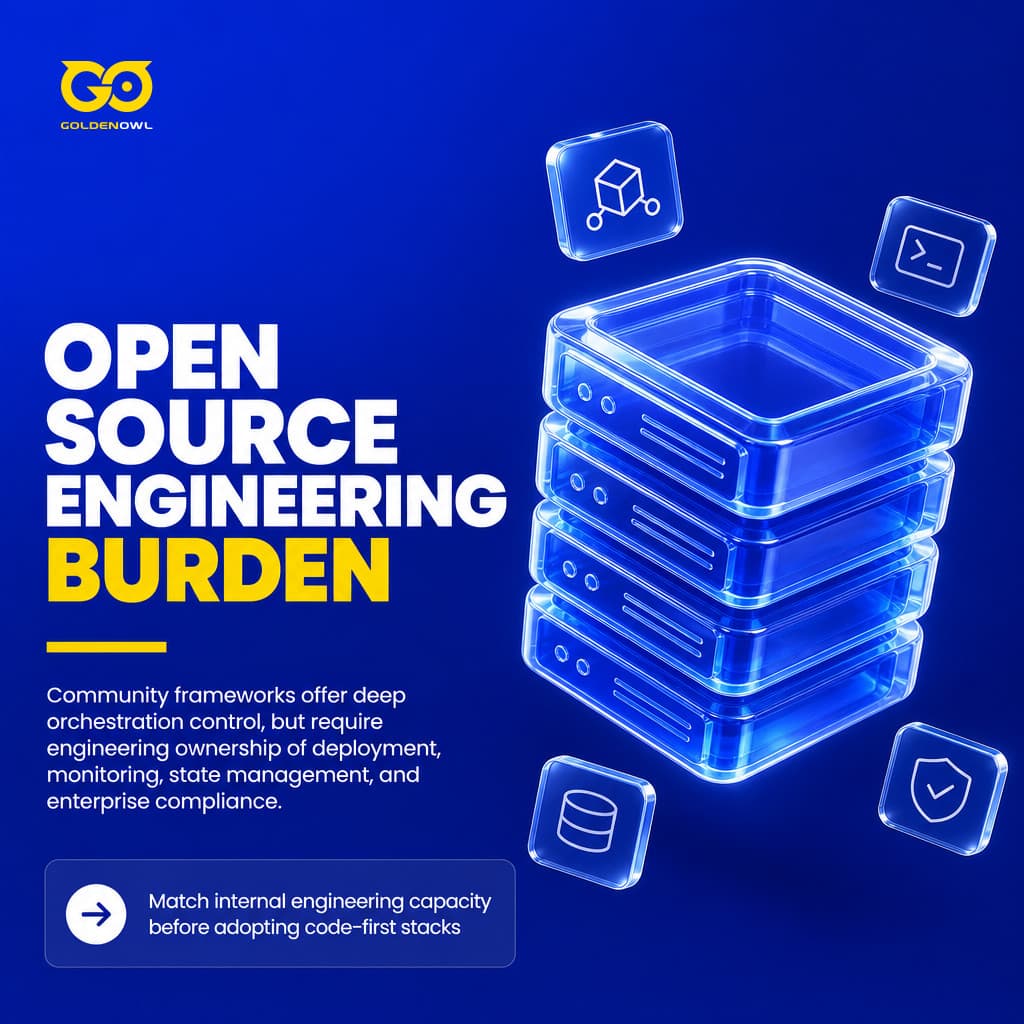
Your team still owns production deployment, monitoring, governance, and failure recovery around the core framework. Those capabilities take engineering investment.
Developer frameworks give you infrastructure, not a finished product. LangChain and the related frameworks CrewAI and AutoGen provide the building blocks, while your engineering team handles security, governance, and scalability. LangGraph, AutoGen, and CrewAI provide the most orchestration flexibility, but score lowest for governance and time to deploy.
They fit engineering-led organisations that want deeply customised agent architectures and can operate within manageable regulatory obligations.
Enterprise AI suites
Enterprise AI suites bring agent building together with identity, data, workflow, analytics, and compliance features. Hyperscaler platforms add enterprise-grade governance and pre-built connectors within their own ecosystems.
The upside is unified administration when your organisation already runs inside one vendor ecosystem. The downside appears later, when moving agents, data, and workflows elsewhere creates ecosystem lock-in. When evaluating unified vendor software packages, also consider broader ai software solutions.

Let your existing commitment to one vendor's ecosystem guide the choice. Ecosystem tradeoff is a platform decision.
Managed agentic platforms
Managed agentic platforms suit organisations seeking production-proven, governed AI agent solutions without the engineering burden of community-developed frameworks or the ecosystem lock-in found in hyperscaler suites.
They combine visual configuration, pre-built enterprise connectors, multi-agent orchestration, and enterprise governance in one production-ready environment.
This category includes the following capabilities:
- Deployment in weeks rather than months, with 48-hour proof-of-concept cycles.
- Pre-built connectors for 300+ enterprise systems, including ERP, CRM, HRIS, finance, and operations.
- Governance architecture for regulated industries, including audit trails, RBAC, SOC 2, and GDPR alignment.
- Support for conversational agents, voice AI, document AI, and agentic business intelligence.
If you need agents running in production within weeks, a platform approach usually gives you faster, safer results. Enterprise platforms also provide central oversight, role-based access, and production monitoring.
Organizational selection dimensions
Choose the category by weighing deployment scope, engineering ownership, ecosystem dependence, and compliance requirements.
Scale of ambition: department versus enterprise.
A no-code builder or lightweight developer framework can cover one clearly defined workflow inside a single team.
Once infrastructure crosses departments, core enterprise systems, and regulated operations, you need enterprise governance architecture from day one.
Engineering resources and ownership model.
Developer frameworks rely on an engineering team with expertise spanning LLM orchestration and state management, plus production MLOps.
If that team exists and maximum customisation matters, LangGraph or AutoGen remain legitimate choices.
If you want to deploy AI agents without building and maintaining the infrastructure, a managed agentic platform offers a faster, lower-risk route to production.
Ecosystem dependency.
Copilot Studio connects particularly well with an existing Microsoft 365, Dynamics, and SharePoint environment.
Operations spread across several cloud providers and varied SaaS tools may call for custom integrations. Ecosystem-agnostic platforms with pre-built connector libraries offer more flexibility without locking you into one ecosystem.
Regulatory and compliance requirements.
Financial services, healthcare, energy utilities, and legal services operate under frameworks where governance can't be treated as optional.
Evaluate SOC 2 compliance, immutable audit logging, agent-level RBAC, and clear data residency and retention policies first. Governance can't be an afterthought.
Your source of differentiation matters here. When proprietary logic drives your advantage and internal engineering capacity is high, build with code-first frameworks. When immediate compliance and auditable guardrails matter alongside enterprise connectors, choose a managed enterprise platform.
With internal engineering bandwidth limited, partnering with an ai solution provider can speed deployment while reducing its risks.
Evaluation Criteria for AI Agent Development Solutions
Choosing a platform means matching its architecture to your governance demands, connected systems, and engineering capacity. These criteria come from deployments in retail, logistics, financial services, healthcare, real estate, and energy.
Assess six dimensions: how agents are orchestrated, how deeply systems connect, governance and auditability, scalability and deployment architecture, time to deploy, and total cost of ownership. At scale, the platform supplies memory, tools, audit trails, governance, orchestration, and deployment infrastructure.
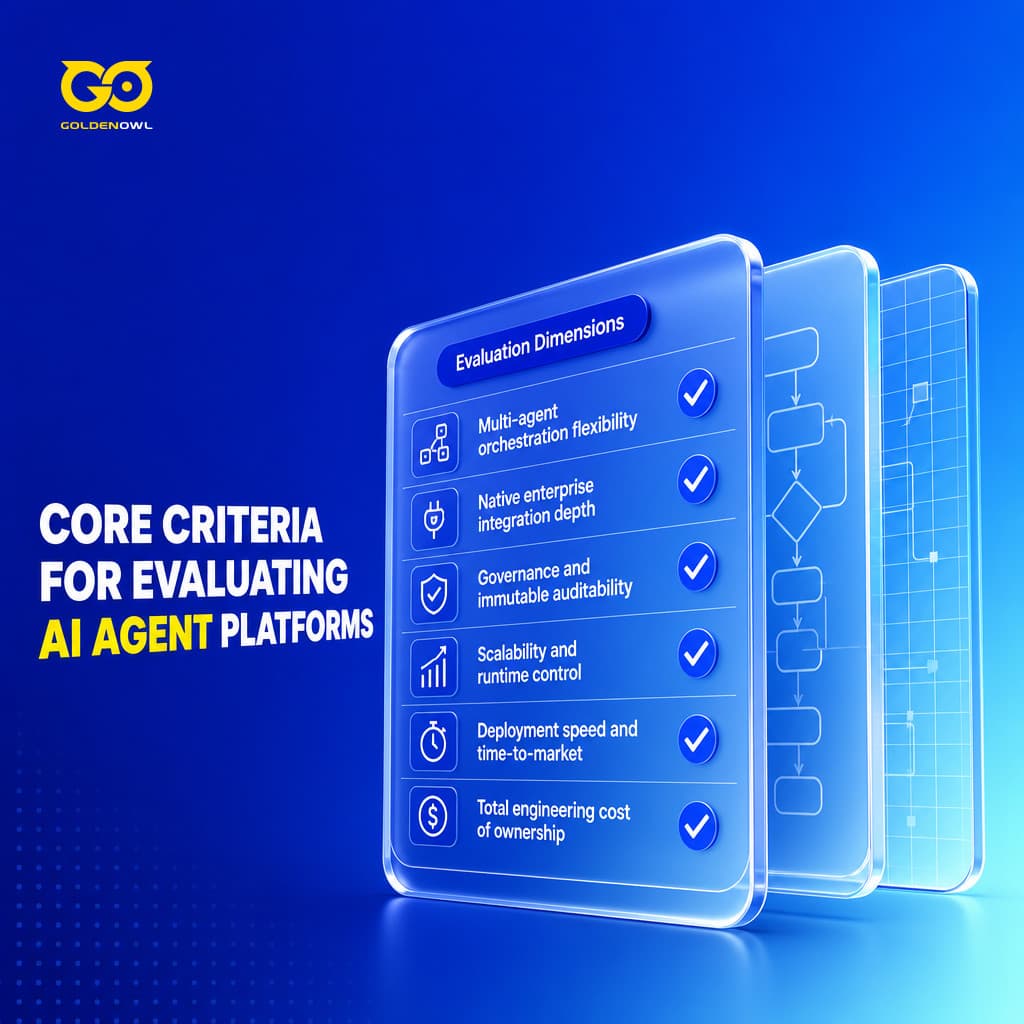
The IDC FutureScape report projects that, before 2026 concludes, AI-agent orchestration at scale will be used by nearly half of organisations worldwide.
Multi-agent orchestration capabilities
Test orchestration through collaboration, task handoffs, failure recovery, decision loops, and visibility into what each agent does.
Most orchestration designs fit into two broad categories:
Single-agent execution
With single-agent execution, one model follows its instructions, uses its tools, observes results, and keeps the workflow moving.
Distributed execution
Distributed execution splits workflow steps among coordinated agents, so one agent's result can feed directly into another agent's input.
Manager coordination
The manager pattern places one central agent in charge, using tool calls to assign specialised agents their tasks or domains.
Decentralized handoffs
Decentralized handoffs let peer agents pass tasks based on specialisation, without sending every decision through a central manager.
You can picture these designs as graphs, with agents as nodes, manager links as delegated assignments, and decentralized links moving execution through handoffs.
Splitting prompts and tools across agents can improve complex workflow performance and scalability, especially when if-then-else branches make one prompt difficult to expand.
The number of tools alone says little about difficulty. What matters is their similarity and overlap, since some systems handle more than 15 well-defined tools while others break down when fewer than 10 tools are substantially overlapping. (Anthropic’s engineering team)
Frameworks take different routes through workflow logic. Declarative systems map branches, loops, and conditionals in advance, using graph nodes and edges for deterministic or dynamic handoffs.
The Agents SDK takes a looser, code-first route, so developers can express workflow logic with familiar programming constructs instead of mapping the entire graph beforehand.
Enterprise integration depth
Check native enterprise connections, two-way read and write access, integration-layer permissions, and APIs for internal systems. Without the ability to write to such as an ERP, CRM, or operational system, an agent becomes an expensive summary generator.
Enterprise agents deliver value through actions across SAP, Salesforce, Oracle, Shopify, ServiceNow, and custom tools. The platform requires real-time, bidirectional sync with governance covering every read and write.
Tools extend agents through APIs exposed by the underlying applications and systems. Where legacy software has no APIs, computer-use models can work through its web and application UIs.
Most agents rely on three broad classes of tools:
- Data: Query transaction databases and CRMs, read PDF documents, or search the web so agents can retrieve workflow context.
- Action: Send emails and texts, update CRM records, or hand customer service tickets to people, including database and record changes.
- Orchestration: Agents can serve as tools for other agents, as in the Manager Pattern described above.
Managed agentic platforms come with pre-built connectors reaching 300+ enterprise systems.
Governance and auditability
A platform for regulated settings must provide immutable logs for every action, agent-level RBAC, workflow-specific human checkpoints, and support for SOC 2, GDPR, plus industry requirements.
In regulated industries, governance often becomes the limiting factor. Before choosing a platform, inspect audit trails, role-based access, and paths for human escalation.
Gartner, Inc. predicts that escalating costs, unclear business value or inadequate risk controls will cause over 40% of agentic AI projects to be canceled by the end of 2027.
As agents touch more systems, their attack surface grows, so you need least-privilege access and ongoing monitoring.
Strong guardrails cover privacy threats, including system prompt leaks, and reputation threats, including brand-aligned model behavior. The controls include:
- Simple deterministic measures, including blocklists, input length limits, and regex filters, to block prohibited terms and SQL injections.
- Scope controls that flag off-topic queries and keep agent responses within their intended scope.
- Detection for unsafe inputs, including jailbreaks or prompt injections that try to exploit system vulnerabilities.
- Output checks that prevent unnecessary exposure of personally identifiable information (PII).
- Harm screening for inputs involving hate speech, harassment, or violence to support safe, respectful interactions.
Give each tool a low, medium, or high risk rating based on read-only or write-enabled access, reversibility, account permissions required, and financial impact.
Human intervention usually becomes necessary for two primary triggers:
- Exceeding failure thresholds: Set limits on retries or actions; repeated failures to understand customer intent should escalate to a person.
- High-risk actions: Sensitive, irreversible, or high-stakes actions should receive human oversight while reliability develops.
After misreading demand, an agent with broad API access could change pricing across 500 stores.
Limit its authority, require approval above a set threshold, and keep automated rollback in place.
Observability tools capture, visualize, and analyze traces, placing prompts, responses, and tool calls into a timeline. They make debugging, prompt refinement, performance measurement, and behavior checks easier, with Langfuse providing this tracing.
Scalability and infrastructure control
Pick a platform that can grow from one pilot agent to hundreds of concurrent production instances without a redesign, while supporting multi-cloud, auto-scaling, and air-gapped environments.

You can't retrofit scalability later. A successful pilot can still reveal a platform built for demonstrations instead of production.
Choices made in the pilot can become expensive limits at scale, especially around state management, failure recovery, and concurrent workload handling.
Since reaching 1.0, LangGraph has focused its development on production needs, such as persistent execution, interruptions that bring a person into the loop, and short-term plus long-term memory.
Agno combines a framework and runtime for agent platforms while leaving ownership of infrastructure and data with you. It brings together a Python SDK, the AgentOS runtime, and a control plane.
Agno keeps sessions, memory, and knowledge in your database, while offering more than 100 tool integrations, human-approval pauses, and OpenTelemetry tracing. The full combination of capabilities is not described here.
Total cost of ownership
Compare licensing against implementation and maintenance engineering, usage-based charges, and the failure costs that appear when a platform can't support production workloads.
“Free” open-source software loses its appeal once implementation, maintenance, and compliance engineering enter the calculation.
Run the comparison over 12 months: current process cost equals hours × headcount × loaded rate, while agent-assisted cost equals platform + integration + oversight.
According to IBM, deploying agentic AI across 270,000 employees produced a $4.5 billion productivity impact.
Gartner®, Inc. predicts that “By 2029, agentic AI will autonomously resolve 80% of common customer service issues without human intervention, leading to a 30% reduction in operational costs.”
Organisations using these patterns report average cost reductions of 40%, while invoice processing falls from days to hours.
Begin with one internal burden. If an IT team spends 40% of its week on ticket triage, status updates, and routing, compare those tasks under the current process cost and the agent-assisted cost.
Business Impact and Deployment Governance
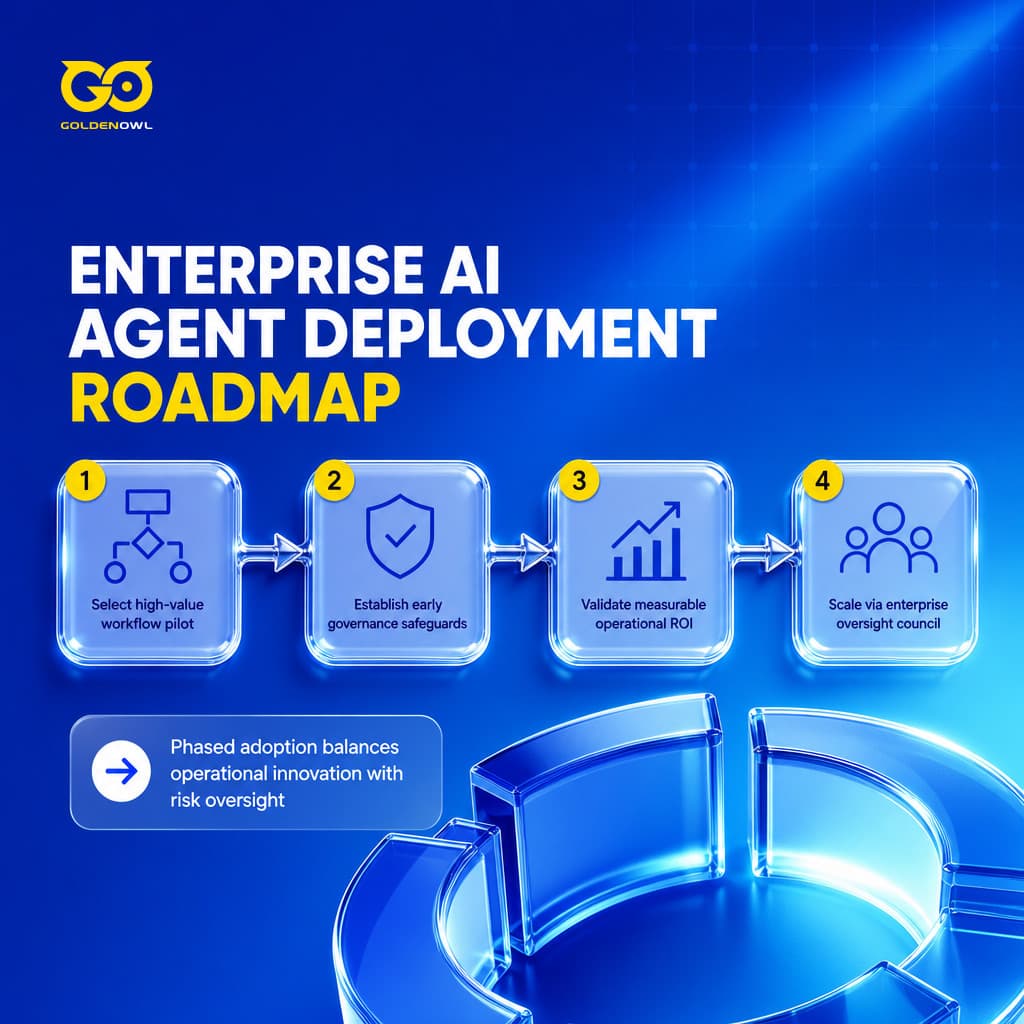
Start with one high-value workflow, then use an ROI formula to build a credible case for investment as AI agents cut costs and improve efficiency at scale. Gartner Inc. reports that task-specific AI agents will be integrated into Forty percent of enterprise applications by the end of 2026, compared with less than 5% today.
Stage the rollout by beginning small, testing with real users, and expanding capabilities while keeping human handoff available. Put layered safeguards around the system, including strong authentication, access controls, and risk-based pausing or escalation to a human when needed. As adoption grows, create an AI governance council to set escalation authority. Support it with audit-ready operations and internal oversight skills for controlled growth.
Workflow Suitability for Autonomous Agents
Once those safeguards are in place, workflows that traditional automation struggles with are strongest candidates for autonomous agents when they involve:
- Complex decision-making
- Difficult-to-maintain rules
- Heavy reliance on unstructured data
Before committing to an agent, check that the use case clearly meets these criteria; otherwise, a deterministic solution may be sufficient on its own.
Core Architecture Components
A sound agent begins with a foundation model that fits the task’s complexity, latency, and cost. Smaller, quicker models may handle retrieval or intent classification, while harder decisions call for more capable models. Match the model to the work, then use Evals to establish a baseline and verify the accuracy you need. Functions and APIs, as well as other external tools, let the agent take action and coordinate data and orchestration. Keep tool definitions standardized, documented, tested, and reusable across agents.
Turn operating procedures and policy documents into clear, smaller actions with defined outputs. Spell out what happens when information is incomplete or an unexpected case appears, so the agent has less room for guesswork and interpretation errors.
From there, the agent follows an observe-plan-act loop. It takes in inputs and results, breaks goals into parts, chooses actions, and uses its tools, with every result informing the next decision. Memory preserves context across sessions and tracks state. For durable context, consider enterprise object store solutions for agentic ai workflows. Persistent storage or filesystem abstractions keep long tool outputs available for later use.
Orchestration and Multi-Agent Patterns
With tools in place, one capable agent can cover many tasks, and the simpler setup makes evaluation and maintenance easier. Shift to multiple agents when one keeps stumbling over complex instructions or repeatedly picks the wrong tools. Long chains of conditional prompts make branching hard, while similar tool schemas can break planning and tool selection. Split the logical sections across agents when that may help.

Multi-agent setups follow two main coordination patterns. In manager orchestration, a central agent assigns pieces to specialists and directs the workflow, which fits when one agent should control the process and interact with the user. In a decentralized handoff, agents sit on equal footing and pass execution along when a central controller isn't necessary.
Declarative and non-declarative graphs create a separate trade-off. A declarative graph can be easy to read early on, but it may become awkward as the workflow grows more dynamic and complex, eventually requiring a specialized language. Don't let an autonomous loop write to financial records or send external communications to customers without explicit human confirmation for high-impact actions.
Open-Source AI Agent Frameworks
Open-source frameworks have moved agent development beyond ad hoc scripts and prompts into mature systems for reasoning, planning, and task execution.
The development challenge
Build around both autonomy and structure: let AI adapt as tasks change, while keeping enough control for dependable behavior.
Framework philosophies
Most frameworks favor either explicit graph workflows or lighter model-driven loops.
LangGraph
LangGraph adds a directed graph to LangChain, turning each agent step into a node.
Nodes handle prompts or subtasks, while edges carry data and decide how the workflow moves forward.
Branching and error handling
Use LangGraph when several steps require deliberate branching and recovery when errors occur.
Available languages
LangGraph supports Python and JavaScript.
Stateful workflows
Choose LangGraph when your AI tasks need persistent state across workflow steps.
Explicit task control
It fits task breakdowns and parallel branches, with custom logic placed at defined points.
LangChain DeepAgents
DeepAgents is LangChain's agent harness for opinionated workflows, built on top of LangGraph.
Low-level primitives
LangGraph gives you the low-level building blocks for agent workflows.
Built-in capabilities
DeepAgents layers on planning, subagents with separate context windows, and filesystem access through local or sandboxed backends. It also includes context management, shell access, human-in-the-loop approvals, and reusable skills.
DeepAgents supports any tool-calling model and runs with Python and JavaScript.

Deep agent pattern
Use DeepAgents when you want planning and file-backed memory, with subagents available without wiring each piece together inside LangGraph.
OpenAI Agents SDK
For multi-agent workflows, the OpenAI Agents SDK turns OpenAI's agent patterns into primitives:
- Agents: An LLM with instructions and tools.
- Handoffs: Delegation between agents.
- Guardrails: Validation of inputs and outputs.
- Sessions: Automatic conversation history management.
It includes built-in tracing and support for realtime voice agents.
As of July 2026, the SDK was at 0.18 within its 0.x series, ships frequent releases, and offers a separate JavaScript/TypeScript edition.
Teams committed to OpenAI's stack get official multi-agent support with little abstraction overhead from the OpenAI Agents SDK. For that use case, it's the first place to start.
Claude Agent SDK
Behind Claude Code sits the same harness used by the Claude Agent SDK.
Production-tested agent loop
You don't have to write the loop yourself, because a programmatic SDK gives you the production-tested Claude Code runtime.
Runtime control
Hooks let you intercept points in the agent loop, while in-process MCP servers expose tools without subprocess management and detailed allowlists set tool permissions.
The SDK runs on Python 3.10+ and TypeScript.
Claude-based development
Choose the Claude Agent SDK for Claude-based agents that require file access and shell tools, along with subagents and Claude Code's hardened permissioning.
Google Agent Development Kit
Built by Google, ADK is an open-source, code-first framework for building, evaluating, and deploying AI agents.
Workflow runtime
Now on 2.x, ADK uses a workflow runtime with graph-based execution for routing, loops, retries, and nested workflows.
Agent delegation
Its Task API handles structured delegation between agents, including multi-turn and human-in-the-loop work.
Model and provider support
Google ADK connects natively to Gemini, supports other providers, and supplies an interactive CLI plus web UI for local testing.
For organisations using Google's ecosystem, ADK pairs multi-agent orchestration with Gemini model support.
Reduced boilerplate
Session management and runner abstractions take care of much of the boilerplate, so you can focus on the agent logic.
Pydantic AI
Pydantic AI brings Pydantic's type safety and developer experience into agent development.
Typed agent contracts
Set agent inputs and outputs, including tool signatures, as Python types; validation and OpenTelemetry instrumentation shift many errors from runtime into write-time.
Durable execution and provider support
After reaching 2.x, Pydantic AI added durable execution and a type-hint-driven graph system, alongside broad integrations for OpenAI, Anthropic, Gemini, DeepSeek, Grok, Cohere, and Mistral.
With this approach, progress remains intact through API failures and restarts.
Python developers who care about type contracts, tests, and quick feedback get a lightweight route to production-ready agents with minimal boilerplate.
It gives agent development a FastAPI feel.
Vercel AI SDK
Consider the Vercel AI SDK: it started with TypeScript LLM primitives and grew into a full agent toolkit; AI SDK 7, current as of July 2026, offers ToolLoopAgent, HarnessAgent for setups including Claude Code or Codex, and WorkflowAgent through Vercel's Workflow SDK:
- ToolLoopAgent: Runs the classic tool-calling loop with configurable stopping conditions and typed runtime context.
- HarnessAgent: Runs harnesses such as Claude Code or Codex instead of making developers build the loop.
- WorkflowAgent: Makes each tool execution a durable, automatically retried step through Vercel’s Workflow SDK.
Teams already using the Vercel AI SDK can keep its provider-agnostic model interface and UI streaming helpers while adding agent capabilities.
Microsoft Agent Framework
Microsoft Agent Framework brings Microsoft's agent work together and, for new projects, succeeds both AutoGen and Semantic Kernel.
It pairs AutoGen's multi-agent orchestration with Semantic Kernel's enterprise focus:
It reached a stable 1.x release and provides graph-based workflows for sequential, concurrent, handoff, and group collaboration scenarios. It also includes middleware, YAML-based declarative agent definitions, and consistent APIs across Python and .NET/C#.
OpenTelemetry provides built-in observability, and agents can run on Microsoft Foundry.
For organisations in Microsoft's ecosystem, or teams requiring first-class .NET support with Azure integration, Microsoft Agent Framework is the default choice. Teams using AutoGen and Semantic Kernel are directed there for new projects.
Framework Selection and Architectural Trade-Offs
TypeScript points to Mastra or the Vercel AI SDK, .NET to Microsoft Agent Framework, and Python leaves you with the widest set of choices, so narrow the field early with your team’s language and cloud stack in view. Favor ecosystem fit when provider alignment matters, or keep optionality with a provider-neutral framework. First-class delegation helps with collaboration and multi-agent work, while durable long-running execution tests scalability.
Use Pydantic AI for typed, validated agent logic without much ceremony, especially for single agents or small systems inside Python services. Move to LangGraph when the workflow needs more structure. Its explicit, durable orchestration supports branching and stateful, multi-actor processes, with control that can be audited.
Strands Agents takes a model-driven approach oriented toward AWS, with simple agent loops and fast setup. LangGraph starts with the workflow, so choose it when the process needs auditable control. Strands suits AWS teams that want simplicity; LangGraph suits complex workflows.
Mastra gives teams working fully in TypeScript one cohesive package. LangChain offers a broader integration ecosystem and reaches mixed Python and TypeScript teams more effectively.
Microsoft Agent Framework suits .NET and Azure-centered teams. LangGraph covers more Python and JavaScript teams and brings mature durable execution.
Make tracing and observability part of the final choice. Build the same small task with your top two options, then use OpenTelemetry or Langfuse to evaluate the resulting traces, expenses, and ways each option can fail before you commit.
Frequently Asked Questions
What is an AI agent development platform?
AI agent development platform
There is an infrastructure layer behind an AI agent development platform, used to build, deploy, and manage autonomous systems that plan, take multi-step actions, and adjust as new information arrives without constant human instruction.
Enterprise capability
It gives enterprise AI agents the base they need to move past single instructions and finish multi-step work across connected systems.
What is the difference between agentic AI and enterprise AI agents?
Agentic AI
- Robotic process automation (RPA), RPA executes predefined, rule-based sequences and breaks when processes change.
- Autonomous AI agents, An autonomous AI agent acts more like a driver navigating city streets: it evaluates road conditions and chooses alternative paths to reach the goal, rather than stopping when an unexpected obstacle appears. agentic AI can reason, plan, and act. enterprise agents operate in business environments. governance requirements. security and compliance. system integration.
Agentic AI refers to the broader set of systems that independently reason, plan, and act as tasks or their surrounding conditions evolve.
Enterprise AI agents
Enterprise AI agents bring agentic AI into business settings, surrounding it with governance, security, compliance, and system integration.
Although every enterprise AI agent belongs to the agentic AI category, some agentic AI systems do not meet enterprise production requirements.
What is an example of an enterprise AI agent?
For instance, an enterprise AI agent can assess transaction context in real time for a financial institution and then act on what it finds.
Financial institutions
Financial institutions use agents to assess transaction context as it happens.
What is the difference between AI agents and RPA?
RPA follows predefined rule-based sequences and fails when processes shift, while an autonomous AI agent evaluates new conditions and determines how to address an unforeseen obstacle.
- Robotic process automation (RPA): RPA executes predefined, rule-based sequences and breaks when processes change.
- Autonomous AI agents: An autonomous AI agent evaluates road conditions and chooses alternative paths to reach its goal, more like a driver navigating city streets than a sequence stopping at an unexpected obstacle.
What are the top enterprise AI agents?
You’ll find Cloud-native agent builders, CRM-embedded agents, and Governed AI platforms and enterprise suites, with governance, ecosystem integration, and pre-built connectors drawing the lines between them.
Compare these options on governance depth, multi-model flexibility, integration breadth, and whether technical and business users can build agents without re-platforming.
- Cloud-native agent builders: These are one part of the market's enterprise AI agent options.
- CRM-embedded agents: These are another category of enterprise AI agent.
- Governed AI platforms and enterprise suites: Evaluate them by governance depth, multi-model flexibility, integration breadth, and whether technical and business users can build agents without re-platforming; enterprise suites also offer enterprise-grade governance, deep integration, and pre-built connectors for common enterprise tools.
Which AI agent platform is best for enterprise?
The right enterprise AI agent platform fits your organisation’s requirements for governance, integration depth, and scalability.
Platforms with proven use in regulated industries such as financial services, healthcare, and logistics show those capabilities more reliably than tools judged mainly in developer or SMB settings.
Check for SOC 2 certification, pre-built enterprise connectors, and documented deployments across multiple industries.
How do I compare agent frameworks for my own use case?
Start with task complexity and workflow structure, then pick the amount of orchestration that use case actually calls for.
- Assess task complexity and workflow structure: These determine how much orchestration your use case needs.
- Choose graph-based control for complex workflows: LangGraph, Google ADK, and Microsoft Agent Framework suit complex workflows that benefit from explicit graph-based control.
- Choose a model-driven loop for simpler tasks: Strands, OpenAI Agents SDK, and Smolagents serve simpler tasks through a model-driven loop.
What is multi-agent orchestration, and why does it matter?
Multi-agent orchestration
Multi-agent orchestration coordinates several specialised AI agents around a shared goal, passing one agent’s output to another as input while governing exceptions and monitoring the workflow. Error recovery runs across the pipeline.
Complex enterprise workflow
A document-processing workflow may pass through extraction, validation, exception-routing, and integration agents in sequence, with error recovery handled at every step.
Why it matters
Real enterprise workflows can outgrow what one agent handles reliably, so coordination keeps specialised tasks connected.
Choose based on the task, the systems it must reach, and the controls your organisation has to retain. Use traces from a small prototype to compare options, then align the platform or framework with your engineering ownership. You can now separate agentic AI from enterprise AI agents, tell agents apart from RPA, and assess governance, integration, orchestration, and deployment evidence before committing. The comparison should stay tied to the work the system must perform, which is why the right ai agent development solutions must fit the workflow.
Share this page


Table of Content

Subscribe to Golden Owl blog
Stay up to date! Get all the latest posts delivered straight to your inbox