How do AI agent security solutions reduce enterprise risk? Learn the layered controls and a four-step plan for agent identity, access, and approvals.


How to Evaluate Enterprise AI Driven Networking Solutions
Sep 11, 2026
about 27 min read

Adopting modern ai driven networking solutions directly changes the way you operate enterprise connectivity today.
Adopting modern ai driven networking solutions directly changes the way you operate enterprise connectivity today.
Predictive, self-healing orchestration now steps in to replace reactive troubleshooting whenever you run modern network infrastructure across wired, wireless, and data center fabrics. If you're assessing these autonomous architectures as a technical decision-maker, you must weigh operational frameworks, streaming telemetry ingestion pipelines, and algorithmic remediation fabrics before you can make an informed choice.

Evaluating Leading AI Driven Networking Solutions
Operational wireless telemetry forms the real backbone of modern enterprise network management. Watch how thousands of your deployed access points log every client connection, authentication step, roaming transition, and radio frequency interference event across your enterprise facilities every single hour. Feed these massive telemetry streams straight into machine-scale engines that convert raw signal records into autonomous network tuning decisions without human intervention.
Telemetry-Driven Operations
Campus wireless environments churn out an overwhelming flood of live telemetry across hundreds of access points that your engineering staff can never monitor or triage manually with enough precision. Large enterprise sites log millions of connection handoffs, RF collisions, and authentication events every day that demand automated parsing before your employees run into dropped packets. Deploy dedicated AI optimization engines to digest this continuous telemetry and push dynamic configuration fixes across your entire access fleet. Unassisted human engineering teams simply cannot match that operational speed.
Help Desk Incident Reduction
Teams that roll out dedicated AI wireless optimization tools see Wi-Fi support tickets drop by 65% almost right after rollout. Automated root cause analysis flags chronic connection bottlenecks early, giving your operations staff measurably faster resolution cycles on any tickets that remain.

Predictive Infrastructure Operations
Putting statistical modeling analytics and intelligent automation to work across your switches tunes port configurations, cleans up operational visibility, and speeds up incident response for your team. These algorithmic tools isolate root issues, forecast hardware failures, and roll out targeted fixes with a precision that manual command-line workflows never touch.
Cisco Catalyst Center
Enterprise campus fabrics centralize control through Cisco Catalyst Center, running advanced algorithmic models across thousands of switches and routers at the same time.
- Network engineers manage operations more efficiently and effectively through automated network provisioning, dynamic policy enforcement, and intelligent threat detection across switches.
- Scale-ready intent-based networking runs on Cisco DNA Center AI policy orchestration, where one Fortune 500 retailer lowered policy-related misconfigurations by 60% and compressed configuration times from weeks to hours by automating policy deployment.
- Intelligent roaming and client steering run across hybrid cloud or on-prem setups through Cisco AI Network Analytics, providing your engineers with automated root cause analysis across enterprise access points.
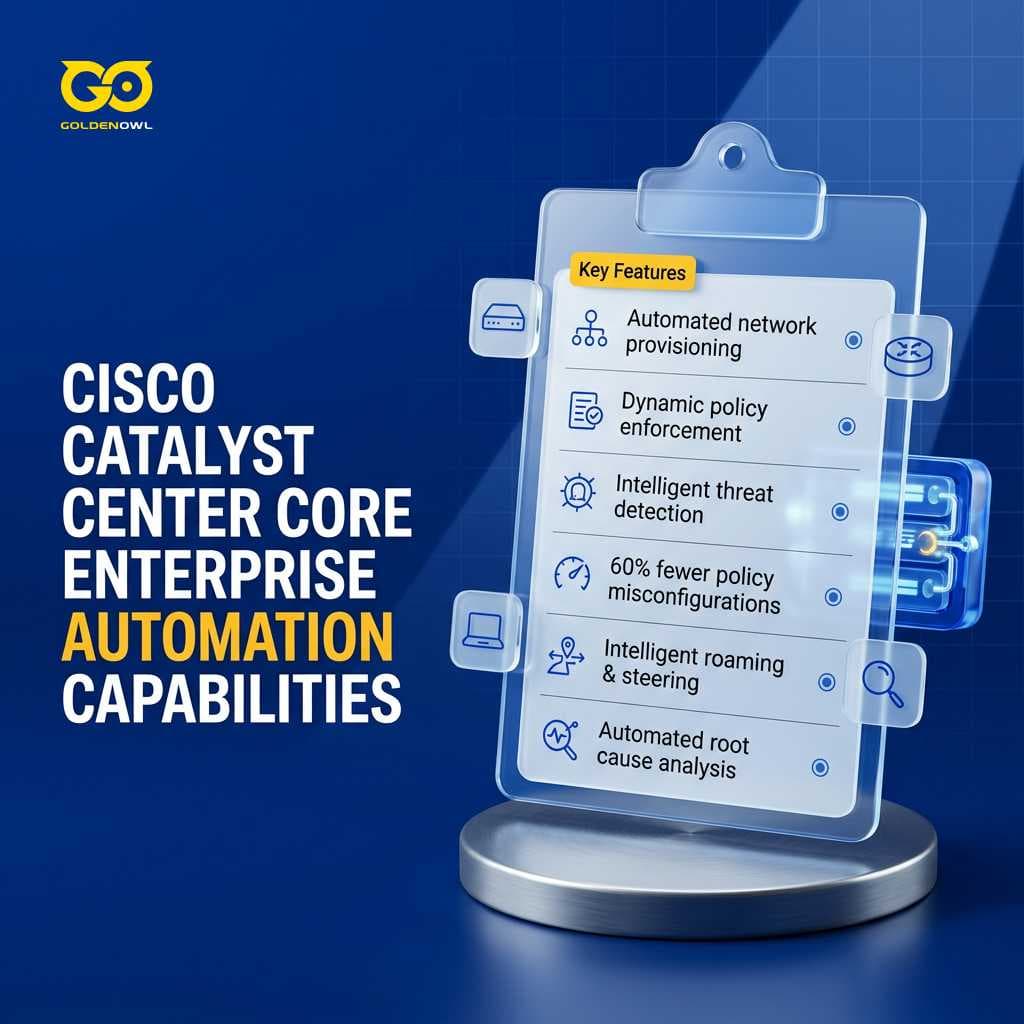
Tools like Cisco DNA Center and ThousandEyes lean on predictive computational models so your organization can automate policy rollouts, balance active traffic paths, and handle predictive maintenance across campus and cloud backbones. Tap into these systems to cut your troubleshooting cycles by up to 50% while watching application behavior across hybrid environments. Demand reflects this shift, with Cisco booking over $2 billion in infrastructure orders tied to AI during fiscal 2025, including $800 million secured in Q4 alone.
Juniper Mist AI
Distributed multi-site campus networks deploy ai native networking solutions like Juniper Mist AI to execute automated operations across every remote building.
- Natural-language explanations replace manual interpretation of raw telemetry through conversational troubleshooting in the Marvis virtual network assistant.
- Real-time signal quality and load figures guide continuous client roaming and RF adjustments via dynamic AI-driven band and access point steering.
- Issues are caught and settled before end users notice them, maintaining reliable connections through continuous tracking of your user journeys and network performance metrics.
Continuous telemetry streams, covering port errors, packet drops, voltage spikes, and thermal shifts, pipe straight into engines like Cisco DNA Center or Juniper Mist AI. Your operations engineers get near-real-time notices, generate auto-triaged tickets, and apply corrective actions across the environment without ever touching a manual console.
HPE Aruba Networking AIOps
Aruba Central pairs HPE Aruba AIOps with machine-driven anomaly detection to trigger autonomous self-healing routines.
Built-in AI Insights delivers automated origin breakdown across your entire enterprise access point fleet. Meanwhile, ClientMatch gauges live traffic volume and device signal quality to steer connected hardware toward optimal radios and bands.
NetInsight works as an assurance engine that provides your team with automated troubleshooting, performance forecasts, and concrete tuning suggestions. Continuous inspection of active traffic and telemetry metrics helps the engine spot silent degradation and outline exact fixes before your links drop.
Agentic AI Operations Platform
Modern agentic architectures merge autonomous control logic, continuous link optimization, and interactive spatial topologies into one unified operating model:
- Conversational, multimodal, and agentic AI power Extreme Platform ONE as an all-in-one networking suite.
- Technical teams monitor and visualize Wi-Fi spaces using dynamic RF mapping paired with advanced AI.
- Performance optimization, security automation, and troubleshooting tasks are already handled by AI agents among early-adopting leaders, with 79% of organizations having deployed AI agents.
Enterprise networking pivots to proactive maintenance when agentic systems learn your baseline, adjust switch configurations, and execute remediation autonomously in real time. Software agents police core routing tables, catch unusual traffic bursts, and reallocate interface capacity without requiring an engineer at the console. Build autonomous decision logic directly into your control layer so devices can update paths, roll out filtering rules, and balance fabric capacity instantly. That speed shows up on balance sheets: surveys show 90% of organizations realize profitable financial gains after deploying network-focused artificial intelligence, with 63% pocketing returns in a quarter or less.
Arista CloudVision
Cloud-Scale Network Telemetry
Arista Networks manages cloud-scale environments through automation features native to its EOS and CloudVision software stack. Deploy these monitoring capabilities across your fabrics to tighten access policies, forecast hardware faults, and balance traffic paths automatically. These underlying algorithmic models get sharper over time because they train directly on state changes streaming from every production switch.
High-Throughput Lossless Transport
Market share gains across major cloud providers stem from deep automation investments, with client environments running Arista monitoring reporting a drop of over 40% in packet loss incidents. Massive machine learning clusters requiring high throughput and tight latency guarantees keep standardizing on Arista Ethernet fabrics. These large data center buildouts support company projections reaching $1.5 billion from AI-driven networking sales in 2025 as enterprise data halls leave proprietary switching fabrics behind.
Nile
Nile delivers an entirely managed Network-as-a-Service model that automates enterprise configuration, telemetry monitoring, and ongoing optimization through software intelligence.
Telemetry feeds, user experience data, and security analytics merge inside its algorithmic stack to enforce guaranteed service levels. Automated self-healing fixes outages before your users notice them, while predictive planning drives proactive capacity scaling across campus links. Teams running this infrastructure see trouble tickets drop by over 50% and trim the duration needed to resolve major faults by 70%.
Customers adopting Nile’s AI-powered NaaS have seen a reduction in network incidents by over 50% and a 70% drop in time-to-resolution for critical issues.

DriveNets Network Cloud
Disaggregated Infrastructure Orchestration
DriveNets Network Cloud deploys embedded algorithmic engines to orchestrate disaggregated white-box hardware at scale, automating switch provisioning, coordinating multi-vendor components, and forecasting interoperability failures across your core routing fabric.
Tier 1 Operator Economics
Rollouts across Tier 1 service providers achieve up to 40% CapEx savings while expanding backbone scale, placing disaggregated hardware clusters right into high-capacity transport paths to support demanding computational modeling and AI workloads.
Darktrace
Behavioral Pattern-of-Life Modeling
Darktrace functions as an autonomous defense platform using machine learning algorithms to uncover and neutralize active cyber threats across your infrastructure in real time. Your security team can respond instantly to potential compromises because the engine isolates anomalous behavioral patterns across live production traffic.
Autonomous Threat Interception
Underlying neural network models establish a unique pattern of life for your specific environment and spotlight deviations the moment they emerge. Enterprises running the system achieve a 92% reduction in undetected threats alongside measurably quicker incident resolution cycles.
Trellix
Trellix operates as an automated network security platform built for fast threat detection and instantaneous defense.
Engineers shield enterprise environments by using Trellix algorithmic models to intercept sophisticated threats, including ransomware strains, advanced persistent threats, and stealthy malware.
SolarWinds Network Performance Monitor
SolarWinds Network Performance Monitor handles proactive telemetry tracking, switch tuning, and infrastructure diagnostics using embedded analytics.
Automated root cause isolation, intelligent threshold alerting, and predictive analytics let your engineers resolve link degradation before business workflows suffer.
Forward Networks
Forward Networks applies algorithmic models to deliver digital twin verification, infrastructure modeling, and continuous enterprise analytics:
- End-to-end network behavior is analyzed and visualized by creating a digital twin of the infrastructure.
- Configuration errors are caught before they reach your live production equipment.
- Regulatory requirements and industry best practices are continuously verified for ongoing security compliance.
NetBrain
NetBrain maps physical infrastructure, automates diagnostic procedures, and coordinates ongoing engineering tasks through intelligent workflows.
Engineering productivity climbs because NetBrain eliminates repetitive diagnostic routines while maintaining a continuously verified repository of network topology maps.
Palo Alto Networks Cortex Xpanse
Cortex Xpanse uses an automated discovery engine to scan perimeter infrastructure, indexing connected assets and highlighting exposures across your organization.
Security gaps get identified and closed before attackers exploit them because Cortex Xpanse constantly scans public IP space for unmanaged infrastructure and exposed services.
Vectra AI
Vectra AI supplies an immediate-response detection platform that surfaces active attacker activity, arming your security analysts with dedicated hunting and monitoring capabilities.
Incident alerts get prioritized by risk using behavioral baselines of network communications and user accounts, helping your engineers isolate compromised systems immediately.
F5 AI Security Platform
F5 recently updated the F5 AI Security Platform with dedicated AI Gateway capabilities that bring token awareness straight into network traffic policies.
Integrated application delivery controls and API defenses work together to secure artificial intelligence inference endpoints and police model resource consumption across your fabric.
Technical Architecture of AI-Driven Network Fabrics
Modern artificial intelligence workloads create staggering raw throughput demands that make cluster designs from just two years back look primitive. You still build on standard enterprise cloud compute, storage, and switching hardware, but AI fabrics connect those boxes across unfamiliar topologies with fresh telemetry streams and specialized observability protocols. Your physical gear has to satisfy tight operating limits that swing dramatically based on whether you run distributed model training runs or edge inference deployments across the fleet.
Continuous Streaming Telemetry and Data Ingestion
Continuous streaming telemetry gives your automation stack a reliable baseline by tracking device state changes in real time across campus switches and dense data center fabrics.
Per-Client Wireless Telemetry Ingestion
Granular telemetry from access points and individual endpoints hits your monitoring tools at rates and scales legacy SNMP polling cannot touch. Modern machine learning models run on continuous behavioral histories instead of basic threshold alerts. That means your ingest pipelines must capture per-client signal strength (RSSI), roaming behavior, authentication events, application latency and throughput, RF interference, channel saturation, and endpoint hardware profiles. Old periodic polling intervals miss those sudden micro-bursts completely.
Data Center Operational Log Streaming
Predictive maintenance models feed continuous time-series logs directly into your operational dashboards to catch hardware degradation before parts fail. These ingest pipelines track packet drops, interface errors, thermal changes, and voltage spikes, while SDN controllers process NetFlow/IPFIX records alongside live routing tables to steer traffic around congested links.
Telemetry Standardization and Data Governance
High-fidelity telemetry gives you the raw material for network automation, but switch telemetry often sits trapped across disconnected legacy tools and messy proprietary formats. Train predictive models on broken or fragmented telemetry inputs, and your software produces bad classifications that trigger misconfigured switch ports and broken routes during heavy traffic hours. Clean data schemas and firm telemetry governance have to come before you let automated remediation touch production gear.
Machine Learning Anomaly Detection and Root-Cause Engines
What is the real job of an automated root-cause engine across an active fabric? When a physical uplink drops, the analytics engine walks the network graph to spot the exact failure source, keeping cascading secondary alarms from overwhelming your on-call engineering staff during an incident.
Topology Event Correlation
Automated diagnostic systems and event correlation tools isolate underlying hardware faults well before users file support tickets, converting raw interface counters into plain-English incident summaries for your operations team. Mean time to resolution falls across every failure category your engineers track across the fleet.
Quantified Failure Prevention
Predictive algorithms inside AT&T's primary AIOps platform spot emerging hardware failures across the company's worldwide network footprint before equipment goes dark. Feeding streaming telemetry into those predictive models helped AT&T slash total unplanned service interruptions by more than 30% while protecting uptime and service continuity for enterprise customers.
Algorithmic Anomaly Detection
Unsupervised autoencoders and graph neural networks establish baseline operational behavior by tracking communication paths, protocol distributions, client sessions, and flow volumes. When tracking physical switch degradation over extended windows, your early warning systems lean on recurrent neural networks (RNNs) and gradient boosting models to evaluate shifting performance curves across time-series metrics.
Cluster Interconnect Evolution Between InfiniBand and Ethernet
Turnkey lossless delivery and rock-bottom latency make InfiniBand the default starting point for high-density GPU computing clusters. Deploying RoCEv2 over standard Ethernet sidesteps single-vendor hardware lock-in while preserving standard operational tooling, though it requires meticulous queue tuning to keep packet congestion under control.
Interconnect architectures handle packet delivery, latency floors, and open technical standards across three distinct operational profiles:
| Fabric Technology | Primary Protocol / Standard | Operational Profile & Trade-offs |
|---|---|---|
| InfiniBand | Proprietary InfiniBand Architecture | HPC networking technology dominated by NVIDIA; persists in large AI datacenters to deliver turnkey lossless transport, but relies on proprietary hardware ecosystems. |
| RoCEv2 Ethernet | RDMA over Converged Ethernet v2 | Increasingly preferred approach for hyperscaler fabrics; avoids proprietary vendor lock-in and runs on familiar switching skill sets, but demands meticulous queue tuning to manage congestion and latency sensitivities. |
| Ultra Ethernet | UEC 1.0 Specification | Open industry standard released in June 2025; backed by the Ultra Ethernet Consortium as a long-term replacement for InfiniBand designed to correct Ethernet congestion and latency sensitivities. |
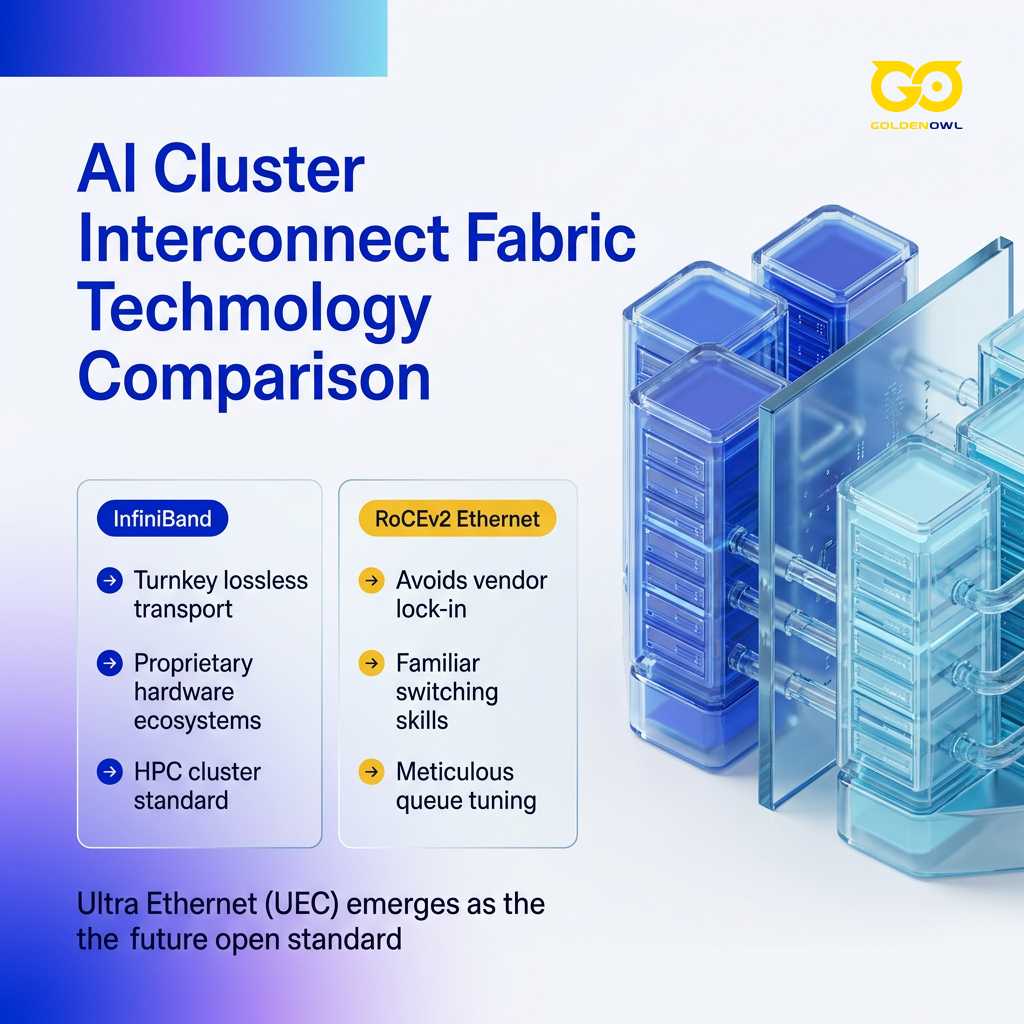
InfiniBand still commands a massive footprint across high-performance clusters dominated by NVIDIA hardware, but modern fabric architectures are opening up fast. Industry backing behind Ethernet accelerated when the Ultra Ethernet Consortium (UEC) released the open Ultra Ethernet UEC 1.0 specification in June 2025 to give operators a vendor-neutral alternative to InfiniBand. Hyperscalers and silicon vendors use these specifications to tame latency and buffer bloat across demanding model runs. Look at your hardware refresh roadmap before betting that proprietary vendor extensions will become industry standards. Custom silicon tweaks rarely make it into universal specifications intact.
Physical Layer Innovations in Silicon and Optical Switching
In modern AI data centers, severe electrical demands and thermal thresholds push physical network engineering straight toward advanced switch silicon and optical packaging.
High-Capacity Switch Silicon Scaling
Broadcom engineered its Tomahawk 6 silicon to double switching capacity over earlier generations while supporting Ethernet across scale-up and scale-out fabrics. Cisco countered with its G300 silicon architecture, pairing the high-throughput chips with matched optical transceivers and dedicated network software tailored for distributed machine learning fabrics.
Co-Packaged Optics and Thermal Management
Sharp power limits and rack cooling constraints mean your future fabrics must lean into optical interconnects. Evaluate Co-Packaged Optics (CPO) architectures across your network tiers to cut intra-rack electrical draw and keep high-density clusters running cleanly over multi-year deployment cycles. Semiconductor teams already rely on machine learning during floorplanning to eliminate thermal hot spots, improve energy efficiency, and compress fabrication schedules for these high-speed chips.
Core Capabilities and Operational Use Cases
Tracking clear operational gains across modern enterprises demonstrates how machine learning reshapes everyday network administration:
- Positive ROI from AI in networking is reported by 90% of organizations, and returns arrive within a quarter or less for 63%.
- AI agents have been deployed by 79% of organizations, with pioneering teams already handing off troubleshooting tasks, security automation, and performance optimization.
- Shifting engineering staff toward more strategic, analytics-driven duties places staff productivity, security posture, and efficiency at the top of realized benefits.
Intelligent Traffic Engineering and Dynamic Load Balancing
AI-powered traffic engineering handles available capacity across tangled network routes, cutting off stubborn bottlenecks while improving transmission quality for your core enterprise services. Out in carrier backbones and hyperscale facilities where single microseconds count, automated systems keep bandwidth running efficiently and steer live data flows right on the fly.
Running large-scale training and inference inside hyperscale clusters forces you to use different data distribution setups and fresh observability tools. Standard IP routing simply falls apart against these security realities once operational workloads scale past older design limits.
To keep inter-data center traffic balanced, Google applies machine learning across its B4 WAN to adjust capacity allocations on the fly. Moving packets proactively based on historical demand trends delivered up to 30% better bandwidth utilization while curbing packet loss during peak traffic spikes.
Streaming telemetry paired with reinforcement learning models powers these automated path adjustments across your transit links every day. When you push routing tables, NetFlow or IPFIX telemetry, and application metrics into an SDN controller, the system reroutes live traffic instantly during unexpected demand surges or active DDoS floods.
This breakdown outlines how different traffic platforms tackle path optimization and automated steering:
| Deployment Platform | Primary Optimization Metric | Algorithmic Routing Technique |
|---|---|---|
| Google B4 WAN | Bandwidth utilization and peak packet loss | Machine learning-based traffic engineering preemptively adjusting routing based on demand patterns |
| Hyperscale AI Datacenters | Microsecond latency and congestion mitigation | Reinforcement learning combined with real-time analytics to dynamically modify path selection via SDN controllers |
| Modern High-Throughput Switching Fabrics | Lossless transport and buffer management | Dynamic flow redirection ingesting NetFlow/IPFIX data, application metrics, and routing tables |
Pairing real-time flow telemetry with algorithmic routing keeps high-throughput switching fabrics from saturating under heavy production loads.
Predictive Maintenance and Automated Remediation
Catching hardware failures early protects uptime and reshapes daily maintenance routines for your infrastructure teams:
- Escalating outages are avoided because AI models detect subtle performance degradations through nonstop assessment of hardware sensor readings, traffic logs, and telemetry data.
- Failure points are forecast using machine learning models, frequently gradient boosting algorithms or recurrent neural networks (RNNs), that process time-series metrics like voltage irregularities, temperature fluctuations, interface errors, and packet loss trends.
- Operational handoffs between AI detection mechanisms and engineering staff are expedited by integrating AI platforms with ITSM software to automatically open, enrich, or auto-resolve incident tickets.
- Truly autonomous network operations will eventually replace AI-assisted human decisions, allowing the management system to detect problems, apply corrective configuration changes, assess the results, and automatically execute rollbacks if performance targets are not met.

Rolling out automated optimization across enterprise wireless gear drives a 65% drop in Wi-Fi support tickets while speeding up incident recovery. Automated root-cause engines pinpoint physical interference and roaming glitches that used to eat up hours of manual troubleshooting.
Behavioral Anomaly Detection and Threat Response
Unlike signature-based methods, AI models can recognize previously unseen attack patterns, making them effective against zero-day threats.
Raw network traffic exposes operational trouble before users notice. Automated anomaly detection catches bad configurations and active intrusions across production backbones where human engineers simply can't inspect gigabits of live packets by hand.
Unsupervised models like graph neural networks and autoencoders establish clean baselines by tracking endpoint behavior, flow patterns, protocol mixes, and port volumes. When trouble appears, security orchestration tools hook directly into this output to quarantine infected devices for immediate forensic audit.
Modern NDR tools watch behavioral trends across your links to score incoming threats by severity. Handing concrete triage steps to your security team cuts down on alert fatigue and wasted hours. You still have to tune baselines regularly, maintain user privacy during deep packet inspection, and keep false alarms close to zero across production spans.
Platforms like Vectra AI give your security team immediate visibility during active threat investigations. By evaluating user behavior against live wire data, Vectra AI flags attacks by operational urgency, giving your engineers the precise context they need to halt lateral movement before attackers compromise neighbouring subnets.
Automated Intent-Based Policy Orchestration
Intent-based systems work like turn-by-turn car navigation: you set the intended policy outcome, and software figures out the rest. The controller works around local congestion automatically without forcing engineers to touch individual switch CLIs hop by hop.
Automating policy builds and deployments helped one Fortune 500 retailer shrink rollout schedules from weeks to hours while slashing configuration mistakes by 60%.
Natural Language Policy Translation
NLP engines parse business rules and convert them into native syntax across switches and load balancers through open APIs. Automated verification checks every new rule for logical conflicts before deployment, while telemetry loops push live configuration updates whenever underlying conditions change.
Intent-Based Network Governance
AI policy engines build, push, evaluate, and audit operational rules across diverse vendor hardware without human intervention. Your engineers stop writing ACLs and QoS policies manually because software turns high-level requirements into coordinated switch configs across the entire footprint. Pulling this off requires open hardware APIs, full audit logs, and human sign-offs on high-risk routing changes.
Network Slicing and Multi-Vendor Disaggregation
Network slicing lets you run independent virtual fabrics over shared hardware while maintaining strict service-level agreements:
Carriers like SK Telecom invest heavily in AI-RAN to support dynamic customer agreements, deploying edge nodes that handle compute and inference directly where incoming traffic originates.
- Slice performance forecasts are generated through deep reinforcement learning models that ingest information from edge computing hosts, core network functions, and radio access networks (RAN) to evaluate application requirements, user density, and traffic behavior.
- Spectrum utilization increased by 25% and SLA infractions across premium tiers dropped after SK Telecom applied an internal AI system to orchestrate 5G resources dynamically for smart factories, autonomous vehicles, and gaming.
- Separating hardware from operating software through disaggregation lets organizations implement multi-vendor components, using AI engines to synchronize performance, push switch configs, and anticipate component incompatibilities across the stack.
- Disaggregated white-box environments protect vendor intellectual property by utilizing federated learning techniques to train management models without exposing proprietary operational data.
Power Consumption and Sustainability Optimization
Adaptive policies trim energy-intensive routing and idle overhead, which can cumulatively reduce power draw across network operations.
Power efficiency rarely tops automation agendas, but it offers huge operational payback across large facilities. Applying dynamic port controls and traffic-aware routing cuts idle power waste and reduces total electrical draw across your server halls.
Teams lower utility costs by rolling out thermal-aware routing, intelligent edge forwarding, dynamic Wi-Fi sleep states, and automated port downscaling across enterprise campuses. Standardized green benchmarks are still maturing, but production data shows that automated physical tuning strips out wasted wattage, helping you hit corporate sustainability targets while trimming recurring power bills.
Strategic Implementation Roadmap for Enterprise Networks
Rolling out ai driven networking solutions calls for disciplined telemetry prep, phased rollouts, and a realistic engineering roadmap anchored to measurable operational checkpoints.
Iterative Deployment Lifecycle
You verify algorithmic networking through a structured multi-stage lifecycle, moving methodically from initial architecture reviews all the way to operational team cross-training.
Readiness Assessment and Architecture Discovery
Target high-friction operational zones across your existing environment first. Your architects should pinpoint routine maintenance, flow anomaly detection, or dynamic routing paths where repetitive tickets and persistent bandwidth choke points constantly burn engineering time.
Organizations already operating modern switching fabrics, telemetry feeds, or SD-WAN overlays can adopt algorithmic control systems without overhauling underlying hardware. But if you lack that streaming baseline, you will need to finish staged hardware and telemetry upgrades before you even touch advanced models.
Building an AI-ready infrastructure brings major technical friction, requiring low-latency fabrics, intelligent switches, and serious compute muscle across high-bandwidth links. Hyperscalers absorbed these expenses years ago, but typical enterprise budgets run into brutal capital constraints. Map out a solid business case, roll out capital expenses in deliberate phases, and unlock new operational features only as your staff proves ready.
Telemetry Standardization and Data Hygiene
Telemetry Ingestion Foundation
Dependable automation stands or falls on operational telemetry collection. That means your engineers have to clean, catalog, and store raw packet traces, audit logs, and standard SNMP statistics together, because pushing sloppy or incomplete inputs into an inference model leaves you with pure guesswork.
Data Governance Prerequisites
High-performing network algorithms run on clean, high-density telemetry streams, but critical operational records often sit locked inside legacy boxes, disconnected monitors, and conflicting log schemas. Training models on corrupted inputs triggers disastrous routing errors in production. Insulate your operations by standing up consolidated collectors, unified metric pipelines, and strict data governance policies before you ever turn on an automated inference engine.
Rigorous data hygiene keeps every ingest pipeline normalized, protected, and fully verified, transforming messy packet noise into dependable telemetry for early incident detection and automated traffic routing.
Vendor Selection for AI Native Networking Solutions
Architectural evaluations have to square compliance obligations with the infrastructure architectures of competing platforms, weighing strict data sovereignty requirements against operational speed. Heavily regulated enterprises usually demand on-premises compute, whereas smaller shops lean toward hosted SaaS controllers. Working through these messy infrastructure trade-offs frequently prompts enterprise leaders to bring in an ai solutions company during platform evaluations.
A lot of prominent network automation platforms operate purely in public cloud environments, forcing you to pipe internal packet data offsite and creating massive compliance headaches. Addressing these governance standards, Cisco DNA Center accommodates strict operating environments by providing both cloud-hosted software alongside on-premises physical hardware appliances.
Look past flashy vendor feature sheets and focus on raw infrastructure compatibility, because any control layer has to talk smoothly with your active switches, edge routers, and multi-vendor gear to avoid monitoring blackouts. Pick modular tooling with exposed APIs, and put every candidate platform through a strict lab trial before signing any commercial contracts.
Examine vendor product roadmaps thoroughly before locking in your enterprise design. Counting on Ethernet to capture data center connectivity, Arista forecasts bringing in $1.5 billion from AI networking sales throughout 2025. Meanwhile, Cisco secured over $2 billion in purchases for AI infrastructure during fiscal 2025, landing $800 million inside its fourth quarter alone. At the physical layer, the Ultra Ethernet Consortium (UEC) delivered its 1.0 specification in June 2025 as an open industry architecture built to challenge proprietary InfiniBand clusters. Production adoption is already rolling out rapidly, with 79% of enterprises relying on autonomous agents to handle security operations, diagnostic troubleshooting, and dynamic bandwidth allocation.
Phased Pilot Deployment and Controlled Scaling
Before turning over automated execution rights on live production systems, guide your team through a disciplined three-stage trial sequence:
- Controlled Scope Isolation: Begin inside a sandboxed environment, testing intent-based traffic routing across an isolated test fabric or machine learning-driven anomaly detection confined to an individual data center pod.
- Operational Baseline Validation: Benchmark algorithmic recommendations against real operating data, evaluating latency stability, raw throughput consistency, and measured reductions in mean time to detect (MTTD).
- Stepwise Autonomous Expansion: Expand operational blast radius gradually, advancing from passive telemetry alerting to full intent-based remediation, or scaling dynamic path calculation across multi-site branch office topologies.
Structure your initial rollout as a 60-to-90-day field pilot inside a single compute pod or secondary branch office, letting engineers evaluate baseline performance away from critical production traffic. Keep the first 30 days completely passive to benchmark suggested changes against manual workflows. Run the following 30 days in advisory mode where staff manually sign off on every tweak, activating closed-loop remediation only after the system maintains an approval rate of 95% on suggested fixes with zero rollbacks needed.
Controlled staging gives your engineering team the confidence and room they need to tune automation sensitivities against real traffic conditions. Engineers validate baseline health by confirming shorter mean times to detect while checking throughput performance and latency figures across every managed segment. Once validated, your fabric safely transitions toward automated changes, pushing dynamic policy fixes and instantly reversing modifications whenever streaming telemetry spots latency spikes or dropped packets.
Operational Cross-Skilling and Cultural Governance
Cultivate cross-functional workflows by pairing network operations directly with data analytics and DevOps.
Maintaining machine learning tooling demands a mix of data engineering, statistical modeling, and deep routing knowledge that you almost never find in a single siloed team. When enterprise pilots die in the lab, a talent bottleneck is usually what killed them. Bridge that knowledge deficit by pairing network engineers with telemetry analysts, rotating responsibilities across infrastructure groups, and bringing in seasoned artificial intelligence specialists where internal skills fall short.
Algorithmic engines exist to support your existing staff rather than replace them. Train your operations personnel to parse statistical anomaly flags, interrogate system recommendations, and fine-tune core policies, creating an operational culture that treats automation as a practical tool for improving fabric uptime.
Handing autonomous platforms total operational freedom across production backbones is an unnecessary gamble. Errant decisions trigger bad routing churn, silent configuration drift, unexpected link flaps, and security rule violations. Enforce hard validation guardrails and mandatory administrative sign-offs for high-impact actions, stripping away repetitive parameter adjustments so your senior engineers can focus on core capacity planning and long-term architecture.
Operational Challenges and Risk Management
Production rollouts of machine intelligence bring real organizational friction and operational exposures that demand structured risk management.
Telemetry Silos and Data Fragmentation
Governance and Hygiene Guardrails Trustworthy results from your models depend entirely on unified logging, standardized telemetry collection, and disciplined data governance to eliminate the phantom alerts that quickly destroy team trust. Build clean ingestion pipelines before you flip on automated workflows, because overselling algorithmic capabilities before checking basic data readiness is an easy way to stumble.
Multi-Vendor Legacy Interoperability
To keep a mixed-vendor network running without disruption, you need modular software, open APIs, and phased deployments inside pilot testbeds to prove that every component stays completely compatible.
Without clear benchmark metrics to evaluate algorithmic progress, proprietary vendor lock-in quickly becomes a brutal technical barrier for your team. Commit to open standards and fully interoperable tooling across your infrastructure to protect your long-term operational freedom.
Algorithmic Oversight and Operational Trust
Engineers run into trouble when they treat automated fixes as an immediate all-or-nothing switch. Let your models run in advisory mode first until their recommendations consistently match seasoned human operational judgment.
Enforce a clear three-tier blast-radius policy to guide this rollout safely across your production network. You can let low-impact adjustments like edge switch port bounces or dynamic RF channel rebalancing execute automatically. Require one-click administrator approval for distribution routing changes, and push core routing updates or multi-site topology shifts strictly into maintenance windows with mandatory manual sign-off.
Without clear governance, this autonomy poses real operational risks: overreaction to false positives, unintended network reconfiguration, or violation of compliance policies.
Letting autonomous agents tweak routing paths and isolate anomalies creates real operational exposure unless you establish explicit key performance indicators, enforce firm guardrails, install human-in-the-loop review gates, and maintain complete end-to-end visibility across your entire environment. Deploy adaptive governance frameworks to balance algorithmic independence with administrative control, ensuring your engineers actively steer system intelligence instead of spending their days babysitting mundane device configurations. That oversight matters right now, because 79% of organizations already deploy AI agents to handle routine troubleshooting, performance optimization, and day-to-day security automation tasks.
Capital Costs of AI-Ready Infrastructure Upgrades
Specialized lossless fabrics unlock massive performance gains for distributed model training, yet they deliver almost no real value across ordinary campus footprints where traffic never overruns switch buffers. If you want to modernize campus cores, you must tie every dollar spent on specialized ai infrastructure solutions directly to measurable operational returns.
Upgrading basic “plumbing” infrastructure comes at a premium, requiring careful cost-benefit analysis, phased capital investments, and scaling based entirely on adoption readiness.
Driven by massive cloud provider buildouts, Cisco booked over $2 billion in AI hardware and networking orders for fiscal 2025, more than doubling its initial forecast. That spending wave accelerated late, with $800 million landing in Q4 alone.
Quantifying Business Impact and Return on Investment
The business case for your CFO clicks into place once you connect lower staffing overhead directly to fewer outages and clear efficiency gains.
Live enterprise deployments prove that machine intelligence delivers real operational gains across several measurable performance benchmarks:
Technical and Operational Performance Metrics
You can see the concrete operational payoff of algorithmic networking across four distinct categories:
- Incident and Troubleshooting Reduction: Organizations running AI-driven wireless optimization platforms report a 65% reduction in Wi-Fi-related IT help desk tickets, while enterprise implementations cut troubleshooting times by up to 50% and record a 70% drop in time-to-resolution.
- Network Resilience and Outage Prevention: Predictive maintenance pairs streaming telemetry data with predictive algorithms. That deployment cuts downtime incidents by over 30%, reduces packet loss incidents by over 40%, and drives down total network incidents by over 50%.
- Fabric Utilization and Configuration Velocity: Machine learning traffic engineering achieves up to 30% better bandwidth utilization and improves spectrum utilization by 25%, while automated policy translation reduces configuration times from weeks to hours and lowers policy-related misconfigurations by 60%.
- Operational Precision Baselines: Track automation rates alongside SLA compliance to establish baseline operational benchmarks. Rely on reduced mean time to detect (MTTD) or improved throughput latency to measure operational precision.
Financial Realization and CapEx Optimization
Direct CapEx and Infrastructure Savings You capture direct operational savings by swapping manual troubleshooting for AI diagnostics, retiring redundant management tools, balancing bandwidth dynamically, and eliminating the emergency maintenance fees that inflate budgets. When you run disaggregated white-box infrastructure on DriveNets' Network Cloud, you pull down CapEx by up to 40%.
Predictive Capacity and Resource Optimization Historical traffic modeling forecasts exact timing for bandwidth expansion and hardware upgrades, giving your team dependable capacity planning without risking expensive under- or over-provisioning. Meanwhile, adaptive routing policies trim energy-heavy routing paths and idle overhead, steadily cutting facility power draw.
Engineering Productivity and Operational Realignment Automated tuning clears away routine troubleshooting, letting your existing engineering staff run larger and more complex wireless networks without adding headcount. That transition protects your security posture and lifts team efficiency, giving your engineers room to focus on strategic, analytics-driven work rather than triaging repetitive operational tickets.
The Evolution of Autonomous Self-Healing Networks
Enterprise production networks will transition into self-driving platforms over the next ten years as artificial intelligence matures from lab experiments into daily practice, expanding organizational speed while hardening day-to-day operations. Industry projections estimate that over one-third of corporate environments will deploy AI across their network operations by 2028. Under that architecture, your systems will handle their own configuration, defense, and remediation with almost no human intervention.
Modern backbones feed real-time telemetry into machine learning pipelines to detect bad optics, failing links, and traffic congestion long before users notice dropped packets. Software-Defined Networking sits underneath that intelligence, giving the platform programmatic control to steer flows, rebalance paths, and protect service levels automatically.
Agentic AI and Autonomous Incident Resolution
Autonomous Control Plane Decision-Making
Agentic AI handles real-time operational decisions across current network fabrics, cutting out the constant need for hands-on triage during routine shifts. When analytical logic runs directly inside the control plane, the system reroutes traffic instantly, triggers security policies, and redistributes switch capacity the second physical wire conditions fluctuate.
Operational Delegation and Adoption
Early-adopter engineering teams already hand off troubleshooting duties, performance tuning, and automated security enforcement straight to algorithmic workflows. Autonomous digital agents now monitor routing paths, catch anomalies, and balance operational resources without human intervention, with AI agents operating across 79% of organizations today.
Operational Risk and Governance Guardrails
Unchecked autonomous execution brings concrete operational risks, whether through broken compliance baselines, bad automated config pushes, or chaotic overcorrections to noisy alarms. Smart teams guard against those failures by setting strict KPIs, enforcing software guardrails, logging every automated decision, and preserving human-in-the-loop approval gates to keep their teams accountable.
The Shift Toward Enterprise Self-Driving Fabrics
Closed-Loop Automated Execution and Rollback
Self-healing fabrics respond to degradations by quarantining bad nodes, applying targeted configuration fixes on their own, validating live telemetry, and rolling back changes immediately if the expected baseline fails to recover.
Strategic Engineering Role Transformation
You shouldn't have your network engineers spending entire shifts tweaking CLI parameters by hand. As wireless fabrics run themselves, your staff moves into governing high-level intent policies and troubleshooting complex edge cases. Strategic architecture and capacity modeling take center stage. Industry data confirms that higher operational efficiency, better staff productivity, and a tighter security posture represent the clearest practical gains from that transition.
Anticipatory Infrastructure Architecture
Corporate connectivity has outgrown reactive, siloed toolsets in favor of integrated, anticipatory architectures. Embedding intelligent operational agents and AIOps directly into standard deployment pipelines now defines the baseline engineering standard for running enterprise fabrics.
Frequently Asked Questions
How is AI-driven wireless optimization different from traditional wireless network monitoring?
Traditional Wireless Network Monitoring
Legacy wireless monitoring setups force your engineers to watch dashboards, track telemetry counters, and push configuration changes by hand. Network administrators roll out these adjustments during late-night maintenance windows, usually after frustrated employees log support tickets about dropped connections.
AI-Driven Wireless Optimization
Self-tuning wireless platforms handle network adjustments automatically, completely removing interactive troubleshooting and routine configuration changes from your engineering staff's daily queue. Instead of waiting around for manual triage, these engines ingest millions of telemetry metrics every second across sudden throughput drops, client roaming behavior, authentication failures, and radio frequency interference. They steer client associations, balance power levels, and tune frequency channels right as RF conditions shift instantaneously. Inspect how your predictive algorithms deliver natural-language underlying origin explanations before you approve automated remediations. Standard operational adjustments take effect in production without staff intervention.
Enterprises adopting automated wireless tuning software see Wi-Fi service desk incident volumes fall by 65%. Automated root cause analysis isolates whatever tricky edge cases remain, drastically shortening your mean time to resolution across live enterprise environments.
Can AI-driven wireless optimization reduce IT staffing requirements for network management?
Automated optimization won't replace your internal engineering team. It strips away routine operational overhead so your existing engineers can manage much larger physical footprints without you adding headcount.
Handing off routine troubleshooting and parameter adjustments lets your senior people focus on long-term architecture instead of clearing basic ticket queues. Specialized human knowledge remains indispensable across your infrastructure for capacity planning, architectural governance, and novel edge-case failures that statistical models have never encountered before, shifting your staff away from reactive firefighting.
Do AI-driven wireless optimization platforms require sending network data to the cloud?
Most modern platforms require persistent cloud access, though certain enterprise vendors still provide on-premise installation options.
Cloud-Native Platforms
Cloud-native engines like Aruba Central AIOps and Juniper Mist AI rely on continuous off-site pipelines. They require your infrastructure to stream operational telemetry directly into vendor clouds for calculation, which prompts strict architectural review if your organization operates under hard data residency mandates.
On-Premises Hybrid Deployments
For teams bound by strict data residency regulations, Cisco DNA Center supports locally hosted mixed environments alongside hosted SaaS alternatives. Technical leaders should evaluate these installation models against legal compliance obligations whenever they design networks for government agencies or heavily audited corporate environments.
What network telemetry data do AI-driven wireless optimization platforms typically collect?
Real-time operational metrics flowing from connected endpoints and physical access points feed into production computational pipelines on a continuous basis:
- Granular access-point and client device data covering received signal strength indicators (RSSI), roaming timelines, and connection success or failure rates.
- Authentication transaction records along with application latency and throughput measurements collected at the client level.
- Live RF interference metrics and dynamic channel utilization rates across wireless spectrum bands.
- Endpoint device classifications, hardware functional capabilities, and physical access-point environmental sensor logs.
Is AI-driven wireless optimization worth the additional licensing cost for a small or mid-size deployment?
Does the software make financial sense? The answer depends entirely on your access density and day-to-day complexity. Tiny remote branch offices with just two or three access points capture limited value from specialized licensing tiers. In contrast, medium and large campuses running dozens or hundreds of devices generate rapid financial returns by curing client performance drops and cutting administrative toil.
The financial payoff shows up quickly across enterprise environments, with 90% of organizations capturing positive ROI after adopting AI networking software, and 63% realizing measurable financial returns in a single quarter or less.
What is AI networking?
AI networking means applying machine learning, automated controls, and real-time telemetry analysis to manage, protect, and optimize enterprise network fabrics while carrying high-capacity distributed computing workloads.
Algorithmic Management and Operational Automation
On the operational tier, intelligent platforms combine streaming telemetry analysis, automated controls, and algorithmic heuristics to oversee network components, enforce security baselines, and adjust device settings. Audit your telemetry feeds regularly so you can catch hidden failure points before intermittent disruptions reach end users. These automated engines surface predictive insights, forecast system breakdowns, and push corrective configurations with far more speed and accuracy than manual workflows allow.
Fabric Transformation and AI Workload Transport
On the transport tier, AI networking refers to custom physical fabrics built to move distributed machine learning data traffic without packet drops. Modern compute clusters link processors across non-traditional topologies where standard IP routing protocols fail to supply the required service quality.
Traffic profiles diverge sharply between heavy AI model training clusters and low-latency inference systems serving live production queries across distributed nodes. High-performance compute facilities reach for modern AI networking architectures to eliminate packet buffer drops, coordinate fabric operations, and preserve predictable transmission speeds.
Nearly four-fifths of organizations, specifically across 79% of enterprises, have put functional AI agents into live production, where early adopters hand troubleshooting, security policies, and performance tuning over to automated software to boost staff productivity, gain operational efficiency, and tighten their security posture. Network architects can read the complete report to review the practical guidelines, operational data, and technical shifts steering AI networking deployments through 2026. The telemetry pipeline sets the operational boundary.
Now that you have the necessary context to match telemetry fidelity directly to your operational bottlenecks, choosing the right platform becomes a straightforward engineering call. You can evaluate whether cloud-streaming models satisfy local data residency rules, identify where automated root cause analysis cuts incident queues, and gauge when client density justifies advanced licensing costs.
Deploy ai driven networking solutions where routine troubleshooting consumes your engineering hours, keep your senior staff pointed at structural capacity planning, and verify that telemetry coverage matches your hardware fabric before signing vendor contracts. Reliable telemetry remains the baseline for every network optimization.
Share this page


Table of Content

Subscribe to Golden Owl blog
Stay up to date! Get all the latest posts delivered straight to your inbox