
How do AI agent security solutions reduce enterprise risk? Learn the layered controls and a four-step plan for agent identity, access, and approvals.


How to Deploy AI Workflow Automation Compliance Solutions
Sep 11, 2026
about 15 min read

Automating verification across every connected system using modern ai workflow automation compliance solutions is now a baseline operational requirement.
Automating verification across every connected system using modern ai workflow automation compliance solutions is now a baseline operational requirement.
Once you operate across cloud environments, you can't lean on manual spreadsheets or periodic, point-in-time reviews anymore to maintain real regulatory governance across your live production infrastructure.
As regulatory rules get heavier, your business needs greater speed and efficiency, turning compliance automation into a key use case of ai for business process optimization. To satisfy that demand, the wider software market fueling these automated workflows is expanding swiftly, with expectations to hit $7.1 billion in value by 2032 while maintaining an annual growth pace of 12.1% compounded.

Key Features of AI Workflow Automation Compliance Solutions
Under fast-moving regulatory mandates, modern compliance software gives you deep configuration options so you can adjust internal setups directly whenever rules demand fresh workflows. Packing these tools in lets your teams wrap up audit prep in weeks rather than letting the effort drag across months.
Centralized Document and Policy Management
Policy and Procedure Hub Compliance platforms act as a centralized repository to store and govern mandatory records like policies alongside operational procedures, wiring document governance directly into daily operations so every file lands where it belongs. That way, authorized personnel retrieve the right documents at the exact right moment.
Audit Trail Linking Mapping your supporting records, procedures, and policies directly to individual controls removes the headache of digging up paper trails whenever an auditor requests your latest approved draft.
Automated Employee Training and Education Verification
Automated Logging Roll out ready-made security modules across your entire staff to satisfy varied standards while automatically logging every single course completion.
Course Distribution These platforms push training content straight to your teams, monitor progress in real time, and trigger automated reminders for overdue assignments or upcoming modules. For instance, automated paths kick off refresher security courses for active employees or start background checks the moment human resources sets up a new hire.
Exportability and Vendor Independence
Compliance data must remain completely portable so that switching software vendors never erases your team's historical audit evidence trail. When platforms rely on proprietary control maps, they create vendor lock-in that stalls program migrations across your organization. Confirm during your initial pilot that an outside reviewer can inspect the audit evidence package without logging into the platform.
Proprietary formats simplify initial collection, but they lock up historical records; ensure you can extract your control relationships directly as unformatted JSON and CSV files paired with external SHA-256 cryptographic timestamps.
Execute this three-step export check during your initial proof of concept:
- Request raw JSON/CSV dumps: Verify that all control mappings and evidence logs download in structured formats without proprietary metadata wrappers attached.
- Inspect cryptographic hashes: Confirm that exported logs retain external SHA-256 timestamps and verifiable chain-of-custody signatures.
- Perform an external dry run: Hand an exported evidence folder to an independent auditor to ensure they can validate compliance without requiring a vendor platform seat.

Closed-Loop Auditor Collaboration
Unified Audit Workflows A closed operational loop eliminates the messy scramble of gathering evidence, tossing files over the fence, and rushing to patch findings. Feedback hits your desk continuously throughout the year, preventing serious control gaps from appearing weeks after the evaluation ends. Connect live system telemetry directly to automated evidence collectors so your team organizes every check inside a shared dashboard, sparing you from walking reviewers through static screenshots during routine audits.
The Evidence Rejection Problem Teams often install compliance software to pull automated screenshots and logs, assuming their prep is finished. Why does that backfire? External auditors routinely throw out half that material for missing production settings, clear timestamps, or complete coverage periods. Those rejections set off frantic fire drills that erase every hour your automated pipelines originally saved.
The Closed-Loop Approach Fixing this operational gap means picking software that bakes the audit process directly into its architecture through an integrated closed loop. Getting your engineers aligned with outside evaluators ensures automated monitors satisfy every requirement early, confirming your evidence passes well before formal review kicks off.
Key Architectural Components of an Automated Compliance Workflow
Never treat an automated compliance framework like a static operational checklist. You have to specify the precise system events that kick off each workflow, assign individual task owners, define the exact proof you need to capture, and establish clear escalation routes for failed controls.

Building an effective continuous compliance architecture requires organizing your system around eight distinct operational elements:
- Trigger rules
- Control mapping
- Ownership and approvals
- System integrations
- Evidence collection and audit trails
- Alerts and escalation paths
- Reporting dashboards
- Continuous improvement loop
Trigger Rules
Execution Boundaries
When you establish clear operational boundaries for every automated trigger rule, your compliance team no longer needs to depend on personal memory, disconnected spreadsheets, or manual reminder pings to stay audit-ready.
Event Triggers
Concrete changes in system state should kick off downstream actions the moment your core technical infrastructure updates. When you provision a new employee, set your rules to run background checks, roll out security education, request policy sign-offs, and open access reviews. Whenever a cloud configuration check fails, fire an immediate alert, route the remediation ticket to the responsible engineer, and record the verified fix as audit evidence.
Common Control Mapping
Tie every workflow directly back to an underlying policy statement, control specification, or regulatory clause so your compliance team understands the precise audit justification behind each task.
Much like an abstraction layer in modern software architecture, control mapping lets your team validate an internal security baseline once and pass that exact technical proof down to every external regulation that cites it.
Targeting workflows toward overlapping requirements spares your staff from endless duplicate work. For instance, a single access review workflow satisfies SOC 2, ISO 27001, HIPAA, and internal security guidelines all at once, knocking out four audits through one verification cycle. Because 90% of ISO 27001 requirements match what SOC 2 demands, finishing the work required for SOC 2 automatically puts you 90% of the way toward completing an ISO 27001 assessment.

System Integrations
System integrations become vastly more useful when you wire them directly into the underlying tools where audit data originates, including cloud providers, HRMS platforms, support ticketing queues, identity providers, mobile device managers, vulnerability scanners, and source code repositories. Pulling data via live connections eliminates manual evidence hunting, enabling compliance officers to track actual control health using continuous production telemetry rather than static screenshots.
How deeply you wire into each system directly governs how reliably you can verify technical evidence across your production environment:
| Integration Depth | Verification Level | Operational Examples |
|---|---|---|
| Shallow Connectivity | Account Existence | Ping services to check if an account exists |
| Deep Configuration | Branch Protections | Verify branch protection rules and code reviews |
| Access Enforcement | Authentication Controls | Inspect MFA enforcement across all contributors |
Deeper platform hooks produce far more defensible records, turning surface-level configuration checks into continuous technical verification you can actually defend in an audit.
Evidence Collection and Audit Trails
High-performing compliance workflows log defensible records continuously in the background while your daily operational tasks run. They build comprehensive audit trails capturing the exact action taken, who authorized it, the completion timestamp, and whether the final outcome satisfied your baseline control requirements.
An effective compliance pipeline consistently gathers and structures these core operational records:
- Captures logs, timestamps, and screenshots during task execution.
- Gathers approvals, policy acknowledgments, and ticket updates.
- Records employee training completion records and remediation notes.
- Maps evidence continuously against your live system state directly into auditor dashboards.
The Role of AI in Modern Compliance Workflows
When you pick an operational compliance platform, you have to separate external regulatory frameworks like the EU AI Act from software that actively deploys machine learning in production. Risk posture changes fast once you drop manual audits based on tiny sample sets and turn routine evidence collection over to autonomous code. Point these cognitive engines at your unstructured legal files, and let machine learning parse raw text into clean, structured proof for your auditors. Modern platforms resolve massive production checklists automatically, without forcing an engineer or risk analyst to inspect individual log entries by hand.
Deterministic Rules vs. Probabilistic Generative Models
Sound compliance architectures maintain governance by separating rigid technical checks under Deterministic Automation from generative models tasked with interpreting unstructured enterprise records.
Clear boundaries separate Deterministic Automation for Configuration Checks, Probabilistic AI (GenAI) for Unstructured Data Parsing, and Neurosymbolic Architecture for Money-Bearing & Audit Controls:
| Automation Architecture | Primary Operational Role | Underlying Execution Mechanism | Primary Risk & Governance Profile |
|---|---|---|---|
| Deterministic Automation | Configuration Checks | Uses APIs to check configurations (e.g., "Is MFA enabled on the root account?") | Binary and rigid; handles high-volume, repetitive technical checks |
| Probabilistic AI (GenAI) | Unstructured Data Parsing | Uses Large Language Models (LLMs) to parse unstructured data, read policies, or draft DDQs | Generative text processing; requires retrieval grounding against hallucinations |
| Neurosymbolic Architecture | Money-Bearing & Audit Controls | Generative AI reads inbound documents; symbolic logic executes database checks, risk routing, and math | Prevents AI hallucinations; rule that ran is always citeable in plain English |
Deterministic rules run like continuous unit tests against your infrastructure configs, while probabilistic models work like human reviewers sorting through non-standard vendor agreements and internal policy documents.
Engineering and risk teams can split these different workloads using one simple rule:
- Use deterministic code whenever evaluating binary system state, numerical thresholds, cryptographic configurations, or database ledgers, such as verifying multi-factor authentication, database encryption, or cloud security groups.
- Use generative AI strictly for interpreting unstructured text, cross-referencing vendor policies, parsing non-standard contract clauses, or drafting your preliminary security questionnaire responses.
Enterprise risk management succeeds when modern ai compliance solutions balance deterministic checks with probabilistic models across technical infrastructure and business documentation. Put your money into platforms engineered for two-speed evidence, pairing continuous scripts for high-volume technical verifications with generative models that actively prepare unstructured contract reviews for human-reviewed administrative controls.
Native Document Comprehension Over Fragile OCR
Legacy Optical Character Recognition (OCR) tools and coordinate templates worked fine back when compliance records arrived in predictable, perfectly uniform formats. Real-world operations, however, depend on messy government paperwork, unstructured supplier agreements, and convoluted legal PDFs from different jurisdictions. Never rely on rigid template parsers when you evaluate unstructured vendor filings. The ingestion pipeline breaks the moment a counterparty submits an ID inside an unusual PDF or a state agency shifts its tax filing layout.
Effective AI in regulatory compliance requires native comprehension, bypassing brittle OCR templates whenever an external regulatory agency suddenly reformats a standard filing.
Cognitive models interpret unstructured compliance records much like human reviewers do, grasping underlying intent regardless of layout variations across documents. Whether you evaluate obscure clauses tucked inside email threads or review an entire fifty-page KYC packet, these systems bypass brittle OCR templates to give your team dependable, automated compliance tooling.
Overcoming Implementation Challenges in Compliance Automation
Compliance across multiple regulatory layers creates steep operational headaches, especially when you lean on traditional rollout practices that slow your team down. Automating compliance workflows across these multi-tiered environments quickly turns into a tough engineering problem that runs straight into legal interpretation.
Staying compliant takes far more work than just purchasing another piece of software. When a platform invents policy details or leaks confidential records into public models, you're taking on massive operational danger. Most friction inside modern compliance programs concentrates right on the operational gap between automated software scrapers and the external auditors assigned to inspect your production controls.
Complex and Stringent Regulatory Frameworks
Statutory Translation Complexity Turning statutory language into technical controls gets tough because the major frameworks lay out broad, high-level operational targets rather than rigid checklists. Frameworks like ISO 27001 leave teams completely uncertain about how to translate baseline rules into their everyday engineering systems.
Regulatory Penalties and Exposure Under GDPR, widely viewed as one of the world's strictest security and privacy laws, technical misjudgments during implementation can easily trigger regulatory penalties reaching millions of dollars.
Grounding and Generative AI Hallucinations
Generative AI models still hallucinate with total confidence, creating direct legal liability whenever you rely on automated software to fill out customer security questionnaires. For instance, if a tool asserts that your company runs penetration tests quarterly when engineers only perform them annually, that false statement creates an enforceable breach of contract.
Your biggest operational hazard is articulate, technically convincing text that sounds completely compliant while misrepresenting how your production controls actually function.
When evaluating an AI compliance framework, deterministic execution is non-negotiable.
You need systems that enforce strict grounding by answering inquiries exclusively from verified internal records like policies, previous DDQs, and past SOC 2 reports with direct citations back to source text. When your tooling can't find supporting documentation, route the query straight to your team instead of guessing, keeping each step tied to internal playbooks through deterministic English rules. Generative models parse chaotic inbound text, while symbolic logic handles math checks, database validation, and risk routing. That process generates a plain-English audit trail showing why each outcome was reached.
Data Privacy and Shadow AI Exposure
AI Governance Absence Data from IBM in 2025 shows that 63% of enterprises lack structured oversight frameworks for artificial intelligence, which means you've got to actively stop your compliance tools from turning into unvetted Shadow AI.

Vendor Training Data Opt-Outs
Data leakage becomes a serious risk whenever software vendors pool customer inputs to train their underlying models, an exposure that remains completely unacceptable for businesses operating under strict regulatory oversight.
Confirm that your software provider offers an explicit opt-out toggle for machine learning training, with trust centers and security portals stating plainly that tenant data remains isolated. That isolation must protect internal vulnerability records and technical control descriptions from training general models that your competitors could easily tap into.
The Evidence Rejection Problem
External reviewers dismiss roughly fifty percent of artifacts collected through automated compliance platforms whenever records omit operational background or fail to cover the full audit timeline:
- You might buy a tool that automatically collects screenshots and logs, then the external auditor arrives and rejects half the evidence because it lacks timestamps, fails to show the relevant configuration, or doesn't cover the entire audit period.
- More often than not, auditors and compliance officers get energy drained from back-and-forth discussions because businesses must keep providing the auditor with context for the documentation and evidence they submit.
- Interpretation differences lead to frequent auditor conversations and last-minute fire drills, negating the time saved by automation.
Step-by-Step Implementation and Workflow Execution
Disciplined operational planning, followed by structured execution and steady internal review, creates the durable backbone of enduring ai workflow automation compliance solutions.
Phased Execution
Start with a focused pilot on one document-heavy process before you try rolling automation enterprise-wide. Direct your team toward sanctions screening, vendor KYC, or SOX evidence gathering across 8 distinct stages: evaluating regulations, identifying risks, drafting policies, setting controls, running training, auditing operations, compiling documentation, and collecting evidence. Staying continuously compliant simply means running this exact automated cycle on repeat over time without letting your operational standards slip.
Initial Analysis and Planning
Kick things off by systematically surveying relevant industry standards and guidelines to figure out your exact regulatory obligations. From there, inspect your internal playbooks to uncover exposures and procedural blind spots, scoring each deficiency by how severely its consequences could hurt daily business operations. Putting in the work on this initial assessment gives you the operational groundwork you need to design and maintain an airtight compliance workflow.
Policy Drafting and Procedure Standardization
Update your legacy rules while writing fresh operating policies to support your expanding automated workflows. These core documents define your program setup, assign unambiguous team responsibilities, and provide a clear control execution roadmap to keep risk under control. Setting explicit directions for tracking, team updates, incident reporting, and file retention ensures that leaders keep employees completely aligned with these revised rules.
Compliance Sequence Outlining
A strict chronological timeline of your compliance obligations lets you schedule staff training, control deployment, and routine surveillance right alongside their specific documentation rules and delivery timelines. If any compliance milestone falls off track, your system needs automated triggers and alerts that fire immediately to prevent costly operational surprises.
Role and Responsibility Delegation
To enforce RBAC across every operational workflow task, you must assign an owner, an authorized reviewer, a clear deadline, and an approved escalation path:
- Each task should have a clear owner, reviewer, due date, and approval path.
- There should be a system to tag users for things like document requests to foster collaboration across teams and break down silos.
- Ensure the platform has Role-Based Access Control (RBAC) that restricts who can invoke AI features and what data the AI can access, ensuring a sales rep generating a questionnaire response should not necessarily have access to the raw vulnerability scan results used to inform that answer.
Execution and Automated Integration
Execution is where plans turn into operational reality, and collaborating with an expert ai solutions company for businesses during technical integration helps preserve internal accountability. Logging and recording every single action remains mandatory throughout this entire phase to build the verification records your auditors will inevitably demand later on.
The First 14 Days of Baseline Monitoring
Two weeks of continuous tool activity across connected infrastructure establishes a clean baseline and cuts down operational noise:
- Connect your core infrastructure (cloud provider, identity provider, version control) and let the tool run for two weeks, even if it flags hundreds of failures.
- Spend this period tuning the tool by marking non-production environments as out-of-scope.
- Document risk acceptances for controls you intentionally do not implement, and map the tool’s standard controls to your internal nomenclature.
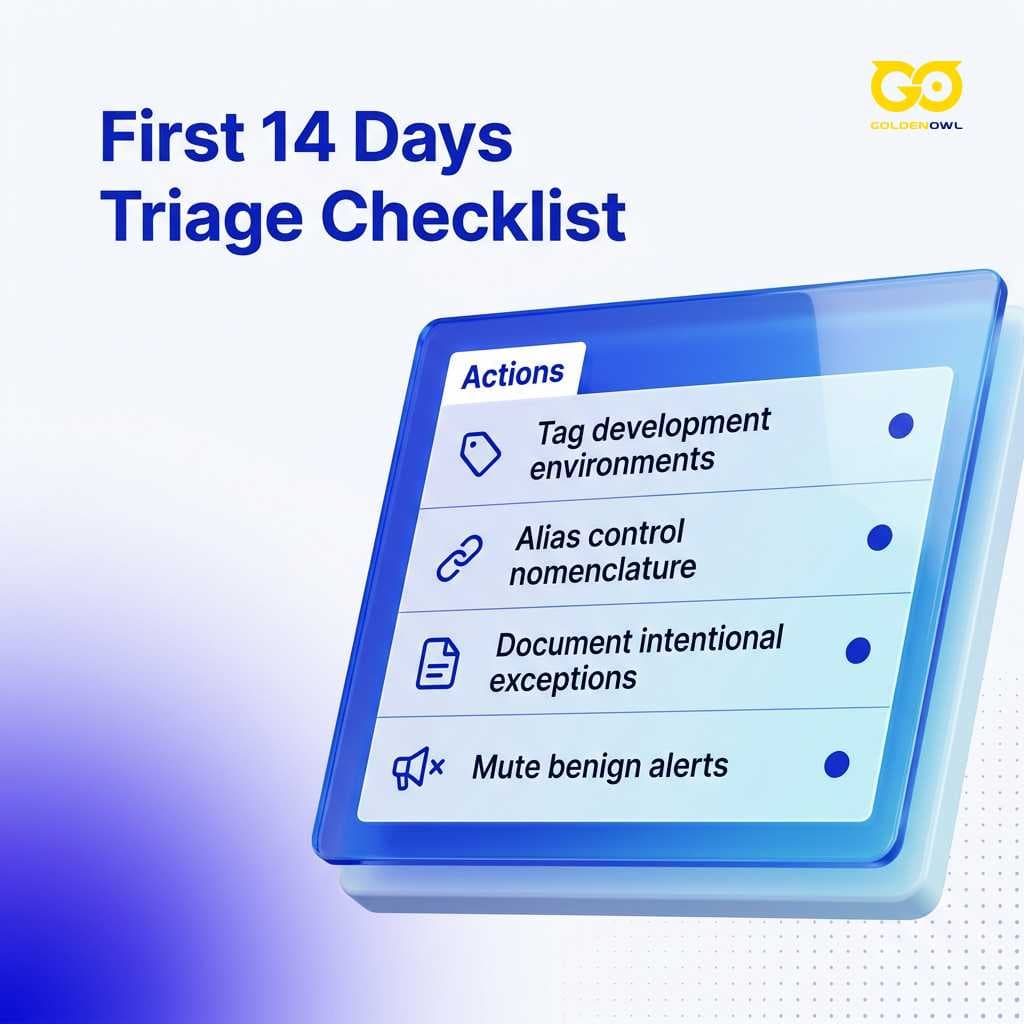
Within the first 14 days of live monitoring, your team should systematically execute four practical triage steps:
- Tag development environments: Explicitly label sandbox, staging, and transient testing clusters as out-of-scope to eliminate false posture alerts.
- Alias control nomenclature: Map your company's existing internal naming conventions directly to the platform's control IDs.
- Document intentional exceptions: Formally log risk acceptance for deliberately omitted controls (such as staging server branch rules).
- Mute benign alerts: Establish temporary alert suppressions for legacy configurations currently queued for engineering refactoring.
Frequently Asked Questions
The answers below break down essential technical boundaries, audit thresholds, and model governance rules for compliance teams planning realistic implementations.
What is the difference between AI compliance and AI-powered compliance tools?
AI compliance
As a reminder, AI compliance requires your organization to follow regulatory frameworks governing machine models directly, including the EU AI Act and ISO 42001.
AI-powered compliance tools
These platforms deploy machine learning across your production systems, automating daily evidence collection, monitoring internal controls, and drafting policy documents across multiple frameworks so your staff avoids manual data entry.
Can AI-powered tools fully automate a SOC 2 audit?
No software platform can complete a SOC 2 audit alone, since issuing the final attestation strictly requires an independent professional opinion from a licensed CPA.
Automated tools can pull continuous logs and format technical descriptions, but a qualified human auditor must still inspect your records, interview your engineering staff, and sign the formal report.
How do I know if an AI tool’s questionnaire answers are accurate?
Retrieval-based grounding
Pick tools that use Retrieval-Augmented Generation to anchor their questionnaire responses directly in verified source documentation. Each generated response must cite the underlying policy record, which lets you trace every answer back to the exact paragraph in your original audit report.
Human review gates
Set up human review gates so that low-confidence prompts route directly to your team instead of letting the model guess. Always require a subject matter expert to sign off on drafted answers before transmitting files to external partners.
How can artificial intelligence be utilized in compliance processes?
On the operational side, machine models speed up routine paperwork across vendor onboarding, standard KYC reviews, and Anti-Money Laundering controls. You can deploy document parsers across unstructured contracts and messy PDF files to execute structured compliance checklists without hiring specialists to read raw text line by line. These intake models catch internal policy violations, assist with periodic regulatory filings, and flag watchlist hits during mandatory sanctions screening against OFAC databases.
Continuous compliance platforms use deterministic rules to monitor operational routines and catch control drift early. Across your infrastructure, production environments maintain audit readiness by pulling security metadata straight from systems like AWS, GitHub, and HRIS on a daily collection schedule.
What are the challenges of AI adoption in compliance?
Rolling out automated governance across enterprise systems introduces specific friction points around software architecture, data isolation, and auditor verification:
- The largest challenges are hallucination risk and technical debt from brittle RPA implementations where unchecked generative models produce factual errors. If an ungrounded model states you conduct quarterly penetration tests when your engineering team only completes them annually, you have delivered an actionable misrepresentation on an enterprise customer contract.
- Legacy stacks push rigid OCR bots and brittle DataOps pipelines that collapse against the reality of global compliance operations. Teams struggle with messy legal contracts, shifting KYC mandates, and variable government forms where brittle AI compliance bots fail because expected document fields shift location.
- IBM reports that 97% of organizations with AI incidents lacked proper access controls, and IBM’s 2025 data shows that 63% of organizations lack formal AI governance policies.
- Some vendors aggregate customer data to train their models, which introduces a risk of data leakage unless an explicit opt-out mechanism ensures proprietary data remains strictly isolated within your tenant.
- The external auditor arrives and rejects half the evidence because it lacks timestamps, fails to display live configurations, or misses parts of the testing window, triggering protracted disputes over technical proof and missing audit records.
Is neurosymbolic AI required for SOX-compliant compliance automation?
Deterministic auditability
Defending regulated financial workflows requires neurosymbolic AI. While unconstrained language models can hallucinate approvals, coupling natural language extraction with deterministic rules creates the replayable audit logs you need to pass strict SOX walkthroughs with external examiners.

Execution boundaries
Probabilistic models handle messy incoming documents, while deterministic code manages database updates, risk calculations, and state transitions. Splitting the architecture this way produces an explainable trail that maps every automated action directly to your internal rulebook.
Rigid symbolic constraints make sense for financial balance sheets, but forcing them onto low-risk administrative tasks only burns engineering hours. The best teams balance daily infrastructure telemetry with required human reviews, ensuring their evidence package stands up when third-party auditors inspect their controls.
Automating compliance comes down to drawing clean lines across your software stack. You now have the blueprint to separate probabilistic document processing from deterministic configuration rules, pairing daily infrastructure telemetry directly with mandatory human sign-offs. Grounding questionnaire responses in verified source text keeps hallucinations completely out of production. By deploying robust ai workflow automation compliance solutions with deterministic validation across regulated controls, you build a defensible audit trail that satisfies external examiners across overlapping security frameworks without burning engineering capital.
Share this page


Table of Content

Subscribe to Golden Owl blog
Stay up to date! Get all the latest posts delivered straight to your inbox