
An AI legal assistant does the first pass of legal work. See what it can and can’t do, and which legal AI tools fit research, contracts, or practice management.


AI Marketing Solutions with Proven ROI
Oct 1, 2026
about 26 min read

They also have to find AI marketing solutions with proven ROI, not just another subscription charge
Modern marketing teams have to produce more without letting costs, quality, or brand standards slip. They also have to find AI marketing solutions with proven ROI, not just another subscription charge. Use this guide to assess those solutions, tie them into current operations, and decide where automation can lift revenue and efficiency.
High-Yield AI Marketing Solutions with Proven ROI
AI delivers its clearest marketing gains through execution, where speed and pattern recognition matter; respondents to McKinsey's 2026 State of AI survey most often attributed revenue gains to marketing and sales, followed by product and service development and software engineering. Repeatable tasks fuel those gains.
Gartner's 2024 Marketing Technology Survey says 80% of execution tasks are a strong match for AI automation, including content drafting, image generation, A/B testing, and social-post scheduling. Strategic work such as positioning, crisis response, and pricing is less suitable, with only 18% benefiting from AI assistance.
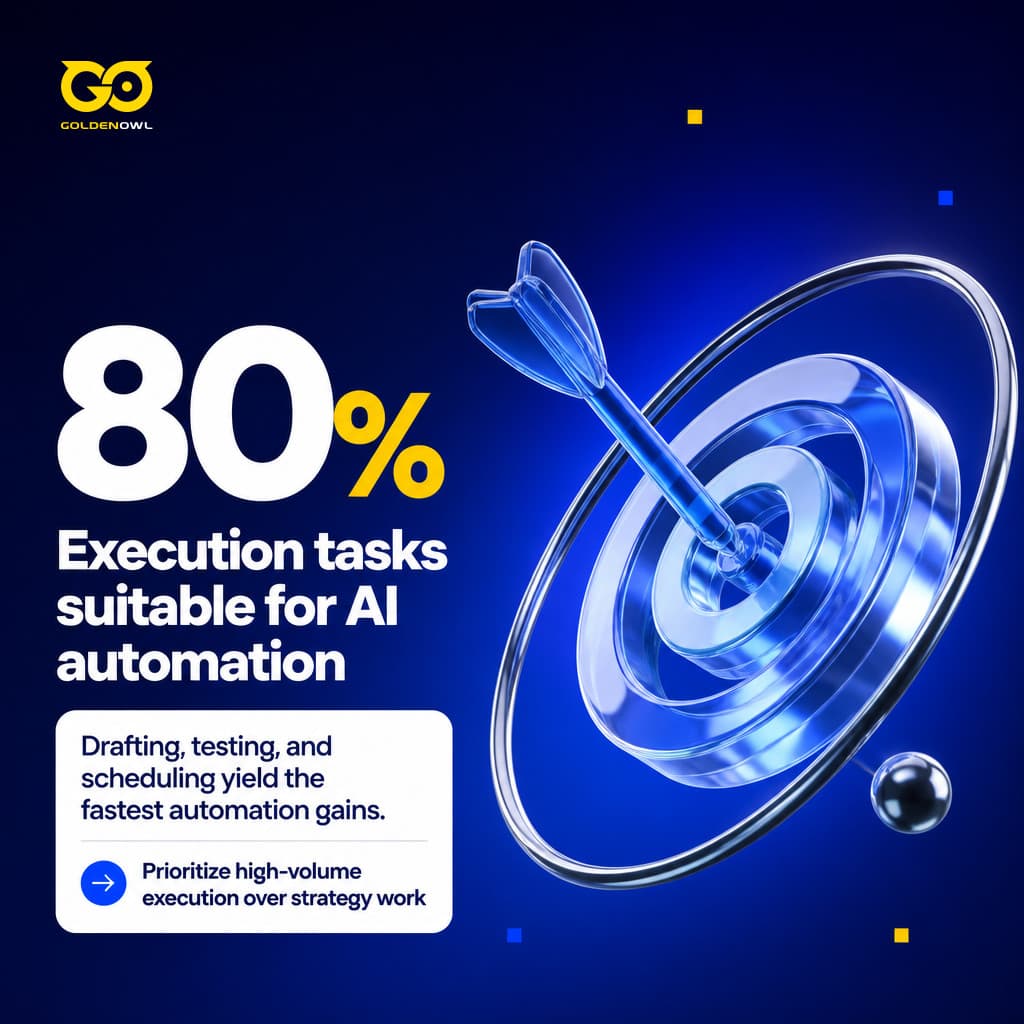
Marketing teams using AI typically see 10-30% higher sales ROI than teams relying on traditional methods.
Content Production
AI can turn product details into descriptions, reducing the burden of writing hundreds of pages manually. Set firm brand guidelines for the tool, then add the judgment, expertise, and personality only people can bring.
Here are the main content production options:
- Copy.ai ($49/month individual, pricing): Produces product descriptions at scale and SEO-optimized category pages.
- Jasper ($125/month Teams, pricing): Trains on brand voice to keep thousands of SKUs consistent.
Content tools may save 10-15 hours weekly, though two or three quality-control stages reduce net savings. A 30-40% net reduction may remain after those checks. Even when a vendor promises a 60-70% time reduction, the actual gain may land closer to 42% after generation, fact-checking, brand-voice editing, and publishing, according to the Content Marketing Institute's 2024 AI Benchmark Study.
The Content Marketing Institute's 2024 study found that 58% of AI-generated marketing content needs substantial revision before publication, meaning 15+ minutes of editing per 500 words.
Stanford HAI's 2024 AI Index Report records factual errors in 14.7% of AI-generated marketing claims, including 11.8% for GPT-4 and 18.3% for Claude 2.
Media Editing
AI speeds up high-volume visual production by changing backgrounds and clearing distracting elements from product images.
- Canva Pro ($14.99/month, verified pricing): Provides Magic Eraser, background removal, and batch image generation for product photos.
Stronger product imagery gives ecommerce companies using visual AI an average 18% conversion improvement. Forrester's 2024 vertical analysis of 127 companies found 2.3x higher ROI from visual AI in ecommerce than in B2B SaaS, while B2B SaaS organizations got 1.8x better returns from content-focused platforms.
A December 2024 G2 review said it created 200 product images in 2 hours versus 3 days manually and gave the tool a 4.7★ rating. Templates cut design time by 80-90%.
Tools like top ai-driven social media video editing solutions for marketing teams help teams handle high-volume visual production.
Email Campaign Testing
Test email variations quickly
Have AI generate several subject-line choices, then run A/B tests instead of spending too long picking one. Shopify Messaging can create those variations from your campaign goals.
Email performance optimization
According to Mailchimp's platform data, AI subject-line recommendations are associated with higher open rates than campaigns without them, based on aggregate results from millions of campaigns.
Dynamic Audience Segmentation
AI segmentation tools sort customers by shifting traits such as “at risk” and “high spending potential,” helping each campaign reach the right audience at the right time.
One mid-sized e-commerce company reported the following changes after using AI for segmentation and more personalized email campaigns.
| Metric | Before AI | After AI | % Change |
|---|---|---|---|
| Sales | $1M | $1.3M | +30% |
| Customer Engagement | 2 mins | 3 mins | +50% |
| Conversion Rate | 2% | 3% | +50% |
The figures link segmentation to stronger sales, engagement, and conversion. High-performing marketing teams personalize across six channels on average, whereas underperforming teams manage fewer than three.

Predictive Delivery Scheduling
Past interaction records can tell you when to send a discount or another campaign. AI reads browsing and cart-abandonment behavior instead of pushing every message out in one batch, so timing follows customer activity.
HubSpot uses AI for content optimization recommendations, predictive lead scoring, and personalized email send times. Its AI-recommended timing has reportedly produced higher open rates than fixed send schedules.
Search Engine Discovery
Products need structured data to show up in AI-generated search summaries, and you can start with three practical steps:
- Use tools like Shopify Catalog to structure data for large language model optimization (LLMO), helping products appear in AI-generated summaries from platforms such as ChatGPT or Google AI.
- Check product pages with Shopify's free audit tool by scanning any product page URL for gaps in the structured data required by AI shopping assistants.
- During the late 2025 shopping season, retailers observed a 694% increase in site traffic originating from GenAI tools, although the user base remained modest.
Search behavior is changing: AI platforms or chatbots are the most common destination for 31% of Gen Z consumers, rather than traditional search engines, while 53% distrust AI-powered search results. Verified brand content still matters.
HubSpot's content assistant and Semrush's ContentShake AI typically need 8-12 weeks to show ROI because they depend on accumulated data, a baseline, and integration with existing marketing systems. SEO content platforms need 12+ weeks before rankings show the change.
Performance Analytics
By region, Shopify Sidekick can identify the best-selling products in seconds, avoiding hours of spreadsheet work or assistance from a data team. The first gain is faster answers.

A reported 47% of marketing leaders see major GenAI benefits in campaign evaluation and reporting, but predictive analytics need 3-6 months of data history for accurate forecasts.
Poor data still limits the result because incomplete or inconsistent contact records worsen the garbage-in-garbage-out problems already present in CRM data and AI personalization.
Knowledge Base Generation
AI turns recurring customer questions into clear, on-brand, searchable FAQs. Support tickets and chat logs are full of recurring customer questions.
These FAQs support search engine optimization (SEO), customer support, and less manual content creation.
Accuracy takes precedence over brand polish in technical documentation and API guides, so ChatGPT Plus ($20/month), not a $49/month individual option, is the most cost-effective choice described here.
Product Recommendations
With historical sales data, AI can suggest related products and build “people also bought” recommendations into product pages. Machine learning spots buying patterns manual curation often misses, which may lift average order value (AOV). In its 2017 Personalization in Shopping report, Salesforce reported that purchases with a recommendation click had a 10% higher AOV than purchases without one.
Sephora has reported the following uses of AI:
- Personalized product recommendations
- Virtual try-on features
- Targeted promotional campaigns
To personalize suggestions across email, its app, and stores, Sephora draws on browsing history, purchase data, and skin tone information. Conversion improved significantly against non-personalized experiences, although specific figures have not been publicly disclosed.
Organizations looking ahead expect machine customers, including AI buying assistants, to generate 25% of total revenue by 2027. By then, 50% of people in advanced economies are expected to use AI personal assistants for daily tasks such as finding products.
Landing Page Iteration
AI theme customization lets marketers create and test targeted landing pages, including Black Friday pages, without waiting for developer time; performance data then points to the next changes.
Quick-win tools such as Canva's Magic Write and Grammarly can show measurable value within 3-7 days, with little technical setup and immediate time savings on routine tasks.
Forrester's integration research puts the average development cost at $6,375 per integration, based on 51 developer hours at $125/hour. Authentication updates, API changes, and error handling add 2-3 maintenance hours each month.
Cross-Industry Implementations
Different industries face changing integration costs because AI has to fit different compliance rules, sales processes, customer data, and content-focused platforms.
Regulated Financial Services
Marketing claims still require approval, so regulated financial services need controlled language and review gates from the start.
AI can improve response rates when the system works inside clear language rules. A financial services company partnered with Persado on email and digital marketing copy, using emotional and motivational framing for specific audience segments; click-through rates improved by 450% over human-written versions.
Enterprise workflow transformation
Nearly three-quarters of high performers say AI has led them to redesign workflows, versus 55 percent last year; only one-quarter of other respondents say they’ve made that shift.
Structured marketing workflows
Consistent results depend on structured source material, clear brand voice rules, set review gates, and human ownership before teams increase output.
Enterprise adoption and financial impact
In 2025, 88% of organizations report regular AI use in at least one function, up from 78% in 2024; marketing is 32% fully implemented and 43% still experimenting.
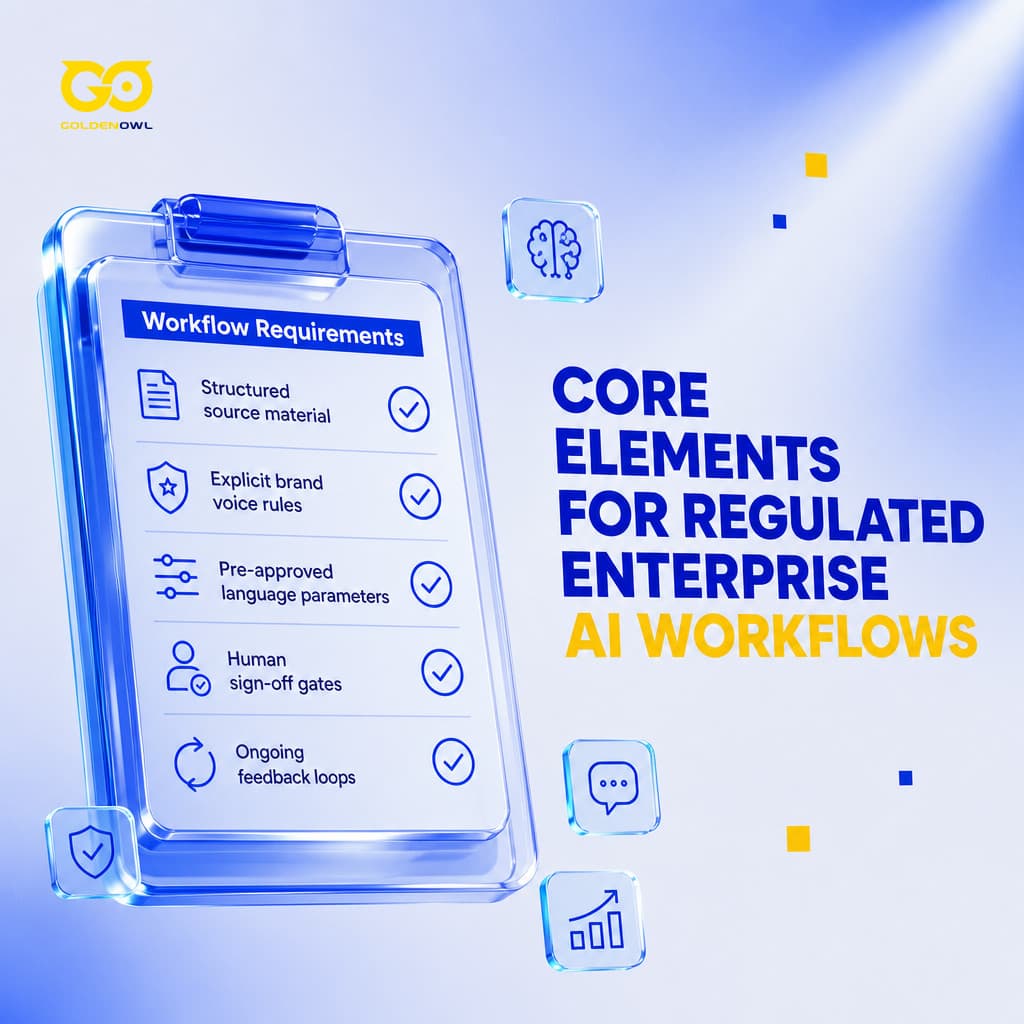
Persado creates copy inside pre-approved language parameters, while a person checks every asset before deployment. Its emotional and motivational framing improved click-through rates by 450% over human-written versions. Another financial services company uses AI for fraud detection and customer communication personalization, finding offers and messages that may suit specific cardholders’ spending patterns while legal and brand review stay in place.
For government and enterprise leaders, risk and compliance rank among the main AI concerns, alongside legacy systems; 60% call them primary challenges.
Retail Personalization
Retail teams can tie customer recommendations, demand forecasting, inventory management, and advertising output into one operating flow.
Demand forecasting and inventory alignment
H&M applies AI to demand forecasting and inventory management, giving marketing a clearer view of product demand and cutting discounts on items that have fallen out of step. Teams spend less time repositioning excess inventory and more time building proactive campaigns.
Dynamic creative optimization
Nike uses AI for dynamic creative optimization, producing several ad versions and steering spend toward the strongest performers through real-time performance data.
Direct-to-Consumer Commerce
Direct-to-Consumer Commerce brands use AI to control advertising budgets and produce customer communications.
- Paid media optimization: An ecommerce company replaced its paid media agency with an AI platform for digital marketing optimization. Across Google, Facebook, and Instagram, the system shifted budget allocation in real time based on performance signals, producing a 336% increase in return on ad spend and a 155% increase in revenue from paid search during the test.
- Personalized shipment notes: Another ecommerce company built AI into its core business model by generating personalized style notes for each shipment. AI writes each note from client preference data, and human stylists review them before sending.
- Workflow sequence: The process is explicit: AI drafts, a human reviews, and the client receives the note.

The table tracks changes in Sales, Customer Engagement, and Conversion Rate before and after AI adoption, including the 2% and 3% figures.
| Metric | Before AI | After AI | % Change |
|---|---|---|---|
| Sales | $1M | $1.3M | +30% |
| Customer Engagement | 2 mins | 3 mins | +50% |
| Conversion Rate | 2% | 3% | +50% |
Business Pipeline Generation
Business Pipeline Generation combines lead scoring, content recommendations, prospect nurturing, and real-time qualification to move prospects closer to sales conversations.
- Salesforce marketing operations: Salesforce uses AI for Einstein-powered lead scoring, content recommendations for its blog and resource library, and personalized email sequences for prospect nurturing. Internally reported results show significant improvements in marketing-qualified lead conversion rates, although specific figures are not publicly disclosed.
- Conversational lead qualification: A conversational AI platform qualified inbound leads on its website in real time, sending high-intent visitors directly to sales conversations instead of form submissions. The reported result was faster lead response and increased sales-qualified lead volume.
- B2B SaaS returns: Forrester’s 2024 vertical analysis of 127 companies found that B2B SaaS organizations receive 1.8x better returns from content-focused platforms. The same analysis reports 1.8x higher ROI from content-focused tools than from visual platforms.
HubSpot Marketing Hub, priced at $800/month Professional with 3 seats, links AI content with lead data through native CRM integration; HubSpot AI reduced blog production time 40% and raised lead quality 23%.
AI Publishing and Media Recommendation Examples
The Washington Post used Heliograf to automatically produce short articles and updates, creating over 850 pieces in one year while journalists handled deeper stories. Routine reporting shifted to the system, lifting content volume and engagement without exhausting the newsroom.
Spotify uses algorithm-driven playlists to keep people listening longer, lift renewals, and grow ad revenue. Each listening session gives the system more information to improve song recommendations and encourage continued use.
Paid Social Campaign Optimization
A fragrance brand used an AI-driven tool to improve TikTok campaigns, cutting cost per action by 15.4% while raising ROAS 32.8%. The campaign delivered over 1.9 million impressions and more than 600 conversions.
Financial Return Benchmarks
AI has raised organizational EBIT for 37 percent of respondents, roughly four in ten. That figure is nearly the same as in 2025, even with more organizations scaling AI technologies.
Only 14 percent of organizations using AI have seen workforce size fall, below half the 32 percent that forecast reductions in last year's survey. Actual change has lagged behind expectations.
The forecast for next year splits: 39 percent expect AI to lower overall head count, while 43 percent foresee little or no change.
Forrester's 2024 review of 127 companies found that successful AI implementations seldom removed full-time positions; most organizations redirected capacity toward higher-value strategy work.

Operating costs hold back AI use for one in five respondents across organization sizes and industries, yet 60 percent plan to raise AI investments over the next year.
Direct Labor Cost Avoidance
The Bureau of Labor Statistics puts the median marketing specialist rate at $50/hour. Saving 10 hours weekly gives a content writer $26,000 in annual value.
Jasper AI case studies from March 2024 found that teams producing 10+ content pieces per week saved 12.5 hours weekly on average.
A content team costing $180,000 annually, the equivalent of three writers at $60K each, could retain two writers, spend $15,000 on AI tools, and save $105,000 annually.
For 80 percent of respondents, AI has lifted individual productivity; 50 percent say it improved decisions, and 83% of marketers using AI report higher productivity.
A Nov 2024 Capterra review captured the practical result: “We didn't cut headcount but 2x'd content output with same team” with a 4.6★ rating.
Quality Review Overhead
Human-in-the-loop workflow
AI content still needs a Human-in-the-loop workflow that runs from generation through expert editing, separate fact-checking, and final approval. In one three-stage review, the writer edits the draft, another editor checks the facts, and the brand director signs off; Capterra reported that this caught 94% of issues before publication (4.5★, Nov 2024). There are three review stages.
Some teams follow the 30% rule as an informal guardrail for brand authenticity. AI takes on 70% of production, such as content drafting, data analysis, and segmentation, while at least 30% stays with people for final editing, strategic oversight, and ethical judgement, helping limit consumer distrust.
Faster generation doesn't create savings right away. Facts still need checking, the brand voice needs protection, and someone must approve the draft for publication.
AI Tool Costs for Solopreneurs and Small Businesses
These figures establish an annual tool cost, not a solopreneur payback timeline. For content drafting, a starter stack pairs ChatGPT Plus at $20/month, or $240/year, with Canva Pro at $14.99/month, or $180/year; the combined $420 annual cost covers 80% of use cases for businesses under $1M revenue.
These tool prices do not establish a small-business payback period. Teams producing 10+ content pieces weekly can add Copy.ai Pro for $49/month, or $588/year, or Jasper Teams for $125/month, or $1,500/year, to keep brand voice consistent.
For teams handling more than 500 products monthly, Copy.ai Business costs $245/month for 5 users minimum, while Jasper Teams can offer better per-unit economics than metered plans.
Enterprise Compliance and Budget Risks
Compliance validation
TrustRadius's 2024 audit found standard GDPR-compliant data processing agreements at only 43% of AI marketing vendors. Enterprise compliance validation can stretch procurement across 4-6 months.
Budget waste
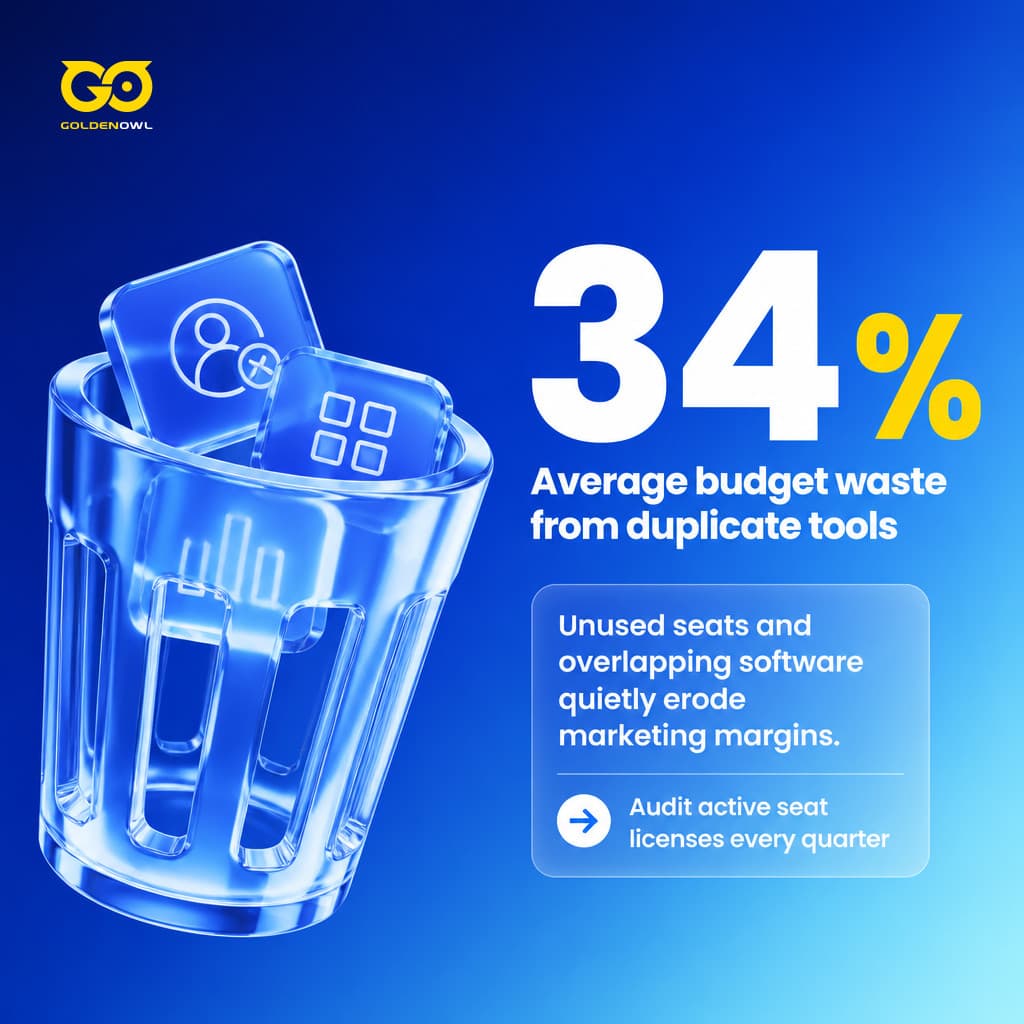
Forrester's 2024 audit puts average budget waste from overlapping functionality and unused seats at 34%. After 90+ days, inactive users make up 41% of licensed users.
A separate Forrester 2024 waste audit found 3.2 tools with duplicate functionality on average, adding to 34% in avoidable spending.
For the small-business tier, Business Wire reports that SMB marketers using AI save 13 hours per week, or about 52 hours per month. That works out to $4,739 in average monthly operational cost savings, or roughly $56,868 a year in reclaimed labor value.
Daily Power Users save up to 57% more time and 36% more in operational costs than infrequent users. The comparison still doesn't establish a break-even period against tool spend.
For mid-market and enterprise teams, comparable weekly savings, annual labor value, and break-even periods aren't available. A tier-by-tier payback table would create false precision.
Vertical Deployment Models
Verticals show 53% differences in feature requirements, so set AI spend against each industry's content, sales, and operating needs.

Ecommerce Brands
Visual content generation
Use visual content generation and automated product descriptions when immediate conversion impact matters.
High-volume catalog content
High SKU counts make unlimited output plans the sensible fit.
Enterprise Software
Long-form content
For B2B demand generation, long-form material, thought leadership, and SEO carry more weight than visual polish; quality and search visibility lead.
CRM integration
Smaller B2B teams can pair Semrush Guru at $249.95/month with ChatGPT Plus at $20/month, spending $270 monthly instead of $800/month for HubSpot Professional.
Professional Services
Professional Services teams have to keep their brand voice steady while tailoring case studies, client testimonials, proposals, and outreach to each client.
Jasper at $125/month Teams lets you train its brand voice feature on existing content, keeping proposals consistent.
At $49/month, Copy.ai automates workflows from prospect research through outreach email sequences.
Use Canva Pro at $14.99/month for proposal design, one-pagers, and case study templates.
Services businesses usually require fewer licenses than product teams, so their tools differ from those built for high-volume product organizations.
Local Businesses
Local discovery and trust rest on review responses, local SEO content, steady social media, and Google Business Profile optimization.
At $20/month, ChatGPT Plus can handle review responses, local blog posts, and social captions.
In Dec 2024, one r/smallbusiness Reddit user reported that ChatGPT cut response writing to 10 minutes from 2 hours weekly, earning 156 upvotes.
Semrush Local, included with Pro at $139.95/month, handles listing management plus AI content for local landing pages.
For one location, use the starter stack and cost outlined in the solopreneur payback section.
Foundational Workflow Requirements
Building AI marketing that wins in 2026 depends less on choosing the newest model than on the system you put around tools such as ChatGPT and Claude.
AI marketing case studies usually point to faster production and more personal campaigns, while reporting better open rates. The repeatable lesson sits in the workflow, not speed or volume.
AI strengthens a team’s existing habits only when five conditions are in place: structured source material, brand rules, verification checkpoints, human ownership, and feedback loops. Fewer than 5% of marketing leaders using GenAI as a standalone tool report major business gains.
Structured Data Repositories
Build the source library with approved facts, product details, customer data, brand voice guidance, prompt paths, review gates, named ownership, feedback, and measurable workflow results. Give the system usable material.
Brand Voice Specifications
Explicit brand voice rules
AI needs clear written standards for marketing language and presentation.
Brand voice consistency usually slips without enough training material, which means 100+ existing content pieces, and the output starts sounding like generic marketing.
Feed the tools 50-100 approved content examples before production use, then refresh that training quarterly as the brand voice changes.
Run a brand voice audit in 5-10 minutes by comparing the draft with your guidelines and tuning its tone for the audience, while flagging generic language.
Prompting without firm brand boundaries is like asking a freelance writer for campaign copy while withholding both the style guide and target persona.
Verification Checkpoints
The verification checkpoints are fact verification, link validation, and an originality check. The surrounding workflow matters more than the standalone tool. When workflow details are disclosed, AI sits within a human-built system that uses strategic integration and clear guardrails.
Use this review process:
- Fact verification: Spend 10-15 minutes per 500 words cross-referencing statistics with primary sources, verifying dates and product details, and confirming competitor claims.
- Link validation: Spend 3-5 minutes checking that URLs work, looking for citation hallucinations, and confirming external links remain current.
- Originality check: Run content through plagiarism detection for 2-3 minutes to find cases where AI reproduces training data too closely.
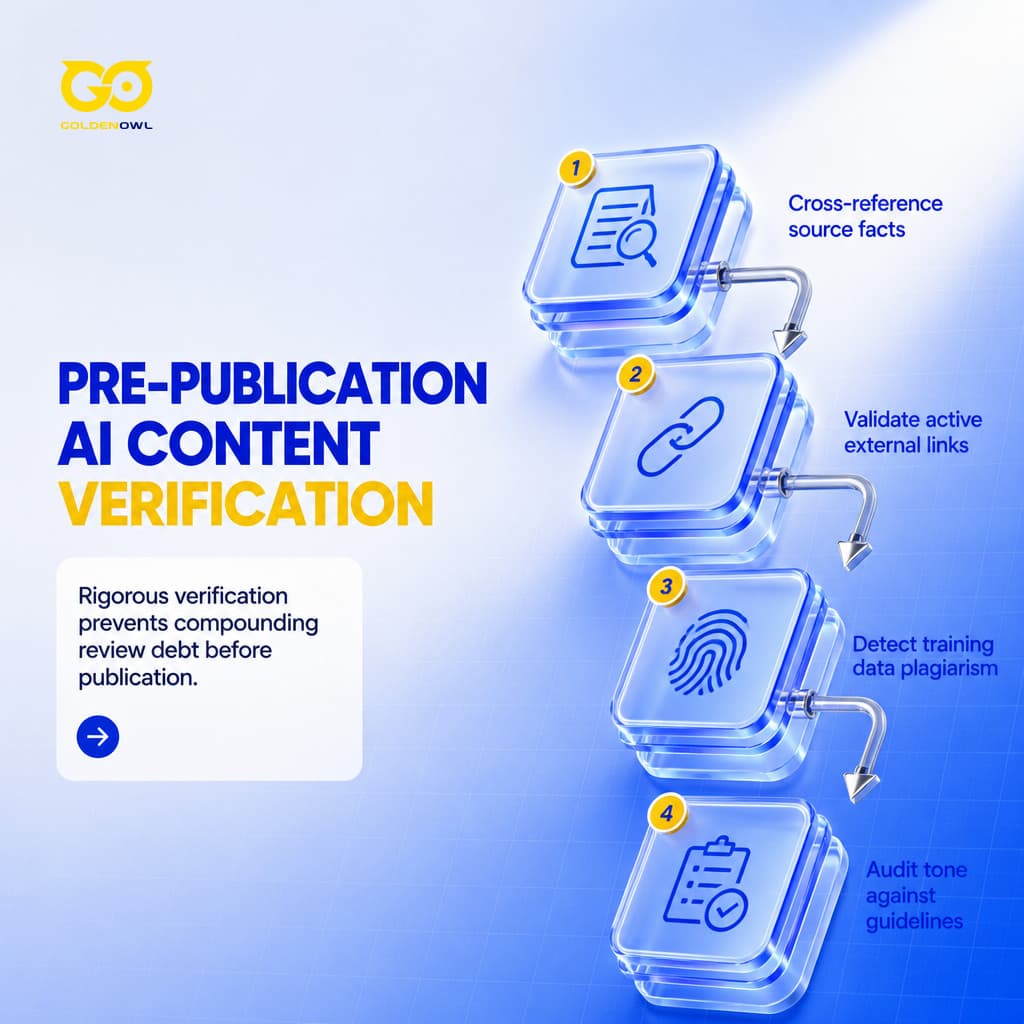
Skip those gates and AI can make productivity look higher while piling up review debt. Verifying a draft can take 10-15 minutes per 500 words, while Link validation takes 3-5 minutes and an Originality check takes 2-3 minutes, yet the same people still repair every draft.
Human Accountability
Give one named person or function responsibility for output quality. The examples above don't show AI replacing marketing functions, because ownership still stays with people.
AI can't assign responsibility for accuracy, claims, voice, or approval. People decide what gets said and what the brand stands for, while also determining what qualifies as quality for the organization and audience.
On a team of 1-5 people, have everyone learn one primary tool deeply and name one person as the AI lead for troubleshooting.
With 6-20 people, appoint a dedicated AI coordinator to manage the tool stack and prompt libraries, while training the team; 15-20% of that person's time should remain reserved for the work.
Teams of 20+ people may need a full-time AI/automation specialist for integrations and custom workflows. The stated ratio is 1 specialist per 20-25 content creators.

Iterative Feedback Loops
A closed feedback loop carries performance data from published content into the next generation and review cycle.
One better prompt can improve one result, while a better workflow improves every result afterward. The gains usually show up in four areas:
- Production efficiency: Less time goes into creating first drafts or asset variations.
- Review efficiency: Teams perform fewer subjective rewrites and face fewer late-stage approval delays.
- Brand consistency: Drift decreases across channels, teams, and markets.
- Performance learning: Feedback improves the connection between what ships and what gets improved next time.
Irreplaceable Strategic Judgment
AI can handle repeated execution tasks, such as creating variants, splitting budget across options, matching content to audience segments, and choosing send times. Creative judgment and brand decisions still stay with people.
People still have to make the strategic calls. Gartner's 2024 survey of 437 marketing leaders found only 18% of strategic tasks suitable for AI automation, leaving Market positioning and competitive differentiation, along with pricing strategy, with people.
Human empathy still matters in crisis communications and sensitive customer situations, including apology statements, because AI lacks the context required for tone-sensitive moments.
A standalone AI tool can synthesize information available to it, but it cannot independently produce findings from proprietary analysis, interviews, or surveys it has not been given.
Phased Implementation Roadmap
When you move beyond a contained pilot, use a 30-60-90 day adoption plan rather than trusting vendor claims of “instant productivity.” HubSpot's AI Playbook for Marketers maps days 1-30 to pilot testing, then moves through team training and expansion in days 31-60 before reaching optimization and scaling in days 61-90.

Pilot Testing an AI Marketing Solution
Pick one workflow that happens often and at high volume, then test work the team already uses or is considering before adding another task.
Test 1-2 high-impact use cases.
Week 1 quick wins include:
- Social media caption generation using Canva AI and ChatGPT
- Email subject line optimization with Copy.ai and HubSpot AI
- Image background removal through Canva and Photoshop AI
- Review response drafting with ChatGPT
Track time saved, judge quality against a human baseline, confirm the tool works with your existing tech stack, and price the case for expanding it.
Organizational Expansion
Training during this stage sets the adoption pace, taking you from 1-3 people in the pilot to use by 50-75% of content creators.
Training priorities include:
- Tool-specific workshops lasting 4-6 hours and covering core features
- Prompt library development for common content types
- Quality control standards and review workflows
- Integration with the existing content calendar and approval processes
Set aside 8-12 hours weekly for an AI coordinator, while budgeting 4-6 hours of initial training per team member; first-month adoption support should receive 2-3 hours weekly.
McKinsey's research found that 64% of marketing leaders underestimate AI training needs, while actual training takes 50-200% longer than early estimates.
The widest misses appeared with prompt-based tools: ChatGPT/Claude training took 180% longer than estimated, versus 40% longer for Jasper templates.
By the end of 2026, generative AI and creative tools are expected to place content creation directly with employees across the organization.
Two-thirds of AI-created marketing content will be produced outside centralized content teams.
Stack Rationalization
Optimization means combining duplicate capabilities, matching licenses to usage data, adding API integrations and custom workflows, and tracking ROI against baseline metrics.
Use the first 90 days to test and train, then remove tools. Measure the savings against the original stack.
A Nov 2024 Capterra account described the sequence simply: everything was tested in the first 30 days, with the team trained during days 31-60; days 61-90 cut 3 redundant tools while saving $400/month (4.6★).
Nearly one-third of respondents, or 32 percent, said agentic coding tools helped their organizations build at least one software product or feature in-house.
Nearly half also said they avoided at least one purchase because software coding agents could build it internally, versus 31 percent of other respondents.
Pre-Scaling Readiness Audit
Before you scale AI-assisted marketing production, audit the workflow against seven questions:
- What source material is approved for AI to use?
- What brand voice rules are specific enough to enforce?
- What claims require verification?
- Who reviews AI output before it reaches senior approvers?
- What does “good” mean before a human starts editing?
- Which workflow are we trying to improve first?
- How will we measure whether AI improved quality, speed, or business performance?
Scaling ahead of those conditions usually creates more review debt.
Integrating AI Marketing Solutions
Custom Application Programming Interfaces
Custom API integrations become necessary for legacy systems and specialized workflows when native connectors fall short. Partnering with an ai solutions company can help build bespoke marketing integrations.
Teams without these technical skills may need support with OAuth 2.0 authentication, REST API experience, JSON/XML parsing, and webhook configuration.
Across marketing teams, technical prerequisites remain uncommon, especially among technology and healthcare respondents, followed by professional services and energy and materials.
Feature depth matters less to time-to-value than integration complexity. Gartner's 2024 Marketing Technology Survey found integration friction was the main AI adoption barrier for 73% of teams, ahead of cost at 54% and skill gaps at 48%.
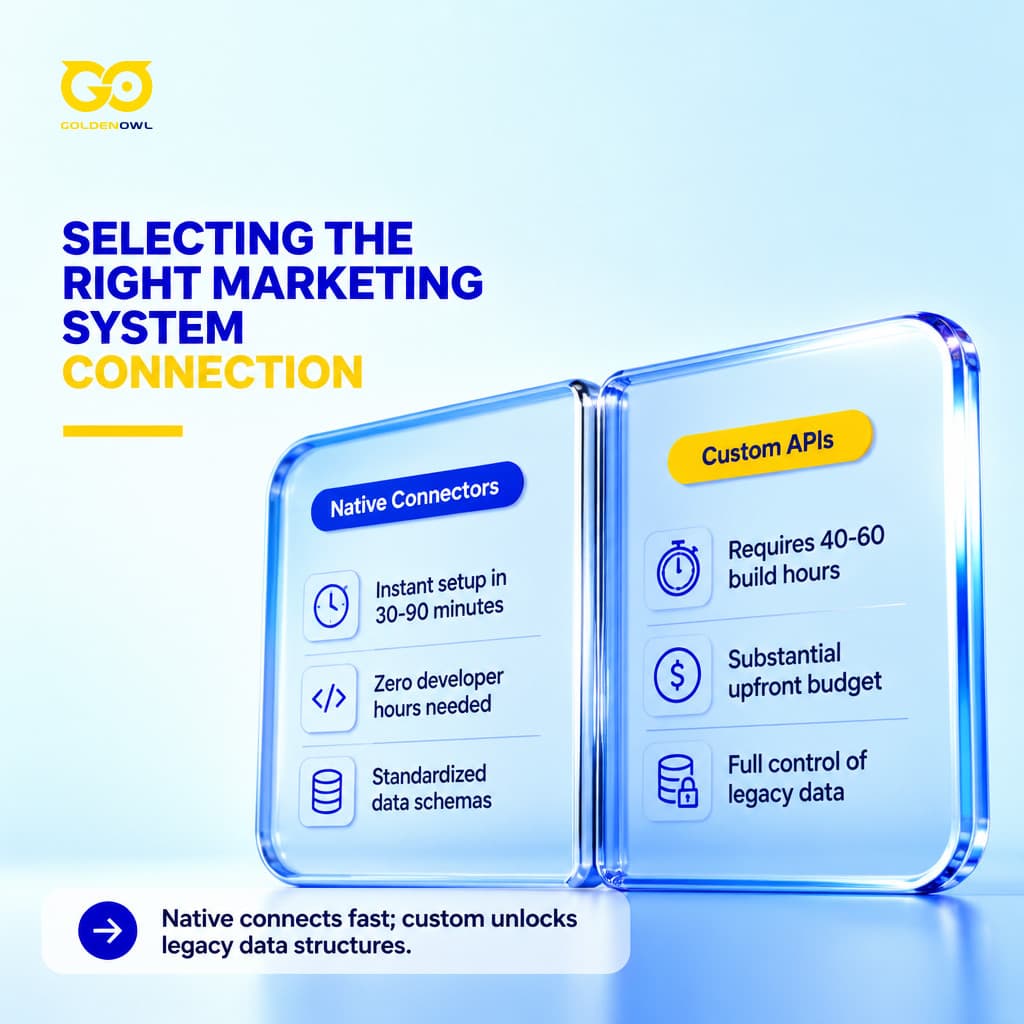
The effort gap between these options is wide: native integrations average 47 minutes, whereas custom API development takes 53 hours.
Setup becomes a measurable cost when integration issues drive 41% of tool abandonment.
Use the table to compare setup time, technical requirements, maintenance, cost, and examples across the main integration types.
| Integration Type | Setup Time | Technical Skill Required | Ongoing Maintenance | Cost | Example Tools |
|---|---|---|---|---|---|
| Native Connector | 30-90 min | Low (OAuth config) | <1 hour/month | Included | CRM + content platform |
| Zapier/Make Workflow | 2-4 hours | Medium (workflow logic) | 2-3 hours/month | $20-$50/month | Any tool → CRM via Zapier |
| Custom API Integration | 40-60 hours | High (developer required) | 2-3 hours/month | $5,000-7,500 one-time | Legacy systems |
Native connectors keep setup and technical demands lowest. Custom API integrations call for far more developer work, while Middleware Automation adds flexibility without a full custom build.
Native Connectors
When either platform changes its APIs, native integrations update themselves; custom builds still require manual maintenance.
HubSpot's App Marketplace contains 47 AI marketing tools, averaging 4.3/5 stars and a 34-minute setup time.
Salesforce AppExchange had 128 marketing applications as of January 2025, including 89 with native Salesforce integration through Lightning components.
Single sign-on comes through OAuth, GUI configuration manages field mapping, and scheduled data syncs run automatically.
Native connectors remove custom engineering and go live instantly, but marketing data has to fit standardized, inflexible schemas.
Middleware Automation
Zapier-based workflows
Zapier-based workflows sit between the two, giving you flexibility without bringing developers into the build. Pick a workflow, map every field, and check task usage before connecting a tool to a CRM. They add $20-$50/month, while G2 reviews from December 2024 put the Advanced plan at $39/month. Each action introduces 5-15 seconds of latency, and premium apps use tasks faster than basic integrations.
Integration failure patterns
When data syncs fail or authentication breaks, troubleshooting can eat 5-10 hours monthly, wiping out the time the integration saved.
A vendor may call its product "easy integration," yet the documentation can reveal OAuth complexity and rate limiting that demand engineering workarounds; without API documentation, troubleshooting may become impossible.
Preparing Your Team for AI Adoption
Confidence in the people introducing AI can fall after integration trouble, slowing adoption; only 31% of individual contributors think their leaders understand the AI technologies they promote.
The fallout appears throughout the organization: 47 percent of mid-level managers and individual contributors report one negative effect, while executives and senior managers report the same at 31 percent.
Graphical User Interface Platforms
The tool decides how much training people need. Canva Magic Write and Jasper templates reach productive use in 3.2 hours on average, while ChatGPT and Claude take a median 28 hours of practice for consistent quality outputs. Template-based GUI tools reach basic productivity faster.
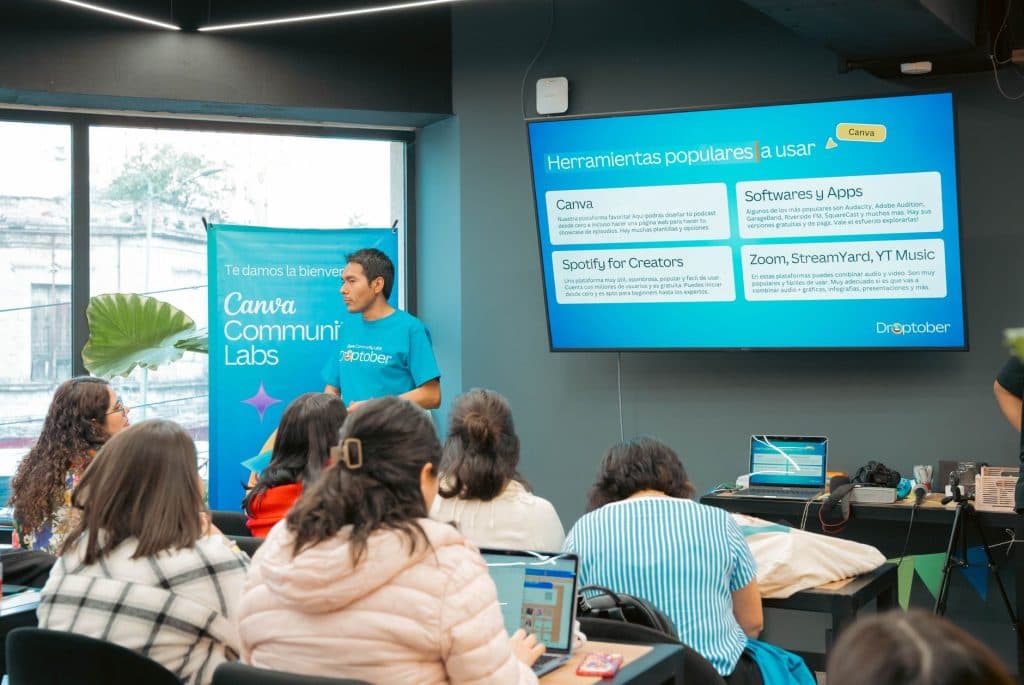
Put non-technical marketers on Template-based tools when speed and low training overhead matter; Jasper guides blog posts, social media, and emails through forms. Basic form-filling skills are enough for a 2-5 hours learning curve.
Prompt Engineering Capabilities
Prompt-engineering platforms ask users to structure prompts, add context, and revise responses through several rounds. ChatGPT demands those same skills in practice. Prompt-based tools take a median 28 hours of practice for consistent quality outputs, with skill requirements varying 8-10x across tool types.
Internal Staff Upskilling
Continue training internal staff when the learning curve and annual budget remain within the limits below:
- The tool learning curve is under 20 hours
- The team already produces content internally
- The budget is under $50K annually for AI tools
- Quality control remains with subject matter experts
Specialist Recruitment
Call in a specialist once the tool estate or quality bar moves beyond what internal staff can manage.
- Managing 5+ AI tools requiring integration expertise
- Prompt engineering quality determines output value
- Annual AI spend exceeds $50K, justifying a dedicated resource
- Custom model fine-tuning or API development is needed
A Reddit r/marketing user called hiring an AI coordinator at 20 employees the best decision, lifting tool usage 3x and improving output quality; the post received 178 upvotes in Nov 2024.
Employment Evolution
Across respondents, two-thirds saw little or no change in total employment over the past year. The finding refers specifically to the total employment measure.
Most respondents don't see AI as a threat to their careers, while 13 percent say, “AI makes me feel anxious about my career prospects.”
Implementation Pitfalls
Automation can damage results when it expands without enough human control. Automated social media posting, for example, can produce brand-damaging content when AI misses cultural context or current events, while Fully automated email sequences can miss the relationship nuances that require a human touch in complex B2B sales cycles.
Factual Hallucinations
Factual Hallucinations are factually incorrect statements presented as truth, and they appear most often in statistics, dates, product specifications, and competitive comparisons.
- Common error areas: Statistics, dates, product specifications, and competitive comparisons.
Nuance Erosion
Generic AI output can weaken brand voice and leave you with extensive editing work, especially when the draft misses the judgment and tone your team uses.
Keep the workflow grounded in real source material, approved examples, voice rules, do-not-use language, human review, and a quality scorecard. Build those controls into the process before production volume increases.
Tool Sprawl
Testing every tool creates costs beyond subscriptions. Managing 8-10 AI tools with overlapping features also wastes time through login management and duplicate training.
- Duplicate writing tools: An audit found, “we paid for 4 writing tools, cut to 2 and saved $3,200 annually” (Capterra, 4.4★, Dec 2024).
Inactive Seat Licenses
Audit usage before renewing licenses, since unused seats turn a software subscription into a recurring expense.
“We paid for 10 licenses but only 6 people used it actively, wasted $7,500 annually” (G2, 3.9★, Nov 2024).
Process Over-Automation
Automated workflows should be avoided in high-stakes touchpoints such as churn risk resolution and enterprise deal discussions, where genuine empathy directly determines buyer retention.

AI lacks contextual awareness for tone-sensitive scenarios, and over-automation creates more work than it saves. Forrester's 2024 analysis of 86 failed AI marketing projects found that this happened in 23% of implementations.
Forty-five percent of martech leaders say that current vendor-offered AI agents fail to meet promised business performance expectations.
Metrics for Measuring AI Marketing ROI
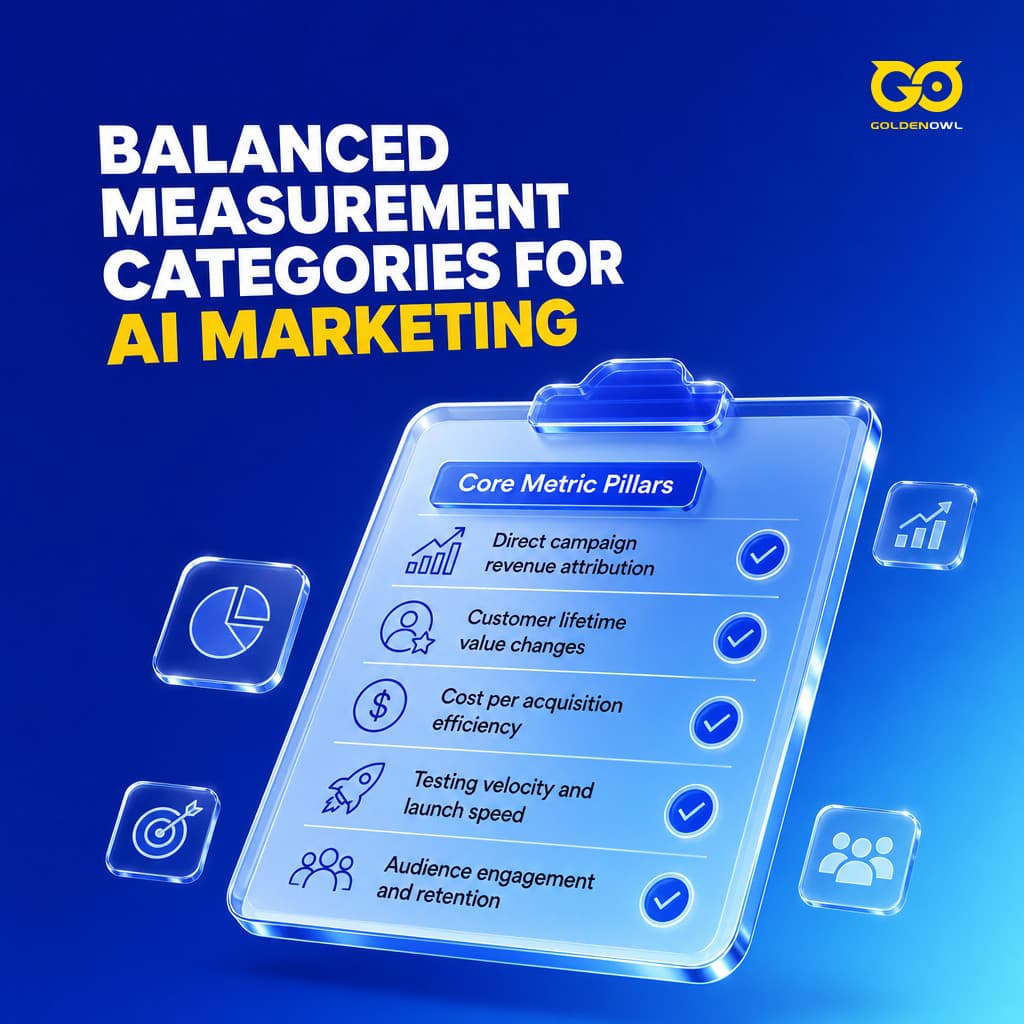
Assess an AI marketing tool by tracking its effect on revenue, efficiency, performance, and lasting competitive gains. The metrics below show how to evaluate each dimension.
But you should judge AI against revenue, efficiency, performance, and lasting competitive gains. High performers are twice as likely to say their organizations have defined processes for measuring impact.
Revenue & Growth Metrics
For revenue, compare sales tied directly to AI campaigns with rising customer lifetime value (CLV), while also checking better lead-to-customer conversion rates. These measures show whether AI-supported marketing is helping growth.
Efficiency Metrics
Use cost per acquisition (CPA), along with faster launches and time saved through automation, to see whether AI cuts the effort needed to run marketing campaigns.
Performance Metrics
Measure clicks and time on page for stronger engagement, then track falling churn alongside more accurate forecasts.
Strategic Metrics
Look for scalable personalization alongside high-volume content production, while assessing lasting advantages over competitors to gauge what AI lets your marketing team do.
Revenue Tracking
Use revenue tracking to tie sales directly attributed to AI campaigns to rising Customer lifetime value (CLV) and better lead-to-customer conversion rates.
- Sales attribution: Sales directly attributed to AI campaigns
- Customer lifetime value: Increases in customer lifetime value (CLV)
- Conversion performance: Improved lead-to-customer conversion rates
Market Expansion Metrics
The Heliograf example measures publishing capacity, not market expansion; it shows how AI-supported content production can increase an organization's publishing capacity.
Operational Efficiency Metrics
G2's Fall 2024 Grid Report analyzed 2,341 verified user reviews and reported a median payback period of 72 days. Treat payback period as an operational efficiency measure because it connects tool adoption with the time required to recover the investment.
Audience Engagement Metrics
Audience engagement tells you whether automated recommendations and messaging prompt customers to respond.
- Subject-line testing: Brands still write the subject lines; AI provides ranked suggestions and predicted open rate ranges.
Competitive Strategic Benchmarks
Competitive Strategic Benchmarks show high performers are 3.3 times more likely than others to intend to use AI to fundamentally transform their business within the next three years.
Compared with others, leading organizations are twice as likely to say their senior leaders show commitment to AI initiatives. Marketers who use AI are over 25% more likely to report content success than those who don't.
Frequently Asked Questions
What do statistics for AI in marketing show?
Global AI marketing revenue is projected to hit $82.23 billion by 2030, and AI solutions already account for 28% of the average marketing tech budget in 2025. Marketing AI spending is also forecast to rise at a compound annual growth rate (CAGR) of 25% from 2025 through 2030.
The workplace data shows where that spending lands, with eight in ten respondents reporting better productivity and about half saying AI helped them build skills and make better decisions. Customer expectations are shifting, too: 68% say advances in AI make trust more important as these tools become part of daily experiences. Together, the figures cover growth, budgets, employee results, and trust.
Taken together, the main figures track market growth, budget share, spending, workplace results, and changing customer expectations:
- Market size: The global AI marketing market is projected to reach $82.23 billion by 2030.
- Marketing tech budget: AI solutions account for 28% of the average marketing tech budget in 2025.
- Spending growth: AI spending in marketing is expected to grow at a compound annual growth rate (CAGR) of 25% between 2025 and 2030.
- Productivity: Eight in ten respondents say AI has improved their own productivity.
- Skills and decisions: About half say AI has helped them develop new skills and make better decisions.
- Trust: 68% of customers say advances in AI make it more important for companies to be trustworthy.
What percentage of marketers are using AI?
Nearly nine in ten respondents say they use AI regularly in at least one business function. Among marketing leaders, 71% report regular GenAI use in at least one function in 2025, compared with 65% in 2024.
Organizations are also putting ai business solutions into more parts of their operations. The share using it across three or more functions climbed from 51 percent to 56 percent. Scale still matters: 54% of respondents at organizations earning at least $1 billion report enterprise-wide scaling, compared with one-third at smaller organizations.
Only 27% of CMOs say their marketing campaigns have limited or no GenAI adoption. At the same time, 93% of marketers say they added AI features to their existing tech stack in 2024.
What is the 30% rule in AI?
In production, the 30% rule assigns 70% of production work to AI and keeps at least 30% with people for final edits and strategic oversight, while people retain ethical judgement. As the earlier Content Marketing Institute finding shows, substantial revision is often needed. Human review therefore belongs in the time calculation.
How much do AI marketing tools actually cost for small businesses?
For small companies, AI marketing tools run from $240-$780 annually for solopreneurs and $3,000-$15,000 annually for SMBs with 3-5 team members. The final price depends on content volume and the feature set you choose.
Which AI marketing tools integrate with HubSpot and Salesforce?
HubSpot's native connectors move content into its CMS and bring in contact data for personalization, while also recording AI-generated assets in Marketing Hub. Salesforce integrations tie AI tools to lead records and opportunity data while supporting campaign tracking.
When a tool lacks a native connection, use Zapier workflows with either platform. They add $20-$50/month and can link any AI tool.
How long does it take to see ROI from AI marketing tools?
Quick-win and strategic platforms are distinguished in the draft, but no separate timeline is assigned to either group.
Quick-win platforms
Include quality-control time when you calculate the break-even point.
Strategic platforms
At $149/month, a Jasper subscription breaks even with 2.98 hours of monthly savings at $50/hour, even after allowing for editing overhead.
Are AI marketing tools GDPR compliant?
Yes, though compliance rests on the vendor and the plan you buy. HubSpot and the Jasper Business plan maintain SOC 2 Type II certification and include GDPR DPAs; Salesforce maintains the same certification and includes those agreements. EU-only servers usually sit behind enterprise plans priced at 2-3x standard pricing.
What are the biggest limitations of AI marketing tools?
AI can't replace human strategic thinking. Its main limits are human judgement and oversight, plus the quality checks required before publication.
- Strategic judgement: Strategic thinking still requires human business judgment.
- Human oversight: AI-generated marketing content may require substantial revision, as Content Marketing Institute's 2024 study found.
- Quality control: Fact verification, brand voice review, and approval affect the time and value gained from AI-generated output.
Do I need a data scientist to use AI marketing tools?
Template-based and prompt-engineering tools don't require a data scientist. You don't need programming knowledge for quality outputs, although custom API integrations do call for technical skills.
Template-based tools
Jasper and Canva take a 2-5 hours learning curve and basic form-filling skills. ChatGPT and Claude usually take 20-40 hours of practice to produce quality outputs, without requiring programming knowledge.
Technical prerequisites
Custom API integrations call for technical skills, plus 40-60 developer hours billed at $100-$150/hour.
An AI specialist may be needed when the organization has any of these conditions:
See the specialist conditions outlined above.
Which AI marketing tools work best for B2B SaaS companies?
For B2B SaaS companies, Semrush supports keyword research along with content optimization and AI writing. HubSpot can connect that AI-generated content to CRM lead data for attribution tracking.
The main tool options are:
- Semrush: Combines keyword research, content optimization, and AI writing through ContentShake AI on Guru tier and above.
- HubSpot: Connects AI-generated content directly to CRM lead data for attribution tracking.
What happens when AI-generated marketing content is inaccurate?
Inaccurate AI-generated content can hurt brand credibility and create legal liability in regulated industries, while triggering rework that takes longer than the original creation, so follow these steps:
- Verify the content: Use fact verification to check claims before publication.
- Review the brand voice: Apply a brand voice audit to find wording that misses the required standards.
- Complete approval: Use mandatory 2-3 stage quality control workflows, including fact verification, brand voice audit, and legal review, before publishing; regulated content may require human-only creation because of liability concerns.
Match repeatable work to the right tool, then measure the result against its time, editing, integration, and approval demands. You now have a framework for evaluating AI marketing solutions with proven ROI, including adoption figures, cost ranges, integration choices, compliance conditions, and limitations. Compare those details with your own workflow and numbers, not with a tool list.
Share this page


Table of Content

Subscribe to Golden Owl blog
Stay up to date! Get all the latest posts delivered straight to your inbox