
An AI legal assistant does the first pass of legal work. See what it can and can’t do, and which legal AI tools fit research, contracts, or practice management.


Understanding the Root Causes of AI Enterprise Solutions Failure
Sep 8, 2026
about 30 min read

Yet meaningful business value still won't show up across most corporate programs, leading to widespread AI enterprise solutions failure on an unprecedented scale.
Corporate balance sheets allocate billions of dollars into enterprise AI initiatives today.
Yet meaningful business value still won't show up across most corporate programs, leading to widespread AI enterprise solutions failure on an unprecedented scale. Breakdowns are rarely caused by the underlying algorithms themselves, because your actual trouble almost always starts with internal organizational gaps, poor planning, and strategic missteps. By digging into each of these common root causes of failure in detail, this guide gives you a clear framework to follow for successful enterprise AI implementations.

Quantifying the AI Enterprise Solutions Failure Rate
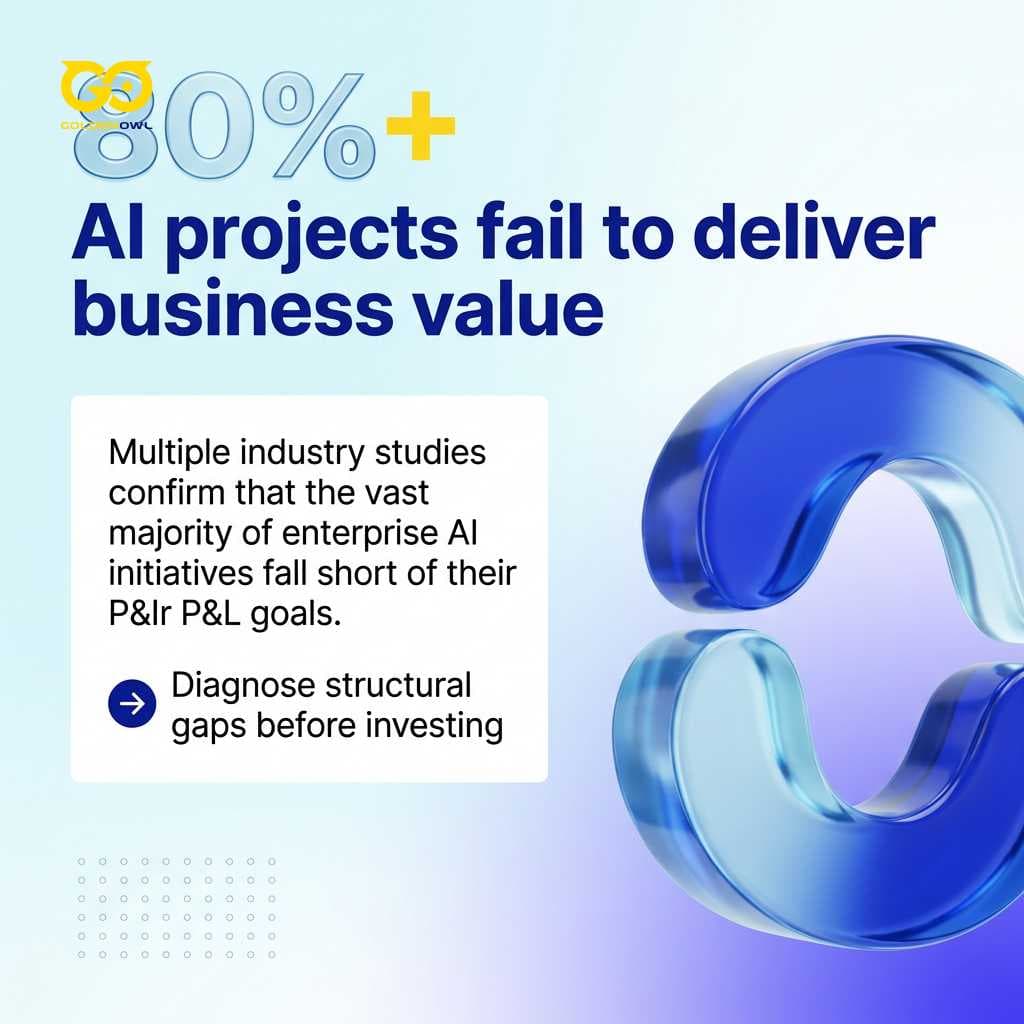
Pin down the true failure rate of enterprise AI before you try diagnosing any operational root causes, because the reality on the ground is far rougher than most leadership teams assume. Behind that widely cited 90% failure benchmark sits an unmistakable consensus confirmed across multiple independent industry studies.
Measure your rollout across three clear attrition gates to see where your pipeline stands. Teams should intentionally scrap at least 50% of initial proofs-of-concept before funding a full pilot, while 40-50% of those surviving pilots must reach production within 6 to 9 months. From there, make sure at least 20% of your live deployments generate documented cost reductions or new revenue within 12 months. When more than 80% of your deployed models fail to move the P&L, you are simply hitting the normal enterprise baseline.
Digging into recent published data shows the sheer scale of this execution gap across corporate deployments:
- More than 80% of AI projects fail to deliver intended business value, roughly twice the failure rate of IT projects that do not involve AI (RAND Corporation, 2024).
- 95% of generative AI pilots deliver zero measurable P&L return, with only about 5% capturing value at scale (MIT Project NANDA, 2025, via Fortune).
- BCG's October 2025 research found that only 5% of companies achieve substantial business value from AI, meaning 95% of enterprise AI investments produce marginal or no measurable impact.
- 42% of companies abandoned most of their AI initiatives in 2025, up sharply from 17% the year before (S&P Global Market Intelligence, 2025).
- More than 50% of GenAI projects are abandoned after the proof of concept (Gartner, 2026).
- Of organizations surveyed, 88% now use AI in at least one function, but only 39% see any EBIT impact. Over 80% reported no meaningful impact on enterprise-wide EBIT despite adoption (McKinsey Global AI Survey, November 2025).
- The average organization scrapped 46% of AI proof-of-concepts before reaching production, and only 48% of AI projects make it into production at all, with an average of 8 months from prototype to production for those that do (S&P Global Market Intelligence, 2025).
- Research from Fullview indicates that 70-85% of AI initiatives fail to meet expected outcomes, and 61% of companies admit their data is not yet "AI-ready".
- A recent PwC survey found only 12.5% of CEOs reported AI delivered both cost savings and revenue growth.
Defining Key Concepts in Enterprise AI
In enterprise software discussions, most confusion stems from four ideas being thrown around interchangeably, and you have to pin down each one precisely before diagnosing why initiatives stumble.
What "Enterprise" Means for AI Initiatives
Nobody agrees on a single standard definition for enterprise across technology circles. For IBM, enterprise-scale AI means durable systems that handle complex organizational setups and stay reliable over multi-year runs. Meanwhile, Google Cloud frames the idea around machine learning that improves major organizational functions at scale across an operation's broader needs.
In daily operations, teams slap this exact label on a 40-person agency and a 50,000-person conglomerate, which causes people to completely misread every published failure statistic.
Figure out your team's real bracket using this four-tier taxonomy:
| Tier | Company Size | Key Characteristics |
|---|---|---|
| Tier 1: Micro and Small | under 50 people | No dedicated IT team, tool decisions made by individuals, AI adoption is entirely informal and driven by personal initiative rather than organizational strategy |
| Tier 2: SME | 50 to 500 people | Emerging tech ownership, no formal AI strategy, some employees using AI independently while leadership remains uncertain about direction |
| Tier 3: Mid-market | 500 to 2,000 people | Has budget and intent, beginning formal AI deployment, at highest risk of pilot-to-production failure where promising proofs of concept never achieve operational scale |
| Tier 4: Large Enterprise | 2,000 or more people | Has data infrastructure and governance frameworks, but organizational complexity becomes the primary barrier to implementation |
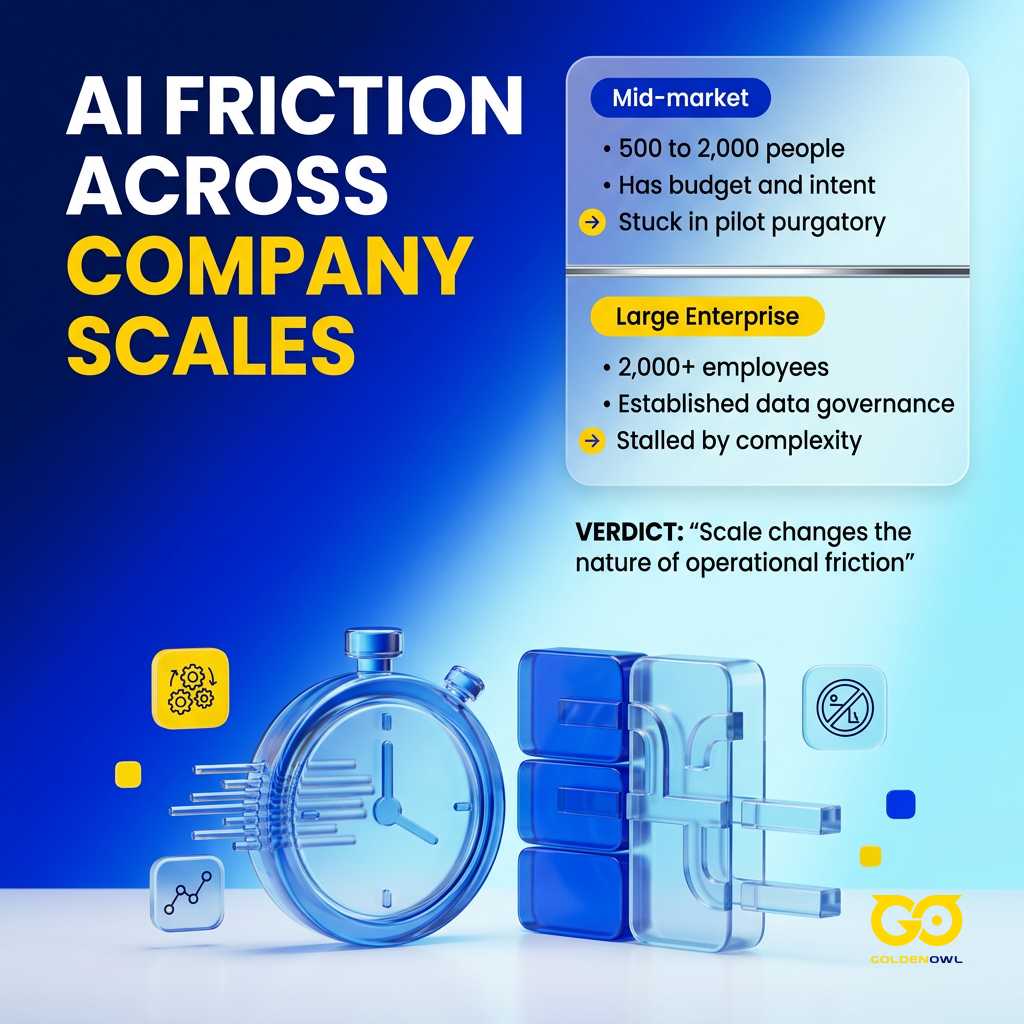
Because benchmark studies from McKinsey, MIT NANDA, and Gartner focus on Tier 3: Mid-market and Tier 4: Large Enterprise players, you can't just drop those stats into Tier 1: Micro and Small or Tier 2: SME operations running 50 to 500 people. A 70% failure rate means totally different operational friction depending on which tier you measure.
The Different Categories of "AI Solutions"
Any enterprise AI roadmap actually spans four distinct setups with completely different budgets, risk tolerances, rollout timelines, and integration work. These tools create fragmented, invisible usage patterns that organizations cannot govern or optimize. To align tools with your internal capabilities, you need to understand these specific kinds of enterprise ai solutions:
- Horizontal AI tools, General-purpose consumer tools such as ChatGPT, Claude, Copilot, and Gemini.
- Vertical AI solutions, Industry-specific tools built for legal, medical, logistics, or financial domains. Horizontal AI: general tools with wide but shallow integration and no company data connectivity. Vertical AI: domain-specific tools with faster ROI if aligned to workflow. Custom AI: bespoke operational solutions with high complexity and heavy data requirements. Agentic AI: autonomous multi-step workflow execution, inaccessible at scale for most Tiers 1-3. These tools create fragmented, invisible usage patterns that organizations cannot govern or optimize. Highest complexity, highest risk, highest potential return. Requires significant data preparation that most organizations underestimate by a factor of three to five.
- Custom AI projects, Systems built or commissioned for a company’s unique operational problem.
- Agentic AI systems, AI that autonomously executes multi-step workflows without human instruction at each step.
Horizontal AI tools
This group covers horizontal consumer apps like ChatGPT, Claude, Copilot, and Gemini. Massive grassroots adoption runs into shallow workflows and zero native company data links, leaving you with disjointed internal habits that leadership can't steer or measure cleanly.
Vertical AI solutions
Specialized vertical tools target legal, medical, shipping, or financial tasks, yielding quick returns once pointed at an existing bottleneck, assuming you match what vendors offer to real day-to-day workflow pain.
Custom AI projects
Custom builds for unique internal workflows deliver major leverage along with heavy complexity, but they demand serious data cleanup that teams routinely underestimate by a factor of three to five.
Agentic AI systems
Autonomous setups manage complex chained steps without someone directing every handoff, yet they remain bleeding-edge software that stays mostly out of practical reach across Tier 1 through Tier 3 operations.
Defining AI Project Success from Productivity to ROI
Why do 49% of organizations rank proving business value as their greatest headache, well ahead of scarce talent or messy data? That struggle happens because outcomes split into three layers, and teams constantly celebrate Layer 1 activity while hoping for Layer 3 financial gains.
Decide which operational layer you are targeting before cutting any purchase orders:
- Layer 1 (Individual): Track saved hours per employee each week, and justify spending with existing software seat licenses rather than custom dev budget.
- Layer 2 (Operational): Track gains in process throughput, error reduction percentages, or cycle time improvements against a specific SLA.
- Layer 3 (Strategic/EBIT): Measure net headcount reallocation, unit cost reduction, or direct top-line attribution, and require finance sign-off on the baseline calculation prior to pilot approval.
A clear view of actual returns requires examining each layer on its own terms:
Individual-level success
An individual employee wraps up tasks quicker, but individual speed rarely moves company numbers without rigid operational structure. For instance, a marketer drafting outbound campaigns 30% faster tells you nothing about customer acquisition costs, conversion efficiency, or top-line revenue growth.
Operational success
A concrete operational loop shows clear gains via faster processing, fewer human mistakes, or verified cost savings across a single routine, which marks the exact boundary where most corporate rollouts halt.
Strategic and financial success
Technology creates genuine bottom-line gains through accelerated sales, permanent overhead cuts, or durable competitive edges. Research by McKinsey reveals that although 56% of organizations run machine learning within at least one business function, only a mere 23% see meaningful earnings growth from it.
Leadership groups write checks expecting Layer 3 financial returns while tracking simple Layer 1 seat activity, so executives end up baffled when small desk-level time savings never show up on the income statement.
The Four Common Types of Project "Failure"
Every project breakdown happens at a distinct operational phase: Never Started, Pilot Purgatory, Deployed But Not Adopted, or No Measurable Impact. Each specific breakdown requires its own post-mortem along with tailored operational fixes:
| Failure Type | Description | Most Prevalent In |
|---|---|---|
| Never Started | The organization knows it needs AI but cannot identify where to begin. Informal AI usage exists but no strategic direction has been established. | Tier 1 and Tier 2 organizations |
| Pilot Purgatory | Pilots show isolated positive results but never graduate to full production. The company cycles through proof-of-concept projects indefinitely. | Tier 2 and Tier 3 organizations |
| Deployed But Not Adopted | The system is built and deployed but employees avoid it, use it inconsistently, or abandon it after initial exposure. This is a people and process failure, not a technology failure. | All enterprise tiers |
| No Measurable Impact | The system is actively used, but no one can demonstrate that it created business value. The ROI question goes permanently unanswered. | All enterprise tiers |
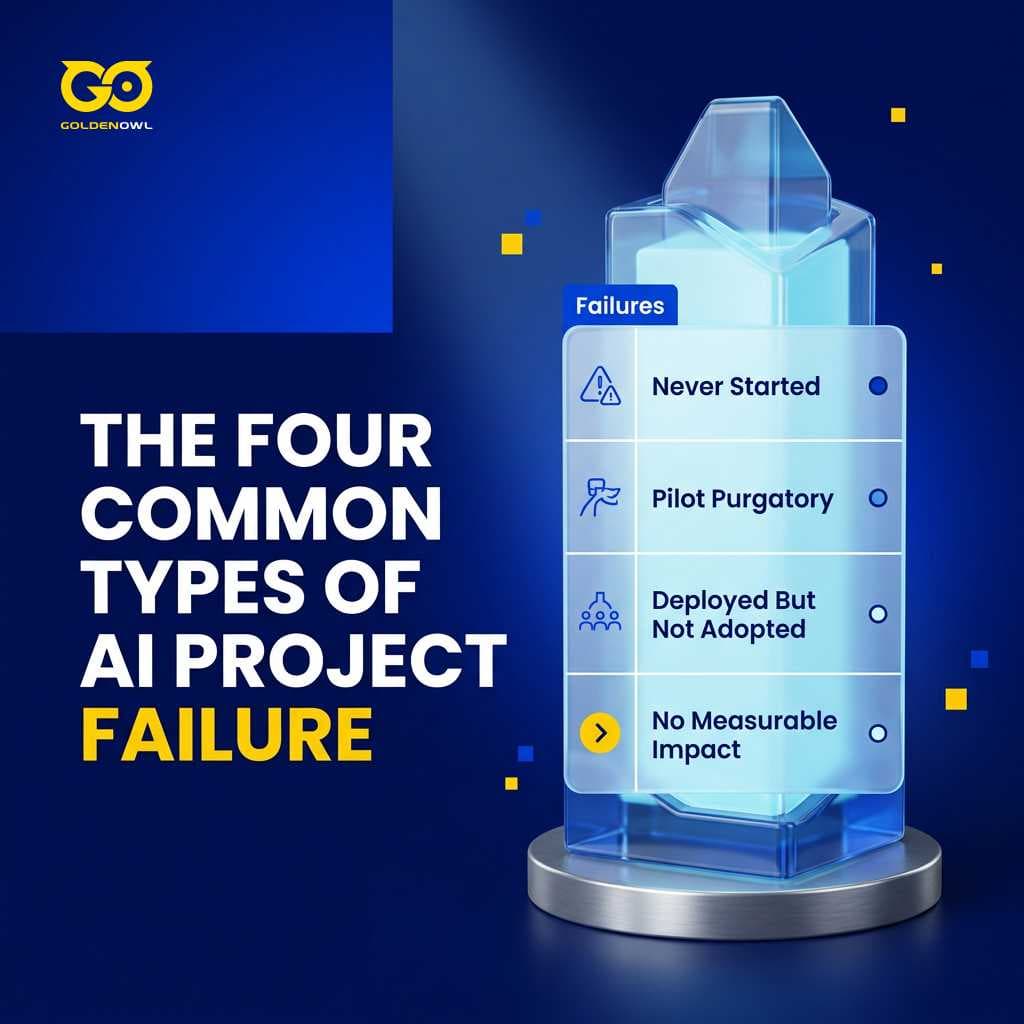
These four stumbling blocks prove that project derailments trace back to predictable operational friction as teams push new tools across changing company scales.
The Core Reasons for AI Enterprise Solutions Failure
Systemic breakdowns across enterprise initiatives compound across high-level strategy, data hygiene, legacy technology, and organizational culture, creating deeply interconnected operational friction points rather than isolated software bugs you can easily patch.
Foundation model capabilities rarely explain why enterprise automation initiatives stall out after early testing. Examine how your team actually operationalizes tools across daily routines before you fault the underlying algorithm. In its evaluation of the 95% failure rate, MIT traced the shortfall directly to organizational learning gaps, a reality corroborated by RAND and Gartner.
Treating machine intelligence like a standard software procurement while managing the subsequent rollout like a conventional product launch is precisely why enterprise deployments collapse before workflows change.
Isolated code bugs or minor technical glitches inside models rarely explain why complex initiatives derail during live commercial execution. Instead, breakdowns reflect repeated strategic errors across industries, driven by the convergence of planning, data, organizational, and integration failures.
While Large Language Models (LLMs) have grown remarkably capable, raw algorithmic capacity rarely prevents an ambitious enterprise rollout from faltering. The collapse occurs at the knowledge infrastructure level, which WorkOS Research describes as the hidden layer sitting beneath the AI.
The most rigorous taxonomy of AI failure causes comes directly from the RAND Corporation in their benchmark 2024 study evaluating collapsed enterprise deployments across industries. Examine their primary categories: misunderstood problem definitions where stakeholders miscommunicate core goals, inadequate training data lacking quality or accessibility, and a technology-first mentality prioritizing market hype over operational fit. Insufficient systems infrastructure prevents reliable production deployment. Finally, teams fail whenever they apply probabilistic software to business problems that completely exceed current technical capabilities.
Strategic and Planning Pitfalls
An unforced rush to adopt generative tools drives the vast majority of enterprise failures, spurred along by board mandates, competitor press releases, and urgent employee expectations. Pushed straight into production without clear success criteria or workflow integration, these implementations collapse under routine operational pressure.
Invisible CEO Matt Fitzpatrick framed this exact adoption breakdown when analyzing why corporate software buyers consistently misunderstand the technology. Markets expect generative tools to behave like simple SaaS where pushing a button works, but real operations require structural redesign.
Market hype routinely celebrates transformative potential while glossing over execution mechanics. Too often, embarking on complex initiatives meant corporate executives acted with only a high-level goal and an ungrounded belief in miracles.
Gartner established this pattern in their April 2026 research, finding that 57% of organizations with failing AI initiatives cited unrealistic executive expectations as the primary root cause behind their stalled technology investments. Scoping demonstrates what is possible rather than engineering what is required to scale.
Forrester warned that corporate leaders remain paralyzed by a lack of understanding, deploying isolated tools with vague operational metrics. Because of this scoping disconnect, 95% of enterprise pilots deliver little to no measurable impact on the corporate P&L.
Hype-driven corporate timelines compound this problem by demanding immediate financial returns from complex platforms that actually require several months of rigorous dataset preparation.
Before choosing vendor technology or training models, the most fundamental failure mode occurs when stakeholders miscommunicate the exact operational problem that machine intelligence needs to solve. Desired outcomes described by business leaders get interpreted differently by technical teams, producing sophisticated systems that fail to map to business-critical objectives.
Gallup revealed in late 2024 that only 15% of U.S. employees say their workplace has actively communicated a clear, coherent AI strategy. A total lack of strategic clarity across the workforce guarantees that problem definition degrades whenever individual pilot projects are scoped.
Early adopters crippled their initiatives by asking what can AI do for us? instead of starting with a concrete, measurable operational bottleneck. Deploying technology without defining concrete operational targets guarantees immediate project drift and failure.
Vagueness ruins operational execution when an executive leadership team simply asks for an AI to improve marketing without specifying the underlying mechanism or workflow touchpoint. The directive never clarifies whether software should generate ad copy, predict customer churn, or optimize ad spend, causing the effort to drift into failure.
Skipping the Discovery and Baselining phase leads straight to stalled pilot programs that lack user alignment or economic justification. Across repeated enterprise surveys, lack of a well-defined use case and unclear business value consistently top the charts of why technology deployments derail.
Workflow redesign must precede any engineering discussion about specific machine learning architectures or tooling. McKinsey confirmed in 2025 that redesigning end-to-end workflows before choosing modeling techniques makes companies 2x more likely to report significant financial returns.
Chasing capability hype over problem fit destroys enterprise technology capital. Across the Gartner Hype Cycle, generative AI sits firmly in the Trough of Disillusionment as of 2025, having crossed the Peak of Inflated Expectations back in 2024. AI Agents occupy the current Peak, indicating that another aggressive round of corporate overinvestment and painful correction is immediately ahead.
A proven formula governs successful resource allocation: 10% algorithms, 20% technology and data infrastructure, and 70% people and processes. MIT and industry best practices documented in 2025 that failure consistently follows when companies invert this ratio, pouring capital into algorithms and tools while completely neglecting the difficult, unglamorous work of operational process and personnel change. Buying tools feels productive; rewiring human workflows requires discipline.

Data and Infrastructure Deficiencies
Even the most advanced reasoning models remain completely ineffective when built upon weak technical foundations.
Deploying sophisticated AI tools on top of fragmented, unstructured, or ungoverned data remains the simple, systemic root cause behind widespread implementation failure.
Data quality represents the most frequent technical obstacle cited across industry. Gartner reports in 2025 that 85% of AI projects fail specifically due to poor data quality or an outright lack of relevant enterprise records. Informatica's 2025 survey ranked data readiness as the top barrier at 43%, with only 12% reporting accessible data. NewVantage reinforced this reality in 2024, demonstrating that 92.7% of corporate executives identify their underlying data assets as the single most significant barrier preventing successful enterprise implementation.
When an organization's data foundation is broken, unreliable, hallucinated, or unusable outputs become inevitable from even the most advanced models.
Expired ingredients pulled from random pantries ruin a dinner no matter how skilled the chef is, and building an enterprise solution on fragmented, low-quality data works in the exact same manner. Disappointment, defects, and untrustworthy results follow regardless of algorithm sophistication.
The quality of training records and the coherence of operational data dictate performance, yet enterprises maintain multiple CRMs, disconnected databases, and conflicting internal business definitions. These fragmented systems reliably produce confident, wrong outputs at massive scale. Constructing a unified data layer serves as the primary operational deployment itself, functioning as the actual core asset rather than a preliminary technical chore handled before rolling out machine intelligence.
As Victor Botev correctly pointed out, deploying an agentic workflow on top of dark data or siloed legacy systems ensures that your pilot never reaches production. Through 2026, Gartner predicts that organizations will abandon 60% of AI projects that remain unsupported by reliable, AI-ready data.
Deploying completed models into production operations requires robust systems infrastructure that traditional enterprises frequently lack. Essential requirements include data pipelines, model monitoring, version control, integration layers, and workflows translating model outputs into operational decisions.
BCG reported in 2024 that only 25% of executives strongly agree their IT infrastructure can scale AI. KLAS Research documented in 2024
Common Failure Patterns by Organization Size and Project Stage
Breakdown points for enterprise AI track directly against your overall headcount and how far you have pushed deployment into daily operational workflows.
Systemic software failures hit businesses of every size, but assuming each team faces identical roadblocks guarantees a flawed diagnosis when operational friction changes completely with scale.
Why Small Businesses Fail Before AI Projects Even Start
Smaller outfits in Tier 1 and Tier 2 rarely see software fail in live production because formal rollouts never leave the ground. Staff members experiment on their own with unvetted tools, leaving your company with zero shared operational value.
Formal uptake among small businesses reached just 8.8% by August 2025, rising from the 6.3% recorded in 2024 as it approached the 10.5% benchmark typical of large enterprises. Beneath that formal number sits massive shadow usage where workers duct-tape their own fixes. Staff members paste internal data into personal apps, feed screenshots to ChatGPT, and run manual shortcuts because standard tooling ignores their actual workday.
Industry data shows the scale of this confusion: while 98% of small businesses use some type of AI tool, 62% state that its tangible commercial advantages remain unclear to them.

Small companies hit three specific operational roadblocks:
- Awareness: Most small business owners do not clearly understand the benefits of AI, which blocks informed strategic decisions about where and how to apply it.
- Tool fragmentation: Different employees use different tools without any shared standard, making collective organizational benefit structurally impossible even when individual productivity improves across desks.
- Data access: Employees using general-purpose AI tools have no secure connection to company data, meaning generated results remain generic rather than contextually relevant.
The "Pilot Purgatory" Phenomenon in Mid-Market AI Projects
Mid-market operators run headfirst into Pilot Purgatory despite having the capital, clear intent, and technical chops to evaluate serious tooling. Controlled tests produce encouraging early numbers, yet their initiatives consistently fail to cross over into live operational production.
Getting trapped in endless evaluation burns massive cash across growing firms. S&P Global Market Intelligence found that scrapped enterprise AI projects averaged $7.2 million in sunk costs in 2025. This is especially pronounced in financial services, where firms sustained heavier losses. Tossing preliminary work is routine operating behavior, with companies binning 46% of their prototypes before deployment. Even a five-minute delay creates cascading operational damage; by the time the manager saw the document, the damaged batch was already boxed for shipment.
Taking a generative model from early intake into production burns between 6 and 18 months of drag for 56% of organizations. Citrix research reveals that nearly two-thirds of leadership teams struggle with this handoff, echoing an enterprise CIO who audited dozens of internal demos and found only one or two genuinely practical systems. The rest were science experiments.
Catch pilot purgatory before it drains capital by tracking three warning signs:
- Timeline slippage: The pilot sits in sandbox testing for over 90 days without processing any live production data.
- Moving success goalposts: Engineering leads hit initial accuracy thresholds, yet deployment stalls pending vague security or internal data integration prerequisites.
- Sponsor detachment: The business unit sponsor stops attending weekly check-ins, leaving technical leads to champion production approvals completely alone.

Mid-market deployments stall out for five specific operational reasons:
- The problem inversion error: Companies decide they need AI because peers use it, then look around for an internal problem to attach the tool to, a backward sequence that guarantees failure. For example, one retail client demanded a predictive analytics engine but went silent when asked what to predict, because their real operational bottleneck was forecasting regional shipping delays rather than purchasing generic predictive capacity.
- Data unreadiness: Mid-market records remain siloed across departments, inconsistent in format, and incomplete in coverage, which means models trained on bad records quickly make bad operational decisions. Before testing algorithms, audit your database schemas and allocate 30 to 40% of the pilot timeline to data preparation alone.
- The integration trap: AI deployed as an isolated island outside normal decision workflows remains accurate but completely useless, as seen when one quality control model hit 99% defect detection accuracy but delivered its findings via PDF with a five-minute delay. By the time the factory floor manager opened the report, workers had already packaged the faulty batch, proving that the underlying algorithm functioned while the delivery architecture failed.
- The UX and adoption gap: Interfaces built for data scientists instead of daily operators get abandoned immediately, which means you must dedicate real engineering cycles to interface design so that front-line workers actually adopt the software.
- Perfection paralysis: Waiting for 100% accuracy before deployment means you never deploy anything, whereas an 85% accurate model that automates 50% of a tedious manual process delivers an immediate operational win.
Architectural Missteps Causing Failure in Large Enterprises
Enterprise giants hold the largest budgets, deepest technical teams, and richest data reserves, yet post the worst production records. If you map their attrition rate across corporate stages, the drop-off is brutal. According to 2025 MIT NANDA findings, AI assessments occur in 60% of large corporations and 20% launch pilot programs, but mere 5% achieve full production with verified returns.
Broken foundational architecture causes the vast majority of these large corporate collapses:
The third-party overlay model: Business context evaporates the moment your architecture rips live records out of transactional systems and dumps them into an external data lake. Severing ties between operational hierarchies, business logic, and transactional history breaks core workflows. Once you pull information away from your ERP and CRM platforms, rebuilding those lost operational relationships outside the source requires millions in continuous maintenance.
Look at Volkswagen and its dedicated software unit, CARIAD, to see what happens when you paste software over fragmented legacy infrastructure. Tasked with uniting code across 12 VW Group brands, CARIAD tried to force one shared architecture over conflicting platforms inherited from Audi and Porsche, which relied on over 200 disconnected suppliers who never coordinated their work. Between 2022 and 2024, CARIAD piled up $7.5 billion in operational losses against just $3.5 billion in revenue, bleeding an astonishing $2.64 billion in 2024 alone. Architecture failures pushed back rollouts for the Porsche Macan Electric and Audi Q6 E-Tron by a full year. Persistent bugs across the VW ID.4 and ID.5 sparked executive turnover alongside 1,600 layoffs. In the end, leadership handed $5.8 billion to Rivian to get working architecture that bypassed CARIAD completely.
Governance and compliance gaps: Permissions and security policies have to live natively inside your data layers rather than getting bolted on as an afterthought. Today, 64% of large enterprises lack the foundational infrastructure needed to run compliant, reliable AI workflows.
Organizational inertia: Cultural friction derails most enterprise deployments before software ever takes root. Department heads almost never oppose tools publicly; they simply ignore them until rollout initiatives suffocate. Internal resistance blocks progress for 87% of corporate leaders, and while 26% have appointed a Chief AI Officer, those leaders rarely hold the budget authority needed to break organizational gridlock.
Ensuring AI Project Success
Experienced operators get real results out of artificial intelligence by confronting ground-level operational snags before writing code.
McKinsey & Company highlights three shared habits among top performers: they build internal knowledge infrastructure, enforce strict governance and quality checks prior to scaling, and build purpose-built data foundations designed for agentic reasoning and high-precision extraction. Working deployments follow an orderly playbook. You wire capabilities directly into everyday workplace software, feed the system durable context, root it inside an active daily workflow, and route each individual task to the right model.
Data from the MIT NANDA Initiative shows that rapid revenue acceleration shows up in only 5% of corporate pilots today. Hiring an ai solutions company yields a working deployment roughly 67% of the time, whereas internal engineering teams hit their mark only one-third as often.
Three core rules dictate execution across every tier. Tie every project to an acute, painful business problem rather than an open-ended technology mandate. Frontline employees always move faster than corporate policy, and staff members who have already figured out how to use these tools effectively will give you the clearest read on what actually works.
Start with a Clear Business Problem and Realistic Scope
Delivering measurable bottom-line value requires clear ground rules when you scope an initiative:
- Successful enterprise AI starts with a clearly defined, repeatable process rather than an open-ended capability goal.
- Define the problem in operational terms before evaluating any technology: document the specific workflow, the specific decision, and the specific outcome that AI will improve.
- Setting measurable success criteria before pilots launch, using specific performance thresholds tied to defined business processes instead of aspirational outcome goals, marks the structural difference between organizations that graduate pilots to production and those that quietly discontinue them.
- Pick a recurring, multi-step task and let AI do it end to end, with a human approving the steps that matter.
- Start narrow, measure rigorously, expand from proof: resist the pressure to pursue enterprise-wide transformation, solve specific, well-defined problems with measurable outcomes, and expand from proven results.
- Score all candidate AI use cases on two dimensions: business impact and technical feasibility; only pursue use cases that score strongly on both.
Build a Purpose-Built AI Data Foundation
High performers treat internal knowledge systems as an urgent operational priority. Across any enterprise, stitching live records together across legacy software environments creates the true foundation you need to generate meaningful financial returns.
A purpose-built data foundation closes the gap between messy operational archives and reliable model outputs. You need this connective tissue to pull structured databases and unstructured documents into an environment your models can query. Instead of patching old data warehouses, winning organizations roll out modern data foundations tailored for agentic reasoning and precision information retrieval.
Auditing your data readiness requires the same relentless scrutiny you bring to formal financial due diligence. You have to inspect access permissions, data quality, governance guardrails, and pipeline integration points before signing vendor agreements. Running a comprehensive data audit before building anything confirms what is clean, accessible, and complete, cutting off pilot failures before they start.
Direct integration drives your return: companies with tight data connections generate a 10.3x ROI, whereas teams wrestling with fragmented data manage only 3.7x.
Prioritize Deep Integration and Human-AI Partnership
Sustainable execution comes down to a straightforward rule across your operating workflows. Stop building isolated tools that force workers to bounce between windows, and embed automated actions straight into their primary software to augment human capacity instead of trying to replace it.
Connect to existing enterprise tools: Hooking models directly into existing operational software lets them read live files and run updates across production systems. Keeping day-to-day work inside active pipelines keeps human judgment attached to critical decisions, which keeps you from getting stuck in an isolated chat interface nobody opens.
Embedded workflow intelligence: Placing machine intelligence inside active daily tools keeps institutional context intact and wipes out expensive technical rework. Real business value comes from putting intelligence inside live production routines rather than standing up a disconnected chat window.
Human-AI collaboration model: Use software to amplify human decision-making instead of trying to automate people out of their jobs, letting algorithms chew through volume while experienced staff resolve tricky edge cases and handle messy judgment calls. In one case, catalog enrichment across 50,000 dormant items generated a 9x ROI for a Big 4 retailer because merchandisers guided category priorities and refined the data logic in real time.

Establish Early Governance and Rigorous Evaluation
Governance works best when it clears paths: protect the operating environment instead of locking down individual tools, because teams adopt rules that speed up delivery and route around controls that stall their day.
Setting up baseline rules early saves months of circular committee debates before your engineers write a line of code. Deploy dedicated ai governance solutions to lock down clear data privacy guardrails and baseline security requirements before launching any trial. High-performing teams establish strict compliance gates and quality checks before expanding their footprint, which explains why smooth corporate rollouts routinely enjoy direct CEO backing.
Define hard production benchmarks before kickstarting any pilot, and evaluate final operational performance strictly against those initial launch targets, even when the resulting scorecard makes people uncomfortable.
Regulatory scrutiny is creating massive balance-sheet exposure for sloppy rollouts. Under European Union rules taking effect in August 2025, enterprises running general-purpose AI must satisfy strict transparency, risk testing, and security mandates, backed by non-compliance penalties that can reach up to 7% of a firm's global annual revenue. These statutory rules force leadership to bake auditing, automated fail-safes, and human review directly into the architecture.
Adopt an Incremental, Hybrid Approach
Aggressive automation roadmaps hit a wall the moment client conversations turn messy. After claiming automated systems handled the workload of 700 customer service staff, Klarna changed direction in 2025 by putting human agents back on high-tier accounts because customers wanted genuine human attention. Commonwealth Bank took the same path in Australia: after rolling out its Bumblebee virtual assistant and signaling 45 job cuts, executives brought those employees back and pivoted the bot toward monitoring fraud.
Watching those public missteps, the top 20% of corporate adopters take a disciplined middle road focused on steady augmentation rather than head-count cuts. Automated systems tackle high-volume tier-one inquiries, while complicated exceptions get passed directly to experienced staff equipped with AI support.
Rolling out new systems in sequential phases helps teams catch design errors early, resulting in 35% fewer critical production bugs than big-bang enterprise launches.
Manage Costs and Measure for True ROI
Protecting capital requires rigorous cost controls and honest tracking against actual cash returns:
- Match the model to the task, routing simple work to fast, cheap models and hard work to frontier models, so cost does not kill the project before it scales.
- Route each task to the right model so quality stays high at roughly 80% less than frontier API rates.
- Organizations must either design around static pricing (e.g. on-prem solutions) or develop prompt governance to manage variable usage-based API charges.
- Allocate resources according to the 10/20/70 model: 10% algorithms, 20% technology and data, 70% people and processes. If the budget allocation does not approximate this ratio, the project is likely technology-led rather than outcome-led.
- Align metrics with strategic and financial success (Layer 3), tracking direct bottom-line impact through revenue growth, significant cost reduction, or documented cost savings rather than isolated individual speedups.
- Set a 60-day measurable result target for the pilot: if results cannot be defined and measured within 60 days, the problem scope is too broad.
Split your capital across three specific buckets when drafting your pilot budget: allocate 10% to fine-tuning and model API queries, dedicate 20% to vector databases, storage infrastructure, and system connectors, and reserve 70% for workflow redesign, interface integration, change management, and team training. Skimping on change management ruins promising deployments. Pouring over 40% of your budget into software licenses leaves your project structurally starved of the enablement work required for daily adoption.
Invest in Talent, Culture, and Internal Capability
Long-term operational success requires systematically building internal capabilities across your organization:
- Organizations with strong data literacy programs show 35% higher productivity and 25% better decision quality.
- Build capability, not dependency: ensure that every AI initiative includes explicit capability transfer milestones so the organization can operate, maintain, and extend the solution independently within a defined timeline.
- Build a cross-functional team that includes a business problem owner, a data engineer, a systems integration developer, and an end-user representative from the affected department.
- Give employees secure access to company data through their preferred AI tools rather than forcing adoption of an approved tool they will not use.
- Scale what already works: when an individual worker creates measurable value with AI, make that workflow shareable, documented, and institutionally sanctioned.
- Evolve existing job roles into supervisory positions rather than executing hasty cuts, recognizing that businesses cutting staff prematurely often lack the talent needed to manage and oversee AI.
Understanding Failure from Multiple Perspectives
Enterprise stakeholders diagnose broken rollouts through completely separate lenses, requiring leaders to map each viewpoint to spot real breakdown points. Put together, these operational perspectives prove that systems fall apart because of sociotechnical friction, unearned executive confidence, and misaligned incentives instead of simple machine errors.
The Management and Executive Perspective
Ultimate accountability landed directly on C-level leaders and division heads who framed artificial intelligence as an existential mandate. Across executive suites and boardrooms, irritation grew as return on investment flatlined and projected efficiency gains never actually showed up on the balance sheet.
Survey data from PwC showed that only 12.5% of CEOs saw their deployments produce both lower costs and higher top-line growth. At the portfolio level, this gap widens when leadership allocates capital against high-level financial targets while measuring personal convenience. A manager spots personal productivity gains, expands departmental spend, and later discovers that no one can prove aggregate enterprise value.
Senior operators now follow an obvious rule: rollout roadmaps for automated tooling must meet the same strict engineering standards you require for core ERP or CRM systems. To navigate deployment hurdles, leadership teams bring in outside advisers alongside newly minted AI Chiefs of Staff.
Yet the Chief AI Officer seat, already present across 26% of large enterprises, usually operates without the budget control or operational authority required to knock down organizational roadblocks.
The Technical and IT Perspective
Engineering departments bore the brunt of integration headaches, raising red flags that internal pilots were just polished prototypes running without real production infrastructure beneath them.
Down in the weeds, infrastructure architects tackled hardware shortages, bandwidth bottlenecks, and memory ceilings that executive sponsors ignored during initial planning. Early prototypes stalled before reaching production because no one budgeted for scalable compute capacity, and sudden spending cuts pulled resources before IT could stabilize the systems. At the same time, strict regional privacy mandates pushed security groups to lock down access, strangling pipeline feeds.
System readiness poses a huge operational hurdle, since 64% of enterprises still lack the underlying architecture necessary for stable day-to-day operations. When you rip records out of source applications and dump them into external storage lakes, you strip away operational hierarchies, audit histories, and business context, creating an expensive secondary layer that engineering teams cannot keep running. That chronic headache pushes technical groups toward zero-copy patterns and unified data fabric designs where queries run against primary databases directly.
The Employee and End-User Perspective
On the ground, frontline workers felt these hurried deployments as constant friction and personal career anxiety. Staff watched coworkers get laid off or woke up to find essential operational software replaced without warning. Across banking and retail, customer service agents pushed back against routing callers through clumsy bots, leading union officials in Australia to demand that employees help shape workplace change instead of being sidelined by it.
Black-box screening setups triggered intense friction across hiring pipelines, with applicants comparing automated interviews to dating a robot and describing the dynamic as completely dehumanizing.
Internal pushback runs deep, showing up clearly when 31% of workers admit to undermining enterprise AI plans by dragging their feet, feeding tools corrupted data, or ignoring them outright.
Operators on the floor routinely move faster than corporate rules, spinning up shadow workflows whenever approved systems fall short. Staff paste client files and upload corporate screenshots into private $20 monthly ChatGPT seats to get actual work done while leadership spends consecutive quarters waiting for perfect enterprise agents.
The Regulatory and Legal Perspective
Government regulators view broken deployments as open invitations to step in, demanding strict compliance after publicized breakdowns at ICE and expensive settlements from SafeRent.
Regulators banned several high-risk tools outright as the first round of the EU AI Act went live in February 2025. Approaching enforcement dates triggered thorough internal audits once corporate attorneys realized that rogue employee pilots could draw statutory fines reaching up to 7% of global turnover. Meanwhile, data protection agencies started checking whether training corpuses had been stripped of private customer records, spurred by widespread pushback against Microsoft's Recall.
Model bias exposes standard business workflows to immediate financial liability. Regulators in Massachusetts proved that risk plainly. SafeRent resolved a 2024 class-action lawsuit targeting discriminatory housing screens with a $2.2M settlement and binding limits on its tenant scores, establishing that organizations remain liable for algorithmic damage even when a human employee checks the final approval box.
The Society and Market Perspective
Broad market optimism has cooled off quickly, with headlines pivoting away from frontier research models toward messy, expensive rollout failures.
Wall Street watchers now openly compare modern valuations to the late-nineties dot-com boom, warning that speculative pricing guarantees a sharp market correction. Capital allocators pulled back hard after MIT published failure figures, erasing nearly $1 trillion in market capitalization from sector equities.
Enterprise buyers still encounter relentless marketing for new capabilities, yet seasoned operators refuse to let automated tools make unverified decisions without mandatory human oversight. This skepticism creates intense demand for auditable execution paths and deterministic safeguards, redirecting budgets straight toward enterprise compliance, validation frameworks, and operational governance tools.
Future Directions and Opportunities Arising from Failure
Failed rollouts across the industry are already reshaping how your team tackles enterprise AI deployments, and they're altering where the whole software ecosystem heads next:
- Stronger Integration and Platforms: Enterprise computing is shifting away from training novel models from scratch toward deploying platforms that embed AI “within the work”. In practical setups, your teams will use LLM-powered assistants to retrieve and cross-reference records across CRM databases, ERP tables, and help-desk tickets within a single query. Making that work requires you to structure your data warehouses and APIs specifically for model consumption. Software startups and established vendors are targeting this exact integration layer, establishing “intelligence grounded in connected systems of record” as the baseline standard for your stack.
- Governance and Ethics as Core: Directives in the U.S., specifically FDA guidelines and NIST AI rounds, combined with aggressive moves by the EU, make ethical AI mandatory rather than optional for your roadmap. Just as you manage critical IT assets, your organization must invest directly in documentation frameworks like data provenance and model cards. Regulators have backed their rules with serious muscle, setting potential fines reaching 7% of global turnover, which would amount to $4B for a company like Google. Global insurers and government bodies will actively enforce these operational standards across your industry. Instead of reacting after launch, build in fail-safe checks and run ongoing incident response drills with bias-detection algorithms, live oversight of model outputs, and permanent human-in-the-loop controls.
- Revised Costs and ROI Expectations: Operating budgets are replacing one-off software licenses across corporate financial plans, forcing you to account for continuous model retraining, system maintenance, and variable computing. To control unpredictable API usage costs, your leadership must select either static on-prem installations or active prompt governance frameworks. CFOs now demand granular ROI projections and marathon-style project timelines before committing capital. Under this fiscal discipline, pilots receive deeper funding and more calendar runway, with performance judged on concrete metrics like revenue growth, operational savings, and customer retention rather than simple seat engagement.
- Talent and Culture Transformation: Managing human dynamics remains a permanent requirement when you introduce AI into your organization. Defining specific team roles and training employees is just as necessary as picking an AI model. Formal training programs, cross-disciplinary groups, and AI councils will soon become standard organizational units. Certain industries will see brand-new job titles surface, including data whisperer and AI ethicist. Slashing payroll would be right if software operated without errors, but retaining your staff and transitioning them into AI supervisors yields far better results than cutting workers. Pushback against sweeping layoffs proves that replacing human labor with bots is losing favor across leadership. By late 2026, justifying capital allocation purely through headcount reduction will be viewed as an explicit red flag by investors.
- Focus on Incremental and Hybrid Models: The 20% of organizations achieving real adoption prove that incremental augmentation provides a durable path where wholesale worker replacement failed. For example, Commonwealth Bank of Australia (CBA) pivoted its fraud detection workflow to combine models with human investigators, while Klarna structured its customer support to pair automated assistance with direct human escalation. Tomorrow's operating design relies on these hybrid teams, delegating repetitive, high-volume tasks to algorithms while reserving your experienced people for ambiguous edge cases. Under this division of labor, basic customer inquiries run through predictive models, and complex disputes route immediately to human representatives backed by real-time machine intelligence.
- Vendor and Ecosystem Evolution: Mixed deployment results will steer your company toward boutique vendors and focused consultancies rather than default big-tech contracts. Projects executed with specialized AI providers delivered a 2/3 success rate, contrasting sharply with the 1/3 success rate achieved by internal teams. Enterprise buyers will increasingly purchase pre-integrated, domain-specific modules built expressly for vision, finance, or search. Vertical LLMs, such as SAP handling tabular data, alongside models trained around strict regulatory compliance, will anchor this transition. At the infrastructure tier, software startups will supply your developers with specialized prompt engineering frameworks, dedicated API management tooling, and centralized AI governance platforms.
- Regulatory and Social Implications: Rapid shifts in legal statutes and public trust will fundamentally alter how your company runs production algorithms. Early implementation failures have forced corporate executives to take direct operational ownership of their automated outcomes. Mounting litigation and heightened regulatory discovery demands will hold your leadership strictly accountable for algorithmic transparency. Precedents in housing discrimination cases already establish that your firm faces direct liability for algorithmic harm even when a human employee signs off on the automated finding. Before you clear an automated workflow for production, document the complete decision trail and audit the underlying models to the exact standards expected in financial audits.
- Opportunities Arising from Failure: Valuable competitive advantages are opening up for organizations that study these early implementation missteps and adjust course. Measurable ROI was captured by the 5% of projects that targeted concrete, high-friction operational bottlenecks, such as eliminating repetitive manual labor, rather than launching generic chatbots. In Australia, a major bank shortened software testing cycles and accelerated production release dates by applying GenAI directly to developer pipelines. Pharmaceutical manufacturers achieved similar operational gains by applying models to streamline internal compliance auditing. Winning teams capture these efficiencies by coupling algorithms directly with deep domain expertise, measuring progress through saved operational hours and verified error reductions instead of vanity adoption scores.
Key Takeaways for a Successful AI Strategy
Treat high implementation failure rates across the industry as your direct operating manual for building durable value in your own business:
- Acknowledge the systemic baseline: Between 70% and 90% of enterprise AI projects fail to deliver their intended value, making failure the statistically dominant outcome of AI investment. That breakdown is almost always organizational before it becomes technical, rooted in your operating strategy and daily workflow integration rather than model capability.
- Start with the business problem, not the model: Every successful project you run begins with a specific, painful business problem you face daily, not a decision to adopt AI. In practice, organizations reporting significant financial returns are 2x more likely to have redesigned workflows before you let teams select any AI tools.
- Prioritize data foundations and systems integration: Deploying software over fragmented, unstructured, or ungoverned data ensures pilots collapse before production. Building a unified data layer is your actual AI deployment rather than an isolated setup task. Connect directly to the tools where work already lives so your models operate with full business context.
- Follow the 10/20/70 resource allocation model: Structure your capital deliberately by committing 10% to algorithms, 20% to technology and data infrastructure, and 70% to your people and business processes. Neglecting change management and human workflow integration is the fastest route to shelfware.
- Build permanent capability over consulting dependency: Renting external capability creates brittle implementations and dependency traps where project momentum leaves with the contractor. You must require explicit internal capability transfer milestones on every initiative to ensure your team maintains long-term operational autonomy.
- Empower and learn from the frontline workforce: Across your organization, individual workers are already finding ways to leverage AI tools to solve operational bottlenecks. Align your corporate governance directly to secure and scale what your frontline workforce is already proving works in practice.
Recent corporate blunders prove that your returns depend entirely on disciplined problem scoping and purpose-built infrastructure. When you lock down that internal alignment alongside your machine learning stack, you stop systemic enterprise failure for good.
Run this framework and you hold a battle-tested roadmap for putting machine learning to work without repeating common corporate mistakes. Real execution comes down to wiring targeted tools directly into daily workflows, cleaning up data pipelines, and standing up internal teams that own the systems. Once you stop chasing frontier algorithms and eliminate the root causes of AI enterprise solutions failure, your deployment locks in durable productivity gains.
Share this page


Table of Content

Subscribe to Golden Owl blog
Stay up to date! Get all the latest posts delivered straight to your inbox