
How to use AI in real estate: automate lead follow-up, speed up valuations and marketing, and keep every step compliant with Fair Housing rules.


Choosing Between a Forward Deployed Engineer vs Product Manager
Oct 12, 2026
about 8 min read

Forward deployed engineer vs product manager: compare ownership, skills and career paths to decide which role fits your team.
The forward deployed engineer vs product manager decision starts with a tension most teams have felt: a product can work perfectly as code and still fail to fit a customer’s business.
A proof of concept shows both sides of it. It wins the enterprise over, and if it quietly stays in production, the technical debt piles up. Read on for how the two roles split scope, skills and daily work. By the end you should know which hire fits the bottleneck in front of you.
Forward Deployed Engineer vs Product Manager Core Distinctions
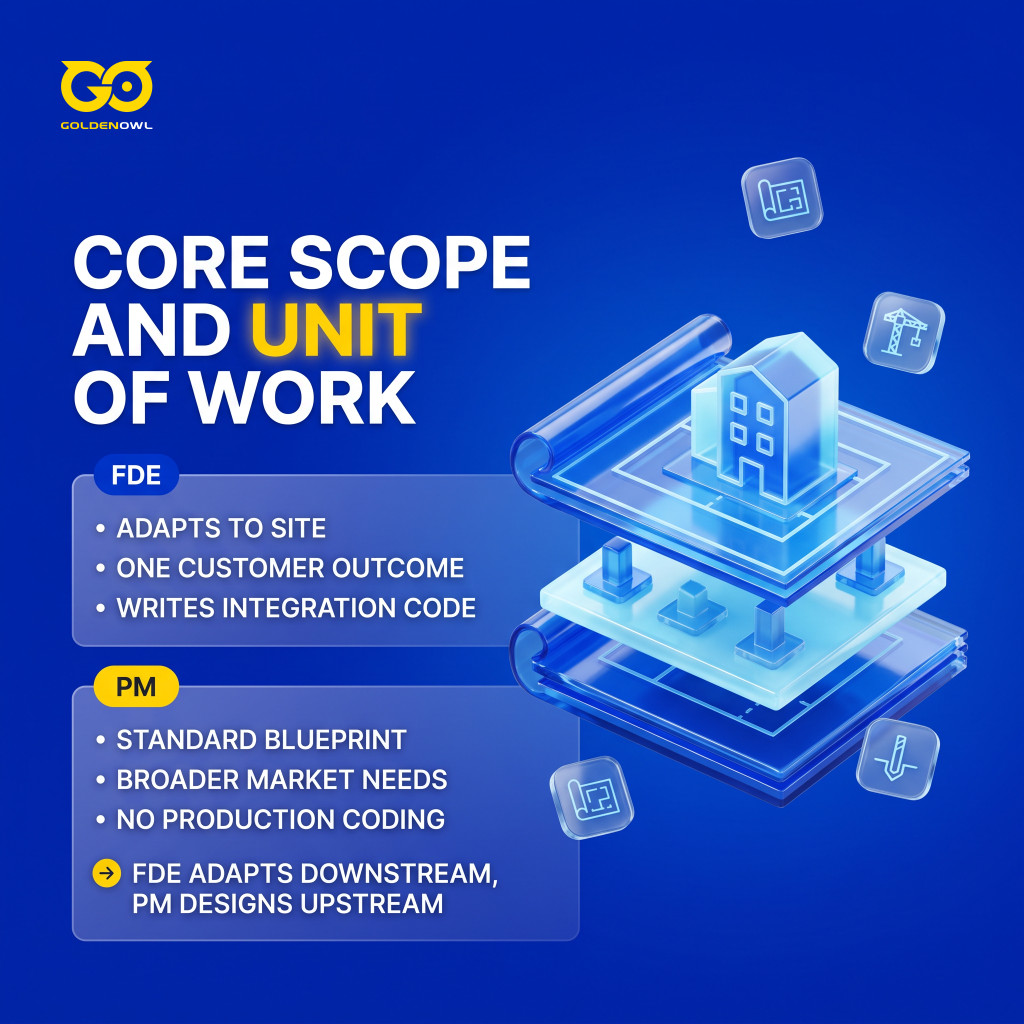
The cleanest line between them is scope. A Forward Deployed Engineer makes one deployment deliver the outcome a single customer defined. A Product Manager looks at the whole product and asks what serves the wider market. You’ll find both in customer meetings, though, and both leave fingerprints on the roadmap.
The difference shows up the moment a product enters a customer’s operation. It arrives with that customer’s data and workflow, and with its own reasons the plan might fail in practice. Forward Deployed Engineers work downstream from the code there. Product Managers work upstream.
Scope of Impact
An FDE has a deep, immediate impact on one enterprise client. A PM’s decisions can reach thousands or millions of users.
The FDE’s job centers on making one client successful. Say a major bank needs a custom machine learning pipeline wired into its systems. The FDE builds it.
A PM’s reach is bigger, because one feature can serve thousands or millions of users. That’s why the product can’t be tailored to a single client: it has to stay broad enough for a massive market. So the PM sets requirements for the whole product, and the FDE adapts the implementation to one customer’s systems and constraints.
Technical Depth and Code Ownership
Often the FDE’s code is the glue between the core product and a client’s legacy systems. That’s integration for one customer, not core-product development. The skills start with software engineering: a language like Python, Java or C++, and a grasp of system design. Python used in real-world data pipelines is an especially useful skill. Data engineering counts as much, from SQL and ETL processes to cloud infrastructure on AWS, GCP or Azure.
PMs typically don’t write code. Their days go to market research and product strategy. They define features, too, and they keep engineering, design, marketing and sales pointed the same way.
Forward Deployed Engineer Role
A Forward Deployed Engineer (FDE) is a highly skilled software engineer. The job is to work directly with customers, often on-site, deploying, integrating and customizing a company’s software. The name comes from the military, where forward-deployed units sit on the front line. These engineers do the same in a client’s business operations.
Production System Architecture and Integration
Making a product work inside a client’s infrastructure takes integration work and troubleshooting, and FDEs do both right in the client’s environment. On the integration side, they write custom APIs, connectors and scripts so the core product works with what the client already runs. On the troubleshooting side, they debug deployment issues on-site, often under tight deadlines.

Rapid Prototyping and Proof of Concept Delivery
FDEs build proofs of concept (PoCs) quickly, because a working PoC can show a client the product’s value. It also surfaces real constraints early and can secure enterprise buy-in. The catch is what happens next. If the PoC is expected to stay in service as production infrastructure, the team can end up with severe technical debt.
Product Manager Role
Product managers take the broad view of things. They read user behavior to set success measures, and they steer the roadmap toward needs the market will pay for. Profit belongs inside that definition of success.
Product Strategy, Roadmaps, and Cross-Functional Alignment
The PM’s job is to connect long-term vision to priority calls, and priority calls to roadmap features. The vision has to line up with company objectives first. After that, customer feedback, market research and technical feasibility decide how features get ranked. In practice the PM tries to understand the problems agent builders face as a group. From there come the strategic priorities and the roadmap, and then SDKs, APIs and features built with research and engineering.
Doing that means aligning engineering and design, even though neither team reports to the PM.
Multi-Customer Feature Prioritization
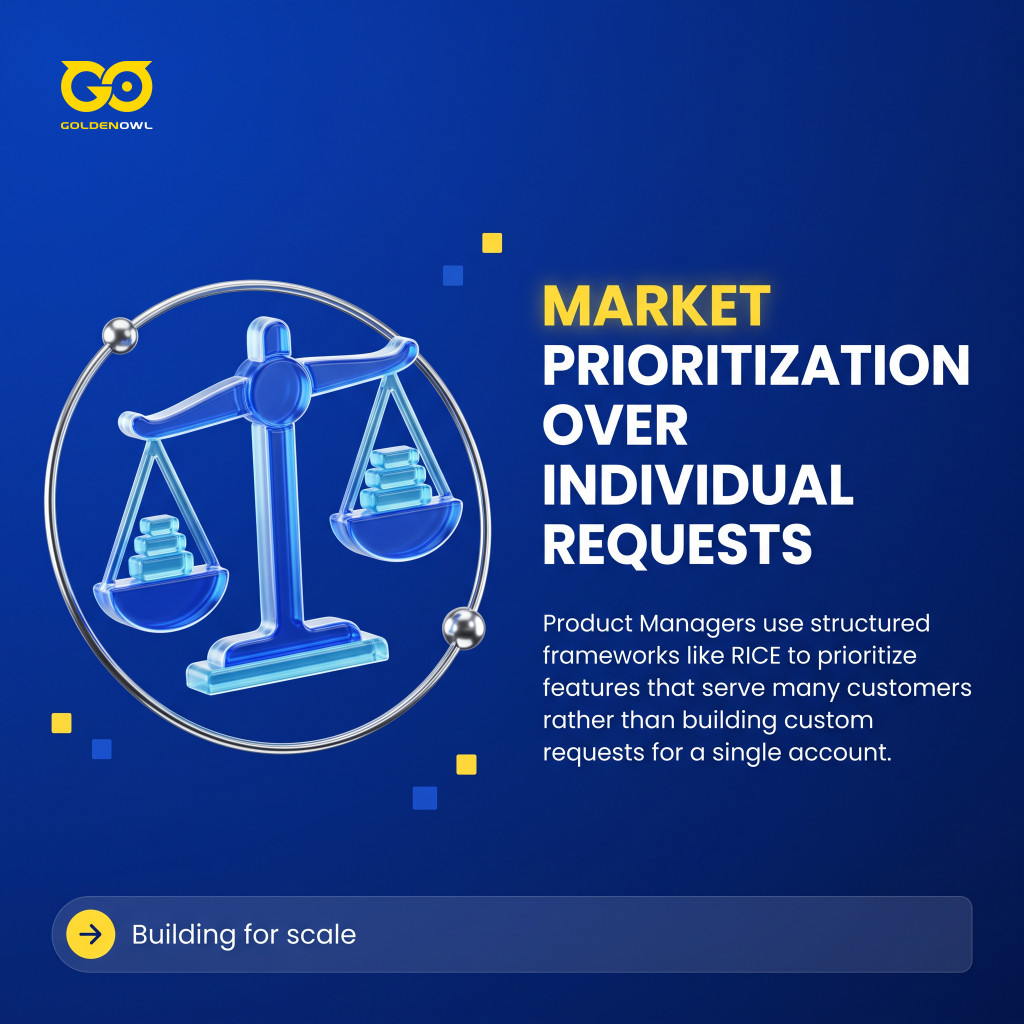
To rank what comes next, a PM can lean on frameworks like RICE: Reach, Impact, Confidence and Effort.
Now picture one feature that has to work for many customers. Someone has to own the shared design that lets it serve all of them, and someone also has to own the abstraction behind that design. A forward deployed engineer focused on one account isn’t the right person to make that product-wide call. The PM is, and the PM has to guide engineering and design teams without directly managing them.
Skills Breakdown Across Roles
Engineering and Distributed Systems Competencies
Read the Frontier Agents Engineer posting under Forward Deployed Engineering and you can see the technical skills a deployment engineer needs. They include programming and systems fundamentals, plus tools for working inside customer systems.
The posting asks for "strong Python programming skills" and fundamentals in distributed systems and system design. Docker and Kubernetes are on the list too, along with infrastructure as code and CI/CD. The day job is building agent runtimes and integrations directly inside customer systems, along with tracing and eval harnesses.

Product Judgment and Strategic Prioritization
A platform PM has to set the order of work without complete information, and avoid thrashing. PM postings also ask for years of shipped products.
Here’s a typical choice. One customer asks for a feature, while other work would solve a problem agent builders face as a group. A PM weighs how broadly each need applies, what customer feedback and market research support, and whether engineering can deliver it. The question isn’t which request is loudest. It’s which outcome deserves priority.
An FDE who moves into product work needs sound prioritization too, along with the discipline to turn down a paying customer.
Hiring Decision Framework
The 90-Day Inaction Test
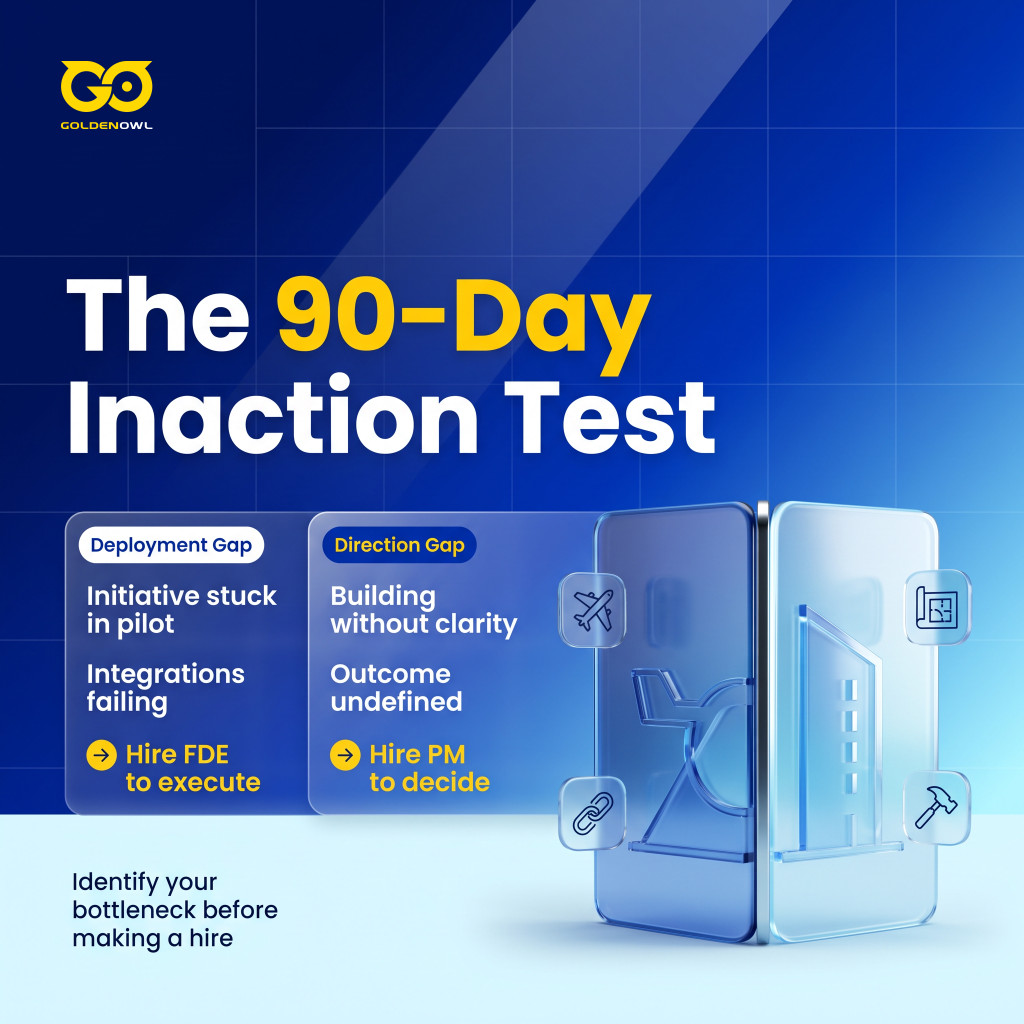
Hire a product manager when pilots stall because buyers can’t say what problem the tool is meant to solve. If enterprise pilots stall because integrations fail and client data can’t enter your platform, hire a forward deployed engineer.
Here’s another way to see it. A company that knows its outcome but has no deployment needs an execution-focused hire. Engineers building without direction need a product decision-maker. Here’s a useful test: imagine you do nothing for ninety days.
Maybe a decided initiative sits stuck in a pilot, unused, while the demo gets run again for new stakeholders. The gap there is deployment, and a forward deployed engineer can close it. Or engineers keep building, and you can’t tell whether any of it is the right call. That’s a direction gap, and a product manager can address it. Mix the two up and the cost is real. A company that mistakes a deployment problem for a product problem may hire a product manager, then spend two quarters producing better documents about a system that still isn’t live.
Early-Stage Startup Hiring Priorities
Hire a Forward Deployed Engineer when a clear customer outcome exists but nothing is running. You can even rent one fractionally, which spares you the American salary band.
The mirror case is a team whose engineers build without a settled view of what matters. There, deciding is the bottleneck, not shipping, so hire a product manager.
Working Models and On-Site Expectations
Time on the customer’s site differs a lot. Forward Deployed Engineers do significant travel and on-site work. Product Managers travel moderately and aren’t embedded. Forward Deployed Product Managers (FDPMs) sit in between. Their travel runs from moderate to significant, and they work closer to customers than a typical PM.
Job postings make the pattern concrete. One FDE posting asks for up to 50% travel and three office days a week. A public sector PM role is remote-friendly, though travel is required. A public sector FDPM travels to classified sites.
| Forward Deployed Engineer | Product Manager | Forward Deployed Product Manager | |
|---|---|---|---|
| Travel / on-site | Significant (client sites, on-site deployments) | Moderate (customer visits, not embedded) | Moderate to significant (closer to the customer than a typical PM) |
Career Transitions Between Engineering and Product
The paths between engineering and product are real. A Forward Deployed Engineer can become a Product Manager. Years of direct customer engagement build technical empathy and teach how customers actually use products, which is a real head start. The Forward Deployed Product Manager role is the usual bridge. From there the path can lead on to leadership titles. VP of Field Engineering or CTO sit on the engineering side, and VP of Product or CPO on the product side.
Engineers moving into product management often fall into one trap. They treat every customer complaint as an urgent engineering task, which is a mistake: bespoke work like that can undermine platform consistency.

Frequently Asked Questions
What is the actual difference between a forward deployed engineer and a product manager?
Forward Deployed Engineer (FDE) work means building production systems for one customer’s environment and getting them live. A Product Manager (PM) works across the full customer base instead. The PM decides what the product should do and defines the roadmap, then partners with engineering to deliver it.
Does a forward deployed product manager write code?
Sometimes, but coding isn’t the point of the job at either company. One posting allows "custom development if required," and the other asks for technical fluency, or "not deep coding." At both companies, production code stays with the FDE.
Can a forward deployed engineer become a product manager?
Yes, and Forward Deployed Product Manager is the usual bridge. Two companies count earlier embedded or solutions experience as a plus. The skill to build next is prioritization, including knowing what to leave unbuilt for a paying customer.
Do product managers need to know how to code?
Coding isn’t a strict requirement for most PM jobs. A technical background or a grasp of system architecture still helps, because it lets a PM talk with engineering teams and make roadmap promises they can keep.
Which Role Pays More Between an FDE and PM?
At entry to mid-level, Forward Deployed Engineers typically earn a modest premium. The role demands specialized technical skills. In the United States, an FDE averages $130,000 to $190,000 per year.
A mid-level PM earns less, at $110,000 to $160,000.
Are forward deployed engineer and AI product manager the same job?
No, they’re different jobs. An AI product manager chooses which AI capabilities to create and who they’re meant for. A forward deployed engineer takes an AI capability that already exists and puts it to work inside a business, using the business’s data and working within its constraints. The FDE doesn’t build the AI capability itself.
Is there a difference between a forward deployed engineer and a project manager?
Yes, a big one. A project manager lays out a plan, follows it and reports on progress, but doesn’t build the system. A forward deployed engineer does build it.
Are forward deployed roles remote?
Forward deployed roles may require on-site work, and one FDE posting asked for up to 50% travel. A public sector PM can work remotely, but travel is still required.
Do forward deployed engineer roles exist in India?
Yes, though these jobs are still uncommon by title. They cluster in GCCs and AI startups, mostly in Bengaluru. Engineers there do FDE-shaped work under titles like Solutions Engineer, Customer Engineer, Deployment Engineer and Technical Consultant. That overlap with traditional solutions engineer positions is discussed in forward deployed vs solutions engineer roles.
Should a startup hire a forward deployed engineer or a product manager first?
If the product can’t yet meet an early customer’s needs, choose an FDE. When many customers use the product in much the same way, pick a classic PM instead.
Conclusion
Look at the work first and the title second. An FDE takes a defined customer outcome and turns it into a live system. A PM decides which outcomes the product should pursue across customers. The forward deployed engineer vs product manager distinction explains the coding expectations, the travel demands and the situations where each job fits. Read the description for the actual work, because titles can mislead.
Share this page


Table of Content

Subscribe to Golden Owl blog
Stay up to date! Get all the latest posts delivered straight to your inbox