
How to use AI in real estate: automate lead follow-up, speed up valuations and marketing, and keep every step compliant with Fair Housing rules.


Solutions Engineer vs Forward Deployed Engineer
Oct 12, 2026
about 7 min read

Solutions engineer vs forward deployed engineer: compare focus, ownership, skills and pay to decide which role fits your technical needs.
Here’s a pattern you may know. A deal closes, and months go by without any integration or deployment moving. The customer still hasn’t seen the product work in their own environment. Or it goes the other way, and the prospect can’t tell before signing whether the product will survive contact with their systems.
Those are two different gaps. A solutions engineer vs forward deployed engineer comparison starts by asking which one you actually have. Is it technical validation, support for the buying decision, or ownership of a deployment? Your answer decides whether you hire for proving fit or define a role around owning the integration until it’s live. It also tells you what to spell out about ownership, customer work and commercial expectations.
Solutions Engineer vs Forward Deployed Engineer: How the Roles Differ
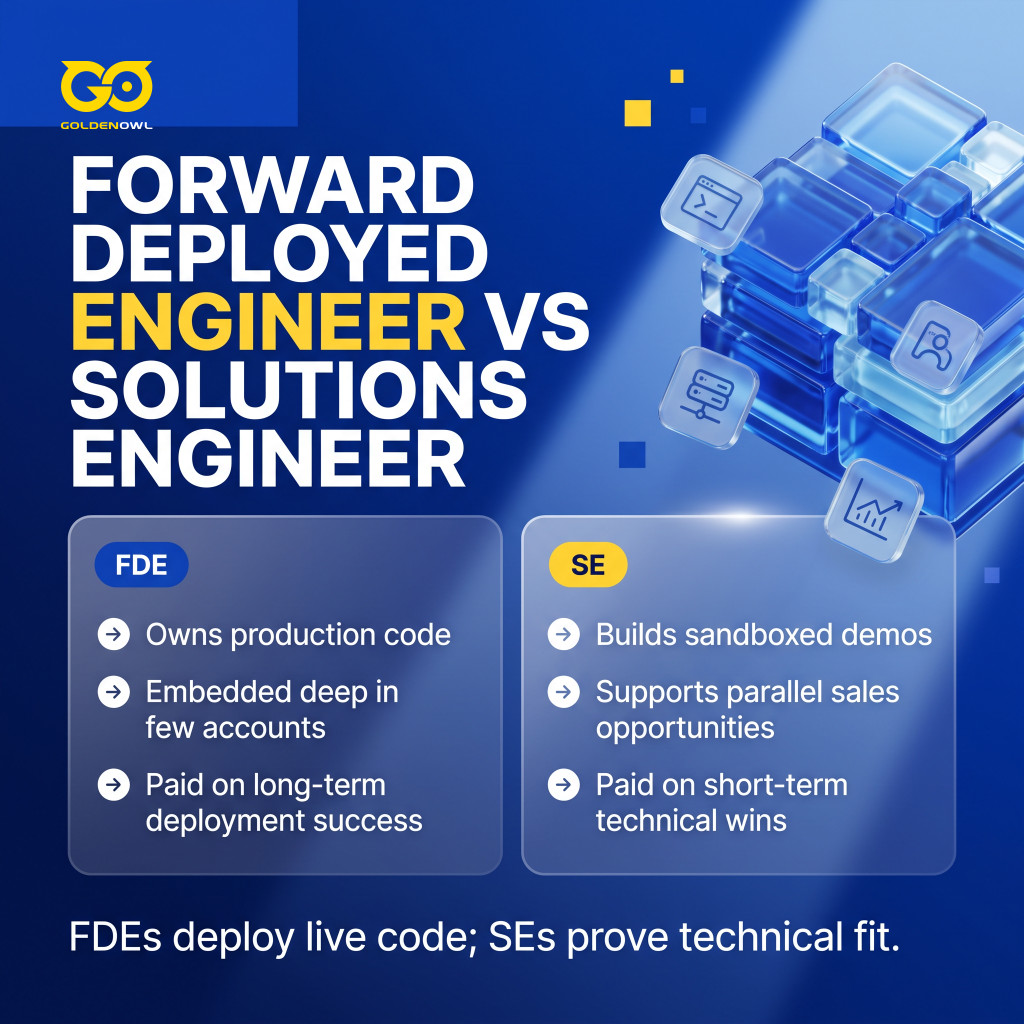
Start with the Solutions Engineer (SE), whose goal is the technical win. The SE spends the week finding out what each prospect needs and showing that the product fits. Proofs of concept and technical objections fill most of the rest, and all of it is spread across several opportunities. The Forward Deployed Engineer (FDE) has a different goal: getting the product live. That means writing code and fixing integration problems in the customer’s own environment, and the FDE owns the result.
Timing won’t settle it, because when each role joins can vary. A product that touches production data or security systems may need a serious evaluation before the contract is signed, and an FDE can help at that point. So ask two other things. Is the job validation, or ownership of production? And does it spread across many deals, or go deep on a few accounts?
The product matters too. With technical products that depend on infrastructure, data or agents, deployment can start before evaluation ends. A controlled demo is a poor test of real systems. It can look perfect and still say nothing about the customer’s own data.
Who Owns Production Code?
Start with who writes the code that runs live. An FDE does, in the customer’s environment. A Solutions Architect designs systems and rarely ships code on the customer’s site. A Sales Engineer builds demos but doesn’t run production systems. Don’t confuse an embedded builder with an advisory consultant either; forward deployed engineer vs consultant covers that difference.
In production, the FDE answers for the code, and the Solutions Architect answers for the architecture documents. FDEs also live with technical debt inside the customer’s environment. If nobody owns an integration that has to run in production, that’s the person to hire. An SE, by contrast, supports evaluation before the sale with demos and technical guidance and doesn’t own deployment work.
Which of the two goes deeper into code? The table answers that.
| Dimension | Forward Deployed Engineer | Solutions Engineer |
|---|---|---|
| Code depth | Production code, APIs, integrations, debugging, and data workflows | Demos, configuration, scripts, architecture, and POC code |
What do FDEs actually build? Custom data pipelines come first, along with integrations made for one customer. Automation, APIs and deployment tools follow, and so do extensions. This code often runs in production at customer sites, and it can shape future product features. SEs work differently. They build demos and POCs in sandboxes with synthetic or anonymized data, and they usually stay out of the customer’s production environment.
Engagement Depth and Customer Ratios
An FDE stays close to a few accounts. A pre-sales specialist works across many opportunities at once.
| Dimension | Forward Deployed Engineer | Solutions Architect | Sales Engineer |
|---|---|---|---|
| Embedded with customer team for weeks/months | ✓ Yes | Days to weeks | ✗ Per-call basis |
| Customer-per-engineer ratio | 1 (deeply embedded) | 3-10 (parallel design) | 10+ (deal flow) |
Treat those ratios as rough. What they show is how different a day feels. In the first 90 days, an FDE pours most effort into a few accounts. First comes learning how the customer’s systems are built and what limits them. Deploying and managing the technical work comes after that. Complex engagements can run for weeks or months, and a successful proof of concept doesn’t end them. A pre-sales specialist, meanwhile, can run several discovery calls, demos and POCs in a single day. That same day, an FDE might be sitting with one customer’s developers, chasing an integration bug or a production problem.
Commercial Alignment and Performance Measurement
Pay and performance differ as well. FDEs are measured on engineering milestones and customer outcomes, and they often earn renewal-related pay. They usually report to Engineering or Customer Engineering. Sales Engineers are judged by the deals they influence. Their commission depends on closed-won revenue, and they report to Sales. Solutions Architects may get deal bonuses and report to Pre-Sales or Customer Engineering.
| Dimension | Forward Deployed Engineer | Solutions Architect | Sales Engineer |
|---|---|---|---|
| Compensation tied to deals closed | Sometimes outcome bonuses | Sometimes | ✓ Primary commission driver |
| Compensation tied to renewals | ✓ Often | ✗ Rarely | ✗ Rarely |
| Typical reporting structure | Engineering or Customer Engineering | Pre-Sales or Customer Engineering | Sales |
Put that in money terms. An SE’s pay usually has a meaningful variable share tied to closed-won revenue, so an SE is judged by deals influenced and not by deployments shipped. At senior levels the base may run from $140,000 to $190,000, and variable pay can add 10 to 30 percent of sales or revenue.
FDEs have no quota to hit. They’re measured against engineering milestones instead, which covers technical delivery, implementations that work and customer outcomes over the long run.
The no-quota setup has a cost side. FDEs put a lot of engineering effort into fewer customers, so each customer deployment costs more. Treat an FDE as a more technical SE and you’ll distort your CAC and staffing assumptions.
What Forward Deployed and Solutions Engineers Do
Forward Deployed Engineer
Inside the customer’s environment, forward-deployed engineers work as embedded software engineers. They write and ship production code, including RAG pipelines.
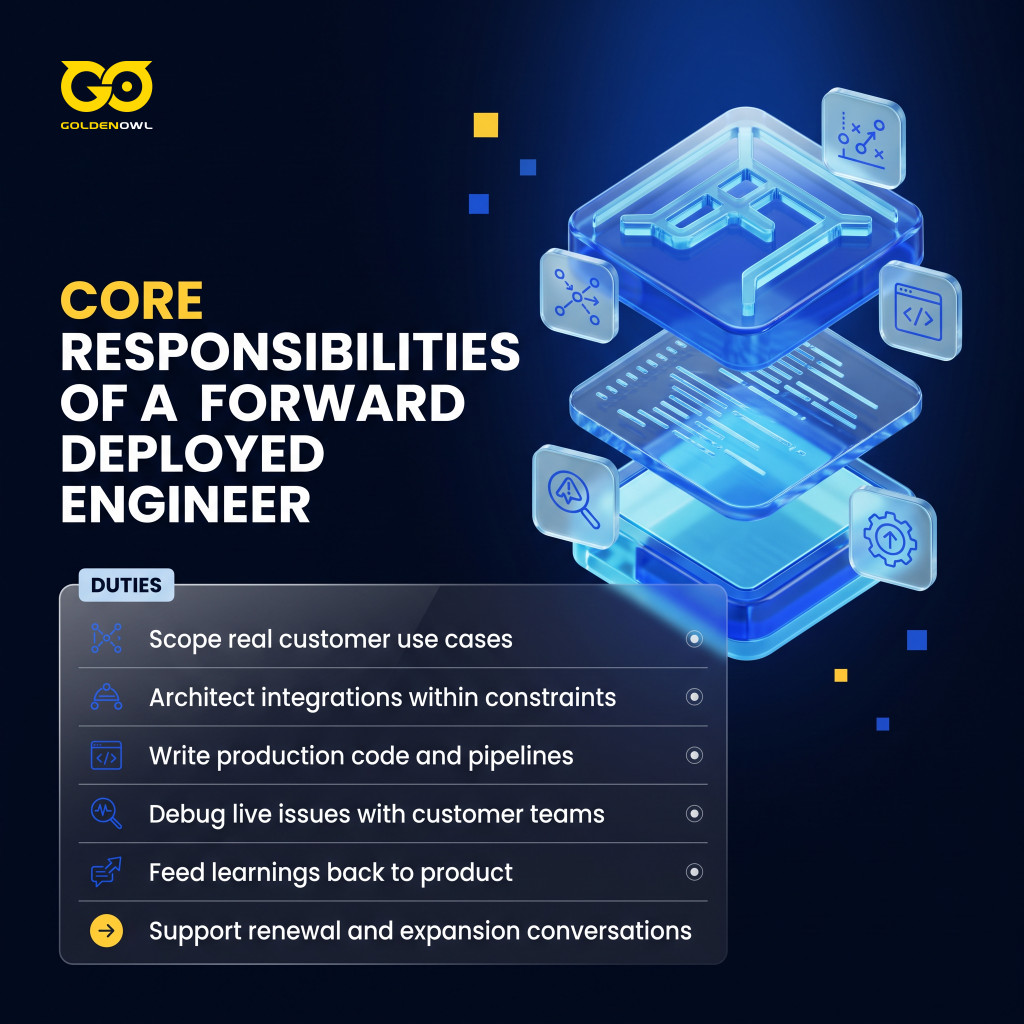
An FDE owns deployment from start to finish and stays on the account until it produces measurable business outcomes. First comes scoping. The customer’s actual use case often differs from the version in the sales deck, so the FDE has to find out which one is real. Next the FDE designs an integration around the customer’s data and authentication setup, and around any compliance limits. Then the FDE writes the production code in the customer’s own repo or environment, such as RAG pipelines, agentic workflows, custom integrations and evals. When something breaks live, the FDE debugs it alongside the customer’s engineers. What the FDE learns goes back to the core product team, where it can influence the roadmap. And the FDE stays on the account through renewal and expansion talks.
Solutions Engineer
An SE helps a prospect decide whether the product can solve a technical problem. Discovery calls and custom demos are the main tools. Solution design, proofs of concept and integration talks round it out. During the sale, SEs run the demos and answer the technical questions. They also design the POCs and handle objections.
The technical victory arrives when the prospect confirms that the proposed solution meets their needs. Then who owns production? That’s the line in forward deployed engineer vs solutions engineer. After the sale closes, the detailed implementation work usually passes to another team, such as engineering, deployment or customer success.
From Technical Discovery to Production Deployment
Technical Discovery to Proof of Concept
Discovery starts with questions. The pre-sales team gathers the customer’s needs, architecture and integrations. It also collects security restrictions and success criteria. Then comes the demo or POC, built around whichever technical questions could derail the deal.
There’s one exception. If validation uses real customer data, custom code or production infrastructure, bring deployment skills in early. The team can then spot implementation risks before they turn into commitments.
Proof of Concept to Production Deployment
A successful POC shows that an approach can work, and nothing more. Production asks for more: authentication, scale and monitoring, plus failure handling, security and upkeep.
After validation, the FDE takes over more of the work. The approach becomes real code and gets connected to the customer’s system. Then the problems specific to that environment have to be solved. Who owns production remains the clearest difference between the two jobs.

Compensation and Market Economics
Forward Deployed Engineer Compensation
US data for 2026 puts a typical FDE salary at $150,000 to $240,000 or more. Equity can push senior pay at well-funded tech companies well beyond that.
Solutions Engineer Compensation
Mid-level Solutions Engineer roles cost less. By current U.S. standards, many pay a base of $110,000 to $150,000, and total compensation can reach $180,000.
Workforce Planning for FDEs and Solutions Engineers
Salary is only one factor, and headcount matters too. FDEs are closer to engineering or R&D capacity that gets used on customer issues. SEs are closer to sales capacity that supports revenue. So budget each role where it belongs.

Frequently Asked Questions
What Separates a Forward Deployed Engineer vs Solutions Architect?
An FDE builds the system alongside the customer. A Solutions Architect designs it. The FDE holds commit rights, ships production code and handles incident response inside the customer’s environment.
What is the difference between a Sales Engineer and a Forward Deployed Engineer?
Solutions Engineers help customers decide to buy. Forward Deployed Engineers help them succeed after the purchase. A Sales Engineer supports the sales cycle, and some companies call that role a Pre-Sales Engineer or Solutions Consultant. That’s the central distinction in a solutions engineer vs forward deployed engineer comparison.
Do Forward Deployed Engineers carry a sales quota?
No, FDEs carry no quota. Sales Engineers have the most variable pay tied to deals. FDEs typically earn the highest total pay, since they pair engineering depth with a hand in renewals and expansion revenue.
Do Solutions Engineers write as much code as Software Engineers?
No, they write less. Solutions Engineers help customers decide whether to buy. Software Engineers own the application architecture and the core platform APIs, and they own the foundational features that scale. SEs may still build customized proofs of concept (PoCs) that make the product work with the customer’s data.
Which role should enterprises prioritize for complex AI or cloud deployments?
For products that are powerful but hard to deploy, prioritize FDEs. That describes nearly every enterprise AI product in 2026. An agent may work in a demo and then break the moment it meets the customer’s data.
Conclusion
The useful distinction isn’t how technical each title sounds. It’s whether the work proves fit before a sale or owns working software after it. Sales Engineers and Solutions Engineers help customers decide whether to buy, while FDEs build and support systems in the customer’s environment. Software Engineers own the underlying application and platform. So the right title in a solutions engineer vs forward deployed engineer comparison depends on whether the need is sales support or production engineering. Before opening a role, write down which of those two needs is immediate, then define the role around that ownership.
Share this page


Table of Content

Subscribe to Golden Owl blog
Stay up to date! Get all the latest posts delivered straight to your inbox