
How to use AI in real estate: automate lead follow-up, speed up valuations and marketing, and keep every step compliant with Fair Housing rules.


Will Lawyers Be Replaced by AI?
Sep 22, 2026
about 17 min read

The foundation of junior careers are changing faster than headline employment numbers actually reveal—raising the question, “will lawyers be replaced by ai?”
Legal work keeps growing, while paths into law and the foundation of junior careers are changing faster than headline employment numbers actually reveal—raising the question, “will lawyers be replaced by ai?”
Ask a more useful question about whether a lawyer, in the course of legal practice, is moving toward work the market will keep paying for as the junior layer grows thinner over time.
Consider the more useful question of whether AI will replace a lawyer's job or whether a lawyer is developing toward work that the market will continue to pay for as the junior layer becomes thinner over time.

Will Lawyers Be Replaced by AI in Legal Practice?
For the foreseeable future, AI won't replace lawyers wholesale: legal employment and firm revenue remain strong, while licensing, professional responsibility, and human accountability stay with people.
In 2024, Am Law 100 firms set revenue records: total gross revenue hit $158.3 billion, up 13.3% year over year. Revenue per lawyer reached $1.28 million, while attorney headcount rose 7.7%. (David Lat’s Original Jurisdiction)
By December 2025, U.S. legal employment had climbed to a record 1,208,100 jobs, according to preliminary Bureau of Labor Statistics data.
AI can't swear an oath, get a license, or face disbarment. It also can't carry professional responsibility for advice, leaving the legal system anchored in human lawyers and human accountability.
The profession is moving quickly toward adoption. In surveys of legal professionals, 80% foresee AI having a high or transformational effect on their work over the next five years.

The 2026 AI in Professional Services Report records GenAI adoption at 41% among law firms and 47% among corporate legal departments. In 2025, the corresponding figures were 28% and 23%, respectively.
Displacement fears haven't stopped strong employment. For 2025 law graduates, employment reached 87.7%, indicating that the industry continues to need talent as legal work changes quickly.
Why Senior Attorneys and Strategic Counsel Remain Irreplaceable
Senior legal work and Strategic Counsel expose the limits of current AI, where judgment, accountability, and human context remain part of the job. AI cannot take an oath. AI cannot obtain a license.
- Fabricated case citations: By December 2025, courts had documented 660 AI-fabricated case citations in court filings, compared with 120 between April 2023 and May 2025. Courts are identifying four to five new documented cases each day. When a fabricated precedent creates an ethical and professional violation, that error rate is not minor.
- Complex legal problems: On rigorous benchmarks involving complex, novel legal problems rather than simplified tasks, the best-performing AI models score around 37% on the most difficult evaluations.
- Limits of pattern matching: AI performs well when matching patterns against training data, but struggles with novel legal arguments, scattered regulatory sources, and ambiguous situations requiring human context.
- Senior legal work: Litigation strategy, high-stakes negotiation, regulatory advisory, complex M&A counsel, and courtroom advocacy remain human territory because of capability and client expectation.
- Professional boundaries: Among legal professionals, 96% believe allowing AI to represent clients in court would be a “step too far,” while 83% view AI-generated legal advice as inappropriate.
- Confidentiality safeguards: 96% demand safeguards for confidential data.
- Authoritative content: 94% demand outputs grounded in authoritative content.
- Defensible reasoning: 90% say AI must produce reasoning that can be explained and defended.
Where Displacement Pressure Concentrates Across Junior Roles and Support Staff
AI pressure falls most heavily on structured, repeatable positions, though it varies across Paralegals, junior associates, and support staff.
| Legal Role | Displacement Exposure & Mechanism | Key Benchmark Metric |
|---|---|---|
| Paralegals | Document organization, research support, routine drafting, and case file management fall squarely within current AI capability. | The National Association for Law Placement documented a 26% reduction in paralegal hiring at the 250 largest U.S. law firms since 2018. McKinsey estimates that approximately 69% of paralegal tasks could be automated using current technologies. |
| Legal administrative roles | Legal secretaries, legal assistants, and administrative coordinators perform structured, repeatable administrative work that current AI handles reliably. | The WEF's 2025 Future of Jobs Report lists legal secretaries among its fastest-declining occupations globally, with AI and automation driving the decline. |
| Junior associates | The work remains, but the volume of work and the economic justification for large associate cohorts are under pressure because AI is absorbing tasks that previously required headcount. | In high-volume litigation matters, a complaint response system cut associate time from 16 hours to 3-4 minutes. Lawyers have reported productivity gains greater than 100 times. |
Paralegals carry the clearest exposure, while Legal administrative roles face the sharpest near-term displacement. Junior associates sit between those groups: their work remains, yet larger associate classes have less of it. These roles don't face the same pressure.
In a LawGeex comparison, its AI reviewed five standard NDAs alongside 20 US-trained attorneys. It finished in seconds; the attorneys took an average of 92 minutes. Accuracy was 94% for AI and 85% for lawyers.
Current AI use is more common among in-house legal professionals than at law firms. Within that group, 86% turn to AI for legal tasks at least once a week.
Core High-Pressure Legal Tasks Automated by AI
For in-house legal teams, high-volume cognitive work is where AI has the clearest role, and these teams use it more often than law firms. Research, document review, drafting, and summaries fill much of routine legal work.

Law firm pilots
Law firms are running AI pilots, while many tools are already in use, and those efforts are giving lawyers major time savings.
Annual time savings
AI tools could free up nearly 240 hours per year, and legal platforms reduce the mental effort required for everyday tasks by up to 25%. The 2025 Legal Trends Report found this through a first-of-its-kind neurological study.
Work volume and quality
The 2026 Legal Trends for Mid-Sized Law Firms report says AI helps legal professionals handle more work. Among large firms, 75% reported greater volume, while 74% saw better quality and value.
Adoption
By 2025, 70% of U.S. law firms were exploring or piloting generative AI, including 46% of firms with 100 or more attorneys. American Bar Association data showed lawyer use reaching 30%, up from 11% in 2023.
Among legal professionals, adoption measures 71% and 87%, then climbs consistently as firm size increases.
E-Discovery
E-discovery became one of AI’s earliest and broadest legal applications, scanning electronic information for non-privileged material tied to a case or claim and giving you near-instant access.
The same pattern appears in document review. A paralegal may examine fifty pages while AI assesses thousands of contract or discovery-document pages, flagging anomalies, missing clauses, and relevant precedents at scale.
In 2025, legal professionals using AI tools reported the following:
77% use it for document review.
Legal Research
With CoCounsel and Lexis+ AI, lawyers can ask questions in everyday language and get answers selected from large databases, with citations linked, within minutes.
Those databases cover:
- Regulations
- Statutes
- Practice areas
- Jurisdictions
- Case laws
In 2024, Thomson Reuters reported that lawyers gained an average of four hours per week from its AI tools.
Across the U.S. legal market, those hours created approximately $100,000 in new billable time per lawyer annually.
CoCounsel Legal reports an average 1/3 decrease in time devoted to document review, research, and drafting.
Legal-specific platforms offer cited sources, secure data handling, and answers grounded in actual case law and statutory language.
Legal professionals also expect clear standards from the AI tools they use.
94% demand outputs grounded in authoritative content.
ChatGPT differs from traditional legal research platforms because it does not search a case database in real time.
It generates responses from patterns in language.
That process can yield polished, confident answers even when the answer is wrong.
Verification remains essential.
Professional judgment remains essential.
ChatGPT may sound certain without finding current case law or statutory language, so you must verify its output before relying on it in legal work.
Document Automation and Management
AI-driven document-management software organizes contracts, case files, notes, and emails through tagging and profiling, while Full-text search helps you find those digital files.
- Document automation: Intelligent templates populate documents with case information, turn existing Word documents into reusable templates, and provide access to thousands of up-to-date court forms across all 50 U.S. states.
- Data entry: Data pulled directly from practice management systems removes manual data entry and keeps information consistent across documents.
- Version control: Document ID and check-in/check-out privileges protect version control and security.
- File sharing: Document management software connects with systems such as Microsoft Office, making files easier to share.
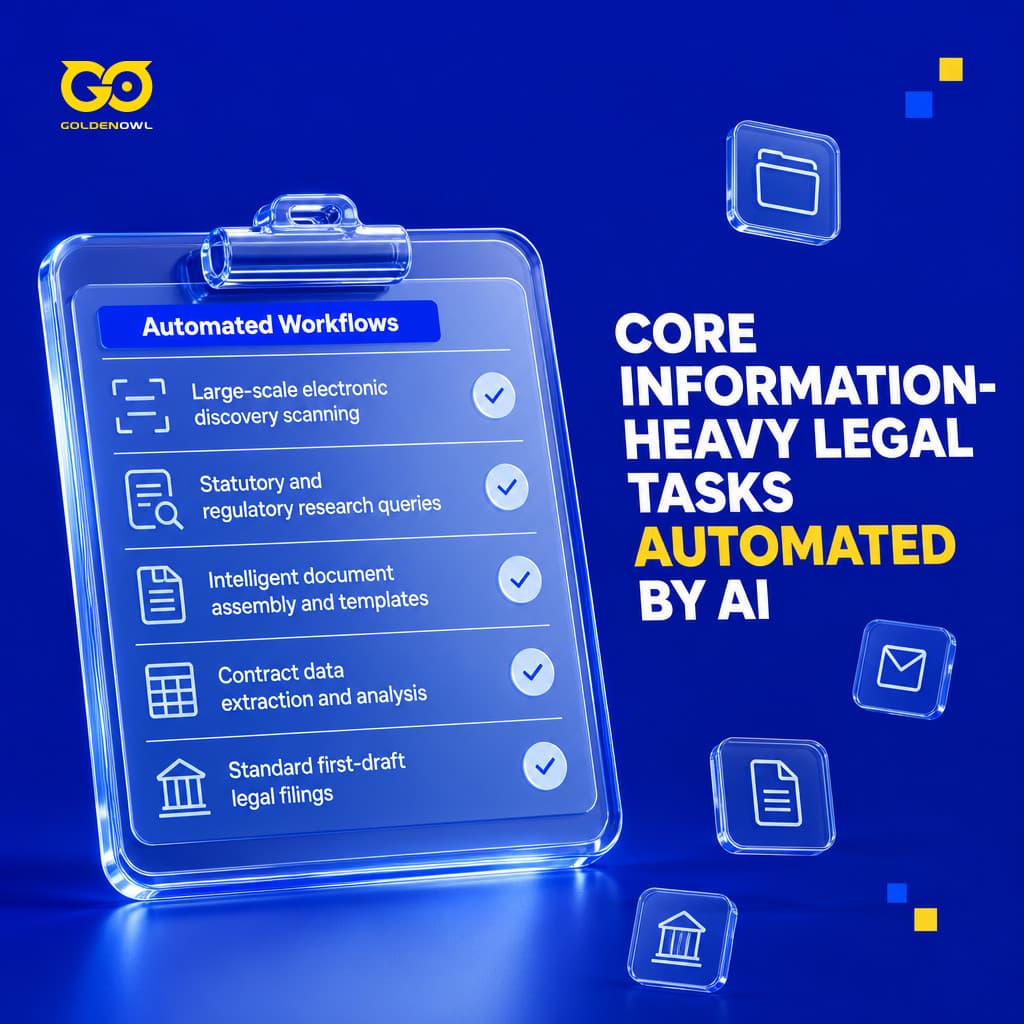
- Routine drafting: AI increasingly generates standard motions, first-draft pleadings, boilerplate agreements, and letters with minimal human input.
Contract Analysis and Due Diligence
AI-based due diligence tools find documents needed for review, including files with a specific clause, and highlight differences or changes between documents.
Due diligence software can review large numbers of contracts within seconds.
That cuts manual review effort, although human review of the data remains recommended.
In 2025, the following applied to legal professionals who used AI tools:
- 50% use it for extracting contract data.
- 24% use it for contract policy compliance.
Choosing a Purpose-Built Lawfirm AI Solution Over Generic Tools
The right AI tool depends on the legal task in front of you. Clio’s 2026 Legal Trends for Solo and Small Law Firms report found that ChatGPT and Microsoft Copilot are still the most widely used options across firms of every size, reaching 43-48% of legal professionals. Dedicated legal research platforms reach only around a third. Larger firms, meanwhile, turn to legal-specific systems more often for document drafting, e-discovery, and contract review. That split shows up across firm sizes.

Generic tools may be easy to reach for, but they aren't tied to legal databases and can produce hallucinations, ethics violations, or data privacy breaches. When you assess ai legal solutions, check the source of its legal information, its confidentiality controls, and how lawyers verify its answers before choosing a platform.
Choose based on where the information can safely live. Privileged client records and tasks that depend on verified case citations belong in a sandboxed legal system with closed retrieval, such as Vincent by Clio. General enterprise AI can handle internal administrative drafts or reshape text that's already public.
The Fiduciary Standard and Authoritative Grounding
Legal professionals expect AI to keep confidential information safe, rely on authoritative sources, and leave lawyers accountable for the final work product.
- Confidential data: 96% demand safeguards for confidential data.
- Authoritative content: 94% demand outputs grounded in authoritative content.
- Cited answers: For large firms and in-house teams, Vincent by Clio delivers cited, court-ready answers from more than one billion curated legal sources.
- Traditional verification: Confirm legal references with traditional research tools.
- Independent verification: Independently verify AI-generated legal citations before submission.
- Final accountability: Lawyers remain strictly accountable for the final work product.
Confidentiality and Data Governance Standards
Confidentiality controls determine whether an AI tool is fit for work that includes client information.
Approved platforms
Firm management and IT security must approve an AI platform, and it must follow applicable ethical guidance, including ABA Model Rule 1.6 on Confidentiality of Information, before confidential, privileged, or identifying client information enters it, unless no such information enters it. Never put client data into a public, open-web AI tool. Confidentiality remains the biggest danger AI brings to legal practice.
AI policy
Set an AI policy that lists approved tools and the data each one may handle. Put those rules in writing for your team, particularly at a smaller firm, because 57% of solo firms and 55% of small firms lack AI policies, compared with 30% of mid-market firms and 24% of enterprise firms.
Vendor security
Check every AI vendor before confidential information touches its system. Legal-specific platforms should meet standards such as SOC 2 Type II and ISO 27001, and you should confirm that firm data won't be used to train AI models.
Data governance controls
Have your firm's IT department configure data residency settings, meet applicable data protection regulations, and block firm data from being used for AI training. Those are the core controls.
Private enterprise architecture
A law firm can work with an ai solutions company to build secure, private enterprise architecture around these requirements.
Client expectations
Clients understand both the upside and the danger of sharing data with AI tools, so they're pressing firms to maintain confidentiality through stronger security measures. Pending California legislation, SB 574, would give attorneys an explicit statutory duty not to enter confidential client information into public generative AI tools. The duty would carry statutory force.
Leading AI Tools Deployed in Modern Legal Practice
Choosing among AI tools starts with their confidentiality controls. Clio’s 2025 research reported that firms adopting AI broadly were nearly three times as likely to report revenue growth.
Fathom
Meeting transcription tools create accurate records while reducing constant note-taking. These tools can:
- Record Zoom or in-person meetings.
- Generate searchable transcripts.
- Create summaries and action items.
- Reduce the risk of missing key details.
Fathom can support mediations, client meetings, internal strategy sessions, and CLE note-taking. Those are useful records, but you still need to check the recording rules. Recording requirements under United States law depend on the jurisdiction. Some states require one-party consent from the person recording, while others require all-party consent. Federal law (18 U.S.C. 2511) generally requires one-party consent, although state laws may be more restrictive. Recording without the required consent may constitute a criminal offense and civil liability.
Otter
Speech-to-text tools cover the same basic recording tasks for legal teams:
- Record Zoom or in-person meetings.
- Generate searchable transcripts.
- Create summaries and action items.
- Reduce the risk of missing key details.
Before recording attorney-client communications, get client consent, satisfy your ethical confidentiality duties, and secure the recordings.
Harvey AI
Harvey AI, used by firms including Allen & Overy and PwC Legal, draws on OpenAI's models and is fine-tuned for legal workflows.
The figures reported in late 2025 were $150 million raised by Harvey AI and an $8 billion valuation.
Casetext
Thomson Reuters acquired Casetext, then folded it into Westlaw Precision under the name CoCounsel.
- Acquisition and product: Thomson Reuters completed the acquisition on August 17, 2023, paying $650 million in cash for Casetext, a company founded in 2013. Its GPT-4-powered CoCounsel already served more than 10,000 law firms and corporate legal departments.
- Task coverage: Thomson Reuters described CoCounsel as handling document review, legal research memos, deposition preparation and contract analysis “in minutes.” This task-level description shows where the tool fits without claiming that lawyers’ judgment can be automated.
- AI integration: As Thomson Reuters reported, the company had separately committed to spending $100 million-plus annually on AI integration.
The Transformation of Law Firm Business Models
When AI enters a law firm, it changes how people arrange work, handle matters, set prices, and stand apart; the effects reach operating processes, knowledge systems, staffing assumptions, and the connection between hours recorded and value delivered.
Reengineering Business Processes and Project Management
Productivity, a quantum leap?
People interviewed expect AI-enabled practices to improve legal work, while practice-specific “case methodologies” shape the way those firms actually deliver that work.
Case methodologies
Use those methods to control new AI tools: subject each piece of software to review and testing before approval against the standard of legal service you intend to provide. That methodology becomes the firm’s control point.
Complementary capabilities
AI can help firms build processes that run more efficiently and consistently, then shape methods that sit alongside the software. Those paired capabilities can become a competitive advantage.
Differentiation between firms
Different firms will build their own processes and AI tools, along with distinct knowledge databases, producing meaningful differences in the way each one puts AI to use.
Proof of concept
Proof-of-concept projects are altering how firms run and manage their operations. These pilots often grow into process-redesign efforts where previously neglected areas receive attention and old-process reasoning is challenged, including routines firms had followed for decades.
The claim that established practice should continue simply because it is familiar no longer holds.
AI capabilities
As firms add new processes and tools, their AI capabilities will increasingly separate one firm from another. Cloud-based practice management software currently serves only 57% of firms, versus 71-74% among solo and small practices.
The Billable Hour Under Market Pressure
Billing is coming under pressure from saved time and client preferences, with lawyers expected to devote more hours to analysis and strategy. The figures below put that pressure on hourly billing.
- Time released by AI: The 2025 Future of Professionals Report predicted that AI could free up approximately 240 hours per year per legal professional.
- Expected decline in hourly billing: As workflows become more streamlined, 43% of legal professionals anticipate that hourly billing models will decline over the next five years.
- Client preference: 71% of clients prefer fixed or flat fees, although 86% of solo firms and 78% of small firms have made no pricing changes in response to AI.
- Hours and higher-value work: The dominant viewpoint is that total hours worked would remain similar or even expand, while attorneys would have more time for analysis and strategy.
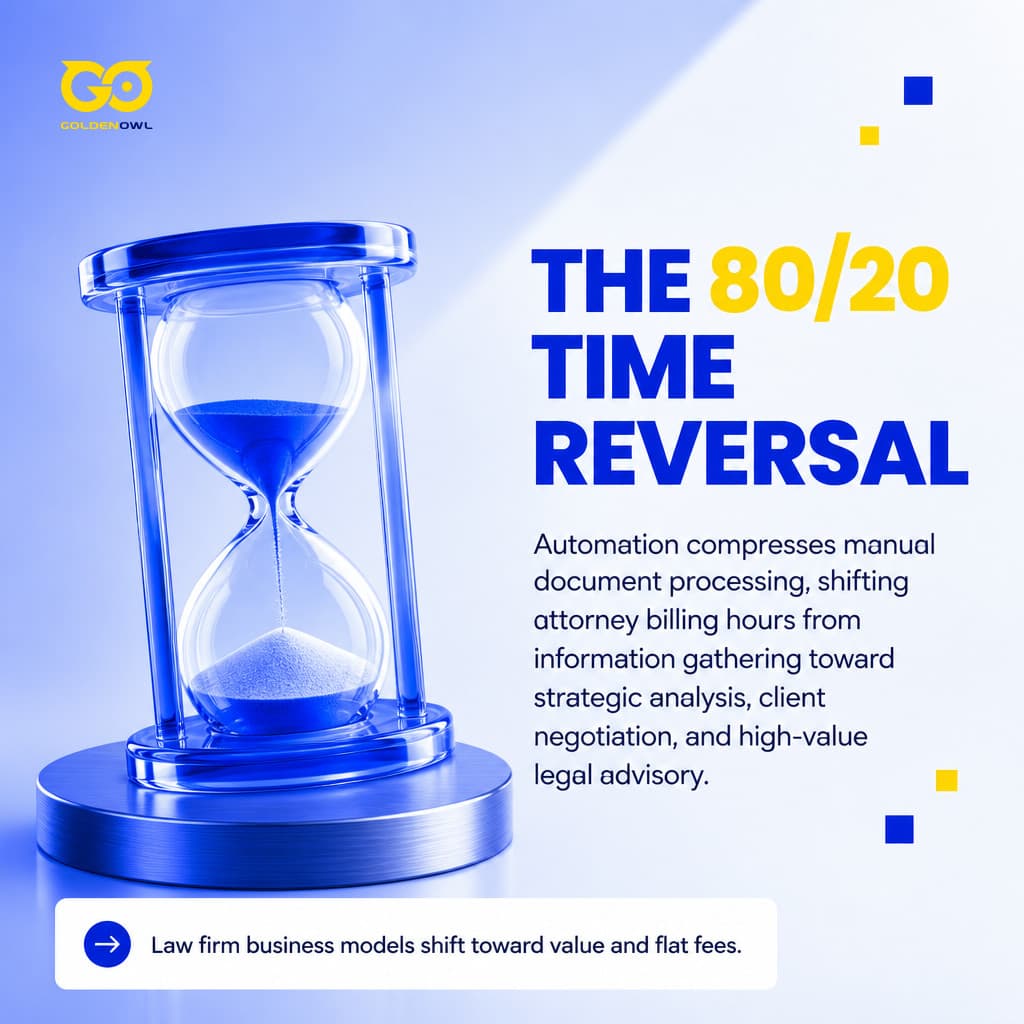
- The 80/20 inversion: AI may reverse the existing allocation, where 80 percent of time went to collecting information and 20 percent to strategic analysis and implications. The aim is to flip those timeframes.
- Firm agreement: 90% of the firms interviewed expressed this opinion.
- Client expectations: 78% of corporate clients say that AI-enabled quality improvements are very important or essential.
- Delivery gap: Only 6% say that most of their providers actually deliver those improvements.
- Relationship pressure: 32% are reconsidering relationships with firms falling behind.
With routine deliverables, fixed-fee pricing powered by automation can lift a firm’s profit margins. The tradeoff is that the firm absorbs the loss when unforeseen complexity pushes the matter beyond its expected scope.
Strategic Adaptation Roadmap for Firms and Attorneys
Pair genuine AI fluency with advisory, judgment-heavy work to gain ground. Build commercial and multidisciplinary skills, then move toward growing legal complexity in areas such as AI regulation and data privacy, with cross-border compliance also in demand. Knowing the surface features of a tool won't carry you far.
People who prepare for the legal work that remains will be ahead of those who don't. Build AI fluency and move closer to matters requiring discernment while strengthening the commercial and advisory skills clients pay for. PwC's 2025 data reported a 56% wage premium for workers with AI skills in exposed occupations.
Law's AI shift will likely unfold through immediate gains on routine tasks, followed later by changes to pricing and firm staffing and eventually by broader access to justice.
In its December 2025 Year 2 report, the American Bar Association's AI Task Force made much the same point, describing AI as rapidly becoming core infrastructure for legal practice.
Establishing Internal Law Firm AI Governance Policies
Set rules for the tools your firm permits and for the information lawyers and staff can enter into them. Together, those choices shape how sensitive client information is handled.

- Clear guidelines: Set clear guidelines before lawyers or staff choose tools on their own, since public, open-web systems can invite sensitive client information, confidentiality breaches, inaccurate research references, and potential malpractice claims, as the 2026 Legal Trends for Solo and Small Law Firms explains.
- Approved platforms: Choose Approved platforms such as Clio Work that meet security standards, including SOC 2 Type II and ISO 27001.
- Training-data restrictions: Require Training-data restrictions that prevent approved platforms from using firm data to train AI models.
Cultivating Technical Literacy and Prompt Competence
A lawyer who uses ChatGPT only at a surface level differs from one who has redesigned research and drafting around CoCounsel or Harvey, carefully checking results and responsibly explaining their limits to clients. The former knows the interface; the latter understands the workflow.

That second lawyer stands out because simple tool use no longer does. PwC's 2025 data showed that workers with AI skills in exposed occupations earned wages 56% higher.
Good training gives firms a path to responsible, ethical AI use. You don't have to master artificial intelligence science, but you do have to learn how these tools behave and use them responsibly while spotting possible ethical or privacy concerns.
Once you understand that, you can choose when and how to use AI while vetting, implementing, and running these tools in your practice.
Use the sequence below to build that understanding:
- Copy a difficult email into Chat after removing every client-specific detail.
- Tell ChatGPT how you want to answer and identify details relevant to the response.
- Ask Chat to make the email clear, direct, and professional.
- Review the generated response carefully.
- Keep what works, discard what does not, and revise the email in your own voice.
The process shows you where the tool helps and where it falls short.
Technical fluency doesn't require learning computational code. Strong legal prompts look more like careful legal drafting, with clear constraints and jurisdictional and analytical guidance.
Shifting Associate Career Trajectories Toward High-Value Strategic Advisory

Move toward advisory and judgment-intensive work deliberately.
Choose legal work centered on human judgment and strategic counsel, where professional accountability remains central. Build industry depth, develop client relationships, and move toward complex advisory matters that are expanding instead of document-processing work that is shrinking. The premium remains in judgment-intensive work. Creativity is projected to increase by 53%.
Build commercial and cross-functional fluency.
The in-house lawyers moving ahead connect legal advice to business strategy, understand the commercial setting behind each question, and speak clearly with business partners. Their advice reflects commercial reality alongside legal risk.
No automated tool can carry that judgment across functions.
Position around growing regulatory complexity.
Build depth in AI regulation, data privacy litigation, algorithmic accountability, and cross-border compliance. These areas are seeing new demand because legal complexity is growing, with AI opening a field rather than removing one.
Survey responses point in the same direction: 85% believed AI adoption in their practices would bring new roles and require new skills.
Respondents also expect demand to rise for these capabilities:
- Ability to adapt to change: 71% increase
- Problem-solving: 56% increase
- Creativity: 53% increase
- Communication skills: 52% increase
The 2024 Future of Professionals Report found that 42% of surveyed legal professionals wanted more of their valuable time spent on expertise-driven legal work over the next five years.
Frequently Asked Questions
Will AI fully replace lawyers?
Legal employment reached 1,208,100 jobs in December 2025, confirming that AI hasn't fully replaced lawyers.
Legal employment continues to grow as firms use AI to keep up with demand, not to eliminate lawyers. Am Law 100 firms posted record revenue and added attorneys in 2024, while the BLS projects 4% growth for lawyers through 2034. Legal employment still holds the record.
Can AI actually do legal work accurately?
Structured, pattern-based tasks suit AI, including standard contract review, research synthesis, and routine drafting, where it can move quickly and accurately.
LawGeex's results showed that AI correctly reviewed standard NDAs in 94% of cases, versus 85% for human attorneys.
Results weaken on complex and novel legal problems, where leading systems scored around 37% on rigorous benchmarks.
By December 2025, courts had recorded 660 fabricated AI citations, so hallucinated legal authority remains an ongoing problem.
Set clear controls before you put these tools into use:
- Safeguards for confidential data: 96% demand them.
- Grounded outputs: 94% demand outputs grounded in authoritative content.
How should lawyers respond to AI disruption?
Build the capabilities respondents expect to become more sought after. Creativity: 53% increase.
- Ability to adapt to change: 71% increase
- Problem-solving: 56% increase
- Creativity: 53% increase
- Communication skills: 52% increase
Check legal references with traditional research tools, because lawyers remain strictly accountable for the final work product.
Set your AI strategy before you compare vendors. Thomson Reuters’ 2025 survey found that organizations with a visible strategy had 2x the likelihood of reporting AI-driven revenue growth and were 3.5 times more likely to obtain AI’s critical benefits.
Only 22% of 2,275 professionals surveyed across legal and adjacent professions said their organization had a visible, defined AI strategy. Meanwhile, 4 in 10 were adopting AI informally or ad hoc, leaving work definitions, controls, and verification responsibility unsettled.
What practice areas are law firms focusing on for AI?
Nine practice areas now account for where law firms are focusing their AI applications.
- Privacy and data security: 69%
- Business and tort litigation: 50%
- Intellectual property (copyright and trademark): 45%
- Intellectual property (patents): 35%
- Litigation (other): 25%
- Mergers and acquisitions: 25%
- ESG: 18%
- Labor and employment: 15%
- Securities and capital markets: 15%
How will AI change legal pricing and billing models?
AI is pressing on hourly billing and pushing more firms toward flat-fee arrangements.
The dominant viewpoint
The prevailing view is that total hours could stay similar or grow, with attorneys spending more of that time on analysis and strategy.
The direction of travel
As workflows get more streamlined, 43% of legal professionals expect hourly billing models to decline over the next five years. Clients are moving in the same direction, with 71% preferring fixed or flat fees, although no pricing response to AI had been made by 86% of solo firms and 78% of small firms.
As workflows become more streamlined
The 2025 Future of Professionals Report estimates that AI could free approximately 240 hours per year per legal professional. It could also flip the 80/20 allocation, moving from 80 percent of time spent gathering information and 20 percent on strategic analysis and implications. That shift has the backing of 90% of firms interviewed.
As of today, 59% of firms rely on flat fees either exclusively or alongside hourly rates. Among firms with wide AI adoption, 45% have already changed their pricing structures.
Corporate clients are asking law firms for more value. While 78% consider AI-enabled quality improvements very important or essential, only 6% believe most providers supply those improvements, and 32% are reconsidering their relationships with firms that are falling behind.
Are clients using AI to research legal questions?
Yes. Many clients already use AI to research legal problems, which can improve their information while raising expectations for speed and value.
According to the 2025 Legal Trends Report, half of consumers have either turned to AI for legal questions or would consider doing so. Among those who used AI, 28% were ultimately directed to contact a lawyer.
AI tools can:
- Make routine legal tasks easier: This frees time for higher-value client interactions.
- Provide predictive insights: These insights can inform views about potential case outcomes and improve client counseling.
- Offer real-time language translation: Translation supports communication with global clients.
- Generate customized reports and updates: These reports improve transparency and engagement between lawyers and clients.
Client expectations are changing firm relationships, with 32% reconsidering relationships with firms falling behind.
The 2026 Legal Trends for Mid-Sized Law Firms report (LTR) found that, among legal professionals, 55-75% report that AI enables them to address client needs more quickly. Client satisfaction improved at 44% of mid-sized firms and 63% of large firms.
The practical rule is simple: use AI for repeatable information work, verify its results, and leave judgment, strategy, and client responsibility with lawyers. The answer to “will lawyers be replaced by ai?” is no: The figures show available time and continuing accountability.
Share this page


Table of Content

Subscribe to Golden Owl blog
Stay up to date! Get all the latest posts delivered straight to your inbox