How to use AI in real estate: automate lead follow-up, speed up valuations and marketing, and keep every step compliant with Fair Housing rules.


How AI Procurement Solutions Automate Enterprise Sourcing
Sep 17, 2026
about 8 min read

Enterprise AI Procurement Solutions automate repeatable execution, support supplier negotiations, and move procurement organizations toward strategic commercial guidance
Growing supplier networks and shifting conditions force procurement teams to manage complexity while expanding margins and maintaining operational agility.
Artificial intelligence recasts procurement by taking source-to-pay activity out of reactive administration. Enterprise AI Procurement Solutions automate repeatable execution, support supplier negotiations, and move procurement organizations toward strategic commercial guidance, while Enterprise Sourcing gains support without losing its commercial focus.

Core Applications Across the Sourcing and Negotiation Lifecycle
In practice, use artificial intelligence in two ways: autonomous agents run routine transactions, while analytical support helps you handle complex deals.
For some procurement activities, full automation is possible, “freeing up bandwidth on the buyer team to focus more on strategies and relationships.” In other cases, AI augments the buyer, making them “more productive, more effective, and more value‑add to the enterprise.”
These procurement agents take in context, decide, map the work, offer options, and act on their own; they’re advanced AI systems.
Choose a workflow that repeats, has plenty of data, and ties to a measurable commercial result. Put high-volume tasks such as supplier qualification, tail-spend negotiation, intake, and contract compliance ahead of choices requiring strategic judgment. Before you choose, check that the data exists, exception paths are clear, and a human owner can review escalations.
For supplier selection, profiling, tendering, and negotiation, connect an integrated ecosystem of agents to specific economic levers.
An orchestrator now brings together knowledge retrieval, tool execution, and system integration, while roughly 70% of procurement work runs through one chat-based interface.
Value Creation from AI Procurement Solutions
The connected agent system makes AI-first procurement timely in a commercial environment where costs rise, customers demand more, and sourcing conditions turn volatile. Those pressures set the timing.
AI agents improve competitiveness.
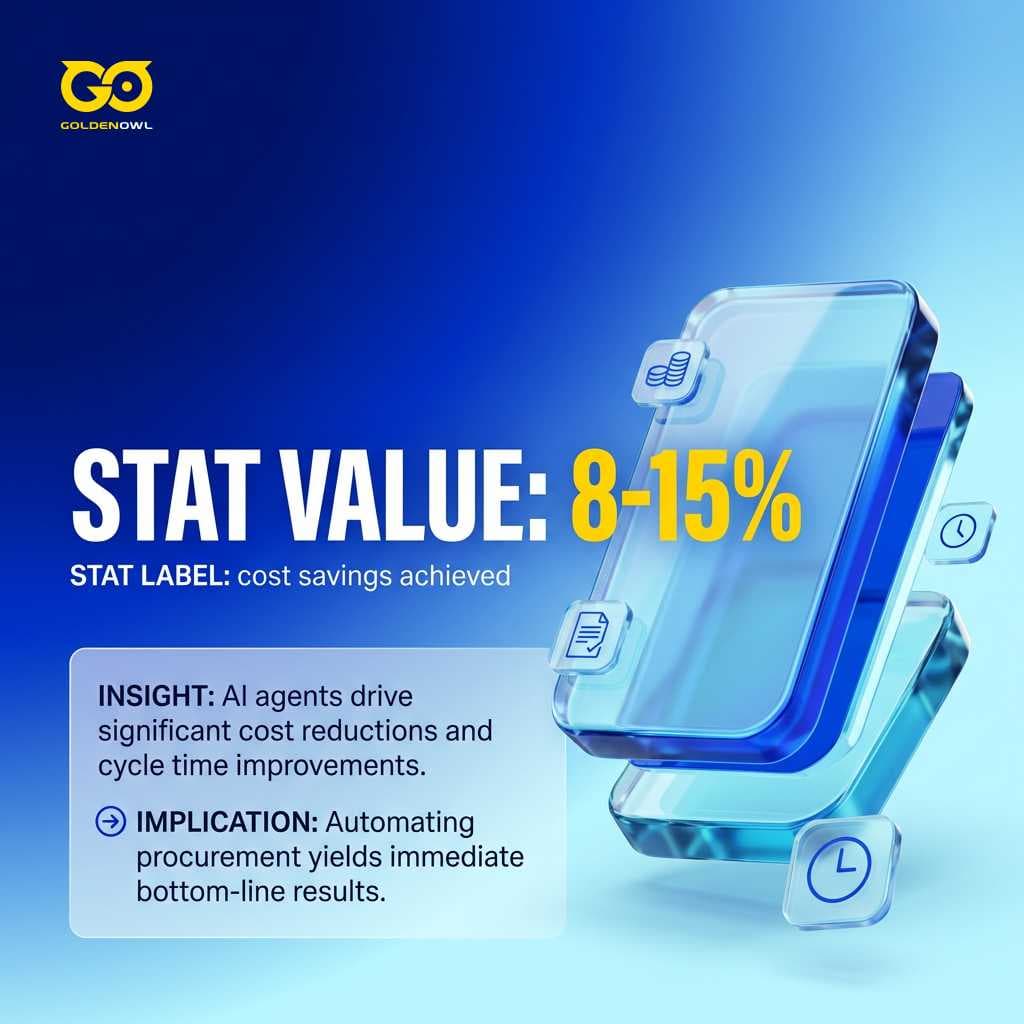
- Cost savings: 8% to 15%
- Sourcing cycle time: decreases from 30% to 60%
- Buyer capacity: Based on BCG modeling, this can increase by 60%.
Put more transactional hours into agentic AI, freeing procurement employees to direct more of their effort toward strategy.
Technology is expected to turn procurement into an organization that’s 25 to 40 percent more efficient, more agile, and increasingly agentic, as shown in Exhibit 5.
Research now finds that procurement manages 50 percent more spending per full-time equivalent (FTE) today than it did five years ago.
Best-performing procurement functions have generated an EBITDA margin improvement of five percentage points or more by enhancing quality and engagement while also reducing costs.
Through these changes, one organization captured $370 million in cost savings during year one, while millions more were projected across the next three years.
Measure the results against procurement’s existing performance measures. In a controlled three-month A/B test, the organization executed faster and achieved measurable negotiation uplift, while also contributing materially to EBIT without depending on AI-specific adoption proxies.
One prominent services provider formalized its approach with a proprietary procurement framework designed to deliver 45% productivity gains.
Roadmap for an AI Procurement Software Solution
Choose ownership, sequencing, foundations, autonomy, capability, governance, and measurement deliberately to get real value from agentic AI.
Move past copilots by selecting work that can shift productivity and bottom-line impact. Put sourcing, negotiation, supplier risk management, and intake processing near the top of the list. You’ll get more from processes tied to clear economic or operational bottlenecks than from low-risk use cases chosen mainly because they’re easier.
Design around workflows, not isolated use cases, so data, decisions, and execution connect across the full source-to-pay life cycle. Even when a use case shows ROI, it should still sit inside an integrated, end-to-end, AI-enabled workflow.
Lay the foundation early: Data integration, technology architecture, and governance help you deploy more agents faster and deliver value earlier. Fix data quality now, because agents can’t take on decisions until the underlying data supports autonomy.
After the first high-impact use cases show impact, move toward a hybrid human/AI operating model. Fully redesigned workflows can then run through a hybrid human/AI workforce.
Procurement should own these deployments and their outcomes, define the use case, own success metrics, and stay accountable for operational results.
Treat autonomy as a progression, not a yes-or-no switch: move from advice to human-in-the-loop decisions, then, with oversight, to full execution rights.
Build capability beside each use case through internal agentic factories, giving procurement repeatable methods to identify, deploy, and scale agents.
Design governance in from the start, then judge agentic AI by commercial outcomes: captured savings, negotiation uplift, cost avoidance, EBIT contribution, and speed-to-decision in critical situations.
High-Impact Direct Spend Prioritization
Prioritize Direct materials and complex services instead of tech procurement, which generally represents only a small share of overall spending and offers limited negotiating leverage. This focus should be understood within the broader landscape of ai solutions in supply chain management.
Concentrating value there speeds learning and creates results too large to dismiss when scaling questions come up, although flawed early-agent assumptions can disrupt essential supply chains. Direct spend shows economic return faster.
Graduated Operational Autonomy
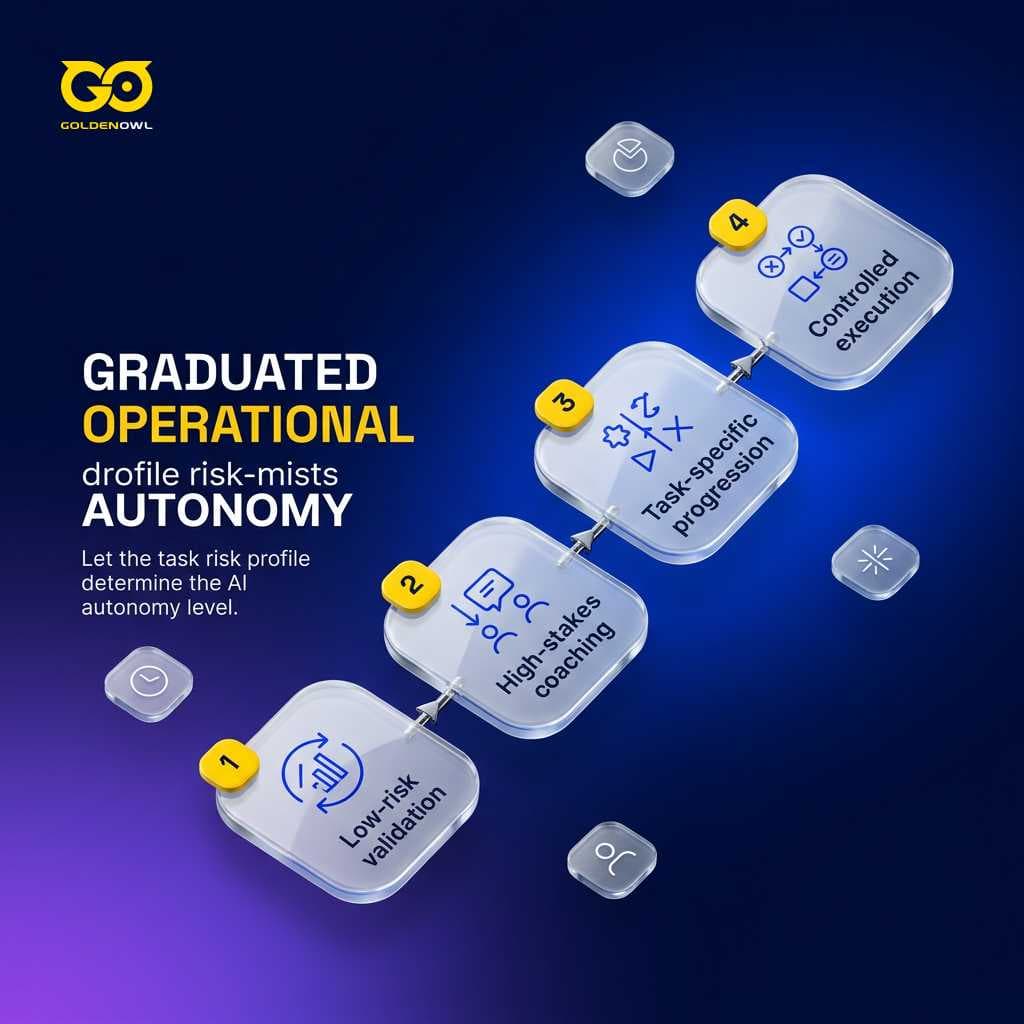
Autonomy will advance at different speeds across different procurement tasks.
- In structured, low-risk areas such as repetitive analysis and contract validation, agents will advance quickly.
- In high-stakes work such as negotiations, an agent may stay in a coaching role indefinitely.
- Let the task determine the progression rather than applying one uniform path.
- Autonomy is a lever, not a goal.
Integrated Architecture and Agent Factories
Shared governance patterns and reusable components turn the initial rollout into the start of a portfolio instead of a standalone project.
First deployment
Bring the team behind the first deployment into the next one, carrying its building blocks and common governance practices through every subsequent deployment.
Procurement professionals
As the portfolio expands, procurement professionals will shift from executing tasks to curating an agentic ecosystem, applying judgment wherever AI falls short.
Enterprise agent architectures
Partnering with an ai solutions company can help you build reusable enterprise agent architectures.
In tender automation, one global services firm already has nine agents and seven RPAs in production. Separately, a leading provider of enterprise software has created a sense-reason-act platform that operates across the source-to-pay chain.
Reorganizing Procurement Operating Models for AI Integration
When enterprise rewiring begins, leadership has to put organizational strain, talent, new capabilities for purchasing, and digital enablement on the agenda. Those priorities came through clearly at a recent CPO Executive Forum.
Employees don't need Procurement watching every purchase. Give them established but flexible frameworks, approved vendor lists and catalogs, and dynamic buying channels, then manage the underlying work in a different way. The operating model should carry more of the load.
Efficiency improves under this model, but the bigger payoff comes when procurement shifts from handling transactions to shaping strategy. Bring your knowledge of supply markets and industry trends into business planning cycles, and let Procurement champion enterprise rewiring early in the age of AI. That reach extends well past the purchasing team.
Because the redesign runs through finance, operations, and enterprise strategy, the CEO or COO must own the effort. Build the procurement architecture to create an advantage for the entire enterprise, rather than improving one function in isolation.
Strategic Category Management
Strong procurement functions split strategic and transactional roles, then set clear competency requirements for both.
According to two-thirds of respondents, their companies divide strategic procurement from transactional work so teams can pursue higher-value initiatives. Only half of travel and leisure companies maintain that separation, compared with more than three-quarters of consumer and advanced-industry companies.
A cruise line changed its cost performance by building strategic category management and applying fresh approaches across every primary category. Its procurement department had fewer than 100 people, yet the company still changed its organization and technology to keep the activities separate. Supplier relationships got better, then supplier performance improved and deliveries arrived on time.
Dedicated Centers of Excellence
A dedicated COE is becoming part of the procurement structure, particularly at larger organizations.
- Adoption: Over half of respondents report that their organizations now have a dedicated COE, with larger organizations more likely to invest in this capability.
- Value creation: A COE can standardize and optimize processes, share knowledge and best practices, and support advanced analytics for insight generation.
- Current capabilities: COEs most often cover process excellence, risk management, and environmental, social, and governance (ESG) management, leaving room for more advanced capabilities.

In leading functions, the COE sets the common approach and keeps standards tight across AI, analytics, and e-sourcing.
At a global insurance company, strategic head count grew 20 percent after leaders created a center of excellence (COE) with more than ten new skills. Procurement’s sphere of influence over spend doubled.
Modernizing with a Generative AI Procurement Software Solution
Procure-to-pay systems
Core procurement technology still struggles with adoption because of historical usability issues, including P2P, SRM, and e-sourcing. At the latest forum, P2P systems were reported by 60 percent of large organizations and 30 percent of small organizations.
A P2P system can cut costs by 2 to 5 percent, although adoption still varies by company size.
E-sourcing solutions
Only a third of attendees said their companies use e-sourcing systems, even though these tools have proven useful for addressing the long tail and generating significant savings. The shortfall shows up in complex categories.
One company deployed e-sourcing tools for maintenance, repair, and operations (MRO), a typically complex category, and reduced costs by 20 percent.
Gen AI adoption remains a work in progress: forty percent of procurement functions have either implemented or piloted gen AI.
The Operational Case for Procurement Leading Enterprise AI
Procurement lags well behind other functions on agentic-AI adoption, even though much of its work suits autonomous systems. Across a survey of 385 organizations, the figures were 35% for software development teams, 31% for IT operations, and 26% for marketing, while procurement reached only 9%.
Procurement makes a strong case for ai business solutions because of the work it handles. Its high-volume, partly structured workflows can run while results stay tied to financial measures. Supplier choices, contract terms, and spend data also sit beside manual document work, scattered supplier information, and overlooked risk signals.
Procurement has three characteristics, rarely seen together in other functions, that make it a strong base for agentic deployment. Each one can stand on its own, but the combination puts procurement among the enterprise functions most ready to benefit.
Economic visibility is the first. Few functions tie daily activity to financial results as closely as procurement does, since supplier choices, pricing discipline, contract terms, and compliance all reach the bottom line in the chief financial officer’s financial terms.
The second is process structure at scale, which gives procurement repeatable work. Its repeatable, multi-step workflows cover supplier onboarding, RFP management, and contract monitoring, giving agents room to reason, act, and adapt across tasks.

Persistent friction is the third characteristic. People still have to step in at just key points, from document validation and supplier risk assessment to category misclassification and stakeholder coordination. Traditional automation struggles when these systemic inefficiencies call for judgment instead of simple rule-following.
Key Takeaways for Procurement Transformation
Test a small pilot, learn from the evidence, and let AI sharpen buyer judgment without taking it over; these pilots give you usable proof.
- Start with experimentation: Enough technologies are already proven, tried, and tested to justify beginning with a small pilot or limited piece of procurement spend. Those efforts produce many learnings, and failure gives you a chance to do it better next time.
- Expect the gap to widen: The distance between organizations building AI-enabled procurement capabilities and those that are not will continue to grow.
- Sharpen negotiation skills with AI: Buyers gain the most from AI when they use it to sharpen negotiation skills rather than replace them.
Procurement transformation begins with repeatable tasks you can test, then moves toward stronger judgment and clearer ownership. Launch a small pilot, learn from what happens, and keep the buyer in the decision. Organizations that build these capabilities will widen the gap over those that wait to build them. AI procurement solutions earn their place when they improve the tasks buyers already handle day to day, especially negotiation, instead of adding another layer between the buyer and the outcome.
Share this page


Table of Content

Subscribe to Golden Owl blog
Stay up to date! Get all the latest posts delivered straight to your inbox