
How to use AI in real estate: automate lead follow-up, speed up valuations and marketing, and keep every step compliant with Fair Housing rules.


How AI Is Used in Finance to Improve Operations
Sep 22, 2026
about 14 min read

Manual reconciliation and delayed reporting give way as AI aids finance teams, illustrating how AI is used in finance across everyday operations.
Manual reconciliation and delayed reporting give way as AI aids finance teams, illustrating how AI is used in finance across everyday operations.
Real-time forecasts, guided decisions, and autonomous actions are reshaping financial operations. This guide covers use cases proven in production, institutional implementation roadmaps, risk governance structures, and frameworks for measuring total return on investment for finance executives in practice.

How AI Is Used in Finance Across Key Workflows
The finance AI market breaks into four finance domains where you can measure workflow value directly.
- It covers real-time transaction monitoring and anomaly detection for AML.
- Credit and lending covers application scoring and document verification for underwriting support.
- It covers document intelligence and settlement prediction alongside automated reporting.
- Customer engagement covers virtual assistants and personalization for advisor support.
Most financial AI deployment still improves processes rather than reinventing the business model. Four of the top 5 use cases sit in back-office work, with process automation at 79%, while data visualisation and software engineering each reach 75% and data and knowledge management reaches 69%; these are all common internal use cases.
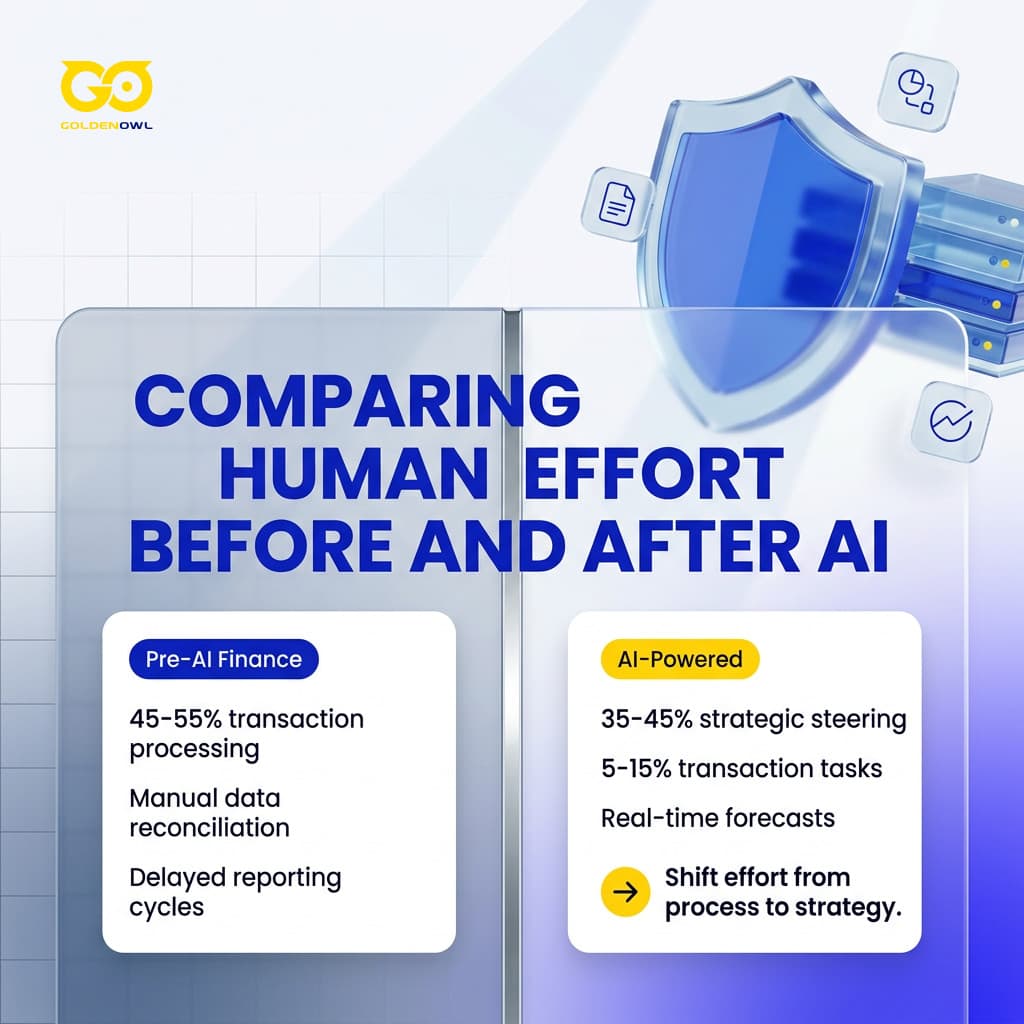
Transaction processing currently absorbs 45% to 55% of finance effort. In a future shaped by AI, strategic decisioning and steering will account for 35% to 45% of human time, while transaction processing falls to 5% to 15%.
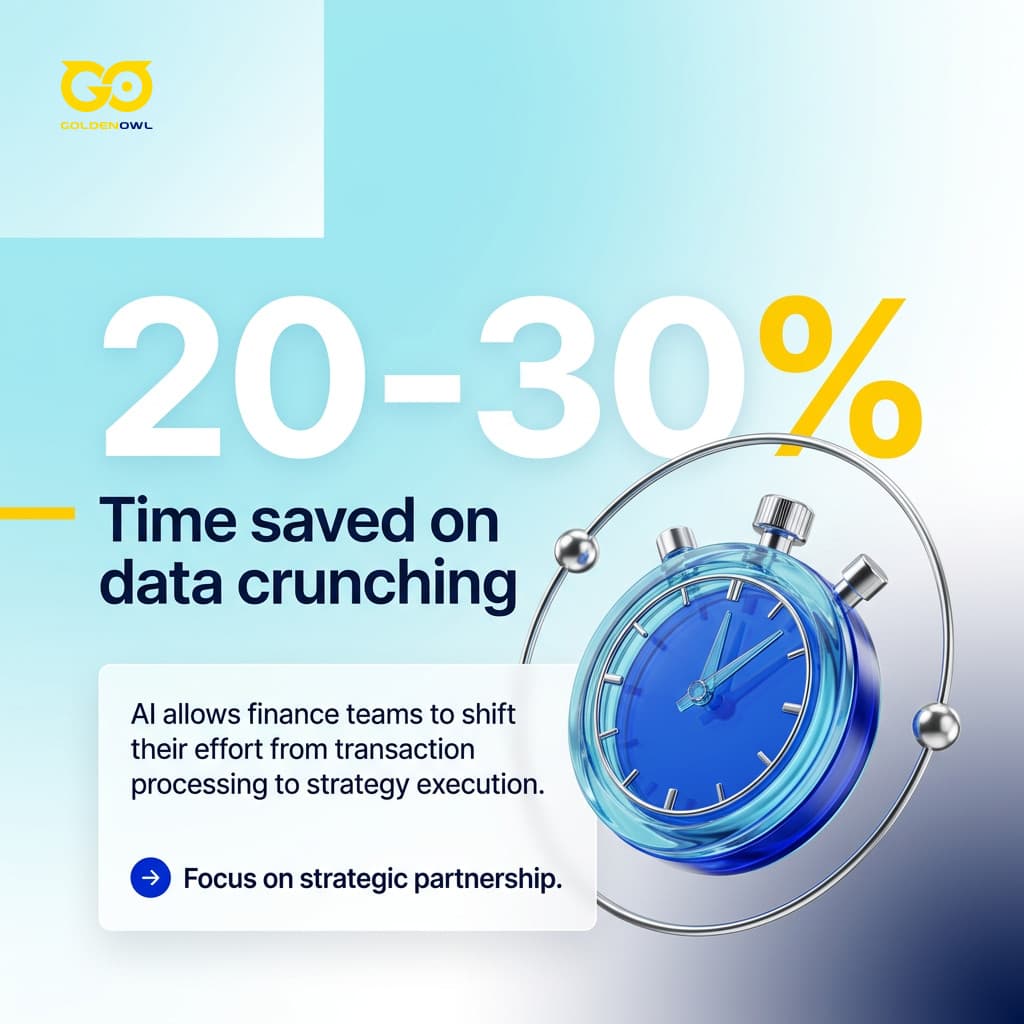
Across finance functions where AI has been adopted, professionals spend 20 to 30 percent less time crunching data. That recovered time shifts toward business partnership and strategy execution.
For a deeper look at how leading ai banking solutions modernize core institutional workflows, use these applications as your practical map.
Fraud Detection
Real-time scoring
In financial services, fraud detection remains the most mature AI application. Gradient boosting and neural networks read transaction patterns, device signals, and behavioral data, then give every event a real-time score.
False positives remain the main problem: an aggressive model can block legitimate transactions and erode customer trust. Use high-volume labeled data, clear ground truth, confirmed fraud and legitimate activity, plus a measurable loss metric.
Currently, 58% of respondents in the surveyed financial services industry use fraud detection.
Credit Underwriting
Traditional credit scoring relies on payment history plus account age and utilization. ML models widen that view by adding transaction behavior and employment patterns, while in some markets using alternative data signals to improve accuracy and access.
Among surveyed financial services industry respondents, 54% either use credit risk modelling or are piloting it.
Most jurisdictions require explainable credit decisions. Applicants have the right to know why credit was denied, which makes black-box models noncompliant here; explainable AI or model documentation is mandatory.
Anti-Money Laundering
Anti-money laundering monitoring can generate huge alert volumes, with over 95% becoming false positives in some institutions. ML models trained on confirmed typologies can cut that noise and let compliance analysts focus on actionable results.
The main AI applications in this workflow are listed below:
- Regulatory reporting: GenAI drafts Suspicious Activity Reports (SARs), summarizes audit findings, and synthesizes regulatory changes; human review is required before filing.
- Escalation oversight: AML monitoring has very high regulatory exposure, so human sign-off is required on every escalation before filing.
- Audit trails: Records must show what data the model used, what decision or recommendation it produced, who reviewed it, and what action was taken.
Among regulators, 27% are testing or have put AI into use for AML/CFT supervision.
Document Intelligence
Structured extraction
Document intelligence turns Unstructured documents, such as contracts, financial statements, identity documents, and forms, into structured data, making it one of the highest-ROI AI applications in financial operations.
Among financial services firms surveyed, 69% have either deployed data and knowledge management or are piloting it. Validation remains the design constraint, so consequential extracted fields require human validation.
Record to Report and Accounting Operations
Record-to-report (R2R) can run as an autonomous process, creating journal entries with embedded policy checks, catching anomalies before period-end, and producing precise financials with forward-looking insights.
Record-to-report
Reporting moves from backward-looking information toward forward-looking insight, while humans oversee exceptions and provide process assurance.
Finance effort distribution
As AI takes on more routine activity, finance effort moves from transaction processing toward strategic decisioning and steering.
Tax and controls
Tax continuously tracks new legislation and standardizes AI-driven classification and filing. Controls use ML to tune thresholds and flag high-risk transactions, supporting real-time monitoring and audit-ready dashboards.
Institutional Case Studies
These cases show financial institutions pairing a defined operational problem with an AI method, governance controls, and an outcome they can measure.
Production problem
Identify a clearly defined specific operational problem first. From there, spell out the AI approach, put governance controls in place, and measure the outcome you can track.
Disciplined execution
Financial institutions can run plenty of AI pilots, but the harder job is moving an experiment into production while figuring out where AI creates value and where it introduces new risk.
Mastercard Decision Intelligence Pro
Fraud outcomes
Mastercard launched Decision Intelligence Pro in 2024, and the system reviews over 1,000 data points tied to each transaction. On average, fraud detection rates are 20% higher, while false positives have fallen by up to 200% in specific scenarios. That gives card issuers a direct way to lower fraud-operation costs.
Bank of America Erica
Since its launch, Erica, Bank of America’s virtual assistant, has handled over 2 billion client interactions, including approximately 2 million daily engagements.
JPMorgan Chase COiN
COiN Contract Intelligence
Public filings show that COiN Contract Intelligence brought the time spent reviewing credit agreements down from approximately 360,000 manual hours annually to seconds.
Extraction method
ML and image recognition let the platform automatically pull around 150 data points from each contract.
Keep Human validation of extracted fields in place, because high-volume document tasks are strong ML candidates when their output can be validated at scale.
Use Case Prioritization Framework
Rank every AI use case by business value, implementation readiness, and risk through the Value, Readiness, Risk framework.
Assign every use case a 1-3 rating on each dimension. Move forward with high value, high readiness, and manageable risk; keep high-value cases paused until the data and infrastructure catch up.
A roadmap ties pilots to business priorities. Choose the sequence before starting, then decide which use case follows each one.
Business Value Assessment
Baseline metric
Start with a baseline metric: record the current measure, the intended shift, and AI’s link to that shift. A usable value statement would be: “We’ll cut fraud losses by raising detection accuracy from 84% to 90%, with detection measured against confirmed fraud events during the prior 12 months.”
Measurement difficulty
For 55% of industry respondents and 63% of surveyed regulators, proving the result remains difficult. The share rises to 76% among large financial institutions.
KPIs
Every investment should have KPIs linking process improvement with quality across financial, operational, strategic, and employee value.
Data Readiness and Architectural Feasibility
Data assessment
Financial AI often underestimates data readiness as a constraint. Check its volume, quality, accessibility, and recency: labeled records, accurate and consistent inputs, inference-time model access, and history that still matches current behavior.
Integration bottlenecks
Real-time applications can hit integration bottlenecks when legacy core banking systems require data to be batch-extracted, transformed, and loaded before the model can use it.
Adoption pain point
For AI adoption, data availability and quality are identified as the leading pain point by 66% of AI vendors, 46% of regulators, and 40% of industry participants.
Regulatory Exposure and Model Risk
Credit decisions, AML filing, and insurance underwriting carry high regulatory exposure. These use cases require explainability, documentation, validation, and human accountability.
Requirements change across jurisdictions. In the US, the Equal Credit Opportunity Act and Fair Housing Act require adverse action notices. GDPR Article 22, in the EU, places limits on decisions affecting individuals that are made fully automatically. In Singapore, MAS guidelines require model-risk validation and governance.
About two-thirds of surveyed organizations do not assess AI for prejudice, unjustified discriminatory treatment, exclusion, or system-wide bias. Only 37% treat model explainability and opacity as an operational risk.
Across all stakeholder groups, data privacy and protection ranked among the top 2 risks; it was cited by 65% of AI vendors, 74% of industry respondents, and 80% of regulators. Hallucinations and unreliable outputs followed, cited by 67% of vendors, 70% of surveyed industry firms, and 70% of regulators.
The Six Pillars of AI-Ready Finance
Across these risks, finance has six connected pillars: technology, data, operating model, talent, adoption, and governance.
Operating model change
AI is reshaping the finance operating model, from teamwork and service delivery to skill building, work design, and decision-making. That changes how finance serves the enterprise.
Technology Architecture
Finance AI ranges from productivity tools and predictive analytics through GenAI and agentic platforms, with each level enabling quicker, more scalable decisions.
Traditional ML continues to anchor production finance AI, while GenAI extends further into knowledge work and Agentic systems remain early-stage, requiring stronger human-in-the-loop design.
Turn your future finance technology vision into practice with three steps:
- Technical assessment: Conduct a top-to-bottom review of the stack and record its constraints.
- Architecture comparison: Compare the current technical architecture with the future state to decide what to keep, invest in, or sunset.
- Gap closure plan: Create a road map for executing the future technology vision.
Building Versus Buying AI Solutions for Finance
Vendor platforms enable immediate deployment and manage maintenance, while custom models preserve proprietary operating logic and call for ongoing internal engineering.
Treat build versus buy as a continuing portfolio decision, rather than a choice made once. A custom solution draws on time, expertise, engineering, data science, and a well-formed enterprise technology and model strategy. Existing software vendor applications can reduce reliance on engineering and development when you buy or rent technology. The tradeoff stays active.
Decide when native in-tool AI capabilities fit the job and when custom solutions are required.
An external ai solutions company can support financial institutions across the pilot-to-production lifecycle by helping define, test, and put AI deployments into operation.
In regulated financial services, require contracts that provide access to model documentation, performance data, and validation reports.
Data Readiness Phases
Data maturity moves through three phases:
- Curated data foundations: This phase mainly provides reliable standard reporting.
- Decision-ready and AI-ready data: Structure and optimize data for AI consumption and modeling.
- Continuously improving data: Add automated monitoring, retraining, and real-time quality controls.
Most finance organizations are still in phase 1 while pursuing phase 3 AI outcomes. Phase 2 cannot be bypassed.
AI scales poor data instead of improving it, so data governance remains the backbone of finance transformation, not merely a prerequisite.
Operating Model Redesign
Redesign the operating model across six dimensions: organizational capabilities, service delivery, organizational design, people and ways of working, data systems and technology, and governance and decision rights.
The balance of decision authority between AI and humans depends on model confidence, risk appetite, and ambiguity. That balance changes from one decision to another. Ambiguity affects the allocation of decision authority.
Inside the organization’s decision ecosystem, AI agents can reason, recommend, and sometimes execute actions autonomously within defined guardrails.
AI systems record decision outcomes and send them straight into learning loops, letting finance organizations govern both decisions and the environment where decisions are designed.
Talent Evolution and Skill Development
The traditional finance specialist is becoming a finance athlete:
- A cross-functional generalist who collaborates with AI;
- Someone who applies business context to model outputs; and
- Someone who escalates human judgment when AI surfaces exceptions.
Most companies still have not reached that point. Deloitte’s State of AI in the Enterprise 2026 report says 84% have yet to redesign jobs around AI capabilities.
The future professional blends core finance skills with digital and soft skills. Paired with AI fluency, judgment, empathy, and contextual intelligence become competitive differentiators.
Trust, Adoption, and Workplace Culture
Self-reported AI usage decreased by 15%, even though employer-provided GenAI solutions continued to be available; that availability alone did not stop usage from falling.
Trust rests on four factors:
- Capability: The AI produces accurate, unbiased, and high-quality materials.
- Reliability: The AI delivers consistently and dependably on its defined purpose.
- Humanity: The tool supports specific needs directly and improves human work performance.
- Transparency: The AI explains its outputs and decision logic in plain language.
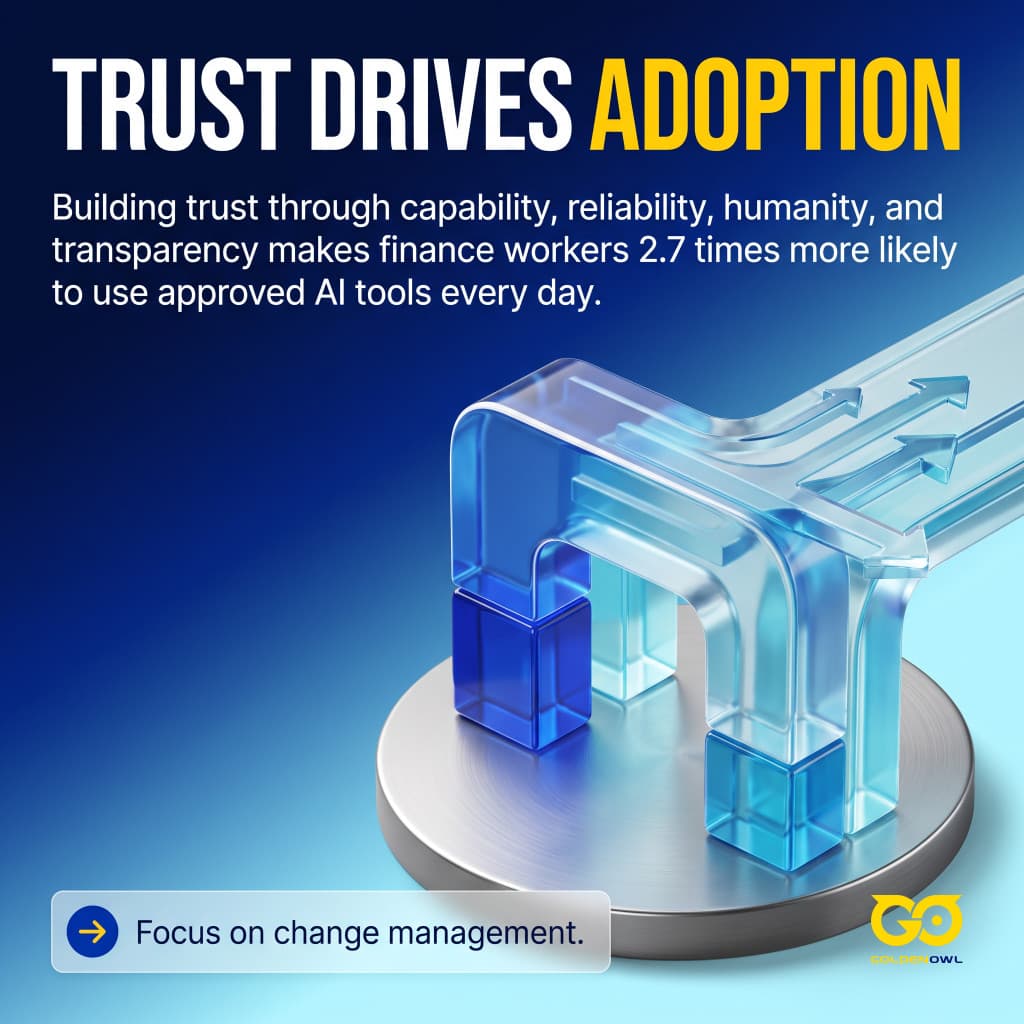
Finance workers who trust AI are 2.7 times more likely to use GenAI every day, can save 2.3 times as many hours weekly, and are 1.4 times more likely to remain within approved tool guardrails.
Enterprise Governance and AI Assurance
A governance framework needs clear ownership, accountability, and roles, with controls measured against the five pillars of AI assurance.
- Transparency: Finance must explain what a tool produced.
- Fairness: Controls must address fairness and bias.
- Privacy and security: AI activity must account for privacy and security.
- Reliability: Assess system performance and reliability.
- Accountability: Identify who reviewed the output and who was accountable.
Deloitte’s State of AI in the Enterprise report says nearly three-quarters of organizations expect to deploy agentic AI within two years, but mature governance frameworks for these systems are in place at just 21% of organizations.
Internal audit helps close the gap through a Gap closure plan by reviewing the AI landscape, testing controls in practice, and taking findings continually to the audit committee. It’s an active reviewer.
State what each tool produced, who reviewed the output, and who remained accountable for it.
Governance functions as a cultural discipline, with roughly 20% policy and 80% behavior.
Risk Management, Oversight, and Regulatory Compliance
Mapping exposure by workflow matters because AI handling accruals, disclosures, and ERP systems increases the cost of errors and weak controls. Regulators report more concern than vendors about cyber and operational resilience at 59% compared with 32%. The same pattern applies to critical third-party risk at 43% versus 23% and consumer protection and bias at 41% versus 21%. Industry shows greater concern about lost human oversight (60% versus 42%). These differences appear before deployment.
Finance’s most mature AI use sits in software engineering: 42% is fully deployed, while 33% remains in development. That maturity also creates a major path for cyber risk to spread. Among respondents, 51% worry about losing human oversight, while 48% flag adversarial AI. Cyber and operational resilience concerns run at 32% for vendors, 46% for industry, and 59% for regulators. Systems using personal and financial data must meet GDPR, CCPA, and sector-specific requirements, and adversarial inputs remain attack vectors, as do model inversion attacks and data poisoning.

Past data can carry inequities, so test legally protected characteristics before deployment. People affected by consequential automated decisions have the right to understand which factors shaped the result. Explainability standards differ too: Seventy-eight per cent of regulators regard explainability as critical or important, whereas 50% of industry uses explainable AI methods.
Make human review mandatory before any consequential action affecting rights or financial access. It is also required before AML and fraud escalation and before multi-step agentic actions. Regulators most often place primary responsibility with the financial institution (38%), while industry and vendors prefer case-by-case responsibility, with industry at 35% and vendors at 39%. SHAP and LIME can support explainability obligations, with model documentation providing additional support.
Measuring Return on Investment and Enterprise Value
Profitability outcomes
When you measure AI investment alongside workforce preparedness, the profitability picture comes out positive but uneven. AI brings increased profitability for more than 40% of respondents, while 43% report no change. Of organisations investing over $100,000 USD in AI each year, 62% have attained advanced maturity; of that group, 62% report increased profitability, versus 39% among those spending less. Profitability rises for 56% of fintechs, versus 34% of traditional FIs.
Baseline Performance Benchmarking
Before deployment, set a defined baseline for every use case and name the Baseline, Intervention, Cost inputs, Outcome metric, and Monitoring interval for review. Without a defined comparison, the AI outcome cannot be quantified, leaving it as an unsubstantiated claim.
| Step | What to define |
|---|---|
| 1. Baseline | Current metric value before AI deployment |
| 2. Intervention | Which AI capability is being deployed and to what scope |
| 3. Cost inputs | Implementation cost; ongoing cost; change management |
| 4. Outcome metric | Post-deployment measurement of same metric against baseline |
| 5. Monitoring interval | Defined period for next performance review |

After deployment, compare the same metric with the baseline, count implementation, ongoing, and change management costs, and schedule the next performance review interval. You can then measure AI ROI in finance against evidence rather than treating an unsupported result as proof.
Operational, Risk, Customer, and Financial Metrics
Assess AI across four groups of metrics, then connect process changes to Operational metrics, Risk metrics, Customer metrics, and Financial metrics:
- Operational metrics: processing time per unit, error rate, throughput volume, and FTE hours per function.
- Risk metrics: fraud detection rate, false positive rate, AML alert-to-SAR conversion rate, model accuracy on holdout data, and default rate in approved cohort.
- Customer metrics: first-contact resolution rate, CSAT, average handling time, and digital channel adoption.
- Financial metrics: cost per transaction, loss rate, compliance cost per FTE, and net interest margin on AI-assisted approvals.
Accounting for Total Cost of Ownership
Positive ROI in year one is not achieved when a model reduces fraud losses by $2M but costs $3M to build, operate, and govern annually.
Include implementation cost, governance overhead, change management, and ongoing monitoring in the calculation. Otherwise, ROI claims that omit any of them are misleading.
Frequently Asked Questions
What are the most common uses of AI in finance?
Finance teams already rely on several production-proven applications: Fraud detection and prevention, Credit scoring and loan underwriting, AML monitoring, Customer-facing virtual assistants, and Document intelligence for onboarding and operations.
- Fraud detection and prevention: AI identifies suspicious activity and helps prevent fraud before losses occur.
- Credit scoring and loan underwriting: AI supports credit scoring and the underwriting of loans.
- AML monitoring: AI monitors activity for anti-money laundering purposes.
- Customer-facing virtual assistants: AI supports customers through virtual assistants.
- Document intelligence for onboarding and operations: AI handles documents across onboarding and operational work.
At 74%, AI-powered customer support leads front-office use cases; adoption reaches 82% among FinTechs versus 67% among incumbents.
What are the main risks of AI in financial services?
Financial-services AI brings risks involving models, data, human oversight, and third-party vendors. Centralized sensitive data creates another risk.
- Model bias: Historical discrimination can enter automated decisions through the training data.
- Explainability gaps: In adverse-action contexts, weak explanations can create regulatory liability.
- Data privacy breaches: Centralized sensitive data can raise the risk of privacy breaches.
- Model drift: Changes in behavior patterns can reduce model accuracy over time.
- Third-party vendor risk: Institutions may deploy AI they do not own or fully understand.
Regulators cite operational resilience at 59%, compared with 46% among industry respondents. Regulators also cite opaque models and explainability limits at 56%. Loss of human oversight reaches 55% in industry and 51% among AI vendors. Adversarial AI-related cyber threats reach 50% in industry and 57% among regulators, while algorithmic bias and fairness reaches 43% among vendors.
How should a financial institution choose its first AI use case?
Choose a financial-institution use case with a measurable outcome, sufficiently high quality data, and exposure that fits current governance capabilities, using the Value, Readiness, Risk framework to compare options. A first use case should also link to a material business metric.
Next, match the vendor category to the biggest operational problem, test the workflow with your own data, and treat the first vendor call as a working assessment.
- Apply the Value, Readiness, Risk framework: Assess the candidate use case for business value, implementation readiness, and risk.
- Match the vendor category to the bottleneck: Contact the category that addresses the biggest operational problem, rather than the vendor with the most features.
- Test the workflow with your own data: Use the first vendor call to assess the workflow on internal data.
The solution categories and initial contacts below line up with common finance bottlenecks:
| If your main problem is… | Solution category | Contact first |
|---|---|---|
| Slow, manual invoice entry and coding | AP automation | Vic.ai: ask for a pilot on your last 90 days of invoices. |
| Late customer payments and unmatched remittances | Order-to-cash / cash application | HighRadius: request a demo using your own remittance files. |
| Long month-end close and reconciliation backlog | Close and reconciliation | BlackLine: ask how much of your reconciliation volume it can auto-match. |
| Out-of-policy expenses and duplicate payments | Spend audit | AppZen: request a retrospective audit of recent expense reports. |
Before signing, confirm native ERP integration, run a pilot on your own data, review references from customers your size and in your industry, and require auditable AI decision records.
Fraud alert prioritization and document extraction often stand out as initial options, pairing high value and data-rich workflows with low adverse-action exposure.
How can finance teams measure AI ROI?
Set the baseline before deployment, then measure AI ROI by following that same metric after the system goes live.
- Set the baseline: Establish the metric before deployment.
- Define the costs: Include implementation, ongoing operation, and governance.
- Measure the outcome: Compare the post-deployment metric with the baseline.
- Set the review period: Use 30/60/90 days post-launch, followed by quarterly reviews thereafter.
What is AI’s impact on the future of finance?
Manual work gives way to an insight-driven finance function.
AI is moving finance from a manual transaction engine toward an insight-driven strategic partner. The mandate remains: close the books, manage risk, allocate capital, and steer decisions, while the methods used to carry out that work change.
Key Takeaways
Productivity gains are already showing up, while broader enterprise value remains harder to prove.
- Productivity: Finance teams are already seeing productivity effects from AI.
- Enterprise value: Broader enterprise value remains harder to prove with current evidence.
- AI spending and maturity: Fifty-three per cent of surveyed industry respondents spend under $100,000 USD annually on AI while reporting high maturity in GenAI and agentic AI.
Finance still has to close the books, manage risk, allocate capital, and steer decisions; understanding how AI is used in finance helps teams deliver that mandate. AI changes the way you deliver that mandate, and Finance teams already show productivity effects. Enterprise value is less settled, because current evidence doesn't establish it with the same clarity. AI spending and maturity move together: Fifty-three per cent of industry respondents surveyed spend under $100,000 USD annually and nevertheless report high maturity in GenAI and agentic AI.
Share this page


Table of Content

Subscribe to Golden Owl blog
Stay up to date! Get all the latest posts delivered straight to your inbox