
How to use AI in real estate: automate lead follow-up, speed up valuations and marketing, and keep every step compliant with Fair Housing rules.


How to Choose Conversational AI Software Solutions for Your Business
Sep 21, 2026
about 13 min read

Choose conversational AI software solutions carefully, because the right platform can reshape customer interactions, internal workflows, and operational overhead.
Choose conversational AI software solutions carefully, because the right platform can reshape customer interactions, internal workflows, and operational overhead.
Natural-sounding conversation isn't enough to make the choice: before you commit, check autonomous reasoning, regulatory compliance, system integrations, and safeguards for human escalation. The guide is split into three parts, covering leading software platforms, the architecture beneath them, and practical implementation frameworks for modern enterprises.
Leading Conversational AI Software Solutions
Across the market, conversational AI products fall into two broad groups.
Established enterprise platforms, including Gartner Magic Quadrant Leaders, focus on conversation design, contact-center links, governance, telephony, and agent assist for buyers with existing systems.

A first shortlist helps.
- Choose Fini, Sierra, Decagon, or Ada when autonomous customer-service resolution comes first.
- Choose Cognigy.AI, Kore.ai, Parloa, or Genesys Cloud CX when contact-center orchestration and telephony depth matter most.
- Choose Retell AI or Amazon Lex when developers need control over voice or cloud infrastructure.
- Choose Intercom Fin, Zendesk AI, Freshdesk Freddy AI, or Tidio Lyro AI when an existing support ecosystem or faster deployment matters.
- Choose Rasa when on-premises control and model flexibility outweigh turnkey implementation.
Autonomous agents make up the other group. They use account context to handle requests and take action themselves, instead of routing customers onward or helping a human do it. Ask whether the product actually acts, or only talks.
What sits underneath the product matters more than the demo. Retrieval and paraphrasing hit a ceiling, while structured logic applied to policies and data can carry out actions with confidence. That gap separates a useful response from a finished resolution.
Rate every platform against six criteria before sending a pilot to real customers.
Apply one decision lens to every vendor. Pin down its best-fit buyer, automation type, connected channels and systems, pricing method, and likely trade-off. You’ll end up with a shortlist tool, not a feature catalog.
Automation and resolution depth. Check whether the platform takes an issue all the way through, or mainly routes customers and supports agents, using published or customer-reported figures.
Channel coverage. One system may handle voice, chat, email, and messaging. When channels split apart, the customer experience usually does too.
Architecture and accuracy. Dig into how the product creates answers, limits hallucinations, and takes action in systems of record instead of merely describing those actions.
Integrations. Verify named CRM, helpdesk, customer-service, and telephony links, plus open standards such as the Model Context Protocol.
Compliance and data governance. Check certifications, data-residency choices, and whether customer data is used to train models.
Pricing model and transparency. A vendor may publish predictable prices, or tie them to seats, conversations, resolutions, or outcomes.
Fini
Resolution depth
For regulated B2C support, Fini autonomously resolves 90% of volume, achieving 99% accuracy across voice, chat, and email.
Structured execution
Rather than simply restating documents, Fini applies structured execution to policies and account context. It can issue a refund or update an account instead of telling someone how to do it.
Knowledge Atlas
Its Knowledge Atlas helps maintain that accuracy by creating articles from resolved tickets, flagging conflicts, and tracing every answer back to one source.
Pricing
Fini charges $0.49 per resolution under outcome-based pricing, with a free Starter tier and custom Custom pricing available.
Guarantee
The Zero Pay Guarantee lowers pilot exposure: if Fini doesn’t reach 90% resolution in 90 days, the customer pays nothing.
Compliance
Fini holds SOC 2 and ISO 27001 certification, meets HIPAA requirements with BAA eligibility, and is GDPR and CCPA ready. Y Combinator and Matrix Partners back the company.
Sierra
Founded by Bret Taylor and Clay Bavor, Sierra builds production AI agents for large brands across chat, SMS, email, and voice.
Sierra says voice has overtaken text as the main channel across its customers. Enterprise demand has moved quickly in that direction.
Sierra charges for successful resolutions, rather than per seat. It publishes no rate and sells through a formal process.
Outside estimates put its contracts in the six figures.
Sierra lists SOC 2, ISO 27001, HIPAA, GDPR, CCPA, and PCI among its compliance coverage.
Its named customers include SoFi, Sonos, ADT, Ramp, and WeightWatchers, while published cases report resolution rates from 65% to 94%.
Decagon
Decagon uses Natural-language Agent Operating Procedures to direct its agents across voice and written messaging channels, letting teams set behavior without code.
Decagon Voice uses that same logic in call center ai solutions to modernize telephony and inbound phone routing.
The platform connects with Salesforce, Zendesk, Intercom, and Kustomer, and handles multilingual conversations with real-time translation.
Decagon keeps pricing private, offering per-conversation and per-resolution models. Most customers select per-conversation pricing for predictability.
Decagon is SOC 2 Type II certified, GDPR compliant, and offers HIPAA eligibility for enterprise plans through a BAA.
Named customers include Duolingo, Chime, ClassPass, Notion, and Rippling, with published resolution rates around 70%.
Cognigy.AI
Contact-center platform
Built for contact centers, Cognigy is an enterprise conversational AI platform and a named Leader in the 2025 Gartner Magic Quadrant for Enterprise Conversational AI Platforms.

NICE CX stack
NICE acquired Cognigy in 2025, and the platform now sits at the center of the NICE CX stack.
Languages and connections
Cognigy supports more than 100 languages. Its conversational IVR authenticates and prequalifies callers, with connections to Genesys, Avaya, NICE, Amazon Connect, Five9, Twilio, and RingCentral.
Governance
Natural-language generation and a voice gateway handle high concurrency. Its governance certifications include ISO 27001, ISO 27701, SOC 2 Type II, TISAX, and BSI C5.
No-code interface
Through Cognigy.AI’s no-code interface, enterprises can launch virtual assistants quickly without extensive developer involvement.
Analytics
Teams can use analytics and reporting to track performance and improve conversational experiences.
Cognigy names Lufthansa, Bosch, Toyota, Mercedes-Benz, and DHL as customers.
Kore.ai
XO Platform
Kore.ai offers the XO Platform, a no-code enterprise system for customer and employee automation, and remains a Leader in the Gartner Magic Quadrant for Enterprise Conversational AI Platforms.
Deployment
Deployment can run in the cloud, a private cloud, or on premises.
Languages and integrations
Kore.ai supports roughly 120 languages and connects with Twilio, Genesys, NICE, and Salesforce. It also includes smart handoff and post-call analytics.
Trust portal
Its trust portal lists SOC 2 Type 2, PCI DSS, ISO 27001:2022, GDPR, CCPA, and EU AI Act readiness. HIPAA support is available through a BAA, alongside on-premises deployment.
Automation
Kore.ai covers customer service along with internal tasks such as HR and IT support.
Those compliance and deployment choices can bring setup complexity that most growing companies don’t need.
Its customers include CVS Pharmacy, Eli Lilly, Airbus, and AT&T.
Intercom Fin
Resolution channels
Fin, Intercom’s AI agent and lead brand, handles customer questions across voice, email, chat, and social.
Help center content
Fin pairs a messaging inbox with an AI agent that draws on existing help center content across SMS, WhatsApp, chat, and email.
Pricing
The customer pays $0.99 for a conversation after confirming the answer, and standalone use requires a 50-resolution monthly minimum.
At high volume, per-resolution pricing can get expensive unless you monitor it closely.
Optional Intercom seats begin at $29 per agent per month.
Compliance
Fin carries SOC 2 and ISO 27001 certifications, HIPAA attestation, and GDPR compliance.
Published results generally land between 42% and 50%, although some customers report higher rates in narrow use cases.
Rasa
Rasa is open-source and self-hosted, separating language understanding from business logic. That gives regulated industries such as banking and telecom more control over data and decision auditability.
Rasa’s on-premise deployment options support data security and compliance for enterprises with strict regulatory requirements. Infrastructure meeting standards such as GDPR and HIPAA helps protect data, while high-regulation environments can deploy securely without giving up functionality. Businesses retain control over assistant behavior and data access.
Rasa’s LLM-agnostic approach prevents enterprises from being locked into a single vendor.
Rasa Studio lets teams design and iterate quickly without heavy developer involvement.

Conversation repair makes natural dialogue easier to handle. Assistants can absorb unexpected behavior and continue when users stray from the script.
Rasa still takes in-house engineering capacity to build and maintain.
Amazon Lex
Amazon Lex creates voice and text conversational interfaces through integration with AWS services.
Because Amazon Lex connects directly to an existing AWS environment, it does not require a separate vendor relationship.
Automatic speech recognition paired with natural language understanding supports chatbots and virtual assistants.
Amazon Lex runs voice and text chatbots and virtual assistants across service operations, websites, and messaging channels.
Its usage-based pricing follows existing AWS cloud spend.
Amazon Lex takes more hands-on development than purpose-built customer-service platforms. It fits an engineering-led team better than a support team looking for a ready-made tool.
Microsoft Copilot Studio
Platform role
Microsoft Copilot Studio lets organizations create, manage, and deploy AI-powered copilots and conversational applications.
Custom copilots
Its tools support custom copilots that connect business data and workflows through natural-language interfaces, including an enterprise ai chatbot for ecommerce for tailored conversational shopping assistance.
Channels and connections
Organizations can tailor responses, link enterprise systems, and deploy across the web, Microsoft Teams, and other messaging platforms.
Genesys Cloud CX
Omnichannel management
Genesys Cloud CX brings omnichannel routing for voice, chat, email, and social together with workforce engagement tools, analytics, and automation.
Enterprise integration
Organizations can manage interactions across channels from one interface while connecting the software to enterprise applications.
Visibility
Genesys Cloud CX gives teams real-time visibility into customer engagement metrics.
Platform Selection Criteria
Test two or three conversational AI software solutions against all six criteria before you talk to a vendor.
Pick the platform family first; it determines which options make your shortlist.
Established platforms fit organizations bringing AI into an existing enterprise contact center, especially when they need conversation design and agent assist supported by deep telephony integration. When you want issues handled from start to finish, choose an autonomous agent instead of routing them.
Pricing Structures
The pricing examples make clear how much investment can differ between a basic pilot and a more complex deployment.
- Basic pilot solutions: These typically cost $10,000-$20,000.
- Complex enterprise-grade software: Custom capabilities and interfaces can exceed $250,000, while third-party estimates put contracts in the six figures.
Technical Deployment Requirements
Implementation approach
CAIPs mostly offer low-code and no-code building; conversational flow tools let teams set up nodes and connections with drag-and-drop actions.
Back-end connections
Integrations tie the conversational AI application to back-end systems, services, data sources, and other applications.
System actions
A genuinely integrated platform should retrieve account details and handle a return or record update.
Open standards
Make open-standard support part of the integration check, including support for the Model Context Protocol.
When prebuilt software can't handle custom architectural workflows, you may hire a custom ai solutions company.
Regulatory Compliance
Your compliance checks should cover controls that protect data, models, and access.
- AI guardrails: These address risks in GenAI models and AI-driven components, including prompt injection, data leakage, bias, hallucinations, and unauthorized access.
- Data security: Baseline controls include encryption for communications in transit and at rest, PII redaction and/or anonymization, and functions supporting industry standards and regulations.
- Certifications: Regulated buyers should require SOC 2 Type II plus HIPAA, ISO 27001, or PCI where relevant.
- Data residency: Many platforms offer data-residency options and on-premises deployment models.
- Rasa: Rasa’s on-premise deployment options let an organization retain complete control over sensitive data while meeting global regulatory requirements.
- Kore.ai: Kore.ai can run in the cloud, in a private cloud, or on premises.
Strategic Implementation Checklist
More than 40% of agentic AI projects may be scrapped by 2027 when organizations put them into production without the required governance and monitoring framework under human oversight.
Pre-Purchase Planning
Before creating a shortlist, assess your current application environment to shape the CAIP vision and choose suitable UseCases.
- Decide whether you need a dialog platform for your contact center or an autonomous agent that resolves requests end to end.
- Define the use cases to automate first, along with the resolution rate required to justify the spend.
- List the CRM, helpdesk, contact-center, and telephony systems that the platform must integrate with.
- Confirm data-residency and compliance requirements before you create the shortlist.
Vendor Evaluation
Answers
Find out how the platform forms answers and blocks hallucination.
Resolution numbers
Ask for published automation or resolution figures linked to one named use case.
Compliance certification
Verify each compliance certification through the vendor’s trust portal, not on its marketing pages.
Pilot
Test a Pilot on real conversations, and measure resolution rather than deflection.
Phased Deployment
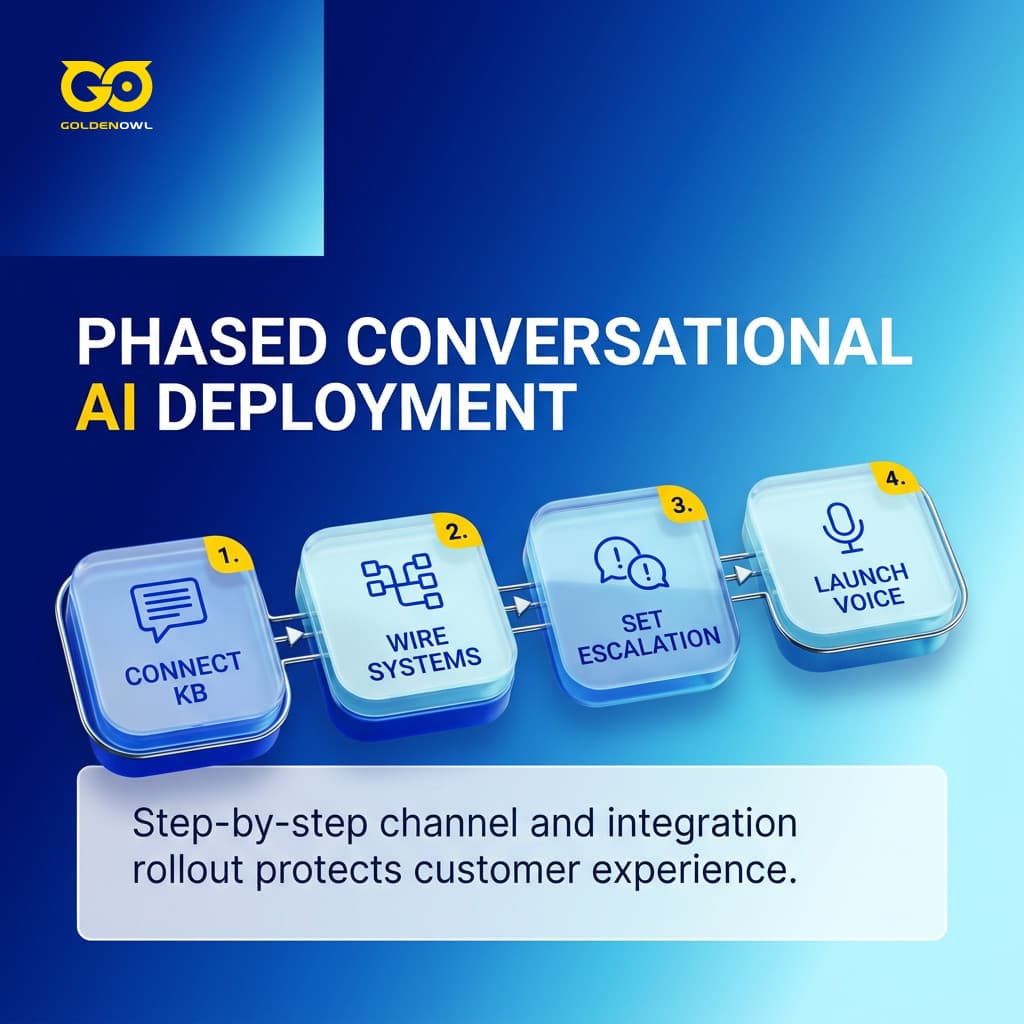
Roll out in phases: connect required systems, then test the agent’s actions before voice activation, with escalation rules set beforehand.
- Connect the knowledge base and helpdesk first, then validate accuracy on live traffic.
- Wire the CRM and back-office systems so the agent can act, then test the audit trail.
- Set escalation thresholds and confirm that handoff carries full context to human staff.
- Turn on voice after the digital channels hold their numbers.
Post-Launch Governance
Baseline
Against your Baseline, review weekly resolution and escalation rates alongside CSAT.
Escalations
Study Escalations and find the gaps the agent should learn to address next.
Core use cases
Only broaden languages and channels once Core use cases have proved stable.
Performance
When products and policies change, monitor Performance and retrain the system.
Human-in-the-Loop Operations
Setting boundaries as products and policies shift keeps Conversational AI in its lane. Send judgment-heavy complaints, high-stakes actions like account cancellations or large refunds, and matters involving personal or financial information to people. Escalate unresolved frustration or unclear intent. Let the system handle routine lookups and straightforward policy questions on its own.
A safe handoff rests on four elements.

- Trigger: Set the condition that requires escalation in advance.
- Action: Transfer the conversation to a named human queue.
- Context: Pass the transcript and any relevant customer or issue context.
- Recovery: Explain clearly what happens next and prevent the bot from repeating the same failed flow.
People must keep flows current, watch performance, retrain the system when products or policies change, and handle escalated conversations. That oversight also addresses distrust, because customers with sensitive matters still want a person. 30% would wait indefinitely for one, while 11% would pay extra to bypass chatbots. 95% want to understand the reasons behind AI decisions, up 63% from 2025.
Conversational AI Business Benefits
Companies using conversational AI can serve customers 24/7, lift satisfaction, work more efficiently, and cut costs through automation.
Customer Experience Improvement
The evidence below tracks how AI agents and agentic AI are reshaping customer experience and satisfaction:
- Service leadership: 90% of service leaders believe AI agents improve customer experience.
- Interaction quality: 87% of CX leaders believe agentic AI can dramatically improve each customer interaction.
- Customer satisfaction: Satisfaction is far higher among the 67% of customers who used conversational AI tools just a few months ago than among those whose last use was over three months ago, at 45%. The gap shows how quickly AI experiences are evolving.
Operational Efficiency Gains
AI agents are changing employee effectiveness and adoption, reaching 23% of companies; answers arrive quickly.
- Field service work: 81% of field service technicians believe AI agents can help them work more effectively, while 80% believe agentic AI will let them focus on more fulfilling aspects of work.
- Current adoption: Agentic AI is already used at least moderately by 23% of companies.
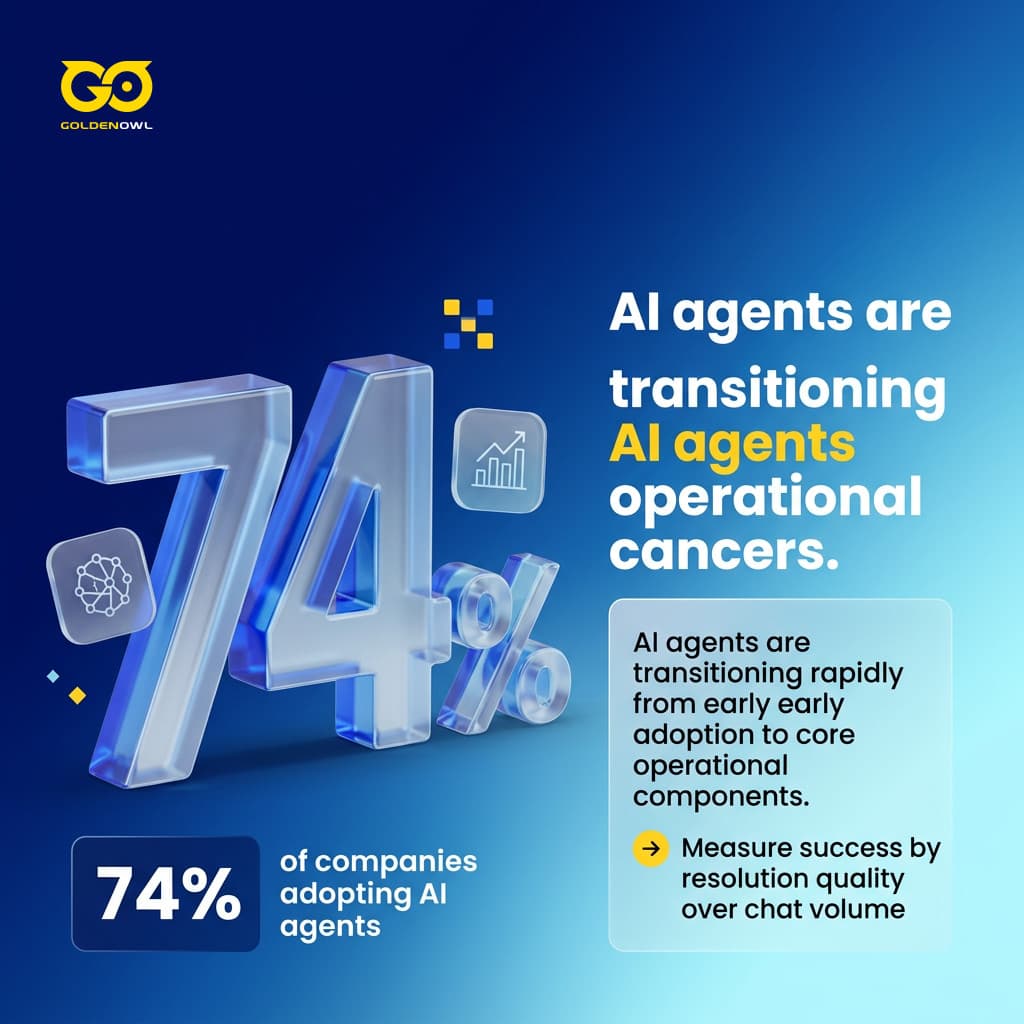
- Expected adoption: Within two years, nearly 3 in 4 companies, or 74%, will use AI agents moderately; 23% will use them extensively, and 5% will make them a core component of their operations.
Atlas, a fintech customer, lifted support automation from 15% to 70-80% and got answers in under 60 seconds, alongside Fini's 3M+ monthly resolutions across fintech and healthcare.
Support Cost Optimization
For customer service operations and leaders, AI agents are expected to lower service expenses and shorten case resolution times by 20% on average. Marketing forecasts point to +20% higher marketing ROI and -19% lower marketing costs. The total investment required for a conversational AI solution still depends on several factors.
Frequently Asked Questions
What is a conversational AI platform?
When you need to build software that imitates human conversation, a conversational AI platform supports text, voice, and visual content across channels.
Conversational AI platforms
Gartner defines CAIPs as platforms chiefly designed to build applications that mimic human conversation through multiple channels and modalities, including text, voice, and visual content.
Autonomous agents
Autonomous agents rely on the architecture underneath, so compare that foundation before you compare the demo.
What's the difference between conversational AI & generative AI?
Conversational AI understands language in real time and gives meaningful replies, while generative AI produces new content in several formats.
Conversational AI solutions
Chatbots, virtual assistants, and voicebots help people find information or finish tasks by interpreting language and responding during the exchange.
NLU reads intent and context, while NLG creates human-like replies across the journey from input generation to output delivery.
Generative AI
Generative AI uses prompts to create fresh material in formats that span written text, imagery, sound, and video.
Conversational AI agents increasingly use generative AI for more context-aware replies and more personalized user experiences.
What is the difference between a conversational AI platform and an AI agent?
A conversational AI platform supplies business software, such as CRM integrations, escalation rules, and analytics, while an AI agent can act on a request.
Conversational AI platforms
Unlike ChatGPT or Claude, conversational AI platforms bring CRM integrations, escalation rules, and analytics into business use.
AI agents
When you’re comparing options, the platform provides the software, while the agent understands a request and carries out the action.
How does conversational AI work?
Machine learning, NLP, and NLU process speech and text inputs before conversational AI answers a user’s request.
A conversational AI agent usually moves through four steps:
- Understand the user’s input: Analyze the message for intent, key information, and conversation context.
- Process the request: Choose an action, such as retrieving CRM data, connecting with another business system, or asking a follow-up question.
- Generate a response: Produce a clear, human-like answer.
- Learn from interaction: Use the user’s output and reactions to improve accuracy and personalization over time.
Rasa builds on this approach through CALM (Conversational AI with Language Models), pairing generative AI with enterprise-grade control.
With CALM, businesses can create adaptive, context-aware assistants that manage unexpected inputs reliably without depending on rigid or black-box systems.
Which conversational AI platforms are recognized market leaders?
Market reports can show platform maturity and breadth, but analyst recognition doesn’t prove practical suitability. Compare every vendor against your needs for resolution depth, voice, integrations, compliance, deployment model, and pricing.
The 2026 Gartner® Magic Quadrant™ Conversational AI Platforms report places vendors in these positions:
- Leaders: Google, Salesforce, SoundHound AI, and Kore.ai.
- Challengers: Netomi and Boost.ai.
- Visionaries: NiCE Cognigy, IBM, and Omilia.
- Niche Players: PolyAI, Sprinklr, Druid AI, and Avaamo.
The 2026 Forrester Wave™ Conversational AI Platforms report sorts vendors into these categories:
- Leaders: NiCE Cognigy, Kore.ai, and Omilia.
- Strong Performers: Yellow.ai, Uniphore, Sierra, SoundHound AI, Automation Anywhere, Rasa, and Intercom.
- Contenders: Netomi, PolyAI, LivePerson, and Ada.
Do conversational AI platforms support voice?
Yes, conversational AI platforms support voice with speech-to-text and text-to-speech, using automatic speech recognition and synthesis for spoken exchanges.
Spoken interaction
Voice assistants interpret and answer spoken questions, enabling real-time, hands-free use, particularly on mobile devices.
Multichannel handling
Across 130+ languages, Fini lets one agent manage voice, chat, and email, delivers a first response in around five seconds, and smoothly transfers cases to people when needed.
Choose among conversational AI software solutions based on the work you need them to handle. Start with architecture and resolution depth, then test voice, integrations, compliance, deployment, and pricing against that workflow. The vendor list narrows your options; the live fit makes the choice.
Share this page


Table of Content

Subscribe to Golden Owl blog
Stay up to date! Get all the latest posts delivered straight to your inbox