
An AI legal assistant does the first pass of legal work. See what it can and can’t do, and which legal AI tools fit research, contracts, or practice management.


How to Choose an Enterprise AI Chatbot Solution for Ecommerce
Sep 9, 2026
about 12 min read

Rolling out an enterprise AI chatbot solution for ecommerce tackles these exact purchasing roadblocks instead of serving up canned dialogue
Friction at checkout, slow response times, and unclear product specs kill ecommerce transactions far more frequently than absent buyer demand.
Buyers walk away the moment storefront friction interrupts their session. This happens when finding a return policy takes digging through three layers of navigation, when a shipping question sits unanswered, or when side-by-side product comparisons stall out. For teams managing high-volume enterprise storefronts, running the numbers on conversion baselines proves that even minor improvements produce millions in net-new revenue.
Rolling out an enterprise AI chatbot solution for ecommerce tackles these exact purchasing roadblocks instead of serving up canned dialogue, routinely generating a 10-25% lift during pilot phases before driving lasting returns across the entire funnel. Providing tailored shopping advice while resolving heavy support volumes makes conversational automation an operational necessity for modern enterprises.

Enterprise AI Chatbot Solution for Ecommerce
Retail brands deploy varied conversational ai software solutions to connect customer-facing storefronts with rigid back-office inventory systems.
Picking the right conversational engine comes down to your existing technical stack:
- Shopify Plus: Shortlist Gorgias for native tabless order editing, or Intercom Fin for complex multi-brand help desks.
- Salesforce Commerce Cloud: Choose Salesforce Agentforce for CRM-native data grounding and autonomous order workflows.
- Composable / Headless (commercetools, BigCommerce, SAP): Select multi-model builders like Yellow.ai or Ada to orchestrate custom APIs without platform lock-in.
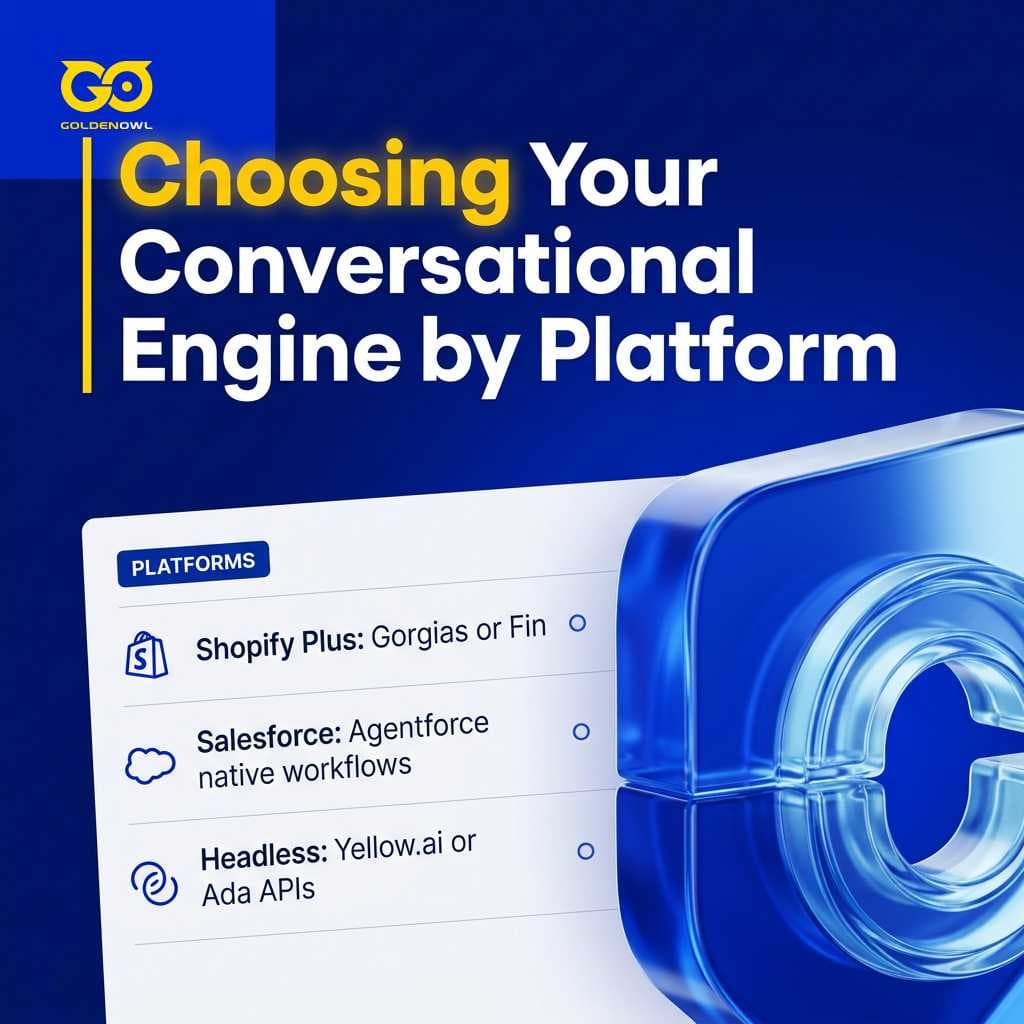
Platform recommendation matrix based on current ecommerce stack
Market Scope
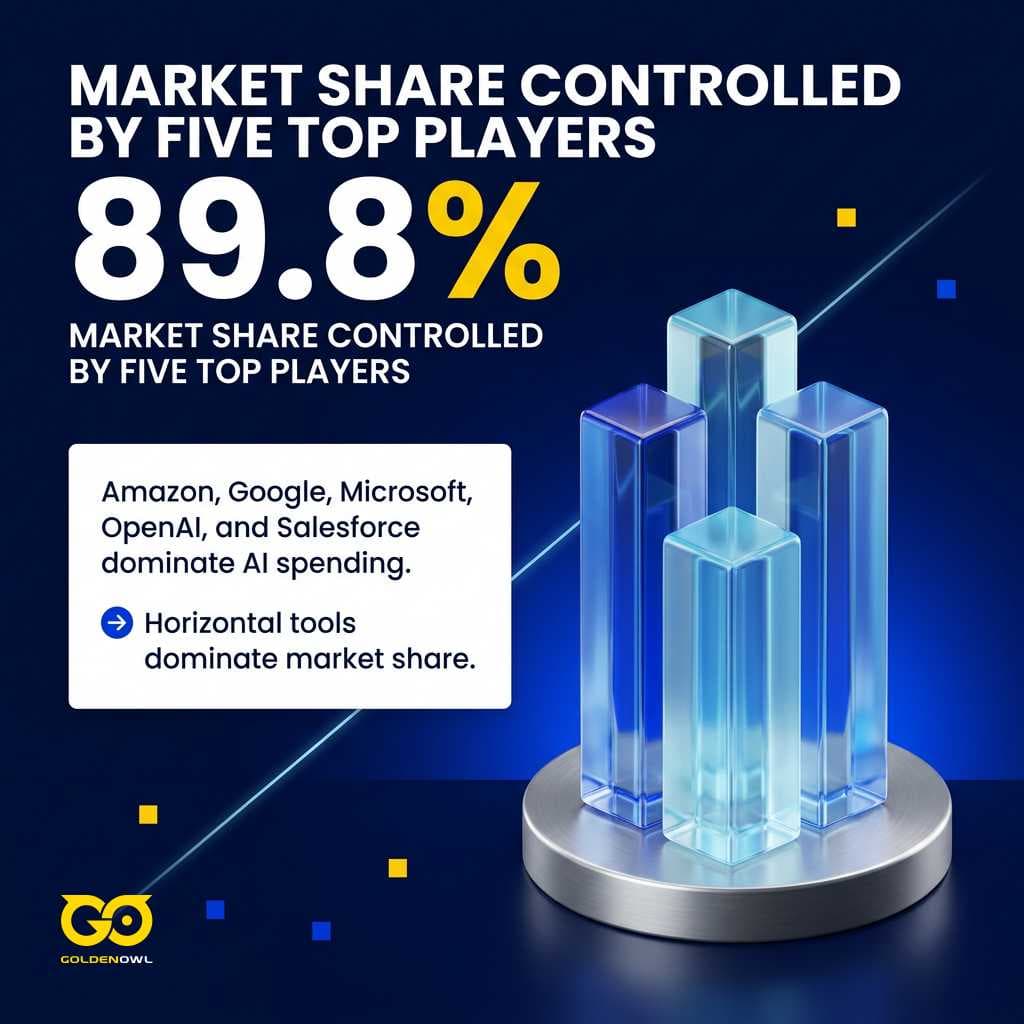
Industry forecasts from MarketsandMarkets show the broader AI assistant space growing from $3.35 billion in 2025 up to $21.11 billion by 2030, with conversational chatbot software taking a 34.2% slice. Within that 2025 footprint, five major players, Amazon, Google, Microsoft, OpenAI, and Salesforce, control 89.8% of total spending.
Enterprise Criteria
True enterprise chatbots have to process orders and handle returns end-to-end without dropping the ball across channels. You should demand tools that plug directly into your core storefront databases, protect your brand voice, and pass conversations to human reps with full historical context when tickets spike. At this scale, your systems must lock down customer records whenever automated workflows touch private payment profiles or generate return labels. Exactly eight operational criteria separate real platforms from toys.
Operational Safeguards
Your front-end chat interface can only be as flexible as your transactional rails are strict. Keeping the generative AI layer strictly separated from your ERP database stops probabilistic models from hallucinating unapproved markdowns or messing with live inventory counts. Let language models figure out customer intent and answer product questions, but make sure every completed purchase or adjustment clears hard programmatic checks in your ERP and pricing tables first.
Chatfuel
If you run most of your brand discovery and direct sales on Facebook and Instagram, Chatfuel offers a simple no-code builder built specifically for social selling. Your team can set up a bot in an afternoon to answer routine product FAQs, handle direct messages, and trigger automated replies to public post comments.
Comments Autoreply reaches shoppers who leave comments on public posts without requiring manual staff hours. If your workflow stretches beyond Facebook, Instagram, and Telegram, you'll need to stitch together extra tools to cover the rest of your stack.
Configure trigger rules for specific words in incoming customer messages so the bot returns the correct reply every single time.
Engati
Built around eSenseGPT, Engati pulls scattered retail communication channels together into a single centralized console.
The platform leans on intent detection to route incoming queries across channels, passing active chats to human agents with background history preserved when escalations happen. Keep in mind that longer multi-turn conversations can sometimes lose context or fumble vague requests from shoppers.
OneView Inbox consolidates website, WhatsApp, Facebook, and Instagram into one operational dashboard.
Tidio
Tidio blends automated customer service workflows with direct integrations for popular ecommerce platforms:
- Lyro AI agent answers support questions accurately from FAQ content without manual flow-building.
- Native Shopify, WooCommerce, and Magento integrations that work without custom configuration.
- eCommerce-specific flows for cart abandonment recovery and automated product recommendations.
- Lyro’s conversation cap on lower plans means costs rise fast as volume grows.
Drift
Drift gears its conversational platform toward B2B pipeline development and structured account sales:
- Revenue-focused AI agent with account-based targeting to engage and qualify high-value B2B visitors.
- Meeting booking built directly into the conversation flow without redirecting to an external tool.
- Real-time buying intent signals and firmographic data to prioritize the right accounts.
- Strong Salesforce and HubSpot integration pushes qualified conversation data straight into pipeline.
- Primarily a sales tool; support deflection and post-sale use cases are secondary, requiring significant configuration before the AI performs reliably.
ManyChat
Social Commerce Automation
Automated comment-to-DM flows turn social engagement into private sales chats across Instagram, Facebook, and SMS. Using custom keyword triggers and story links, you can easily automate promotional campaigns and limited-inventory product drops without manual effort.
Marketing Stack Routing
Built-in integrations with Mailchimp, ActiveCampaign, Shopify, and Zapier let you funnel captured shopper leads straight into your marketing funnels without custom code. Just remember the platform lacks a built-in website widget and reserves its deeper branching logic for higher-priced plans.
GetMyAI
For merchants with massive catalogs, intricate spec sheets, or custom wholesale pricing tables, GetMyAI delivers fast, accurate answers to high-intent shoppers before they buy.
Simple setup with minimal technical requirements puts stores into production within hours, handling high volumes of product specifications and FAQ inquiries simultaneously without manual operator intervention. However, its thinner integration ecosystem provides fewer enterprise features for automated lead qualification, native CRM sync routines, or unified omnichannel deployments across external platforms.
Ada
Reasoning Architecture
Ada combines a multi-model reasoning core with automated voice, multi-channel chat, and rigid Playbooks designed for deterministic issue resolution.
Enterprise Scale
Hooking straight into Twilio, Gorgias, Salesforce, and Zendesk, this setup routinely drives automated resolution rates exceeding 80% inside high-volume support operations. But steep software costs and heavy engineering overhead make it completely impractical if you're a mid-sized merchant on a tight rollout timeline.
Multi-Model Transactional Agent Platforms
Orchestration Flexibility
Modern orchestration engines let you toggle between OpenAI, Anthropic, Google, or Grok depending on your speed and cost targets. Having that flexibility lets your technical team test accuracy head-to-head and swap models on the fly without rewriting backend business rules. Crucially, all transactions must undergo final verification through systems of record before completion.
Extensible Connectivity
You can hook in external databases and CRMs using native tool calls or tap into more than 6,000 Zapier connectors for Slack, Notion, and WhatsApp. These agents live on website widgets or custom endpoints with human escalation, billing on predictable plans starting at $20 monthly instead of per-resolution fees.
Salesforce Agentforce
Platform Grounding
Salesforce built Agentforce specifically for enterprises already entrenched in its ecosystem, rolling out autonomous agents across sales and service channels without external ETL plumbing. Because it sits natively on Commerce Cloud and central CRM records, every agent action grounds itself in live customer order data.
Enterprise Execution
These autonomous agents handle shopping, support, and sales natively, fitting neatly into organizations anchored to Salesforce as their central source of truth. You are locked into their proprietary model stack without an open picker. For pricing, you buy $500 credit blocks of 100,000 units, which deduct $0.10 per automated action alongside $0.20 for each completed self-service conversation.
Yellow.ai
Yellow.ai deploys its VoiceX engine for large enterprises needing multilingual voice automation across 35 channels:
- Supports more than 35 channels and 135-plus languages.
- VoiceX for autonomous, human-like voice conversations across phone and messaging.
- Runs on a multi-LLM orchestrator with cloud, on-premise, and hybrid deployment for enterprise compliance.
- CDP integration for personalized, profile-aware conversations handling product, payment, delivery, and cancellation queries.

Platform Selection Framework
Map three operational variables across your stack before you book a single software demo: your monthly interaction volume, the percentage of customer inquiries demanding backend actions, and your required channel and language footprint. These concrete inputs pinpoint your pricing exposure during unexpected traffic spikes, clarify how deep technical integrations must go, and separate basic helpdesk bots from full conversational builders.
Your existing system of record determines how cleanly any bot integrates across support, whereas open builder environments trade that native alignment for faster initial setup and granular operational control. Always deploy your platform's native agent first. Run Zendesk AI if you are on Zendesk, deploy Fin on Intercom, tap Agentforce on Salesforce, and reach for Gorgias if your store runs on Shopify and needs direct order edits in chat.
Market Concentration
MarketsandMarkets calculated that five enterprise vendors, Amazon, Google, Microsoft, OpenAI, and Salesforce, controlled 89.8% of the AI assistant market in 2025. That research values the overall space at $3.35 billion in 2025 and projects it hitting $21.11 billion by 2030, where dedicated chatbot and conversational platforms form the single largest segment at more than a third of the market at 34.2%.
None of these five vendors is an ecommerce support specialist, which leaves specialized builders and helpdesk agents to lead this evaluation. Salesforce is the sole market-share leader that appears in both categories, operating through its native Agentforce product.
Brands looking at general ai enterprise solutions quickly find that horizontal tools miss the specialized ecommerce business logic needed for real support. A handful of focused platforms regularly outperform these supposed market leaders on response speed, resolution accuracy, and customer satisfaction during everyday order workflows.
Monthly Interaction Volume
Your actual monthly interaction volume reveals which pricing structure makes commercial sense:
- Under about 3,000 conversations a month, a no-code builder or Tidio Lyro wins on cost.
- Between 3,000 and 8,000, per-resolution and per-message pricing beats per-seat contracts.
- Above 8,000, negotiate an enterprise contract with overage caps or consider a build for the highest-volume flow. If you process 10,000 tickets monthly, automated systems resolve ~8,000 for $8,000, compared to $60,000+ in agent headcount.
Action-to-Query Ratio
The ratio of tickets demanding backend changes against static lookups defines your architectural requirements:
Deciding whether you need simple information retrieval or multi-step transactional workflows comes down to what shoppers actually try to accomplish inside your chat interface. Static return policy questions require basic document retrieval. You should audit your recent tickets for live customer requests, like changing shipping addresses, rerouting packages in transit, issuing account store credits, or modifying line items. Pulling off those live account updates requires transactional APIs that can write state modifications straight back into your production systems of record without manual intervention.
When order modifications, refunds, or cancellations account for more than a third of inbound shopper dialogues, shortlist Gorgias, Fin, Zendesk AI, or Agentforce around your core database, or pick a custom builder with dedicated actions.
An AI agent relies on an underlying language model to parse customer intent, reason through multi-step requests, execute actions in connected databases, and resolve support cases end to end.
Pricing Meter Structures
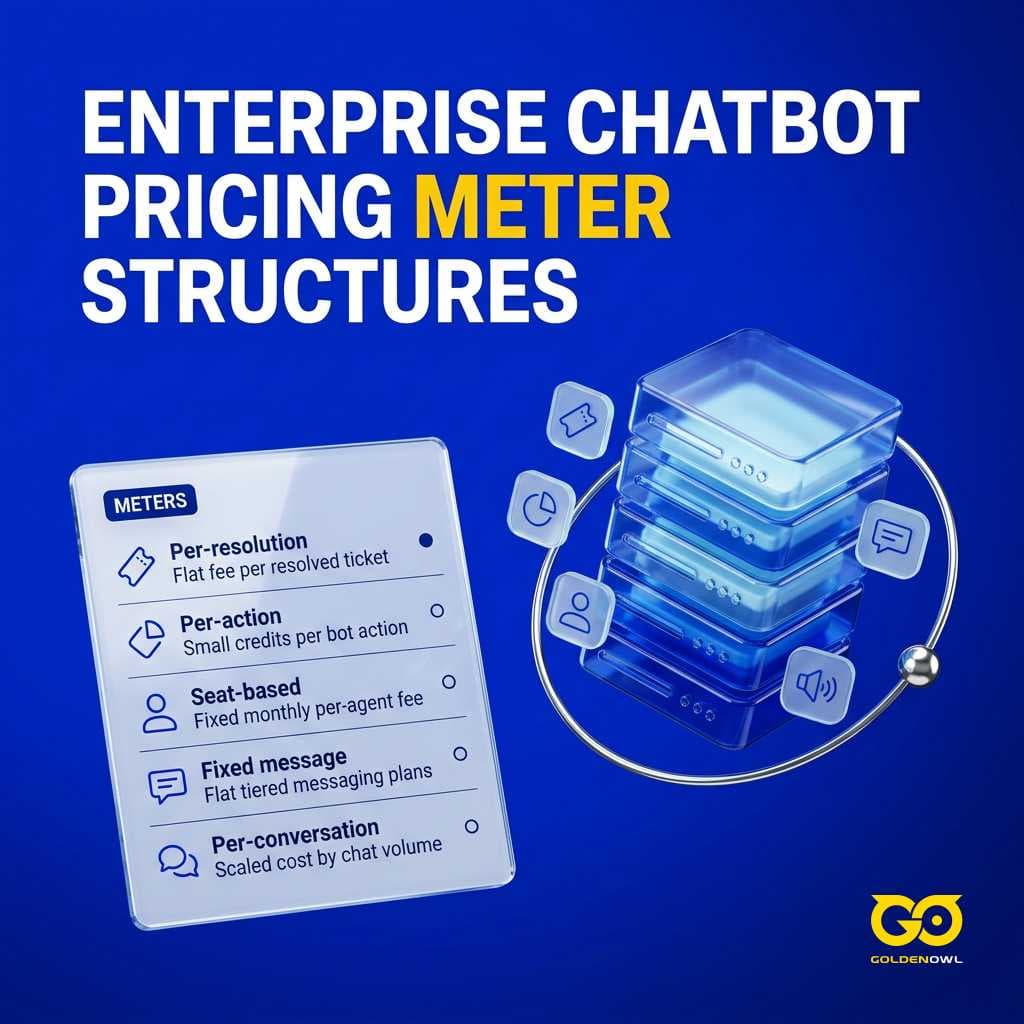
Enterprise support platforms calculate ongoing usage charges across five distinct billing units:
- Per-resolution pricing: Intercom Fin starts at $0.99 per resolution on top of base seat fees from $29 per agent monthly, while competing platforms bill $1 per resolved ticket; Zendesk AI agents bill per automated resolution with pricing established in enterprise agreements.
- Per-action pricing: Salesforce Agentforce charges $0.10 per action and $0.20 per self-service conversation, packaged in prepaid $500 blocks containing 100,000 platform credits.
- Seat-based pricing: Agent assistance tools like Zendesk Copilot charge $50 per agent monthly, whereas Gorgias subscription plans begin at $10 each month and scale upward across defined ticket volume tiers.
- Fixed message tiers: Standalone builders provide flat tiers like $20 a month for 2,000 messages and $100 for 20,000 messages with three agents and direct API access.
- Per-conversation meters: Lyro AI starts at $42/month for 50 conversations, with costs scaling upward as conversation limits are exceeded.
Forecasting your holiday volume protects your operating budget before signing, since per-resolution and per-conversation meters climb aggressively during peak shopping windows. Model a consistent baseline of 10,000 monthly conversations across per-resolution, per-action, per-conversation, and per-message pricing structures to gauge the real cost variance. Negotiating hard contractual overage caps will keep runaway resolution fees from blowing up your support spend during busy weeks.
Compare candidate billing models before signing:
- Multiply expected peak monthly tickets by your target containment rate (e.g., 10,000 tickets × 70% resolution = 7,000 resolved cases).
- Calculate consumption cost: 7,000 resolutions × $0.99/resolution = $6,930/month.
- Compare total consumption against agent licensing by calculating human seats saved (7,000 tickets ÷ 800 tickets per agent per month = ~8.75 FTEs saved). If combined seat fees and human agent compensation exceed this consumption total, per-resolution billing delivers superior unit economics.

Building vs Buying an Enterprise AI Chatbot Solution
Weigh your operational scale directly against compliance demands before you choose to construct an in-house enterprise AI chatbot solution. Restrict internal engineering strictly to edge cases where non-negotiable compliance rules or unique legacy integrations lock out external vendors. These internal builds swallow $20k to $250k in upfront capital plus 15 to 20% in annual maintenance, hitting an operational break-even threshold around 8,000 conversations a month.
Commercial platforms win decisively whenever rollout speed matters most, embedding directly into your current software suites within minutes or days under consumption or resolution pricing.
Running a hybrid compromise gives many teams practical leverage by purchasing base platform software while collaborating with an ai solution provider to implement custom integrations and handle strict governance requirements. This split preserves your rapid delivery timeline while cleanly hooking into LangChain to manage workflow execution, Pinecone to house vector embeddings, and audited SOC 2 security controls.
Core Enterprise System Requirements
At the infrastructure level, your chatbot's sales numbers depend on raw system plumbing rather than slick conversation scripts or model size. When you treat these bots as core revenue engines instead of isolated side projects, you need hard deterministic API guardrails instead of probabilistic prompting.
Protecting your margins means you must split fuzzy conversational chat from hard transactional execution. Let the generative model read buyer intent and steer dialogue, but enforce pricing thresholds, return windows, and inventory reservations directly inside your ERP, CRM, and order management systems. Sub-50ms synchronisation across these back-office links lets dynamic checks run mid-conversation, directly wiping out discrepancies caused by static or delayed data.
Running this stack through unified API logic lets the setup operate across headless web, mobile, and messaging channels without fragmenting your customer journey or business rules.
Enterprise Governance Requirements
Embedding AI chatbots directly across your ecommerce operations turns everyday governance from a back-office chore into an active board-level duty. Leaders can't treat this as an afterthought; teams must evaluate cold mechanics to verify that live setups stay safe, auditable, compliant, and dependable under load.
An enterprise's initial software architecture dictates downstream risk exposure, hard scaling ceilings, long-term maintenance overhead, and overall lifetime operating expenses. When you run governance alongside product design and integration from day one, you avoid the painful cost of retrofitting mandatory compliance guardrails onto a live system down the road.

Most engineering teams anchor these requirements on cloud foundations like AWS or Azure. Developers wire up encrypted databases, API gateways, network firewalls, and identity and access management (IAM) layers right away, frequently tapping skilled implementation partners so regulatory guardrails get baked into your code instead of glued on afterward. Established vendors validate this posture through formal credentials like SOC 2 Type II, HIPAA, and ISO certifications to preserve enterprise security and keep automated decisions accountable.
Because conversational logs capture sensitive buyer records and personal details, conversational platforms processing customer information have to satisfy territorial privacy mandates such as CCPA and GDPR.
Solid compliance reviews require rigorous attention across three operational areas:
- Data protection regulations: Chatbot systems must align with GDPR compliance, CCPA, and regional privacy laws covering explicit consent, data minimization, and the right to erasure. For global eCommerce platforms, enforcing cross-border data transfer controls remains equally mandatory.
- Data storage and residency: You must clearly define where conversation records sit, how long logs are retained, and which roles can access them. Cloud configuration choices and regional hosting requirements dictate these retention policies across each market.
- Security controls: Encryption in transit and at rest, role-based access controls, audit logs, and regular security reviews are essential. Chatbots integrated with payment systems or customer accounts must follow the same security standards as core commerce platforms. Native PII masking, role-based access controls, and SOC 2-aligned data handling frameworks built in from the architecture layer enable secure global deployment.
Performance Measurement
If you want to figure out whether your commercial chatbot actually works, you have to measure bottom-line cash alongside operational efficiency before spending more engineering hours. Review your enterprise AI chatbot solution for ecommerce directly against verified customer outcomes, focusing on recovered revenue and lower ticket volume. Base your evaluation on audited financial metrics, where raw conversation volume never substitutes for actual cash.
Deploy revenue-grade tools that track human escalation rates and answer precision across your checkout funnel, noting user drop-offs at critical conversion points. These behavioral metrics feed your conversation design, pointing your developers toward order completion and real operational savings instead of vanity chat counts.
Tracking these core operational and financial benchmarks reveals whether your setup actually fixes buyer friction, delivering a 99.5% faster response time while pushing CSAT scores up by 30%:
- Conversion lift: Measure the percentage increase in completed purchases after chatbot sessions versus unassisted visits to see how your eCommerce AI chatbot supports buying decisions.
- Abandoned cart recovery rate: Track how many stalled checkouts you recover through proactive chat prompts, securing revenue that traditional email reminders routinely miss.
- Average order value (AOV): Monitor changes in basket size driven by recommendations and cross-sells to calculate the revenue impact on every order.
- Support deflection and cost savings: Measure how many pre-sale queries your system resolves without human intervention, since disciplined eCommerce customer support automation cuts support costs while keeping buyers on the purchase path.
Long-term commercial upside depends on how tightly your automated flows hook into core backend systems and balance-sheet returns. You want to anchor your conversational architecture to disciplined unit economics through deterministic rules and rigid data governance, turning routine support questions into a steady driver of higher operating margins.
Making automated storefront assistance work demands matching your conversational tooling directly to your existing systems of record and actual operational limits. Connect your chat workflows to inventory databases and enforce deterministic execution paths, auditing every customer session against verified revenue lift. When you gauge containment alongside final order margins while tracking resolution speed, you transform simple messaging into dependable infrastructure. Treat the rollout of an enterprise AI chatbot solution for ecommerce as an operational asset where every automated touchpoint must clearly earn its place on the balance sheet.
Share this page


Table of Content

Subscribe to Golden Owl blog
Stay up to date! Get all the latest posts delivered straight to your inbox